Introduction
Data observability tools help teams understand whether their data is healthy, reliable, and fit for use across pipelines, warehouses, lakes, and analytics layers. In simple terms, these tools watch your data like monitoring watches your servers: they detect failures, delays, unexpected changes, and quality issues before business users notice broken dashboards or wrong reports. They matter because modern data stacks have many moving parts—multiple sources, transformations, and consumers—so even small changes can ripple into large business impact.
Common use cases include monitoring data freshness for dashboards, detecting schema changes before pipelines fail, identifying sudden volume drops or spikes, catching duplicates or missing values, tracing incidents back to the root pipeline step, and proving reliability to business teams. When choosing a tool, evaluate coverage across sources and destinations, alert quality, root-cause workflows, lineage depth, metrics support, anomaly detection accuracy, integrations with your stack, governance controls, time-to-value, and total cost.
Best for: data engineers, analytics engineers, data platform teams, and BI owners who need reliable data for decisions.
Not ideal for: very small teams with a single simple pipeline and minimal business reporting needs where basic tests and logs are enough.
Key Trends in Data Observability Tools
- Observability is shifting from “alerts only” to guided root-cause and faster incident resolution.
- Wider monitoring beyond warehouses, including streaming, lakehouse, and transformation layers.
- Stronger lineage-based triage so teams can see the blast radius of a broken dataset.
- More focus on business-facing reliability metrics like freshness, completeness, and trust signals.
- Growing adoption of automated anomaly detection to reduce manual rule writing.
- Integration patterns are maturing with incident tools, catalog tools, and pipeline orchestrators.
- Data contracts and schema governance are becoming part of observability workflows.
- Teams are standardizing on fewer tools and expecting deeper, end-to-end coverage from one platform.
How We Selected These Tools (Methodology)
- Included tools with strong adoption and credibility in data platform teams.
- Prioritized broad coverage across pipelines, warehouses, and analytics use cases.
- Looked for practical incident workflows: detection, triage, and resolution support.
- Considered anomaly detection quality and the ability to reduce alert noise.
- Evaluated ecosystem fit with modern data stacks and common integrations.
- Balanced enterprise-grade platforms with flexible options for smaller teams.
- Focused on tools that support measurable reliability outcomes for stakeholders.
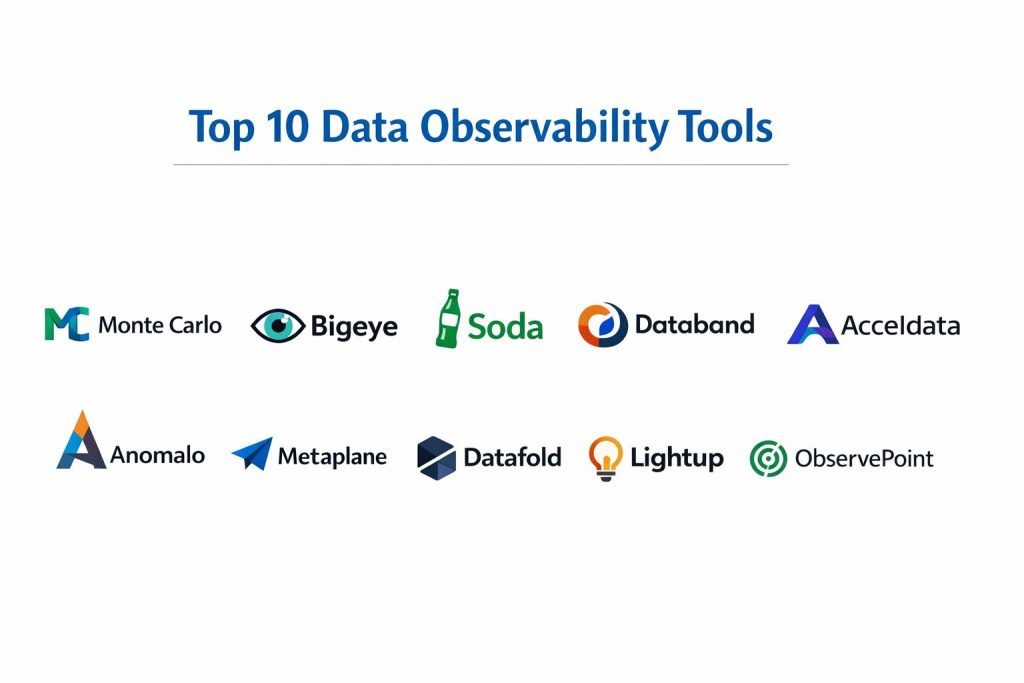
Top 10 Data Observability Tools
1 — Monte Carlo
A data observability platform focused on detecting incidents, reducing downtime, and accelerating root-cause analysis across critical datasets.
Key Features
- Freshness, volume, and distribution monitoring for critical tables
- Automated anomaly detection to reduce manual rules
- Incident workflows with context for faster triage
- Lineage-driven impact analysis for downstream consumers
- Reliability metrics that help teams track improvements
Pros
- Strong incident detection and guided investigation experience
- Helps reduce time spent firefighting broken dashboards
Cons
- May require tuning to match your alert preferences
- Cost can be high depending on scale and coverage
Platforms / Deployment
Web, Cloud
Security and Compliance
Not publicly stated
Integrations and Ecosystem
Fits well into modern data stacks and is commonly used alongside orchestration, transformation, and BI layers.
- Integrates with common data platforms and alerting workflows
- Supports incident tooling and team notifications
- Works best with clear ownership and dataset criticality mapping
Support and Community
Enterprise-oriented support; community strength varies by customer base.
2 — Bigeye
A data observability and quality platform that emphasizes monitoring, alerting, and metrics-driven reliability for data used in analytics and business decisions.
Key Features
- Quality and anomaly monitoring across key datasets
- Flexible rules and checks for business-critical fields
- Incident workflows and alert routing
- Coverage for common warehouse-centric stacks
- Practical dashboards for reliability tracking
Pros
- Strong for teams that want structured data quality monitoring
- Useful reliability reporting for stakeholders
Cons
- Setup effort depends on how complex your data model is
- Some advanced workflows may require careful configuration
Platforms / Deployment
Web, Cloud
Security and Compliance
Not publicly stated
Integrations and Ecosystem
Works best when connected to your warehouse, transformation layer, and alerting channels.
- Common stack integrations for monitoring and notifications
- Pairs well with governance and catalog practices
- Supports operational workflows for incident handling
Support and Community
Vendor support focus; community visibility varies.
3 — Soda
A flexible data quality and observability approach that is popular for teams that want programmable checks and reusable quality patterns.
Key Features
- Test-based monitoring for common quality dimensions
- Rules and checks that can be versioned and standardized
- Good fit for teams adopting data reliability engineering practices
- Works across multiple data sources depending on setup
- Supports automation as part of deployment workflows
Pros
- Strong for teams that want control and repeatable checks
- Good fit for engineering-style workflows and standardization
Cons
- Requires good test design to avoid noisy alerts
- Time-to-value depends on how quickly checks are defined
Platforms / Deployment
Varies / N/A
Security and Compliance
Not publicly stated
Integrations and Ecosystem
Often used alongside transformation tools, orchestration systems, and CI patterns for data changes.
- Works well with version-controlled checks and review workflows
- Can be integrated into pipeline steps for early detection
- Best results when teams define clear data expectations
Support and Community
Community is active; support options vary by offering.
4 — Databand
A data observability platform focused on pipeline health, job monitoring, and data delays, with emphasis on operational visibility for data engineering teams.
Key Features
- Pipeline monitoring and SLA visibility for data jobs
- Detection for delays, failures, and abnormal runs
- Alerts with operational context for faster triage
- Useful dashboards for platform reliability
- Coverage aligned to pipeline-centric use cases
Pros
- Strong for pipeline operations and SLA reliability
- Helps teams catch delays before stakeholders complain
Cons
- Deep value depends on how many pipelines and dependencies you manage
- Some advanced correlation requires good metadata coverage
Platforms / Deployment
Web, Cloud
Security and Compliance
Not publicly stated
Integrations and Ecosystem
Often used with orchestrators and pipeline frameworks to surface job health and data delays.
- Common notification and incident workflows
- Fits best with clear ownership of pipelines and SLAs
- Works well when metadata capture is consistent
Support and Community
Vendor support strength varies by plan; community is moderate.
5 — Acceldata
A platform focused on data reliability and observability at scale, often used in complex enterprise environments with multiple systems and high volume.
Key Features
- Broad monitoring across data systems and workflows
- Reliability metrics and operational dashboards
- Advanced visibility into performance and pipeline health
- Root-cause support through correlated signals
- Useful for large, distributed data platforms
Pros
- Strong for enterprise-scale complexity and high volumes
- Helps connect operational signals across layers
Cons
- Setup can be heavier than lighter tools
- Best value typically appears at scale
Platforms / Deployment
Cloud, Hybrid
Security and Compliance
Not publicly stated
Integrations and Ecosystem
Designed to support large platform stacks with multiple components and teams.
- Integrations across core data systems and operational tooling
- Supports platform-level reliability views
- Works best with clear platform governance and ownership
Support and Community
Enterprise-focused support; community visibility varies.
6 — Anomalo
Overview: A data quality and anomaly detection tool focused on automatically finding issues in data without requiring exhaustive manual rules.
Key Features
- Automated anomaly detection for quality signals
- Monitors distribution shifts, missingness, and unusual patterns
- Helps teams detect issues early with fewer manual checks
- Practical workflows for triage and investigation
- Useful for teams that struggle with rule maintenance
Pros
- Strong for reducing manual rule creation
- Helps detect subtle data shifts that tests may miss
Cons
- Requires thoughtful threshold and alert tuning
- Some teams still need rules for strict business constraints
Platforms / Deployment
Web, Cloud
Security and Compliance
Not publicly stated
Integrations and Ecosystem
Often paired with warehouses, transformation tools, and incident channels to route anomalies quickly.
- Alerting integration for fast response
- Works best when dataset criticality is defined
- Complements test-based checks for deeper coverage
Support and Community
Vendor support focus; community is growing.
7 — Metaplane
A data observability tool focused on monitoring warehouses and critical datasets with an emphasis on fast setup and practical alerts.
Key Features
- Monitoring for freshness, volume, and schema shifts
- Anomaly detection focused on real warehouse usage
- Alerting designed for operational workflows
- Practical views for incident investigation
- Suitable for teams wanting quicker adoption
Pros
- Faster time-to-value for warehouse monitoring
- Helpful for teams starting observability practices
Cons
- Some advanced enterprise needs may require broader platforms
- Coverage depends on supported data stack components
Platforms / Deployment
Web, Cloud
Security and Compliance
Not publicly stated
Integrations and Ecosystem
Commonly used in warehouse-first stacks with straightforward monitoring and alerting needs.
- Integrates with common notification channels
- Fits well alongside transformation and BI workflows
- Works best when ownership is clear for datasets
Support and Community
Support varies by plan; community is moderate.
8 — Datafold
A data reliability tool often used for data change validation, impact awareness, and reducing incidents introduced by transformation changes.
Key Features
- Change awareness and validation for data transformations
- Helps compare outputs and detect unexpected differences
- Useful for reviewing changes before they hit production
- Supports workflows that reduce downstream breakages
- Practical for teams with frequent transformation updates
Pros
- Strong for preventing incidents before deployment
- Helps improve confidence in data changes and releases
Cons
- Best value depends on adoption of change review workflows
- Some observability needs still require runtime monitoring tools
Platforms / Deployment
Web, Cloud
Security and Compliance
Not publicly stated
Integrations and Ecosystem
Fits well into transformation-heavy environments where teams want safer changes and better confidence.
- Works alongside transformation workflows and review practices
- Can complement runtime monitoring for full coverage
- Best results when release discipline is consistent
Support and Community
Vendor support focus; community varies.
9 — Lightup
A data observability tool focused on automated detection of data issues and operational alerting for teams that need fast incident response.
Key Features
- Automated monitoring for common data reliability signals
- Alerting designed to reduce noise and speed triage
- Investigation workflows to isolate root cause faster
- Useful reliability visibility for key datasets
- Practical onboarding for warehouse-first stacks
Pros
- Strong for incident detection and faster response cycles
- Helps teams reduce alert fatigue with better prioritization
Cons
- Stack coverage depends on supported sources and pipelines
- Best results require clear criticality mapping
Platforms / Deployment
Web, Cloud
Security and Compliance
Not publicly stated
Integrations and Ecosystem
Often used with data warehouses and common team alert channels for operational response.
- Notification and incident workflow support
- Integrates best when metadata is consistent
- Complements test-based checks for stricter rules
Support and Community
Support tiers vary; community visibility is moderate.
10 — ObservePoint
A data quality and monitoring tool commonly associated with digital analytics quality and tag governance, useful when data correctness in tracking and measurement is the priority.
Key Features
- Monitoring for analytics data collection consistency
- Helps validate tracking coverage and measurement correctness
- Useful governance patterns for analytics implementations
- Alerts for unexpected collection changes
- Practical for teams managing large tracking footprints
Pros
- Strong for digital analytics quality and tracking assurance
- Useful for marketing and analytics teams that depend on clean signals
Cons
- Not a general-purpose observability tool for all data pipelines
- Best fit is analytics tracking rather than full platform observability
Platforms / Deployment
Web, Cloud
Security and Compliance
Not publicly stated
Integrations and Ecosystem
Often used where analytics data collection and governance are critical.
- Integrates with analytics workflows and governance practices
- Helps teams maintain consistent tracking coverage
- Best results when tagging standards are defined
Support and Community
Support is vendor-driven; community visibility varies.
Comparison Table
| Tool Name | Best For | Platform(s) Supported | Deployment | Standout Feature | Public Rating |
|---|---|---|---|---|---|
| Monte Carlo | End-to-end data incident detection | Web | Cloud | Lineage-driven incident triage | N/A |
| Bigeye | Quality monitoring and reliability metrics | Web | Cloud | Structured quality signals and reporting | N/A |
| Soda | Programmable tests and reusable checks | Varies / N/A | Varies / N/A | Engineering-style quality checks | N/A |
| Databand | Pipeline health and SLA monitoring | Web | Cloud | Job and delay observability | N/A |
| Acceldata | Enterprise-scale reliability visibility | Web | Hybrid | Platform-level correlated signals | N/A |
| Anomalo | Automated anomaly detection for quality | Web | Cloud | Low-rule anomaly detection | N/A |
| Metaplane | Warehouse-first observability setup | Web | Cloud | Fast monitoring with practical alerts | N/A |
| Datafold | Safer data changes and validation | Web | Cloud | Change validation to prevent incidents | N/A |
| Lightup | Automated monitoring and alerting | Web | Cloud | Noise-reduced incident detection | N/A |
| ObservePoint | Analytics tracking quality assurance | Web | Cloud | Tracking governance and validation | N/A |
Evaluation and Scoring of Data Observability Tools
Weights
Core features 25 percent
Ease of use 15 percent
Integrations and ecosystem 15 percent
Security and compliance 10 percent
Performance and reliability 10 percent
Support and community 10 percent
Price and value 15 percent
| Tool Name | Core | Ease | Integrations | Security | Performance | Support | Value | Weighted Total |
|---|---|---|---|---|---|---|---|---|
| Monte Carlo | 9.0 | 7.5 | 8.5 | 6.5 | 8.5 | 7.5 | 6.5 | 7.93 |
| Bigeye | 8.5 | 7.5 | 8.0 | 6.5 | 8.0 | 7.0 | 6.5 | 7.62 |
| Soda | 8.0 | 7.0 | 8.0 | 6.0 | 7.5 | 7.5 | 8.5 | 7.68 |
| Databand | 8.0 | 7.5 | 8.0 | 6.0 | 8.0 | 7.0 | 6.5 | 7.48 |
| Acceldata | 8.5 | 6.5 | 8.0 | 6.5 | 8.5 | 7.0 | 6.0 | 7.43 |
| Anomalo | 8.0 | 7.5 | 7.5 | 6.0 | 7.5 | 6.5 | 7.5 | 7.43 |
| Metaplane | 7.5 | 8.0 | 7.5 | 6.0 | 7.5 | 6.5 | 7.5 | 7.35 |
| Datafold | 7.5 | 7.5 | 7.5 | 6.0 | 7.0 | 6.5 | 7.0 | 7.13 |
| Lightup | 7.5 | 7.5 | 7.0 | 6.0 | 7.5 | 6.5 | 7.0 | 7.18 |
| ObservePoint | 6.5 | 7.5 | 6.5 | 6.0 | 7.0 | 6.5 | 7.0 | 6.78 |
How to interpret the scores
These scores are comparative and intended for shortlisting. A slightly lower total can still be the right choice if it matches your environment and problem type. Core and integrations usually decide long-term platform fit, while ease affects adoption speed. Value can shift based on how broadly you deploy the tool and which datasets you monitor. Use the scores to narrow to two or three options, then validate with a pilot.
Which Data Observability Tool Is Right for You
Solo or Freelancer
Soda can be a practical choice if you want test-driven reliability with engineering-style control. If you mainly support a small warehouse and want quick visibility, Metaplane can be easier to adopt. If your work involves frequent data changes, Datafold can add strong prevention value.
SMB
SMBs often need faster onboarding with reliable alerts. Metaplane and Bigeye can work well when warehouse monitoring is the main need. Soda is strong if you want standardized checks and a repeatable workflow. If incidents are frequent and painful, a platform like Monte Carlo can reduce firefighting time.
Mid-Market
Mid-market teams often need stronger triage and lineage-style visibility. Monte Carlo is commonly aligned to incident workflows and impact analysis. Databand can be valuable if pipeline delays and SLA misses are the biggest issue. Anomalo helps when manual rules are too costly to maintain.
Enterprise
Enterprises often need broad coverage, reliability reporting, and operational governance. Acceldata can fit complex environments, while Monte Carlo can fit organizations prioritizing incident reduction and faster resolution. Tool choice depends heavily on your stack, scale, and governance requirements.
Budget vs Premium
Budget-focused teams often start with Soda-style checks and add monitoring as incidents grow. Premium platforms tend to reduce operational toil faster by improving detection and triage, especially when data is mission-critical.
Feature Depth vs Ease of Use
If you want quick adoption and practical alerts, Metaplane can be easier. If you want deeper incident response workflows, Monte Carlo and Acceldata tend to align better. If your priority is controlling and versioning checks, Soda is a strong fit.
Integrations and Scalability
If your stack has many moving parts, prioritize tools that integrate well with your warehouse, orchestrator, transformation layer, and incident channels. Strong integrations reduce time spent jumping between tools and speed up root cause.
Security and Compliance Needs
Most security posture depends on how access is managed around your data platform and observability workflows. If compliance is strict, validate access controls, auditability, and role-based visibility during evaluation and ensure your internal governance covers dataset ownership and alert routing.
Frequently Asked Questions
1. What problems do data observability tools solve
They detect data delays, pipeline failures, schema changes, and quality issues before business users trust the wrong numbers. They also reduce the time it takes to find root cause.
2. Do I still need data tests if I use an observability platform
Yes. Observability catches unexpected issues and anomalies, while tests enforce known rules and business constraints. Many teams use both for stronger coverage.
3. How do these tools reduce alert noise
They use anomaly detection, dataset criticality, and smarter grouping so you get fewer but more meaningful alerts. Tuning and ownership mapping still matter.
4. What is the difference between data quality and data observability
Data quality focuses on correctness checks, while observability adds monitoring, incident workflows, lineage impact, and operational response practices around data health.
5. How long does implementation usually take
It varies based on your stack and complexity. A small warehouse setup can be quick, but broad coverage with ownership and alert routing takes longer.
6. Which tool is best for preventing issues from data changes
Datafold is commonly aligned with change validation workflows that prevent breaking changes from reaching production.
7. Which tool is best for pipeline delays and SLAs
Databand is focused on pipeline health, delays, and operational monitoring, which makes it a strong fit when SLAs are the main pain.
8. Which tool is best when I do not want to write many rules
Anomalo is designed around anomaly detection to catch issues with fewer manual rules, although some rules may still be needed for strict constraints.
9. How do I pick the right datasets to monitor first
Start with the datasets powering core dashboards, finance metrics, and executive reporting. Map ownership, downstream impact, and expected refresh patterns.
10. What is the best next step after shortlisting tools
Run a pilot with real pipelines and real dashboards, validate integrations and alert routing, and confirm you can trace incidents to root cause quickly.
Conclusion
Data observability tools are not just “nice monitoring.” They protect business decisions by making data health visible, measurable, and actionable across pipelines and consumers. The right choice depends on your stack complexity and the kind of failures you face most often. If your biggest pain is high-impact incidents and slow triage, Monte Carlo can be a strong fit because it focuses on incident workflows and impact understanding. If pipeline delays and SLAs are the core issue, Databand can be practical. If you want fewer manual rules and more automated detection, Anomalo can reduce effort. For teams that want test-driven reliability and repeatable checks, Soda can be a solid foundation. Shortlist two or three options, run a pilot on critical datasets, validate alert quality, and confirm your team can resolve issues faster.