Introduction
Data catalog and metadata management tools help organizations find, understand, trust, and govern data across databases, lakes, warehouses, and applications. In simple terms, they create a searchable “map” of your data, explain what each dataset means, show who owns it, and track where it comes from and how it is used. They matter because teams are handling more data sources, more users, and stricter governance expectations, while still needing fast self-service analytics and reliable AI-ready datasets. A strong catalog reduces confusion, prevents wrong reporting, and speeds up discovery.
Real-world use cases include self-service analytics for business users, faster data onboarding for new teams, lineage tracking for audits, improving data quality by clarifying ownership, and enabling secure data sharing across departments. Buyers should evaluate coverage of connectors, business glossary strength, lineage depth, search quality, governance workflows, role-based access, collaboration features, automation, scalability, and support maturity.
Best for: data teams, analytics leaders, governance groups, and enterprises that need trusted, discoverable data with clear ownership.
Not ideal for: very small teams with a single database and minimal governance needs, or teams that only need documentation without lineage or stewardship workflows.
Key Trends in Data Catalog and Metadata Management Tools
- Automated metadata harvesting is becoming table stakes, with continuous scanning and change detection.
- Active metadata is being used to trigger governance actions, alerts, and policy workflows.
- Deeper lineage expectations are rising, especially for regulated reporting and AI training readiness.
- Business glossary adoption is growing to align technical data with business meaning and KPIs.
- Data product thinking is pushing catalogs to show owners, SLAs, quality signals, and usage metrics.
- Integration with access control and policy engines is becoming more important for secure self-service.
- Collaboration features are expanding, including stewardship tasks, approvals, and guided certification.
- Catalog search is improving with relevance ranking, semantic matching, and context-based suggestions.
How We Selected These Tools (Methodology)
- Selected tools with strong adoption across enterprise and modern data stacks.
- Balanced commercial platforms with credible open-source options for flexibility.
- Prioritized breadth of connectors and practical metadata automation.
- Considered governance readiness: glossary, stewardship workflows, and policy support patterns.
- Evaluated usability for both technical and business users.
- Considered scalability signals for large metadata volumes and multi-domain organizations.
- Looked for ecosystem strength, integrations, and extensibility options.
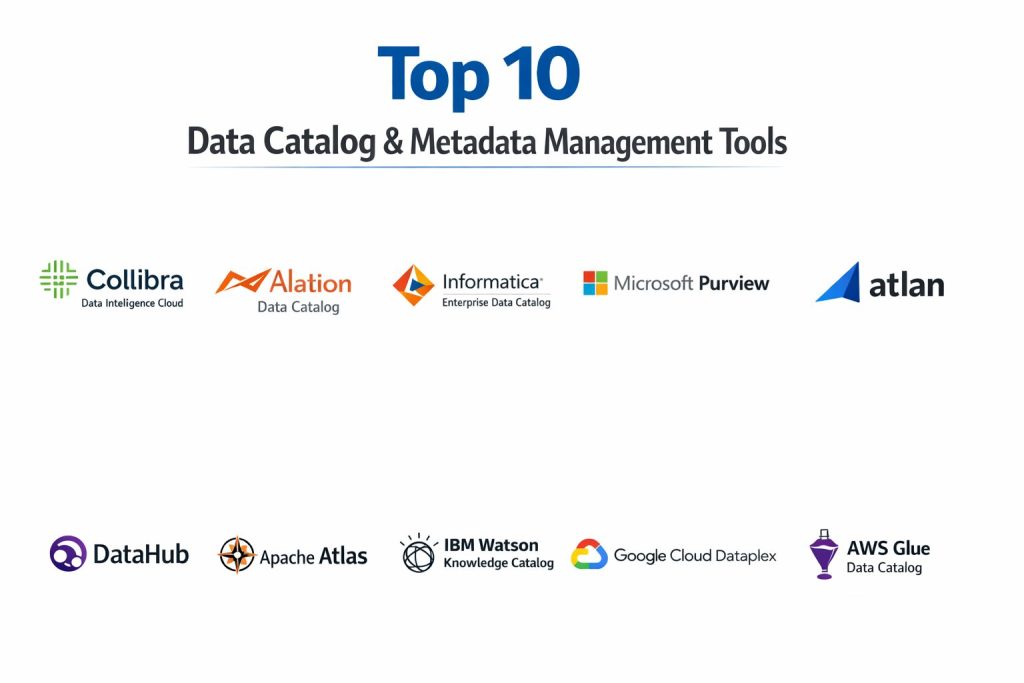
Top 10 Data Catalog and Metadata Management Tools
1 — Collibra Data Intelligence Cloud
A governance-focused data intelligence platform combining catalog, glossary, stewardship workflows, and policy-driven collaboration for enterprise-scale programs.
Key Features
- Strong business glossary with stewardship workflows
- Policy and governance workflow management
- Dataset certification and trust signals
- Metadata harvesting and enrichment patterns
- Ownership, roles, and accountability structures
Pros
- Strong governance depth for large organizations
- Excellent for business-technical alignment through glossary
Cons
- Can feel heavy for small teams
- Program success often requires strong operating model
Platforms / Deployment
Varies / N/A
Security and Compliance
Not publicly stated
Integrations and Ecosystem
Collibra is often used as a central governance layer connecting to many data systems and BI tools through connectors and standardized workflows.
- Connectors across common data platforms
- Integration with governance and stewardship processes
- Extensibility patterns vary by environment
Support and Community
Enterprise-grade support and onboarding options; community strength varies.
2 — Alation Data Catalog
A widely used data catalog focused on discovery, collaboration, and governance-friendly workflows that help users find and trust data faster.
Key Features
- Search and discovery optimized for analysts
- Query-based insights and usage-based trust signals
- Glossary and stewardship collaboration features
- Automated metadata capture and curation
- Certification and endorsement patterns
Pros
- Strong user adoption for analytics discovery
- Helpful collaboration features for business users
Cons
- Governance depth may require careful configuration
- Connector and lineage depth can vary by environment
Platforms / Deployment
Varies / N/A
Security and Compliance
Not publicly stated
Integrations and Ecosystem
Alation typically integrates with warehouses, BI tools, and identity systems, enabling discovery and trust workflows across teams.
- Broad connector strategy
- Integration with common analytics tools
- Extensibility depends on chosen stack
Support and Community
Strong vendor support options; community varies.
3 — Informatica Enterprise Data Catalog
An enterprise metadata and catalog solution designed for large-scale discovery, classification, and governance, often used alongside broader data management suites.
Key Features
- Automated metadata scanning and classification
- Enterprise-scale catalog and discovery
- Lineage and impact analysis patterns
- Integration with data quality and governance programs
- Role-based curation workflows
Pros
- Strong fit for complex enterprise environments
- Works well when combined with broader data management needs
Cons
- Implementation can be complex
- Total cost can be high for smaller teams
Platforms / Deployment
Varies / N/A
Security and Compliance
Not publicly stated
Integrations and Ecosystem
Commonly used in enterprise data programs where metadata, governance, and quality practices are linked.
- Integrations across enterprise data platforms
- Connector breadth depends on licensing and setup
- Works best with standardized data processes
Support and Community
Enterprise support options available; community varies.
4 — Microsoft Purview
A metadata and governance service focused on discovery, classification, lineage patterns, and governance workflows for organizations using Microsoft-centric data estates.
Key Features
- Automated scanning and classification of data assets
- Glossary and catalog experiences for discovery
- Lineage visibility across supported sources
- Policy and access governance patterns
- Integration across Microsoft data services
Pros
- Strong fit for organizations using Microsoft data platforms
- Useful for classification and governance patterns
Cons
- Best value depends on how much of the Microsoft ecosystem you use
- Coverage and lineage depth may vary by source
Platforms / Deployment
Cloud
Security and Compliance
Not publicly stated
Integrations and Ecosystem
Purview typically works best when the organization standardizes on Microsoft data services and identity patterns.
- Tight alignment with Microsoft ecosystem tools
- Connectors for common sources depending on setup
- Governance workflows depend on configuration
Support and Community
Strong documentation and enterprise support options; community varies.
5 — Atlan
A modern, collaboration-first data catalog designed for fast adoption, active metadata, and strong integration with modern data stacks.
Key Features
- Collaboration-first catalog with ownership workflows
- Active metadata patterns driven by usage signals
- Strong search and discovery experience
- Data lineage and relationship visibility patterns
- Integrations aimed at modern analytics stacks
Pros
- Strong user experience and adoption potential
- Good fit for modern data teams and fast-moving orgs
Cons
- Enterprise governance needs may require careful rollout
- Coverage depends on connectors and stack choices
Platforms / Deployment
Varies / N/A
Security and Compliance
Not publicly stated
Integrations and Ecosystem
Atlan is often positioned as an adoption-friendly catalog that connects deeply to warehouses, BI tools, and modern pipelines.
- Broad integrations for modern stack tools
- Collaboration workflows for stewards and owners
- Extensibility depends on environment
Support and Community
Vendor support is strong; community varies.
6 — DataHub
An open-source metadata platform built for active metadata, lineage, and data discovery, often adopted by engineering-led data organizations.
Key Features
- Metadata ingestion pipelines for multiple sources
- Lineage and impact analysis patterns
- Search and discovery for datasets and dashboards
- Ownership, tags, and documentation workflows
- Extensible architecture for custom metadata use cases
Pros
- Flexible for engineering-led customization
- Strong fit for active metadata and lineage programs
Cons
- Requires engineering effort to operate and scale
- User experience depends on configuration and governance maturity
Platforms / Deployment
Self-hosted / Hybrid (varies by setup)
Security and Compliance
Not publicly stated
Integrations and Ecosystem
DataHub is commonly used as a central metadata layer that teams customize to match their ingestion and governance requirements.
- Ingestion connectors and pipelines
- Extensibility for custom metadata types
- Integration depends on deployment choices
Support and Community
Strong open-source community momentum; support varies by vendor options.
7 — Apache Atlas
An open-source governance and metadata framework often used in big data ecosystems to manage classifications, lineage patterns, and governance controls.
Key Features
- Metadata repository and governance framework
- Classification and tagging for governance
- Lineage capture patterns for supported ecosystems
- Policy-oriented metadata modeling
- Designed to integrate with big data stacks
Pros
- Strong fit for certain big data governance ecosystems
- Open-source flexibility and customization potential
Cons
- Requires significant setup and operational effort
- User experience can feel less modern than commercial tools
Platforms / Deployment
Self-hosted
Security and Compliance
Not publicly stated
Integrations and Ecosystem
Atlas is often integrated where open-source big data platforms need governance metadata and classifications.
- Integrations vary by ecosystem and implementation
- Extensibility for custom governance models
- Works best with clear data platform standards
Support and Community
Community support exists; enterprise support varies by providers.
8 — IBM Watson Knowledge Catalog
A catalog and governance tool designed for enterprise data discovery, governance workflows, and stewardship patterns in IBM-centered data environments.
Key Features
- Catalog and discovery with governance workflows
- Business glossary and stewardship collaboration
- Data classification and policy patterns
- Support for trusted data sharing models
- Integration into IBM data platforms
Pros
- Strong governance workflows for enterprise needs
- Useful for organizations aligned with IBM data ecosystem
Cons
- Best fit depends on IBM platform adoption
- Implementation complexity can be higher in mixed stacks
Platforms / Deployment
Varies / N/A
Security and Compliance
Not publicly stated
Integrations and Ecosystem
Often used where IBM data services are present and governance workflows are formalized.
- Integrations with IBM data tooling
- Metadata workflows for stewardship
- Extensibility depends on environment
Support and Community
Enterprise support options available; community varies.
9 — Google Cloud Dataplex
A governance and metadata service focused on organizing, managing, and governing data across lake and warehouse environments within Google Cloud.
Key Features
- Centralized discovery and governance across data domains
- Metadata organization and policy patterns
- Support for data product-style organization
- Integration with lake and warehouse services
- Operational controls for managed data estates
Pros
- Strong fit for Google Cloud-centric environments
- Helpful for organizing multi-domain data estates
Cons
- Primarily optimized for Google Cloud ecosystem
- Cross-cloud needs may require additional tooling
Platforms / Deployment
Cloud
Security and Compliance
Not publicly stated
Integrations and Ecosystem
Dataplex fits best when Google Cloud services are central to storage, processing, and analytics, with governance layered consistently.
- Deep ecosystem alignment within Google Cloud
- Governance patterns tied to cloud policies
- Integration scope depends on your services used
Support and Community
Cloud support options available; community varies.
10 — AWS Glue Data Catalog
A managed metadata catalog that stores table and schema metadata for AWS analytics and data processing services, often used as a foundational catalog layer.
Key Features
- Central schema and table metadata store
- Integration with many AWS analytics services
- Supports automated schema discovery patterns
- Works well for data lake table discovery
- Foundation for governance workflows in AWS setups
Pros
- Strong fit for AWS-native data platforms
- Practical and reliable metadata foundation for many teams
Cons
- Business glossary and stewardship workflows may need other layers
- Best for AWS-centric environments
Platforms / Deployment
Cloud
Security and Compliance
Not publicly stated
Integrations and Ecosystem
Glue Data Catalog often acts as a foundational metadata registry that multiple AWS services rely on, and teams layer governance on top through broader practices.
- Tight integration across AWS analytics services
- Common usage in lakehouse and ETL patterns
- Ecosystem strength depends on your AWS architecture
Support and Community
Strong documentation; support depends on cloud support plan.
Comparison Table
| Tool Name | Best For | Platform(s) Supported | Deployment | Standout Feature | Public Rating |
|---|---|---|---|---|---|
| Collibra Data Intelligence Cloud | Enterprise governance programs | Varies / N/A | Varies / N/A | Stewardship and governance workflows | N/A |
| Alation Data Catalog | Discovery and collaboration for analytics | Varies / N/A | Varies / N/A | Usage-driven trust and discovery | N/A |
| Informatica Enterprise Data Catalog | Large enterprises with complex estates | Varies / N/A | Varies / N/A | Automated scanning and enterprise scale | N/A |
| Microsoft Purview | Microsoft-centric data governance | Varies / N/A | Cloud | Classification and governance patterns | N/A |
| Atlan | Modern data teams and fast adoption | Varies / N/A | Varies / N/A | Collaboration-first active metadata | N/A |
| DataHub | Engineering-led active metadata | Varies / N/A | Self-hosted / Hybrid | Extensible metadata platform | N/A |
| Apache Atlas | Open-source governance frameworks | Varies / N/A | Self-hosted | Classification and governance modeling | N/A |
| IBM Watson Knowledge Catalog | IBM-aligned enterprise governance | Varies / N/A | Varies / N/A | Governance with stewardship workflows | N/A |
| Google Cloud Dataplex | Google Cloud data estates | Varies / N/A | Cloud | Domain-based data organization | N/A |
| AWS Glue Data Catalog | AWS-native metadata foundation | Varies / N/A | Cloud | Central schema and table registry | N/A |
Evaluation and Scoring of Data Catalog and Metadata Management Tools
Weights
Core features 25 percent
Ease of use 15 percent
Integrations and ecosystem 15 percent
Security and compliance 10 percent
Performance and reliability 10 percent
Support and community 10 percent
Price and value 15 percent
| Tool Name | Core | Ease | Integrations | Security | Performance | Support | Value | Weighted Total |
|---|---|---|---|---|---|---|---|---|
| Collibra Data Intelligence Cloud | 9.0 | 7.0 | 8.5 | 6.5 | 8.0 | 8.0 | 6.0 | 7.73 |
| Alation Data Catalog | 8.5 | 8.0 | 8.0 | 6.0 | 8.0 | 8.0 | 6.5 | 7.73 |
| Informatica Enterprise Data Catalog | 8.5 | 7.0 | 8.5 | 6.5 | 8.5 | 7.5 | 6.0 | 7.62 |
| Microsoft Purview | 8.0 | 7.5 | 8.5 | 6.5 | 8.0 | 7.5 | 7.0 | 7.68 |
| Atlan | 8.0 | 8.5 | 8.0 | 6.0 | 8.0 | 7.5 | 7.0 | 7.72 |
| DataHub | 8.0 | 6.5 | 8.0 | 6.0 | 7.5 | 7.0 | 8.0 | 7.39 |
| Apache Atlas | 7.0 | 5.5 | 7.0 | 5.5 | 7.0 | 6.0 | 8.5 | 6.74 |
| IBM Watson Knowledge Catalog | 8.0 | 7.0 | 7.5 | 6.5 | 7.5 | 7.5 | 6.5 | 7.31 |
| Google Cloud Dataplex | 7.5 | 7.0 | 8.0 | 6.0 | 8.0 | 7.0 | 7.0 | 7.27 |
| AWS Glue Data Catalog | 7.5 | 7.5 | 8.5 | 6.0 | 8.5 | 7.0 | 8.0 | 7.74 |
How to interpret the scores
These scores are comparative to help you shortlist options, not declare a single winner for every team. A tool with a slightly lower total can still be the right fit if it matches your architecture and governance maturity. Core and integrations drive long-term success because catalogs fail when they cannot connect broadly and stay current. Ease of use influences adoption, and adoption is what turns a catalog into a living system. Value depends on how much of the platform you truly use.
Which Data Catalog and Metadata Management Tool Is Right for You
Solo or Freelancer
If you are a small team with limited sources, you may not need a full enterprise catalog. Consider starting with the catalog capabilities already present in your platform, then add a richer tool only when discovery and governance friction grows.
SMB
SMBs typically need quick adoption, strong search, and a practical way to define ownership. Atlan and Alation are often chosen for adoption and collaboration. If your environment is cloud-centric, the native catalog layer can also cover many needs.
Mid-Market
Mid-market teams often need lineage, stewardship workflows, and consistent metadata coverage. Microsoft Purview works well when Microsoft services are central. DataHub can fit engineering-led teams that want control and extensibility.
Enterprise
Enterprises often need governance workflows, policy alignment, stewardship operating models, and strong glossary controls. Collibra and Informatica Enterprise Data Catalog are common fits for formal governance programs. IBM Watson Knowledge Catalog can be a strong match for IBM-aligned estates.
Budget vs Premium
Open-source tools like DataHub and Apache Atlas can reduce license costs but increase engineering and operations effort. Premium commercial platforms typically reduce time-to-value through packaged workflows and support, but you must ensure adoption and governance ownership.
Feature Depth vs Ease of Use
If you prioritize governance depth and stewardship workflows, Collibra is a strong contender. If you prioritize user adoption and discovery, Alation and Atlan often perform well. If you prioritize foundational metadata registry inside a cloud platform, AWS Glue Data Catalog and Google Cloud Dataplex are practical.
Integrations and Scalability
Integration breadth is usually the biggest success factor. If you have many systems, prioritize strong connectors and automated harvesting. For scalability, ensure your metadata ingestion can run continuously and handle frequent schema changes.
Security and Compliance Needs
If you have strict governance requirements, focus on role-based access, auditing patterns, policy workflows, and how the catalog integrates with your access control strategy. When vendor claims are unclear publicly, treat them as not publicly stated and validate during procurement.
Frequently Asked Questions
1. What is the difference between a data catalog and metadata management
A data catalog is the user-facing system for discovery, search, and trust signals. Metadata management is the broader discipline of collecting, storing, governing, and operationalizing metadata across tools and processes.
2. Do we need a catalog if we already have a data warehouse
Often yes, because a warehouse stores data but does not automatically explain meaning, ownership, usage context, or lineage in a way business users can trust. A catalog reduces repeated questions and reporting mistakes.
3. What is a business glossary and why does it matter
A glossary defines business terms like revenue, customer, churn, and margin in a consistent way. It prevents teams from using different definitions and improves trust in dashboards and reports.
4. What is data lineage and why do teams care
Lineage shows where data comes from, how it changes, and where it is used. It helps with impact analysis, audits, debugging broken pipelines, and validating trusted datasets.
5. How do these tools help with governance
They support ownership, stewardship tasks, approvals, policy alignment, and certification of trusted data products. Governance works best when catalog workflows match real operating responsibilities.
6. What connectors should I prioritize when evaluating tools
Prioritize your critical sources first: warehouse, lake, BI tools, orchestration, and key business systems. A catalog that misses important systems becomes incomplete and loses adoption.
7. What are common mistakes in catalog implementations
Common mistakes include scanning everything without ownership, not defining glossary standards, failing to certify trusted datasets, and treating the tool as the solution instead of building a governance process.
8. Can open-source tools replace commercial catalogs
They can for many engineering-led organizations, especially when teams can invest in operations and customization. However, adoption, UX polish, and packaged governance workflows may require more effort.
9. How long does it take to see value from a catalog
Value can appear quickly if you start with a focused scope: one domain, a strong glossary, a few certified datasets, and clear ownership. Large programs take longer if they try to cover everything at once.
10. How do we measure success after rollout
Track adoption, search usage, percentage of datasets with owners, certification coverage, reduction in data questions, faster onboarding time, and fewer incidents caused by misunderstood data.
Conclusion
A data catalog and metadata management tool becomes valuable only when it stays current, earns trust, and gets used daily. The best choice depends on your stack, governance maturity, and how you want teams to discover and use data. Collibra and Informatica Enterprise Data Catalog are strong when formal governance, stewardship workflows, and enterprise operating models are central. Alation and Atlan often shine when adoption and collaboration are the biggest goals. Microsoft Purview, Google Cloud Dataplex, and AWS Glue Data Catalog work well as cloud-aligned foundations, especially when you standardize on those ecosystems. Open-source options like DataHub and Apache Atlas can be excellent when you want control and extensibility. Next, shortlist two or three tools, run a small pilot on key domains, validate connectors and lineage coverage, then confirm ownership and operating workflows before scaling.