Introduction
A data lake platform is a system for storing large volumes of raw and semi-processed data in its native form, then making that data usable for analytics, machine learning, reporting, and operational workloads. Unlike a traditional database where you must model everything upfront, a data lake lets you ingest first and shape later, which is useful when data sources are diverse and changing. The strongest platforms do more than storage. They add governance, metadata, access control, quality checks, cataloging, and performance-friendly ways to query the same data without copying it into many separate systems.
Real-world use cases include centralizing logs and telemetry, building a shared analytics foundation for many teams, training machine learning models from historical data, enabling near real-time reporting, and supporting data sharing across business units. When selecting a data lake platform, evaluate storage durability and cost, ingestion options, query performance, governance and access controls, metadata and catalog quality, interoperability with open formats, integration with BI and ML tools, operational complexity, observability, and how easily you can enforce standards across teams.
Best for: data engineering teams, analytics teams, platform teams, and organizations that need to unify data at scale while keeping it accessible for multiple use cases.
Not ideal for: small teams that only need a single reporting database, or organizations without the skills to manage data governance and lifecycle practices.
Key Trends in Data Lake Platforms
- Lakehouse patterns are becoming common, combining open storage with warehouse-like governance and performance.
- Metadata and catalog quality matter more than raw storage size because discovery drives adoption.
- Open table formats are increasingly used to reduce lock-in and improve interoperability.
- Governance is shifting left, with policy-based access control and standardized datasets for self-service.
- Data quality and observability are being treated as first-class platform capabilities.
- Real-time and near real-time ingestion is becoming normal for operational analytics.
- Security expectations are higher, especially for fine-grained access, auditability, and encryption controls.
- Cost optimization is more important as lake usage grows, pushing better lifecycle rules and workload isolation.
How We Selected These Tools (Methodology)
- Picked platforms with broad adoption and strong credibility in modern analytics stacks.
- Included both cloud-native building blocks and higher-level platforms that add governance and query layers.
- Prioritized tools that support multiple workloads: analytics, ML, reporting, and operational use cases.
- Considered how well each option handles governance, cataloging, and access control at scale.
- Balanced enterprise-grade solutions with options that are accessible for smaller teams.
- Focused on ecosystem fit: integrations with BI, ML, orchestration, and streaming patterns.
- Considered operational complexity and the ability to standardize best practices across teams.
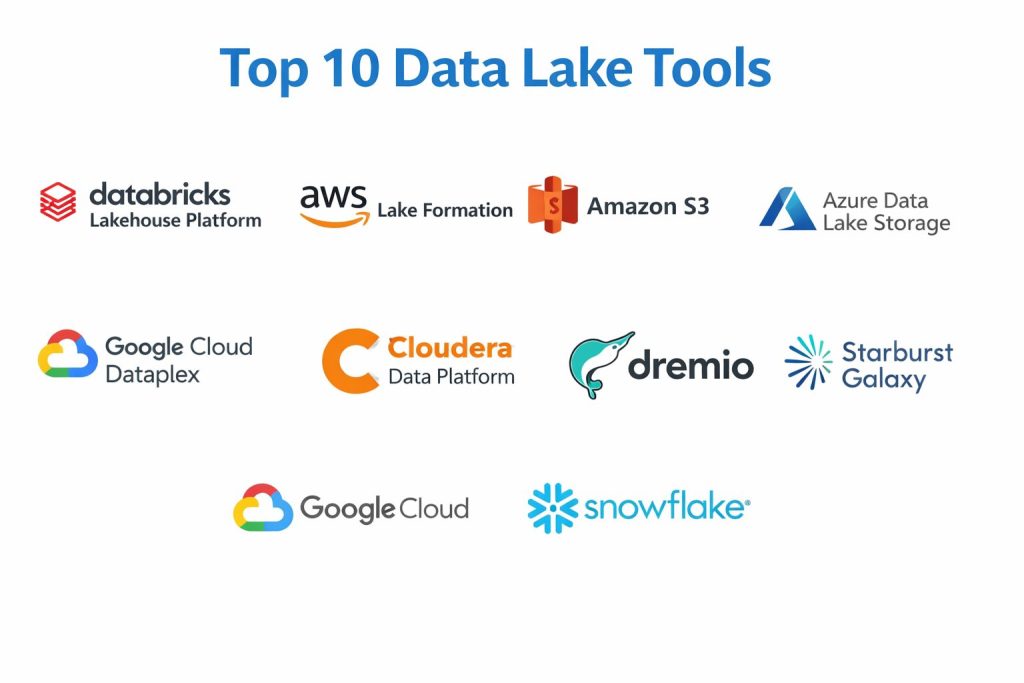
Top 10 Data Lake Platforms
- Databricks Lakehouse Platform
A lakehouse-oriented platform that combines scalable compute with data management features to run analytics and machine learning on lake data with stronger governance and performance patterns.
Key Features
- Managed compute for batch and streaming workloads
- Integrated governance patterns for shared datasets
- Performance-focused query execution for lake data
- Unified workflows for analytics and machine learning
- Operational tooling for job scheduling and monitoring
Pros
- Strong for teams that want one platform for analytics plus ML
- Reduces fragmentation by standardizing compute and governance patterns
Cons
- Platform costs can grow with heavy usage if not governed
- Requires good platform practices to avoid sprawl across teams
Platforms / Deployment
Cloud, Varies / N/A for exact supported environments
Security and Compliance
Not publicly stated
Integrations and Ecosystem
Often fits well with orchestration, BI, and ML toolchains when teams standardize ingestion and dataset contracts.
- Common integrations with orchestration and workflow tools
- Connectors for BI and notebooks-based workflows
- Supports integration patterns for streaming and batch pipelines
Support and Community
Strong community presence and enterprise support options; specifics vary by plan.
2. AWS Lake Formation
A governance-focused layer designed to help build, secure, and manage data lakes with consistent permissions, cataloging patterns, and data access controls in an AWS-centric setup.
Key Features
- Centralized permissions and policy management for lake data
- Catalog and metadata-driven access workflows
- Governance patterns for multi-team environments
- Controls to standardize how data is registered and shared
- Alignment with AWS data services for ingestion and analytics
Pros
- Strong for centralized governance in AWS-first environments
- Helps reduce permission chaos across multiple teams and datasets
Cons
- Best fit when most of the stack lives within AWS
- Requires careful design of roles, policies, and dataset boundaries
Platforms / Deployment
Cloud
Security and Compliance
Not publicly stated
Integrations and Ecosystem
Often used alongside AWS storage and analytics services to standardize how data is cataloged and accessed.
- Works well with AWS-native ingestion and analytics patterns
- Fits common IAM-based operational models
- Commonly paired with a cloud object store foundation
Support and Community
Strong vendor documentation; support depends on AWS support tier.
3. Amazon S3
A widely used cloud object storage foundation that frequently serves as the primary storage layer for data lakes due to durability, scalability, and ecosystem support.
Key Features
- Object storage at scale with flexible lifecycle policies
- Common foundation for lake data in raw and curated zones
- Encryption and access control patterns suitable for large organizations
- Logging and monitoring options for usage visibility
- Broad compatibility with analytics and data processing tools
Pros
- Excellent durability and scalability for lake storage
- Large ecosystem support across many analytics platforms
Cons
- Storage alone is not a complete data lake platform without governance and catalog layers
- Cost control requires lifecycle policies and workload discipline
Platforms / Deployment
Cloud
Security and Compliance
Common capabilities include access policies, encryption options, and logging features; compliance specifics are not publicly stated here.
Integrations and Ecosystem
S3 is commonly integrated with a wide range of compute engines, catalogs, and analytics layers.
- Compatible with many query engines and processing frameworks
- Fits well with streaming, batch, and ML workflows
- Often paired with governance and catalog solutions for enterprise usage
Support and Community
Strong vendor support and widespread community knowledge.
4. Azure Data Lake Storage
A cloud data lake storage service designed for analytics workloads, frequently used as the central storage layer for lake architectures in Microsoft-centric ecosystems.
Key Features
- Scalable storage patterns for lake zones and curated datasets
- Access control and identity integration in Azure environments
- Performance-oriented features for analytics workloads
- Common integration paths with Azure analytics services
- Supports multi-team access patterns when governed well
Pros
- Strong fit for Microsoft-centric data stacks
- Works well as a durable storage foundation for analytics pipelines
Cons
- Storage is only one part of a full lake platform, requiring governance and catalog choices
- Cost and organization can suffer without lifecycle and dataset standards
Platforms / Deployment
Cloud
Security and Compliance
Not publicly stated
Integrations and Ecosystem
Often used with Microsoft analytics tools and third-party engines that can read from cloud storage.
- Common integration with orchestration and analytics services
- Supports standard patterns for batch and streaming pipelines
- Works best with a clear governance and catalog strategy
Support and Community
Strong vendor documentation; ecosystem support is broad in Microsoft environments.
5. Google Cloud Storage
A cloud object storage foundation often used for data lakes due to scalable storage, cost controls, and strong integration with Google’s analytics and data services.
Key Features
- Durable object storage suited to raw and curated lake zones
- Lifecycle and tiering features for cost optimization
- Access control patterns for multi-team environments
- Broad compatibility with analytics and processing engines
- Works well as a storage base for lakehouse-style patterns
Pros
- Strong storage foundation with flexible cost controls
- Good integration potential for Google-centric analytics setups
Cons
- Storage alone does not solve governance, cataloging, or quality
- Strong outcomes require consistent dataset and metadata standards
Platforms / Deployment
Cloud
Security and Compliance
Not publicly stated
Integrations and Ecosystem
Often paired with Google analytics services and external query engines for lake access.
- Works with multiple processing and query layers
- Common integration with orchestration and ingestion tools
- Best results when combined with governance and catalog capabilities
Support and Community
Strong vendor documentation and broad adoption in cloud analytics use cases.
6. Google Cloud Dataplex
A data governance and management layer designed to help organize, catalog, and control access across lake data, supporting multi-team self-service with policies and metadata.
Key Features
- Metadata-driven organization of lake assets
- Governance patterns for consistent access and discovery
- Policy and catalog features to support self-service analytics
- Helps manage datasets across different lake zones
- Supports standardization of lake operations and ownership
Pros
- Helpful for governance and data discovery in Google-centric environments
- Improves control and visibility across a growing lake footprint
Cons
- Best fit when most lake storage and analytics are within Google’s ecosystem
- Requires careful operating model design to avoid inconsistent metadata practices
Platforms / Deployment
Cloud
Security and Compliance
Not publicly stated
Integrations and Ecosystem
Often used to coordinate governance across storage and analytics layers in Google-centric data stacks.
- Designed to align governance with lake storage and analytics services
- Improves catalog and discovery workflows when adopted consistently
- Works best with clear dataset ownership and stewardship processes
Support and Community
Vendor documentation and support options vary by plan; community is growing.
7. Cloudera Data Platform
An enterprise-oriented data platform that supports lake and analytics patterns with governance, security controls, and operational capabilities often used in hybrid and regulated environments.
Key Features
- Enterprise data management and governance patterns
- Hybrid-oriented deployment approaches depending on setup
- Security controls aligned with centralized administration needs
- Supports multiple processing engines and workload patterns
- Operational tooling for platform management at scale
Pros
- Strong fit for enterprises needing centralized control and governance
- Useful for hybrid strategies and regulated environments
Cons
- Can be operationally complex compared to simpler cloud-native setups
- Requires strong platform team skills to run efficiently
Platforms / Deployment
Cloud / Hybrid, Varies / N/A for exact combinations
Security and Compliance
Not publicly stated
Integrations and Ecosystem
Often integrates with enterprise identity systems, governance models, and multiple data engines based on organizational standards.
- Supports common enterprise integration patterns
- Often used with established governance and stewardship programs
- Works best with standardized platform processes and clear ownership
Support and Community
Enterprise support is a key strength; community strength varies by region and adoption.
8. Dremio
A lake-focused query and acceleration layer designed to help teams run fast analytics directly on lake storage while improving usability and performance through semantic and caching patterns.
Key Features
- Query layer designed for lake data access
- Performance acceleration patterns for analytics workloads
- Helps standardize how teams consume lake datasets
- Supports federated access patterns depending on setup
- Improves usability for self-service analytics use cases
Pros
- Strong for enabling fast analytics on lake storage without heavy copying
- Helpful for standardizing dataset consumption across teams
Cons
- Still requires good governance and catalog discipline around datasets
- Performance benefits depend on workload fit and platform design
Platforms / Deployment
Cloud / Self-hosted, Varies / N/A for exact options
Security and Compliance
Not publicly stated
Integrations and Ecosystem
Often used with object storage foundations and common BI tools to expand lake analytics access.
- Works with common lake storage foundations
- Connects to BI and analytics consumption layers
- Fits best when dataset definitions and ownership are standardized
Support and Community
Support varies by edition; community presence is solid in lake analytics circles.
9. Starburst Galaxy
A query platform built around distributed SQL patterns that can enable analytics across data lake storage and multiple sources, often used to improve access without centralizing everything.
Key Features
- Distributed SQL query layer across lake and external sources
- Supports federated analytics patterns depending on setup
- Helps reduce copies by querying data where it lives
- Useful for multi-source analytics and domain consumption models
- Designed for scalable query workloads across data estates
Pros
- Strong for federated analytics and multi-source querying
- Useful when organizations want to avoid moving data unnecessarily
Cons
- Governance still needs strong policy and metadata discipline
- Performance outcomes depend on source systems and workload patterns
Platforms / Deployment
Cloud, Varies / N/A for exact supported environments
Security and Compliance
Not publicly stated
Integrations and Ecosystem
Often fits in architectures that combine data lake storage with multiple operational sources.
- Works with object storage and common data systems
- Pairs well with BI consumption and data catalog patterns
- Best results when access controls and metadata are standardized
Support and Community
Vendor support options exist; community is strong in distributed SQL ecosystems.
10. Snowflake
A cloud data platform often used for analytics that can also participate in lake and lakehouse patterns through external data access and managed governance features, depending on architecture.
Key Features
- Strong SQL analytics and workload management capabilities
- Governance and access control patterns for shared data usage
- Performance-focused query execution
- Enables structured analytics patterns at scale
- Often used as a central analytics layer in many organizations
Pros
- Strong performance and usability for analytics consumers
- Mature governance and operational capabilities for many teams
Cons
- Not always used as the raw lake storage foundation
- Cost planning requires discipline for heavy usage workloads
Platforms / Deployment
Cloud
Security and Compliance
Not publicly stated
Integrations and Ecosystem
Often integrates with many ingestion tools, BI platforms, and orchestration stacks, and can complement lake storage patterns depending on architecture.
- Common integrations with ingestion and ELT tools
- Strong fit for BI and analytics consumption workflows
- Often paired with storage and governance strategies for broader data estates
Support and Community
Strong vendor support and broad community adoption in analytics teams.
Comparison Table
| Tool Name | Best For | Platform(s) Supported | Deployment | Standout Feature | Public Rating |
|---|---|---|---|---|---|
| Databricks Lakehouse Platform | Unified analytics and ML on lake data | Varies / N/A | Cloud | Lakehouse-style compute plus governance patterns | N/A |
| AWS Lake Formation | Centralized governance for AWS-centric lakes | Varies / N/A | Cloud | Policy-based lake permissions and catalog workflows | N/A |
| Amazon S3 | Durable lake storage foundation | Varies / N/A | Cloud | Scalable object storage used as lake base | N/A |
| Azure Data Lake Storage | Lake storage in Microsoft-centric stacks | Varies / N/A | Cloud | Analytics-friendly lake storage patterns | N/A |
| Google Cloud Storage | Lake storage in Google-centric stacks | Varies / N/A | Cloud | Flexible object storage and lifecycle controls | N/A |
| Google Cloud Dataplex | Governance and catalog for Google lake estates | Varies / N/A | Cloud | Metadata-driven organization and discovery | N/A |
| Cloudera Data Platform | Enterprise governance and hybrid strategies | Varies / N/A | Cloud / Hybrid | Centralized enterprise data management | N/A |
| Dremio | Fast analytics directly on lake storage | Varies / N/A | Cloud / Self-hosted | Lake query acceleration and usability layer | N/A |
| Starburst Galaxy | Federated SQL across lake and sources | Varies / N/A | Cloud | Query data where it lives across many systems | N/A |
| Snowflake | Strong analytics layer that can complement lake patterns | Varies / N/A | Cloud | High-performance analytics with governance options | N/A |
Evaluation and Scoring of Data Lake Platforms
Weights
Core features 25 percent
Ease of use 15 percent
Integrations and ecosystem 15 percent
Security and compliance 10 percent
Performance and reliability 10 percent
Support and community 10 percent
Price and value 15 percent
| Tool Name | Core | Ease | Integrations | Security | Performance | Support | Value | Weighted Total |
|---|---|---|---|---|---|---|---|---|
| Databricks Lakehouse Platform | 9.5 | 8.0 | 9.0 | 7.0 | 8.5 | 8.0 | 7.5 | 8.40 |
| AWS Lake Formation | 8.5 | 7.5 | 8.5 | 8.0 | 8.0 | 7.5 | 7.5 | 8.00 |
| Amazon S3 | 8.0 | 8.5 | 8.5 | 7.5 | 9.0 | 8.0 | 9.0 | 8.35 |
| Azure Data Lake Storage | 8.5 | 8.0 | 8.5 | 8.0 | 8.5 | 7.5 | 7.5 | 8.12 |
| Google Cloud Storage | 8.0 | 8.5 | 8.0 | 7.5 | 8.5 | 7.5 | 8.0 | 8.02 |
| Google Cloud Dataplex | 8.0 | 7.5 | 8.5 | 8.0 | 7.5 | 7.0 | 7.0 | 7.70 |
| Cloudera Data Platform | 8.5 | 7.0 | 8.0 | 7.5 | 7.5 | 7.5 | 6.5 | 7.60 |
| Dremio | 8.0 | 7.5 | 8.0 | 7.0 | 8.0 | 7.0 | 7.5 | 7.65 |
| Starburst Galaxy | 8.0 | 7.0 | 8.5 | 7.0 | 8.0 | 7.0 | 7.0 | 7.57 |
| Snowflake | 9.0 | 8.5 | 9.0 | 8.0 | 8.5 | 8.5 | 6.5 | 8.35 |
How to interpret the scores
These scores are comparative and help you shortlist options based on typical platform priorities. A slightly lower total can still be the best choice if it matches your architecture, skill set, and operating model. Core and integrations influence long-term platform fit, while ease of use influences adoption speed. Security scores reflect commonly expected platform controls, but details can vary by plan and configuration. Use these numbers to narrow choices, then validate with a pilot using your real data, access rules, and workloads.
Which Data Lake Platform Is Right for You
Solo or Freelancer
If you are learning or building a small solution, prioritize simplicity and cost control. A cloud storage foundation plus a lightweight query approach can be enough, but you should avoid building a complex governance model too early. If you want a more guided experience, pick a platform that reduces setup work and provides a clear path from ingestion to consumption.
SMB
SMBs often need quick wins: reliable storage, easy access for analytics, and a simple governance model. Cloud-native options can work well when you keep dataset conventions consistent. If multiple teams will share data, choose a governance layer early so you do not end up with confusing permissions and duplicated datasets later.
Mid-Market
Mid-market teams benefit from clearer operating models, stronger catalogs, and standard ingestion patterns. Lakehouse-style platforms can reduce tool sprawl by combining compute, governance patterns, and monitoring. If you already have multiple sources and many consumers, federated query layers can add value when used with strong metadata and access control.
Enterprise
Enterprises should optimize for governance, auditability, and scalable operations. If you have regulated data or many business domains, prioritize policy-based access control, standardized dataset ownership, and strong metadata discipline. Hybrid strategies may be relevant when data cannot fully move to one cloud. Enterprise success usually depends more on operating model and data stewardship than on any single feature.
Budget vs Premium
Budget-focused setups often start with object storage plus selective governance and a query layer. Premium setups typically invest in stronger platform tooling to reduce operational burden and enable broader self-service. The key is to match spend to adoption. Overbuilding a platform before usage grows leads to wasted cost and complexity.
Feature Depth vs Ease of Use
If your team can manage complexity, deeper platforms offer stronger governance and scalable operations. If your team needs speed, choose fewer moving parts and standardize conventions. Ease is not only UI. It includes how easy it is to enforce standards, run pipelines reliably, and keep permissions understandable.
Integrations and Scalability
Choose platforms that fit your ingestion and consumption reality. If you have many BI tools and ML workflows, ensure the ecosystem supports them without constant custom work. Scalability is not only storage scale. It is also policy scale, metadata scale, and operational scale across many teams.
Security and Compliance Needs
If security is critical, prioritize fine-grained access control, encryption controls, auditing, and clear separation of duties. Keep sensitive datasets in clearly governed zones, use least-privilege principles, and standardize how access is requested and reviewed. When details are unclear, treat them as not publicly stated and validate directly during procurement.
Frequently Asked Questions
1. What is the difference between a data lake and a data warehouse
A data lake stores raw and semi-processed data in flexible formats, while a warehouse stores curated data optimized for analytics. Many teams combine both, using the lake for storage and the warehouse for high-performance BI workloads.
2. What is a lakehouse and why do people use it
A lakehouse is an approach that adds warehouse-like governance and performance to lake data. It helps reduce data copies and gives analytics teams a more consistent experience on top of open storage.
3. Do I need a data catalog for my lake
If more than one team uses the lake, a catalog becomes essential. Without it, datasets become hard to find, definitions drift, and trust drops, leading to duplicated pipelines and inconsistent reporting.
4. How do I control costs in a data lake platform
Use lifecycle policies, define retention rules, separate raw from curated zones, and monitor usage by team and workload. Cost control is mostly governance and discipline, not just choosing a cheaper storage tier.
5. What are the most common mistakes teams make
Common mistakes include ingesting everything without ownership, skipping metadata standards, using inconsistent naming, and giving broad access without clear policies. Another mistake is building many one-off pipelines instead of reusable patterns.
6. Can I run analytics directly on lake storage
Yes, many modern query engines and platforms support analytics directly on lake data. Performance depends on formats, partitioning, table management, and how well your platform is configured.
7. How do I handle sensitive or regulated data in a lake
Use strict access policies, encryption controls, audit logging, and dataset zoning. Keep sensitive data in tightly governed areas and require approvals for access, with clear stewardship responsibility.
8. How hard is it to migrate from one lake platform to another
Migration difficulty depends on formats, governance models, and how many pipelines depend on platform-specific features. Using open formats and standardized metadata practices typically reduces migration risk.
9. Do I need real-time ingestion for a data lake
Not always. Many workloads are batch-based and work well with scheduled ingestion. Real-time becomes important when dashboards, monitoring, or operational decisions need fresh data quickly.
10. What should I pilot before committing to a platform
Pilot with real datasets, real access rules, and two or three representative workloads. Validate ingestion, governance, query performance, cost behavior, and operational workflows like monitoring and incident response.
Conclusion
A data lake platform is not just a storage decision. It is a long-term operating model for how your organization ingests, governs, discovers, and uses data across many teams. The best choice depends on your cloud strategy, workload mix, governance maturity, and how many consumers need self-service access. Cloud object storage foundations can be highly effective when paired with strong metadata, access control, and quality practices. Lakehouse-style platforms can reduce fragmentation by standardizing compute and governance patterns. Query layers can improve speed and broaden access when your datasets are well-defined. A practical next step is to shortlist two or three options, run a controlled pilot with real data and policies, and confirm performance, cost behavior, and operational effort before scaling.