Introduction
A Threat Intelligence Platform helps security teams collect, normalize, enrich, and operationalize threat data so it becomes usable in real work. Instead of hunting across scattered feeds, emails, PDFs, and portals, a platform centralizes indicators, threats, actors, and context, then pushes the right intelligence into detection, response, and investigations. It matters now because attackers move fast, security stacks are fragmented, and teams need repeatable workflows that turn raw intelligence into actions inside SIEM, SOAR, EDR, firewalls, and ticketing systems. Common use cases include phishing and malware triage, prioritizing vulnerabilities, blocking known bad infrastructure, tracking threat actors relevant to your industry, supporting incident response with rapid enrichment, and building weekly intel reports for leadership. Key evaluation criteria include data quality, enrichment depth, automation, integrations, collaboration, workflow control, scalability, governance, auditability, and the effort needed to maintain it.
Best for: SOC teams, threat intel analysts, incident responders, CTI teams, MSSPs, and organizations that need repeatable intelligence workflows across multiple security tools.
Not ideal for: very small teams that only need basic enrichment occasionally; in such cases, lightweight enrichment services or a simple process inside SIEM/SOAR may be enough.
Key Trends in Threat Intelligence Platforms
- More automation for ingestion, deduplication, scoring, and confidence management
- Stronger focus on operationalizing intelligence into controls, not just storing indicators
- Wider adoption of intelligence standards like STIX and TAXII for sharing and structure
- Better correlation between CTI and internal telemetry for faster prioritization
- Increased use of risk-based prioritization to reduce alert fatigue
- More collaboration features for CTI, SOC, IR, and leadership reporting
- Deeper integration with SOAR playbooks to enforce consistent response workflows
- Stronger governance expectations around data lineage, access control, and audit trails
- Growth of managed intelligence offerings and curated intelligence collections
- Better support for threat actor tracking and strategic intelligence reporting workflows
How We Selected These Tools (Methodology)
- Included widely recognized platforms used by SOC and CTI teams across industries
- Prioritized tools that support end-to-end workflows: collect, enrich, correlate, act, and report
- Considered integration breadth with SIEM, SOAR, EDR, email security, and network controls
- Looked for scalable data handling, deduplication, and flexible data models
- Evaluated workflow support: case management patterns, collaboration, and analyst productivity
- Considered ecosystem strength: connectors, APIs, community resources, and partner support
- Balanced enterprise platforms with a credible open approach where appropriate
- Favored tools that help reduce operational overhead through automation and quality controls
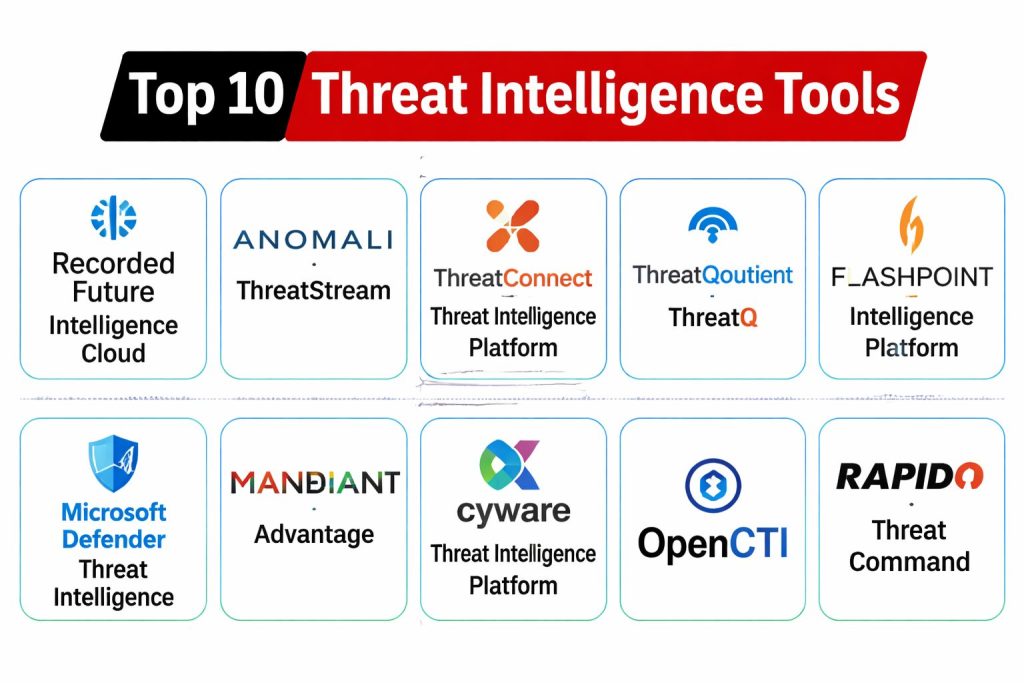
Top 10 Threat Intelligence Platforms
1) Recorded Future Intelligence Cloud
A threat intelligence platform focused on turning large-scale intelligence collection into practical prioritization, enrichment, and decision support. It is commonly used for fast context, alert triage support, and risk-driven intelligence.
Key Features
- Large-scale intelligence collection and context enrichment workflows
- Risk scoring patterns to prioritize indicators and entities
- Analyst-friendly investigation views for infrastructure and threats
- Workflow support for alerts, tracking, and reporting
- Automation and export into security controls through integrations
Pros
- Strong for fast context and prioritization during investigations
- Helpful for both tactical and strategic intelligence use
Cons
- Cost can be higher depending on scope and modules
- Some teams may need time to tune relevance and reduce noise
Platforms / Deployment
- Web
- Cloud
Security & Compliance
- SSO/SAML, MFA, encryption, audit logs, RBAC: Not publicly stated
- SOC 2, ISO 27001, GDPR, HIPAA: Not publicly stated
Integrations & Ecosystem
Recorded Future is often used to enrich alerts and feed intelligence into detection and response workflows.
- SIEM and SOAR integrations: Varies / N/A
- Ticketing and collaboration tools: Varies / N/A
- APIs and export options: Varies / N/A
- Security control integrations: Varies / N/A
Support & Community
Strong enterprise support options and structured onboarding are common; community visibility depends on program access.
2) Anomali ThreatStream
A platform designed to aggregate multiple intelligence sources, normalize data, reduce duplicates, and operationalize intelligence into security workflows. It is widely used for feed management and indicator lifecycle handling.
Key Features
- Multi-feed ingestion with normalization and deduplication
- Indicator scoring, confidence handling, and lifecycle control
- Enrichment workflows to add context for investigations
- Sharing and collaboration features for teams and partners
- Integration patterns to push intelligence into security tools
Pros
- Strong for managing many feeds without drowning in duplicates
- Useful for operational CTI workflows and control distribution
Cons
- Requires tuning to align scoring with your environment
- Value depends on how well integrations are implemented
Platforms / Deployment
- Web
- Cloud
Security & Compliance
- SSO/SAML, MFA, encryption, audit logs, RBAC: Not publicly stated
- SOC 2, ISO 27001, GDPR, HIPAA: Not publicly stated
Integrations & Ecosystem
ThreatStream commonly connects to SIEM, SOAR, EDR, and network controls to distribute intelligence.
- Connectors and integrations: Varies / N/A
- APIs for custom pipelines: Varies / N/A
- Standards support (STIX/TAXII): Varies / N/A
- Automation hooks for enrichment and export: Varies / N/A
Support & Community
Enterprise-oriented support and onboarding are typical; documentation and integration guidance quality can vary by plan.
3) ThreatConnect Threat Intelligence Platform
A platform aimed at managing threat intelligence operations with workflows for analysis, collaboration, and operational output. It is commonly used when teams want a structured way to turn intelligence into cases and actions.
Key Features
- Centralized intelligence management with structured objects and relationships
- Workflow support for investigations, tasks, and reporting
- Enrichment and correlation to connect indicators, campaigns, and actors
- Automation patterns that can tie into response workflows
- Integrations for security stack alignment
Pros
- Strong for organizing CTI work across teams and stakeholders
- Useful for building repeatable intelligence-to-action processes
Cons
- Setup can take time if you want deep customization
- Best results require disciplined taxonomy and workflow ownership
Platforms / Deployment
- Web
- Cloud / Self-hosted / Hybrid: Varies / N/A
Security & Compliance
- SSO/SAML, MFA, encryption, audit logs, RBAC: Not publicly stated
- SOC 2, ISO 27001, GDPR, HIPAA: Not publicly stated
Integrations & Ecosystem
ThreatConnect is often used as an operational CTI hub that pushes outputs into detection and response.
- SIEM, SOAR, EDR integrations: Varies / N/A
- APIs for pipeline extensions: Varies / N/A
- Sharing and standards workflows: Varies / N/A
- Reporting and dashboards: Varies / N/A
Support & Community
Commonly positioned for enterprise CTI programs; documentation and professional services options vary by contract.
4) ThreatQuotient ThreatQ
A platform designed to reduce time spent on manual enrichment and triage by correlating multiple intelligence sources and making intelligence actionable for SOC and IR teams.
Key Features
- Correlation and context enrichment across multiple sources
- Prioritization features to highlight what matters most
- Analyst workflows that support faster triage and investigations
- Integrations to share intelligence with security tools
- Collaboration features for CTI, SOC, and IR alignment
Pros
- Strong for consolidating context and improving analyst speed
- Useful for teams focused on operational intelligence outcomes
Cons
- Requires integration effort to unlock full value
- Data relevance tuning is needed for best signal-to-noise
Platforms / Deployment
- Web
- Cloud / Self-hosted / Hybrid: Varies / N/A
Security & Compliance
- SSO/SAML, MFA, encryption, audit logs, RBAC: Not publicly stated
- SOC 2, ISO 27001, GDPR, HIPAA: Not publicly stated
Integrations & Ecosystem
ThreatQ commonly acts as a correlation engine and distribution hub for intelligence.
- Security stack connectors: Varies / N/A
- APIs and automation: Varies / N/A
- Standards support (STIX/TAXII): Varies / N/A
- Reporting and workflow export: Varies / N/A
Support & Community
Support and onboarding are typically enterprise-focused; community footprint depends on customer participation.
5) Flashpoint Intelligence Platform
A platform often associated with intelligence collection, risk insights, and operational context, especially for teams tracking exposure, fraud, and external threats alongside traditional CTI.
Key Features
- Intelligence collection and analysis workflows
- Contextual insights that support investigations and risk decisions
- Tracking and alerting features for relevant threats
- Reporting patterns for operational and leadership views
- Integrations to export intelligence into workflows
Pros
- Useful for teams needing broader external risk and intelligence views
- Strong for investigations that require context beyond basic indicators
Cons
- Scope and cost can be significant depending on packages
- Teams must define priorities to avoid intelligence overload
Platforms / Deployment
- Web
- Cloud
Security & Compliance
- SSO/SAML, MFA, encryption, audit logs, RBAC: Not publicly stated
- SOC 2, ISO 27001, GDPR, HIPAA: Not publicly stated
Integrations & Ecosystem
Flashpoint intelligence is commonly used to support SOC, IR, and risk programs through enrichment and alerts.
- SIEM and SOAR integrations: Varies / N/A
- Ticketing and collaboration integrations: Varies / N/A
- APIs for custom workflows: Varies / N/A
- Standards-based sharing: Varies / N/A
Support & Community
Typically offers enterprise-grade support and analyst services; community features depend on access and plan.
6) Microsoft Defender Threat Intelligence
A threat intelligence capability that supports investigations, enrichment, and risk decisions, especially for organizations aligned with the Microsoft security ecosystem.
Key Features
- Intelligence views to support investigations and context enrichment
- Entity-centric intelligence for infrastructure and threat tracking
- Integration-friendly workflows for security operations
- Reporting and alerting patterns for operational use
- Alignment with broader security tooling (environment dependent)
Pros
- Strong fit for organizations already invested in Microsoft security tools
- Helpful for enriching detections and speeding investigations
Cons
- Best value often depends on how much of the Microsoft ecosystem you use
- Coverage and features can vary by licensing and configuration
Platforms / Deployment
- Web
- Cloud
Security & Compliance
- SSO/SAML, MFA, encryption, audit logs, RBAC: Not publicly stated
- SOC 2, ISO 27001, GDPR, HIPAA: Not publicly stated
Integrations & Ecosystem
Commonly used alongside Microsoft security products and can support enrichment for SOC workflows.
- SIEM and SOAR alignment: Varies / N/A
- APIs and connectors: Varies / N/A
- Ticketing and workflow tools: Varies / N/A
- Standards and exports: Varies / N/A
Support & Community
Support experience typically depends on Microsoft support plans; documentation is extensive, with broad community discussions.
7) Mandiant Advantage
A platform that emphasizes intelligence-driven security informed by incident response experience and research. It is often used for tracking threats relevant to industries and supporting investigations.
Key Features
- Threat actor tracking and intelligence reporting workflows
- Investigation support with contextual intelligence views
- Alerting and prioritization for relevant threats (setup dependent)
- Integration patterns for operational use
- Research-driven intelligence outputs for strategic decisions
Pros
- Strong for actor-centric intelligence and contextual reporting
- Useful for aligning CTI with incident response readiness
Cons
- Licensing and packaging can be complex depending on needs
- Operationalization depends on integrations and workflow discipline
Platforms / Deployment
- Web
- Cloud
Security & Compliance
- SSO/SAML, MFA, encryption, audit logs, RBAC: Not publicly stated
- SOC 2, ISO 27001, GDPR, HIPAA: Not publicly stated
Integrations & Ecosystem
Often used to inform detection and investigations and can feed intelligence into security workflows.
- SIEM, SOAR, EDR integrations: Varies / N/A
- APIs and export options: Varies / N/A
- Reporting formats and workflows: Varies / N/A
- Standards support: Varies / N/A
Support & Community
Enterprise-grade support and analyst expertise are common; community access depends on subscription type.
8) Cyware Threat Intelligence Platform
A platform designed to help teams operationalize intelligence through sharing, workflow automation, and orchestration-friendly integrations. It is often used where collaboration and distribution are key.
Key Features
- Intelligence aggregation and normalization workflows
- Sharing and collaboration features across teams and partners
- Automation patterns to push intelligence into tools and playbooks
- Case and workflow features for operational CTI programs
- Integration-first approach for security stack alignment
Pros
- Strong for intelligence sharing and operational distribution
- Useful for organizations building repeatable CTI operations
Cons
- Requires clear governance to avoid clutter and duplication
- Integration work is needed to fully operationalize outputs
Platforms / Deployment
- Web
- Cloud / Self-hosted / Hybrid: Varies / N/A
Security & Compliance
- SSO/SAML, MFA, encryption, audit logs, RBAC: Not publicly stated
- SOC 2, ISO 27001, GDPR, HIPAA: Not publicly stated
Integrations & Ecosystem
Cyware is often positioned to connect intelligence with response tools and collaboration workflows.
- SOAR and SIEM connectors: Varies / N/A
- APIs and workflow automation: Varies / N/A
- Standards-based sharing support: Varies / N/A
- Collaboration and ticketing integrations: Varies / N/A
Support & Community
Support and onboarding are typically enterprise-focused; community materials vary by partner ecosystem.
9) OpenCTI
An open approach to managing and modeling threat intelligence with structured relationships and extensibility. It is often used by teams that want flexibility, control, and a customizable intelligence graph.
Key Features
- Structured intelligence model for relationships between entities
- Flexible ingestion patterns and connector-based enrichment workflows
- Strong support for modeling campaigns, actors, and infrastructure
- Extensible architecture for custom connectors and workflows
- Useful for building a tailored CTI knowledge base
Pros
- High flexibility for teams that want customization and control
- Useful for intelligence graph modeling and relationship analysis
Cons
- Requires engineering effort for deployment and maintenance
- Out-of-the-box experience depends on connector setup and tuning
Platforms / Deployment
- Web / Linux (typical)
- Self-hosted
Security & Compliance
- SSO/SAML, MFA, encryption, audit logs, RBAC: Varies / N/A
- SOC 2, ISO 27001, GDPR, HIPAA: Not publicly stated
Integrations & Ecosystem
OpenCTI typically integrates through connectors and APIs that teams tailor to their pipeline.
- STIX/TAXII workflows: Varies / N/A
- Connector ecosystem for enrichment: Varies / N/A
- APIs for automation and export: Varies / N/A
- Integration with SIEM and SOAR through custom pipelines: Varies / N/A
Support & Community
Community strength is a major advantage; support varies based on whether you use community resources or a commercial support option.
10) Rapid7 Threat Command
A platform commonly used for external threat intelligence, exposure monitoring, and operational context. It is often adopted by teams that want continuous monitoring and intelligence-driven prioritization.
Key Features
- Intelligence collection and monitoring workflows
- Alerting and prioritization features for relevant threats
- Context enrichment to support investigations and response decisions
- Reporting views for operational and leadership stakeholders
- Integration patterns to feed intelligence into workflows
Pros
- Useful for ongoing monitoring and intelligence-driven prioritization
- Helpful for building repeatable intelligence reporting cycles
Cons
- Output quality depends on tuning and internal relevance settings
- Integration effort is required for full operational impact
Platforms / Deployment
- Web
- Cloud
Security & Compliance
- SSO/SAML, MFA, encryption, audit logs, RBAC: Not publicly stated
- SOC 2, ISO 27001, GDPR, HIPAA: Not publicly stated
Integrations & Ecosystem
Threat Command typically integrates with SOC workflows for enrichment and alert handling.
- SIEM and SOAR integrations: Varies / N/A
- Ticketing and workflow systems: Varies / N/A
- APIs and export options: Varies / N/A
- Standards-based sharing: Varies / N/A
Support & Community
Support depends on plan and region; many teams rely on onboarding and structured guidance to tune outputs.
Comparison Table
| Tool Name | Best For | Platform(s) Supported | Deployment | Standout Feature | Public Rating |
|---|---|---|---|---|---|
| Recorded Future Intelligence Cloud | Prioritization and fast investigation context | Web | Cloud | Risk-driven intelligence views | N/A |
| Anomali ThreatStream | Feed aggregation, scoring, and operational CTI | Web | Cloud | Ingestion, normalization, deduplication | N/A |
| ThreatConnect Threat Intelligence Platform | Workflow-driven CTI operations | Web | Varies / N/A | Structured intelligence workflows | N/A |
| ThreatQuotient ThreatQ | Correlation and enrichment to speed triage | Web | Varies / N/A | Context correlation across sources | N/A |
| Flashpoint Intelligence Platform | External intelligence and investigation context | Web | Cloud | Broader external intelligence coverage | N/A |
| Microsoft Defender Threat Intelligence | Intelligence aligned to Microsoft security operations | Web | Cloud | Ecosystem alignment and enrichment | N/A |
| Mandiant Advantage | Actor-centric intelligence and strategic reporting | Web | Cloud | Research-driven actor tracking | N/A |
| Cyware Threat Intelligence Platform | Sharing and operational distribution workflows | Web | Varies / N/A | Collaboration and distribution | N/A |
| OpenCTI | Customizable intelligence graph and modeling | Web | Self-hosted | Relationship-based intelligence graph | N/A |
| Rapid7 Threat Command | Monitoring and external threat intelligence | Web | Cloud | Continuous monitoring and alerting | N/A |
Evaluation & Scoring
Weights used: Core features 25%, Ease of use 15%, Integrations and ecosystem 15%, Security and compliance 10%, Performance and reliability 10%, Support and community 10%, Price and value 15%.
| Tool Name | Core (25%) | Ease (15%) | Integrations (15%) | Security (10%) | Performance (10%) | Support (10%) | Value (15%) | Weighted Total |
|---|---|---|---|---|---|---|---|---|
| Recorded Future Intelligence Cloud | 9.0 | 8.0 | 8.5 | 6.0 | 8.5 | 8.0 | 6.5 | 8.05 |
| Anomali ThreatStream | 8.5 | 7.5 | 8.5 | 6.0 | 8.0 | 7.5 | 7.0 | 7.85 |
| ThreatConnect Threat Intelligence Platform | 8.5 | 7.0 | 8.0 | 6.0 | 7.5 | 7.5 | 6.5 | 7.55 |
| ThreatQuotient ThreatQ | 8.0 | 7.5 | 8.0 | 6.0 | 7.5 | 7.5 | 6.5 | 7.45 |
| Flashpoint Intelligence Platform | 8.0 | 7.5 | 7.5 | 6.0 | 7.5 | 7.5 | 6.5 | 7.40 |
| Microsoft Defender Threat Intelligence | 7.5 | 7.5 | 8.5 | 6.0 | 8.0 | 7.5 | 7.0 | 7.65 |
| Mandiant Advantage | 8.0 | 7.0 | 7.5 | 6.0 | 7.5 | 7.5 | 6.5 | 7.35 |
| Cyware Threat Intelligence Platform | 7.5 | 7.0 | 8.0 | 6.0 | 7.0 | 7.0 | 6.5 | 7.15 |
| OpenCTI | 7.5 | 6.5 | 7.5 | 5.5 | 7.0 | 7.5 | 8.5 | 7.30 |
| Rapid7 Threat Command | 7.5 | 7.5 | 7.5 | 6.0 | 7.5 | 7.0 | 6.5 | 7.30 |
How to interpret these scores: the totals are comparative within this list and reflect practical fit across common evaluation criteria. A higher score means broader strength for more scenarios, not a universal winner. Ease and value may matter more for small teams, while integrations and core depth may matter more for mature SOC programs. Security scoring is limited because many public compliance details are not clearly stated. Always validate with a short pilot focused on your actual integrations, workflows, and reporting needs.
Which Threat Intelligence Platform Is Right for You
Solo / Freelancer
If you are an individual analyst or small security function, the main goal is reducing manual work without adding operational overhead. OpenCTI can work well if you have technical capacity to deploy and maintain connectors. Otherwise, you may prefer a managed platform that provides usable intelligence views and quick enrichment without heavy setup, as long as the budget supports it. The most important factor is whether you can operationalize the intelligence into your daily workflow rather than collecting more feeds.
SMB
SMBs usually need fast wins: better triage, fewer false positives, and clear priorities. Platforms that simplify ingestion, deduplication, and enrichment can deliver value quickly if you integrate them into your SOC workflow. If you already rely on a specific security ecosystem, choosing a platform that aligns closely with it can reduce integration cost and shorten time-to-value. Focus on curated intelligence, alert relevance, and simple reporting to leadership.
Mid-Market
Mid-market teams often have a SOC with multiple tools and need tighter workflows. A strong fit here is a platform that supports scoring, confidence, automation, and distribution into SIEM and SOAR, plus collaboration across CTI and IR. You should prioritize data governance, repeatable processes, and the ability to create intelligence-driven blocklists, detections, and playbooks. Consider whether the platform supports your preferred standards and whether it can scale with more feeds and more analysts.
Enterprise
Enterprises need governance, scale, and operational rigor. Look for workflow control, role-based access, auditability, robust APIs, and proven integration patterns. Enterprises also benefit from platforms that support strategic intelligence reporting and threat actor tracking at scale. A key success factor is ownership: define how intelligence becomes action, who approves high-impact changes, and how you measure effectiveness. The best enterprise platform is the one that fits your security architecture and can be consistently used across teams.
Budget vs Premium
Budget-focused organizations should avoid paying for massive intelligence they cannot operationalize. OpenCTI can be strong when you have engineering capacity and want flexibility. Premium offerings can be worth it when they reduce analyst time, improve prioritization, and provide strong context during incidents. The real cost is not just licensing; it is integration, maintenance, and analyst adoption. Choose the option that gives you predictable output and minimal operational friction.
Feature Depth vs Ease of Use
Feature-rich platforms can do more, but only if your team uses those workflows consistently. If adoption is low, choose ease of use and fast operational wins. If your CTI program is mature and you need deep modeling, actor tracking, and customized processes, depth matters more. A practical approach is to pick a platform that feels simple for daily use but still supports expansion through APIs and automation.
Integrations and Scalability
Integrations decide whether intelligence becomes action. Test your core use cases: enrichment into SIEM alerts, pushing indicators into SOAR playbooks, distributing blocklists to controls, and creating tickets automatically. Scalability means the platform can handle more feeds, more data, and more analysts without collapsing under duplicates or noise. If integrations require heavy custom work, confirm you have the resources to maintain them long term.
Security and Compliance Needs
Many platforms do not publicly state every compliance detail. Treat unknown claims as unknown and validate them through procurement. Internally, ensure access control, audit logs, data retention rules, and strong governance around who can push intelligence into blocking controls. Security is not only vendor features; it is how you operate the platform, how you manage credentials, and how you protect sensitive intelligence.
Frequently Asked Questions
1) What is the main purpose of a Threat Intelligence Platform
A TIP centralizes threat data and turns it into usable intelligence for analysts and SOC workflows. It reduces time spent searching across multiple sources and helps push decisions into tools that can act.
2) Do I need a TIP if I already have a SIEM and SOAR
Not always, but a TIP can improve the quality of enrichment, prioritization, and intelligence management. If your team struggles with feed chaos, duplication, or reporting, a TIP can help.
3) What is the difference between threat feeds and threat intelligence
Feeds provide raw indicators, while intelligence adds context, confidence, relevance, and relationships. A TIP helps you transform raw indicators into actionable intelligence and workflows.
4) How do I avoid drowning in too many indicators
Use deduplication, scoring, confidence levels, and relevance filters tied to your business and internal telemetry. Start with fewer high-quality sources and expand only when you can operationalize them.
5) What integrations should I prioritize first
Start with SIEM enrichment, SOAR playbook enrichment, and ticketing integration for consistent workflows. Next, add exports to email security, EDR, and network controls if you have governance in place.
6) How long does implementation usually take
It varies based on integrations and data complexity. A focused rollout with a small number of feeds and a clear workflow can be faster than a broad rollout across many teams.
7) What are common mistakes during rollout
Connecting too many feeds at once, skipping scoring and confidence tuning, not defining ownership, and not integrating into daily operations. Another major mistake is reporting without clear operational outcomes.
8) How do I measure success with a TIP
Track reduced investigation time, fewer repeated manual enrichment steps, improved detection quality, faster incident response decisions, and the number of intelligence-driven actions executed safely.
9) Can a TIP help with threat actor tracking
Yes, many platforms support actor, campaign, and infrastructure relationships. The value depends on whether your team uses those relationships to drive detections, patch priorities, and response planning.
10) What is a practical shortlist approach before buying
Pick two or three tools, test your top workflows with real alerts, measure analyst time saved, validate integrations, and confirm governance controls. Choose the platform that improves outcomes with the least friction.
Conclusion
Threat Intelligence Platforms deliver the most value when they reduce manual work and consistently turn intelligence into actions your security stack can enforce. The right choice depends on your maturity level, available engineering support, the tools you already run, and whether you need tactical enrichment, strategic intelligence, or both. Some teams prioritize feed management and deduplication, while others need relationship modeling, actor tracking, and strong reporting. Before committing, shortlist two or three platforms, run a pilot using real alerts and real workflows, validate the quality of enrichment and relevance scoring, and confirm your critical integrations. Finally, establish governance for who can publish indicators into controls so intelligence improves security without creating operational risk.