Introduction
Security Information & Event Management platforms collect security logs and signals from across your environment, normalize them, and help your team detect suspicious behavior early. A good SIEM turns noisy raw events into investigations you can actually act on, using correlation rules, analytics, alerting, and guided response. SIEM matters because modern environments are spread across cloud, on-prem systems, identity providers, endpoints, and SaaS apps, and attackers move fast across these layers.
Common use cases include: detecting identity abuse and risky sign-ins, spotting lateral movement across servers, investigating data exfiltration signals, monitoring privileged access, supporting compliance reporting, and building a central place for incident timelines. When evaluating a SIEM, focus on data ingestion breadth, normalization quality, correlation and analytics, search speed, alert fidelity, case management, automation options, reporting, scalability and cost predictability, role-based access controls, and how easily it fits your existing SOC workflow.
Best for: SOC analysts, security engineers, incident responders, compliance teams, and IT operations teams who need centralized detection and investigation across hybrid environments.
Not ideal for: very small teams with low log volume and no SOC workflow; in that case a lightweight log monitoring approach or managed security service may fit better.
Key Trends in SIEM
- More focus on fast onboarding through prebuilt parsers, content packs, and guided detections
- Greater reliance on behavior analytics to reduce rule-only detection gaps
- Tighter alignment with SOAR and case workflows to shorten investigation time
- More cloud-first deployments, but hybrid data collection remains common
- Higher expectations for cost visibility and controls around ingestion and retention
- Increased demand for unified views across endpoint, identity, cloud, and network telemetry
- Stronger emphasis on detection engineering, content lifecycle, and tuning discipline
- More automation around enrichment, triage, and alert grouping to fight analyst fatigue
How We Selected These Tools (Methodology)
- Broad adoption across enterprise and mid-market security teams
- Strong core SIEM capabilities: ingestion, normalization, correlation, search, alerting
- Practical SOC workflow support: investigation views, case handling, reporting
- Ecosystem strength: integrations, connectors, content packs, partner support
- Scalability signals: ability to handle large data volumes and complex queries
- Fit across segments: from lean SOCs to mature security operations programs
- Balance of cloud-first and hybrid-friendly approaches
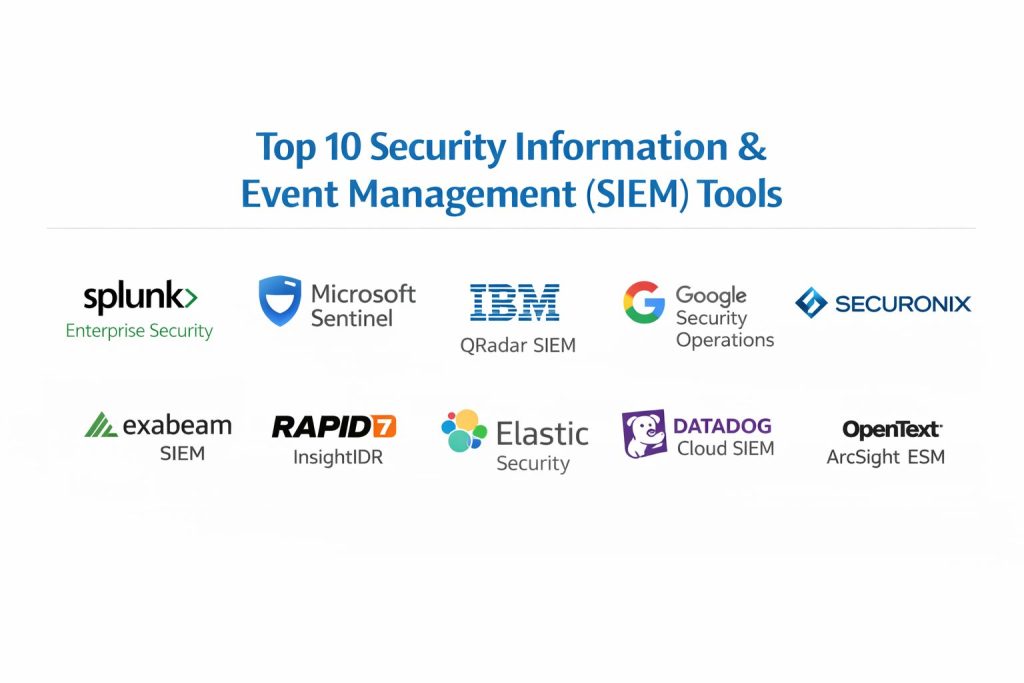
Top 10 SIEM Tools
1) Splunk Enterprise Security
A widely used SIEM for large-scale log analytics, correlation, and SOC workflows. Often chosen by organizations that need deep search, flexible detection engineering, and mature operational processes.
Key Features
- Powerful search and analytics for large security datasets
- Correlation searches and detection content for common threat patterns
- SOC dashboards and investigation views for triage and escalation
- Risk-based approaches and enrichment patterns (implementation dependent)
- Broad ingestion options for diverse log sources and telemetry
Pros
- Very flexible for detection engineering and custom workflows
- Strong ecosystem and large talent pool in the market
Cons
- Can become expensive at high ingestion volumes without cost discipline
- Requires tuning and governance to keep signal quality high
Platforms / Deployment
Cloud / Self-hosted / Hybrid (varies by licensing and architecture)
Security & Compliance
Not publicly stated; capabilities depend on deployment model and identity integrations.
Integrations & Ecosystem
Splunk commonly integrates with identity, endpoint, cloud, network, and application sources, and supports enrichment via APIs and apps.
- Cloud logs and control-plane events
- Endpoint and EDR telemetry
- Identity providers and authentication logs
- Network security devices and firewalls
- SOAR, ticketing, and case workflows (varies)
Support & Community
Large global community, extensive documentation, and mature professional services ecosystem. Support tiers vary by contract.
2) Microsoft Sentinel
A cloud-native SIEM aligned to Microsoft security tooling and cloud services, but also used for broader multi-vendor telemetry. Often chosen by teams that want quick onboarding and integrated investigation across Microsoft environments.
Key Features
- Cloud-based ingestion and analytics with scalable search patterns
- Prebuilt connectors and content for common Microsoft and third-party sources
- Alert correlation and investigation experiences for SOC workflows
- Automation options via playbooks and response orchestration (setup dependent)
- Strong alignment with identity and endpoint telemetry where available
Pros
- Fast time-to-value for organizations already using Microsoft security stack
- Flexible integration approach for cloud-first security operations
Cons
- Cost planning can be challenging without clear ingestion and retention controls
- Some advanced workflows require engineering time to tune and maintain
Platforms / Deployment
Cloud
Security & Compliance
Not publicly stated; enterprise controls depend on tenant configuration and identity governance.
Integrations & Ecosystem
Sentinel integrates through connectors and APIs, especially across identity, endpoints, cloud resources, and SaaS logs.
- Identity and sign-in telemetry
- Endpoint security signals (varies by environment)
- Cloud resource and audit logs
- Network and firewall telemetry via connectors
- Automation and ticketing workflows (varies)
Support & Community
Strong documentation and a large community. Enterprise support depends on Microsoft support agreements.
3) IBM QRadar SIEM
A long-established SIEM known for correlation, offenses, and SOC-centric workflows. Often selected by enterprises that want mature on-prem or hybrid patterns and structured alert management.
Key Features
- Correlation rules and offense grouping for triage and prioritization
- Log normalization and parsing for many common sources
- Investigation workflow centered on offenses and related events
- Reporting and compliance-oriented outputs (setup dependent)
- App ecosystem for extending detections and integrations
Pros
- Mature SOC workflow concepts that help reduce alert overload
- Strong fit for structured operations and compliance reporting
Cons
- User experience can feel less modern than some cloud-first platforms
- Scaling and upgrades can require careful planning in complex environments
Platforms / Deployment
Cloud / Self-hosted / Hybrid (varies by offering)
Security & Compliance
Not publicly stated; capabilities depend on deployment and organizational controls.
Integrations & Ecosystem
QRadar commonly integrates through collectors, parsers, and apps, supporting broad log sources and enrichment.
- Network device logs and flows (setup dependent)
- Endpoint and server logs
- Identity and directory telemetry
- Cloud telemetry connectors (varies)
- Case and workflow integrations (varies)
Support & Community
Strong enterprise presence and partner network. Community resources exist; support depends on licensing and contract.
4) Google Security Operations
A cloud-based security operations platform focused on high-scale log analytics, threat hunting, and investigation workflows. Often chosen by teams that want fast search over large telemetry volumes.
Key Features
- High-scale ingestion and fast search for security telemetry
- Normalization and parsing for many log types (coverage varies)
- Investigation and hunting workflows oriented to threat detection
- Detection content and analytics patterns (implementation dependent)
- Strong fit for multi-cloud and hybrid ingestion (setup dependent)
Pros
- Strong performance characteristics for large-scale hunting use cases
- Good fit for teams that prioritize speed of investigation
Cons
- Requires clear operational processes to manage detections and tuning
- Some integrations may need engineering effort depending on sources
Platforms / Deployment
Cloud
Security & Compliance
Not publicly stated; enterprise controls depend on tenant configuration and access governance.
Integrations & Ecosystem
Google Security Operations commonly ingests telemetry from cloud, endpoints, identity, and network sources via supported log types and parsers.
- Cloud logs from major providers (setup dependent)
- Endpoint and EDR telemetry (varies)
- Identity and authentication events
- Network security device logs
- Workflow and response tooling integrations (varies)
Support & Community
Documentation is strong; community and partner ecosystem varies by region and enterprise adoption.
5) Securonix
A SIEM platform often positioned around analytics-driven detection, user behavior monitoring, and SOC workflows. Commonly selected by teams that want strong behavior analytics paired with SIEM fundamentals.
Key Features
- Behavior analytics and anomaly-focused detection patterns
- SIEM ingestion, normalization, and correlation workflows
- Investigation timelines and alert clustering (setup dependent)
- Content-driven detections with tuning workflows
- Integration patterns for identity, endpoint, and cloud sources
Pros
- Strong fit for behavior-based detection and insider-risk style signals
- Useful for reducing noise through analytics and grouping
Cons
- Requires tuning and data quality discipline to avoid false positives
- Implementation complexity varies based on data sources and coverage
Platforms / Deployment
Cloud / Hybrid (varies by offering)
Security & Compliance
Not publicly stated; controls vary by deployment and customer configuration.
Integrations & Ecosystem
Securonix typically integrates via connectors and APIs for core security telemetry and enrichment.
- Identity, directory, and access logs
- Endpoint and EDR telemetry
- Cloud audit logs and resource events
- Network and firewall telemetry
- Ticketing and response workflows (varies)
Support & Community
Support approach varies by contract; community is smaller than legacy SIEM leaders but active in security operations circles.
6) Exabeam SIEM
A SIEM platform known for analytics-driven security operations and investigation workflows. Often chosen by teams that want improved signal quality through behavior analytics and strong incident timelines.
Key Features
- Behavior analytics to highlight suspicious sequences of activity
- SIEM collection, parsing, and correlation capabilities (setup dependent)
- Investigation timelines that connect related activity into stories
- Detection content and use-case packs (coverage varies)
- Integration patterns for common security and IT data sources
Pros
- Strong investigation narrative approach that helps analyst productivity
- Useful for highlighting risky behavior across identity and endpoints
Cons
- Data onboarding quality impacts outcomes significantly
- Some advanced workflows require SOC maturity and tuning discipline
Platforms / Deployment
Cloud / Hybrid (varies by offering)
Security & Compliance
Not publicly stated; capabilities depend on deployment and enterprise governance.
Integrations & Ecosystem
Exabeam SIEM commonly integrates with identity, endpoint, cloud, and network sources and supports enrichment through integrations.
- Authentication and directory telemetry
- Endpoint and EDR sources
- Cloud audit and activity logs
- Firewall, proxy, and network telemetry
- Case workflow integrations (varies)
Support & Community
Support tiers vary by agreement; community presence is growing, with stronger focus on SOC operations use cases.
7) Rapid7 InsightIDR
A SIEM-focused platform designed for detection, investigation, and response workflows, often adopted by mid-market teams seeking faster operational outcomes with reduced engineering overhead.
Key Features
- Centralized log ingestion and detection workflows
- Investigation views and guided response patterns (setup dependent)
- Common integrations for endpoint, identity, and cloud signals
- Alerting and correlation for practical SOC use cases
- Reporting options for security and operational visibility
Pros
- Often easier to operationalize for lean SOC teams
- Strong focus on investigation workflow and response outcomes
Cons
- Deep customization may be more limited than highly flexible SIEM stacks
- Coverage depends on available integrations and supported sources
Platforms / Deployment
Cloud
Security & Compliance
Not publicly stated; enterprise controls depend on configuration and access governance.
Integrations & Ecosystem
InsightIDR commonly integrates through supported connectors and ingestion patterns.
- Identity and authentication logs
- Endpoint telemetry and security events
- Cloud and SaaS audit logs (varies)
- Network security logs
- Ticketing and workflow tools (varies)
Support & Community
Documentation is solid; support quality depends on contract. Community is active, especially among mid-market practitioners.
8) Elastic Security
A SIEM approach built on search and analytics foundations, often used by teams that want flexible log analytics, custom detection engineering, and control over data pipelines.
Key Features
- Fast search and analytics for log and security datasets
- Detection rules and correlation patterns (setup dependent)
- Dashboards and investigation workflows for SOC operations
- Flexible data pipeline patterns through ingestion and normalization options
- Broad ecosystem for observability-style telemetry alongside security use cases
Pros
- Highly flexible for teams that want control over data and detection design
- Strong search performance and analytics foundation
Cons
- Requires engineering effort and operational discipline for best results
- Out-of-the-box experiences vary depending on data sources and setup
Platforms / Deployment
Cloud / Self-hosted / Hybrid (varies by offering)
Security & Compliance
Not publicly stated; depends on deployment and surrounding infrastructure controls.
Integrations & Ecosystem
Elastic Security integrates through agents, ingestion pipelines, and supported integrations.
- Server, endpoint, and application logs
- Cloud logs and audit telemetry
- Network telemetry sources (setup dependent)
- Alerting and workflow integrations (varies)
- APIs for enrichment and automation (setup dependent)
Support & Community
Large community and strong documentation; enterprise support varies by subscription.
9) Datadog Cloud SIEM
A cloud SIEM capability integrated into an observability-focused platform. Often chosen by teams that want security monitoring close to infrastructure telemetry and fast correlation across operational signals.
Key Features
- Cloud-first log analysis with security detection workflows
- Correlation across infrastructure, application, and security telemetry (setup dependent)
- Detection content and alerting patterns for common threats
- Dashboards and workflows that fit DevSecOps style operations
- Integrations across cloud services and modern stacks (coverage varies)
Pros
- Strong for teams blending security with platform operations workflows
- Useful for organizations already standardizing on Datadog for telemetry
Cons
- Deep SIEM specialization may be less extensive than SIEM-first platforms
- Cost planning depends on log volume, retention, and usage patterns
Platforms / Deployment
Cloud
Security & Compliance
Not publicly stated; enterprise controls depend on tenant configuration and governance.
Integrations & Ecosystem
Datadog Cloud SIEM integrates through platform integrations, log pipelines, and APIs.
- Cloud provider logs and audit telemetry
- Container and platform logs
- Application and API logs
- Network and security device logs (setup dependent)
- Workflow and notification tooling (varies)
Support & Community
Strong documentation and active community in engineering circles; enterprise support varies by contract.
10) OpenText ArcSight ESM
A long-standing SIEM platform used in many large organizations, often for correlation and compliance-oriented monitoring. Typically selected by enterprises that value established SIEM workflows and legacy integration patterns.
Key Features
- Correlation and rule-based detection workflows
- Log collection and normalization patterns for many enterprise sources
- Reporting and compliance use cases (setup dependent)
- Scalable architecture patterns for large environments (implementation dependent)
- Integration options through connectors and ecosystem tooling
Pros
- Mature SIEM foundation with long-term enterprise usage history
- Strong fit for structured compliance reporting and correlation workflows
Cons
- User experience can feel complex compared to newer platforms
- Modernization and pipeline evolution can require significant effort
Platforms / Deployment
Self-hosted / Hybrid (varies by offering)
Security & Compliance
Not publicly stated; depends on deployment architecture and enterprise controls.
Integrations & Ecosystem
ArcSight ESM commonly integrates through connectors and normalized schemas.
- Enterprise system logs and security device telemetry
- Identity and authentication logs (setup dependent)
- Cloud logs via integration patterns (varies)
- Workflow integrations for cases and tickets (varies)
- Connector ecosystem for diverse log sources
Support & Community
Established enterprise support patterns; community resources exist but are more specialized than broader SIEM communities.
Comparison Table
| Tool Name | Best For | Platform(s) Supported | Deployment | Standout Feature | Public Rating |
|---|---|---|---|---|---|
| Splunk Enterprise Security | Large-scale SOC analytics and flexible detection engineering | Windows, macOS, Linux (access varies) | Cloud / Self-hosted / Hybrid | Powerful search and custom correlation | N/A |
| Microsoft Sentinel | Cloud-native SIEM with strong Microsoft alignment | Web | Cloud | Fast connector-based onboarding | N/A |
| IBM QRadar SIEM | Structured SOC workflows and offense-based triage | Web (access varies) | Cloud / Self-hosted / Hybrid | Offense grouping and correlation | N/A |
| Google Security Operations | High-scale hunting and fast investigation | Web | Cloud | High-scale search and investigation | N/A |
| Securonix | Analytics-driven detections and behavior monitoring | Web | Cloud / Hybrid | Behavior analytics for risk signals | N/A |
| Exabeam SIEM | Investigation timelines and analytics-driven SOC workflows | Web | Cloud / Hybrid | Narrative-style investigations | N/A |
| Rapid7 InsightIDR | Mid-market SOC operations with guided workflows | Web | Cloud | Practical detection-to-response workflow | N/A |
| Elastic Security | Flexible SIEM with strong search foundations | Web (access varies) | Cloud / Self-hosted / Hybrid | Search-driven detections and analytics | N/A |
| Datadog Cloud SIEM | Security monitoring aligned with observability telemetry | Web | Cloud | Correlation across ops and security signals | N/A |
| OpenText ArcSight ESM | Enterprise correlation and compliance monitoring | Windows, Linux (access varies) | Self-hosted / Hybrid | Mature connector-based ingestion | N/A |
Evaluation & Scoring
Scoring uses a 1–10 scale per criterion, then a weighted total from 0–10 using these weights: Core features 25%, Ease 15%, Integrations 15%, Security 10%, Performance 10%, Support 10%, Value 15%.
| Tool Name | Core (25%) | Ease (15%) | Integrations (15%) | Security (10%) | Performance (10%) | Support (10%) | Value (15%) | Weighted Total (0–10) |
|---|---|---|---|---|---|---|---|---|
| Splunk Enterprise Security | 9.5 | 7.0 | 9.5 | 7.0 | 9.0 | 8.5 | 6.0 | 8.33 |
| Microsoft Sentinel | 8.5 | 8.5 | 8.5 | 7.5 | 8.5 | 8.0 | 7.5 | 8.22 |
| IBM QRadar SIEM | 8.5 | 7.5 | 8.0 | 7.0 | 8.0 | 7.5 | 6.5 | 7.67 |
| Google Security Operations | 8.5 | 8.0 | 8.0 | 7.0 | 9.0 | 7.5 | 7.0 | 7.96 |
| Securonix | 8.0 | 7.5 | 7.5 | 7.0 | 8.0 | 7.0 | 7.0 | 7.52 |
| Exabeam SIEM | 8.0 | 7.5 | 7.5 | 7.0 | 8.0 | 7.0 | 7.0 | 7.52 |
| Rapid7 InsightIDR | 7.5 | 8.0 | 7.5 | 7.0 | 7.5 | 7.5 | 7.5 | 7.55 |
| Elastic Security | 8.0 | 7.0 | 8.0 | 7.0 | 8.0 | 7.5 | 8.0 | 7.73 |
| Datadog Cloud SIEM | 7.5 | 8.0 | 8.0 | 7.0 | 8.0 | 7.5 | 7.0 | 7.55 |
| OpenText ArcSight ESM | 7.5 | 6.5 | 7.5 | 7.0 | 7.5 | 6.5 | 6.0 | 6.98 |
How to interpret these scores
- These totals compare tools within this list, not the entire market.
- A higher total suggests broader strength across common SIEM selection needs.
- Ease and value can matter more than maximum depth for lean teams.
- Security scoring is constrained because public disclosures differ and deployment choices vary.
- Use a short pilot to validate ingestion, detection quality, and daily analyst workflow.
Which SIEM Tool Is Right for You?
Solo / Freelancer
If you are supporting a small environment, prioritize quick onboarding and manageable operations over maximum complexity. Rapid7 InsightIDR can be practical for lean operations, while Elastic Security can work well if you are comfortable managing pipelines and want flexibility. If you mainly need cloud telemetry coverage and want a streamlined approach, Microsoft Sentinel can be compelling if your environment already aligns with Microsoft services.
SMB
For SMB teams, time-to-value and predictable operations matter. Rapid7 InsightIDR is often a fit for lean SOC workflows. Microsoft Sentinel can work well for organizations leaning on Microsoft identity and endpoint tooling. Datadog Cloud SIEM can make sense when your engineering teams already rely on Datadog telemetry and you want security detections close to operational data.
Mid-Market
Mid-market teams usually need strong integrations, solid investigation experiences, and the ability to tune detections over time. Microsoft Sentinel, Securonix, and Exabeam SIEM are often considered for their operational workflows and analytics-driven detections. Elastic Security can be strong if you want control and have engineering capacity. Google Security Operations is attractive for teams that prioritize hunting speed and high-scale search.
Enterprise
Enterprises often prioritize scale, mature governance, and long-term operational consistency. Splunk Enterprise Security remains a common anchor where flexible detection engineering and large-scale analytics are needed. IBM QRadar SIEM is often chosen for structured offense workflows and established enterprise patterns. OpenText ArcSight ESM can remain relevant in environments with legacy integrations and long-running compliance use cases, especially where existing connector investments are significant.
Budget vs Premium
Budget-focused programs should reduce tooling sprawl and focus on reliable ingestion plus a small set of high-confidence detections. Elastic Security can be cost-effective in some models but may require more engineering effort. Premium programs may choose Splunk Enterprise Security or a cloud-native SIEM at scale, but must control ingestion, retention, and tuning to avoid runaway costs.
Feature Depth vs Ease of Use
If your team is detection-engineering heavy and wants deep customization, Splunk Enterprise Security and Elastic Security tend to align well. If ease of onboarding and integrated workflows are priorities, Microsoft Sentinel or Rapid7 InsightIDR can reduce friction. If investigation narratives and behavior analytics are central, Exabeam SIEM and Securonix can be strong candidates.
Integrations & Scalability
If you have many log sources, prioritize parser quality, normalization consistency, and the ability to manage content packs at scale. Splunk Enterprise Security, Microsoft Sentinel, Google Security Operations, and IBM QRadar SIEM are commonly evaluated for large integration breadth, but results depend on your specific telemetry mix and governance discipline.
Security & Compliance Needs
If you have strict governance requirements, focus on role separation, auditability, retention controls, and access governance in addition to SIEM features. Since public compliance details vary, treat certification claims as unknown unless confirmed through procurement. Operational controls around data access, retention, and logging can matter as much as the SIEM brand.
Frequently Asked Questions
1) What data sources should a SIEM ingest first?
Start with identity logs, endpoint telemetry, firewall or gateway logs, and critical server logs. These usually give the highest detection value early and help establish investigation baselines.
2) How do SIEM platforms reduce alert noise?
Through correlation, suppression, grouping, enrichment, and tuning of detection logic. A disciplined content lifecycle matters more than any single feature.
3) Is a cloud SIEM always better than self-hosted?
Not always. Cloud SIEM can simplify scaling and management, but self-hosted can be preferred for specific data residency or architecture constraints. Hybrid approaches are common.
4) What is the biggest reason SIEM projects fail?
Poor onboarding discipline. If parsing, normalization, and source quality are weak, detections become noisy and analysts lose trust in alerts.
5) How long does SIEM onboarding usually take?
It depends on log source complexity and SOC maturity. A small pilot can move quickly, but a full rollout often takes phased onboarding with continuous tuning.
6) Do SIEM tools include automation and response?
Some provide native automation, while others integrate with SOAR tools. The best setup depends on how mature your incident response process is.
7) How do I control SIEM cost?
Define ingestion scope, filter low-value logs, set retention policies, and measure detection outcomes. Cost control is an operational practice, not a one-time setting.
8) Can SIEM replace EDR or XDR?
No. SIEM centralizes visibility and correlation, while EDR focuses on endpoint detection and response. They work best together with clear roles and integration.
9) What should I test in a SIEM pilot?
Ingest a representative set of logs, validate parsing and normalization, run a small set of detections, measure false positives, and test investigation workflow speed end-to-end.
10) When should I consider switching SIEM platforms?
When the platform cannot meet scale, cost, workflow, or integration needs even after tuning. Before switching, confirm that process and data quality are not the real blockers.
Conclusion
A SIEM is only as effective as the data you feed it and the discipline you apply to detections, tuning, and response workflows. Splunk Enterprise Security is often chosen for deep analytics and flexible detection engineering at scale, while Microsoft Sentinel can be a strong option for cloud-first teams, especially when Microsoft identity and endpoint telemetry are already central. Google Security Operations can appeal to teams focused on fast hunting over large datasets, and IBM QRadar SIEM remains relevant where structured offense workflows are valued. For mid-market teams, Rapid7 InsightIDR, Securonix, Exabeam SIEM, Elastic Security, and Datadog Cloud SIEM can each fit depending on staffing and workflow style. The best next step is to shortlist two or three, run a pilot using your real log sources, validate alert quality, confirm integration coverage, and measure analyst time saved.