Introduction
Identity Governance and Administration helps an organization control who has access to what, why they have it, how they got it, and when it should be removed. In practical terms, it brings structure to access across employees, contractors, partners, and service accounts by combining identity lifecycle management, access requests, approvals, reviews, and policy enforcement. This matters because access sprawl grows fast as teams add cloud apps, SaaS tools, shared inboxes, data platforms, and third-party vendors. Without governance, accounts stay active too long, permissions pile up, and audit readiness becomes painful.
Common use cases include joining and offboarding automation, least-privilege role design, access request workflows with approvals, periodic access reviews for audits, separation-of-duties controls, privileged access visibility, and policy-based access for sensitive systems. When choosing a tool, evaluate identity lifecycle depth, connectors and integrations, access request and approval flexibility, access review experience, role mining and modeling, policy and segregation controls, reporting and evidence for audits, scalability, administration effort, and total ownership cost.
Best for: IT security teams, IAM teams, compliance teams, regulated industries, and organizations that need strong audit trails and consistent access control.
Not ideal for: very small teams with only a few apps and simple access needs where a lightweight directory and manual approvals are enough.
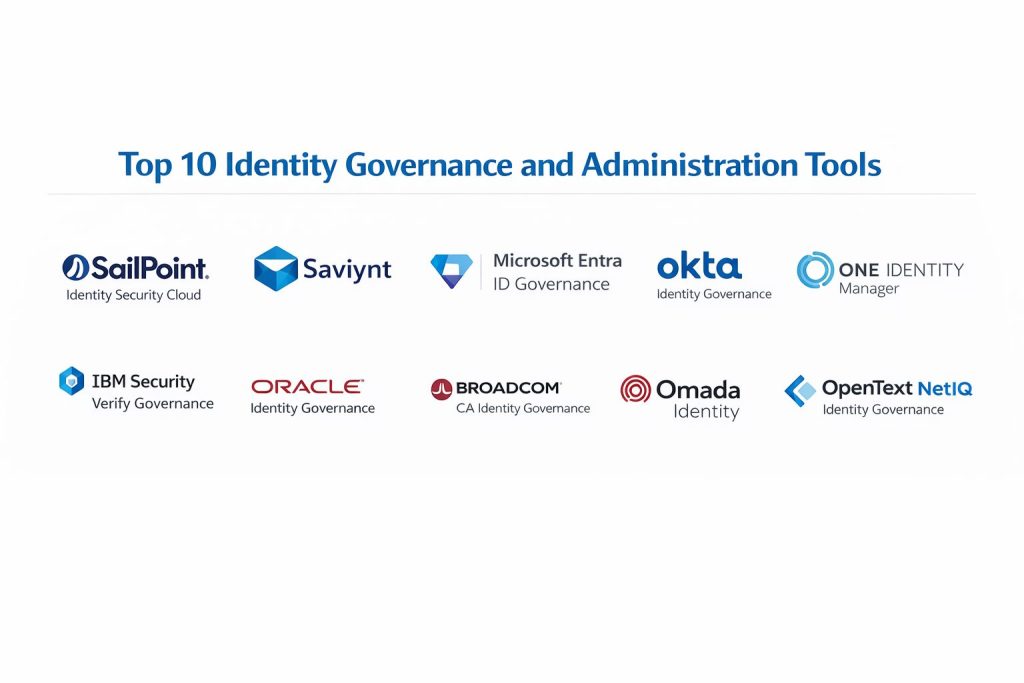
10 Tools Covered
- SailPoint Identity Security Cloud
- Saviynt
- Microsoft Entra ID Governance
- Okta Identity Governance
- One Identity Manager
- IBM Security Verify Governance
- Oracle Identity Governance
- Broadcom CA Identity Governance
- Omada Identity
- OpenText NetIQ Identity Governance
Key Trends in Identity Governance and Administration
- More automation for joiner, mover, leaver changes to reduce manual tickets and delays
- Stronger focus on identity risk, entitlement risk, and policy-based access decisions
- Wider use of access reviews that are simpler for managers and application owners to complete
- Growth of SaaS-first governance, including faster onboarding of cloud app connectors
- Increased demand for role engineering, role mining, and role lifecycle management to reduce access sprawl
- Governance expanding into privileged access visibility and tighter coordination with PAM tools
- Higher expectations for evidence-ready reporting to satisfy audits with less manual effort
- More emphasis on identity data quality, ownership, and authoritative sources for lifecycle accuracy
How We Selected These Tools (Methodology)
- Included tools widely used for enterprise identity governance and access lifecycle control
- Selected a mix that covers SaaS-first and more traditional enterprise deployments
- Focused on governance breadth: requests, approvals, reviews, roles, policies, reporting
- Considered connector ecosystem and practical integration into common IT environments
- Considered scalability across identities, applications, and entitlements
- Looked for tools that support both compliance needs and operational IAM needs
- Balanced mature enterprise platforms with modern governance approaches
Top 10 Identity Governance and Administration Tools
1 — SailPoint Identity Security Cloud
Overview: A well-known enterprise governance platform designed to manage identity lifecycles, access requests, and access certifications across many systems.
Key Features
- Identity lifecycle governance with policy controls
- Access request workflows with approvals and audit trail
- Access certifications for periodic reviews and compliance
- Role modeling support for least-privilege design
- Reporting to support audit and evidence collection
Pros
- Strong fit for large, complex identity environments
- Mature governance coverage across many systems
Cons
- Implementation can require careful planning and skilled setup
- Ongoing administration effort can be significant in complex setups
Platforms / Deployment
Cloud, Hybrid (varies by organization)
Security and Compliance
Not publicly stated
Integrations and Ecosystem
SailPoint typically relies on a connector approach to integrate with directories, HR sources, and business applications. Many organizations use it as the governance layer that coordinates approvals, reviews, and policy enforcement.
- HR source integration for lifecycle triggers
- Directory and app connectors for provisioning and deprovisioning
- Workflow customization support (varies by setup)
Support and Community
Strong enterprise support options; community strength varies by region and customer segment.
2 — Saviynt
Overview: A governance platform often chosen for identity governance, access certifications, and risk-aware access decisions, including cloud application coverage.
Key Features
- Access request and approval workflows with governance controls
- Access reviews and certification campaigns
- Policy-driven controls for risk and compliance scenarios
- Role and entitlement governance for least privilege
- Reporting and evidence support for audits
Pros
- Strong governance focus with risk-aware patterns
- Good fit for organizations modernizing governance across SaaS and enterprise apps
Cons
- Configuration complexity can be high in advanced use cases
- Connector onboarding quality depends on the target systems and internal standards
Platforms / Deployment
Cloud, Hybrid (varies by organization)
Security and Compliance
Not publicly stated
Integrations and Ecosystem
Saviynt is commonly used as a central governance layer that coordinates access decisions and reviews across applications. Integration success depends on connector coverage and how well identity data is standardized.
- Integration with HR and authoritative identity sources
- App connectors for provisioning workflows
- Extensibility for custom governance rules (varies by setup)
Support and Community
Vendor support is commonly used for implementation and scaling; community resources vary.
3 — Microsoft Entra ID Governance
Overview: Governance capabilities that align closely with Microsoft identity environments and access management workflows, commonly used where Microsoft is a central platform.
Key Features
- Access packages for structured access requests and approvals
- Access reviews for periodic entitlement validation
- Lifecycle workflows that help automate joiner and leaver steps
- Policy alignment within Microsoft identity environments
- Reporting support for governance outcomes (varies by setup)
Pros
- Strong fit for organizations standardized on Microsoft identity
- Practical governance workflows for common enterprise needs
Cons
- Governance depth outside the Microsoft ecosystem depends on integrations
- Advanced governance scenarios may require careful design across tools
Platforms / Deployment
Cloud (with hybrid identity patterns possible)
Security and Compliance
Not publicly stated
Integrations and Ecosystem
This option often works best when Entra ID is a central identity provider and when app access is already aligned with Microsoft controls. External application governance depends on integration approach.
- Works well with Microsoft app ecosystem
- Integration with external apps varies by connector and standards
- Common pairing with security and device controls in Microsoft environments
Support and Community
Strong documentation footprint and broad community knowledge; support depends on licensing and enterprise agreements.
4 — Okta Identity Governance
Overview: Governance functionality aligned with Okta-centered workforce identity environments, focused on access requests, approvals, and review patterns.
Key Features
- Access request workflows with approvals
- Access reviews to support periodic validation
- Entitlement visibility and governance patterns (varies by app)
- Integration patterns aligned with Okta app ecosystem
- Administrative controls for governance operations
Pros
- Good fit for organizations using Okta as a core identity layer
- Practical governance workflows for SaaS-heavy environments
Cons
- Depth of entitlement governance depends on connected applications
- Advanced governance requirements may need additional design and tooling
Platforms / Deployment
Cloud
Security and Compliance
Not publicly stated
Integrations and Ecosystem
Okta governance typically benefits organizations already using Okta for SSO and lifecycle patterns, because governance workflows can align with existing application connections.
- Integration with many SaaS apps through Okta ecosystem
- Governance visibility depends on application entitlement exposure
- Workflow alignment with workforce identity practices
Support and Community
Strong documentation and ecosystem familiarity; support tiers vary by plan.
5 — One Identity Manager
Overview: A governance and administration platform commonly used for identity lifecycle management, provisioning, and governance workflows across enterprise systems.
Key Features
- Lifecycle provisioning and deprovisioning workflows
- Access request and approval processes
- Access review capabilities for governance requirements
- Role-based access governance patterns
- Reporting support for compliance processes
Pros
- Strong lifecycle and administration capabilities
- Flexible for diverse enterprise environments
Cons
- Deployment and customization can be complex
- Requires disciplined identity data management to avoid drift
Platforms / Deployment
Hybrid, Self-hosted (varies by organization)
Security and Compliance
Not publicly stated
Integrations and Ecosystem
One Identity Manager often plays the role of lifecycle and provisioning engine while supporting governance workflows such as approvals and reviews. Integration success depends on connector coverage and identity standards.
- Connectors for directories and enterprise systems
- Workflow customization support for enterprise needs
- Reporting aligned with governance processes
Support and Community
Enterprise support availability; community resources vary by region and deployment footprint.
6 — IBM Security Verify Governance
Overview: A governance-focused platform used to support lifecycle governance, access requests, and access certifications with enterprise controls.
Key Features
- Governance controls for identity lifecycle processes
- Access request workflows and approvals
- Access certifications and review campaigns
- Policy and control patterns for compliance needs
- Reporting to support audit evidence collection
Pros
- Strong governance posture for compliance-focused organizations
- Works well in structured enterprise security programs
Cons
- Integration and rollout can be complex in heterogeneous environments
- Administration effort can grow as connector scope expands
Platforms / Deployment
Hybrid, Self-hosted (varies by organization)
Security and Compliance
Not publicly stated
Integrations and Ecosystem
This option is commonly used within broader enterprise security programs and requires strong integration planning across directories, HR systems, and business apps.
- Governance workflows across key enterprise systems
- Policy-driven review and approval patterns
- Integration approach depends on organization architecture
Support and Community
Vendor support is commonly used for enterprise rollout; community resources vary.
7 — Oracle Identity Governance
Overview: A governance platform often used in Oracle-centered enterprises to manage identity lifecycles, access requests, and governance reviews.
Key Features
- Identity lifecycle and provisioning workflows
- Access request and approvals with governance tracking
- Access certifications for periodic validation
- Role governance support for structured access models
- Reporting and evidence generation for audits
Pros
- Strong fit for Oracle application environments
- Mature governance features for structured enterprises
Cons
- Can be heavy for smaller organizations
- Integration and customization can be demanding
Platforms / Deployment
Self-hosted, Hybrid (varies by organization)
Security and Compliance
Not publicly stated
Integrations and Ecosystem
Oracle Identity Governance often fits best when Oracle systems are core business platforms, while also connecting to directories and enterprise apps through connectors and standards.
- Strong alignment with Oracle application ecosystems
- Common enterprise integration patterns for provisioning
- Governance processes benefit from strong identity data ownership
Support and Community
Enterprise-grade vendor support; community strength varies.
8 — Broadcom CA Identity Governance
Overview: An enterprise governance platform designed for access requests, governance reviews, and compliance reporting in large environments.
Key Features
- Access request workflows with approvals
- Access certification campaigns for entitlement reviews
- Policy controls aligned with governance requirements
- Role and entitlement governance patterns
- Reporting for audit and compliance evidence
Pros
- Mature governance approach for large organizations
- Strong focus on certification and compliance processes
Cons
- Implementation may require specialized expertise
- Modern SaaS-first patterns may require additional integration design
Platforms / Deployment
Self-hosted, Hybrid (varies by organization)
Security and Compliance
Not publicly stated
Integrations and Ecosystem
This option is commonly deployed in environments where governance reviews and audit-ready reporting are priorities. Integration depth depends on connector availability and architecture choices.
- Enterprise connector approach for applications
- Strong certification workflow patterns
- Reporting designed for compliance operations
Support and Community
Vendor support available; community resources vary depending on installed base.
9 — Omada Identity
Overview: A governance platform focused on identity lifecycle processes, access requests, and access reviews with a strong governance orientation.
Key Features
- Identity lifecycle governance workflows
- Access requests with approval routing
- Access reviews and certification campaigns
- Role governance and structured access models
- Reporting that supports compliance operations
Pros
- Strong governance focus for structured organizations
- Practical certification and review workflows
Cons
- Integration effort depends on app landscape and connector needs
- Governance success depends on role and ownership discipline
Platforms / Deployment
Cloud, Self-hosted, Hybrid (varies by organization)
Security and Compliance
Not publicly stated
Integrations and Ecosystem
Omada Identity is typically used as a governance and lifecycle layer that coordinates approvals and reviews, and it benefits from well-defined identity sources and clear entitlement ownership.
- Integration with HR sources for lifecycle triggers
- App connectors for provisioning and governance
- Role and policy design support (varies by setup)
Support and Community
Vendor support options available; community resources vary by region.
10 — OpenText NetIQ Identity Governance
Overview: A governance platform used for access requests, access certifications, and governance reporting, often in enterprises with established identity programs.
Key Features
- Access request workflows with approvals
- Access certifications for periodic access validation
- Role governance patterns to reduce entitlement sprawl
- Reporting for compliance and audit support
- Governance visibility across identities and entitlements
Pros
- Strong fit for enterprises that need structured governance programs
- Useful for compliance evidence and certification processes
Cons
- Integration breadth depends on connector approach and environment
- Administration effort increases as entitlement scope grows
Platforms / Deployment
Self-hosted, Hybrid (varies by organization)
Security and Compliance
Not publicly stated
Integrations and Ecosystem
OpenText NetIQ Identity Governance is commonly deployed as a governance layer that helps manage access request, review cycles, and reporting across key systems, supported by connector patterns and internal standards.
- Connectors and integration patterns depend on environment
- Governance workflows align with compliance operations
- Role modeling benefits from strong ownership and data standards
Support and Community
Vendor support available; community strength depends on installed base.
Comparison Table
| Tool Name | Best For | Platforms Supported | Deployment | Standout Feature | Public Score |
|---|---|---|---|---|---|
| SailPoint Identity Security Cloud | Large-scale governance across many apps | Varies / N/A | Cloud, Hybrid | Mature certification and role governance | N/A |
| Saviynt | Risk-aware governance and certification | Varies / N/A | Cloud, Hybrid | Governance with policy-driven access controls | N/A |
| Microsoft Entra ID Governance | Microsoft-centered identity governance | Varies / N/A | Cloud | Access packages and access reviews | N/A |
| Okta Identity Governance | SaaS-heavy governance in Okta environments | Varies / N/A | Cloud | Governance aligned with Okta ecosystem | N/A |
| One Identity Manager | Lifecycle administration with governance workflows | Varies / N/A | Hybrid, Self-hosted | Strong lifecycle provisioning engine | N/A |
| IBM Security Verify Governance | Enterprise governance with certification focus | Varies / N/A | Hybrid, Self-hosted | Structured certifications and reporting | N/A |
| Oracle Identity Governance | Oracle-centric governance programs | Varies / N/A | Self-hosted, Hybrid | Mature enterprise governance workflows | N/A |
| Broadcom CA Identity Governance | Compliance-driven certification programs | Varies / N/A | Self-hosted, Hybrid | Strong certification campaign patterns | N/A |
| Omada Identity | Governance with lifecycle and role focus | Varies / N/A | Cloud, Self-hosted, Hybrid | Practical review workflows and role design | N/A |
| OpenText NetIQ Identity Governance | Access certifications and audit readiness | Varies / N/A | Self-hosted, Hybrid | Strong review and evidence reporting focus | N/A |
Evaluation and Scoring
Scoring approach
Each tool is scored from 1 to 10 on each criterion, then combined into a weighted total from 0 to 10 using the weights below.
Weights
Core features 25 percent
Ease of use 15 percent
Integrations and ecosystem 15 percent
Security and compliance 10 percent
Performance and reliability 10 percent
Support and community 10 percent
Price and value 15 percent
| Tool Name | Core | Ease | Integrations | Security | Performance | Support | Value | Weighted Total |
|---|---|---|---|---|---|---|---|---|
| SailPoint Identity Security Cloud | 9.0 | 7.0 | 8.5 | 7.0 | 8.0 | 8.0 | 6.5 | 7.88 |
| Saviynt | 8.5 | 7.0 | 8.0 | 7.0 | 7.5 | 7.5 | 7.0 | 7.65 |
| Microsoft Entra ID Governance | 8.0 | 8.0 | 7.5 | 7.5 | 8.0 | 8.5 | 8.0 | 7.93 |
| Okta Identity Governance | 7.5 | 8.0 | 7.5 | 7.0 | 7.5 | 8.0 | 7.5 | 7.55 |
| One Identity Manager | 8.0 | 6.5 | 7.5 | 7.0 | 7.5 | 7.0 | 6.5 | 7.18 |
| IBM Security Verify Governance | 8.0 | 6.5 | 7.0 | 7.0 | 7.5 | 7.0 | 6.5 | 7.10 |
| Oracle Identity Governance | 8.0 | 6.0 | 7.0 | 7.0 | 7.5 | 7.0 | 6.0 | 6.93 |
| Broadcom CA Identity Governance | 7.5 | 6.0 | 6.5 | 7.0 | 7.0 | 6.5 | 6.0 | 6.75 |
| Omada Identity | 8.0 | 7.0 | 7.0 | 7.0 | 7.5 | 7.0 | 7.0 | 7.30 |
| OpenText NetIQ Identity Governance | 7.5 | 6.5 | 6.5 | 7.0 | 7.0 | 6.5 | 6.5 | 6.83 |
How to interpret the scores
These scores are comparative and meant to support shortlisting, not declare a universal winner. A lower total can still be the best choice if it matches your identity architecture, application landscape, and compliance needs. Core features and integrations usually drive long-term success, while ease of use affects adoption speed. Value depends heavily on licensing and the amount of configuration you require. Use the total as a guide, then validate with a pilot using real applications and real approval flows.
Which Tool Is Right for You
Solo / Small Team
If you are small but already standardized on Microsoft or Okta for workforce access, starting with governance that aligns to your identity layer can reduce complexity. Keep the scope tight: a few high-risk applications, one or two approval paths, and a simple review cadence.
SMB
A practical approach is to pick a tool that can scale connector coverage without heavy customization. Focus on fast lifecycle automation, clear approvals, and a review process that managers will actually complete. If your environment is SaaS-heavy, governance aligned with your identity layer can speed rollout.
Mid-Market
Mid-market organizations often need better role structure and cleaner audit evidence. A tool with stronger role governance and certification workflows can reduce access sprawl over time. You will usually benefit from a phased rollout, starting with core business apps and expanding steadily.
Enterprise
Enterprises typically need deep governance, large-scale certifications, and consistent policy enforcement across many systems. Choose a platform that can handle complex workflows, large entitlement sets, and strict reporting. Ensure you can assign clear owners for applications, entitlements, and review decisions.
Budget vs Premium
Budget decisions often fail when implementation effort is ignored. Consider not just licensing, but also connector work, identity data quality, and process alignment. Premium options may reduce risk in complex environments, while budget-friendly paths work best with limited scope and strong standards.
Feature Depth vs Ease of Use
If your compliance demands are strict, prioritize depth in certifications, policy controls, and reporting. If you need faster adoption, prioritize simpler request and review experiences. A tool that is powerful but hard to operate often leads to incomplete governance in practice.
Integrations and Scalability
Connector depth is often the real deciding factor. A tool can look strong on paper but fail if it cannot reliably read and manage entitlements across key systems. Prioritize the apps that matter most to your audit and risk exposure.
Security and Compliance Needs
If you must prove access decisions, approvals, and periodic reviews, ensure the tool provides evidence-ready reporting and durable audit trails. When security details are not clearly stated, treat them as not publicly stated and validate directly during procurement and architecture review.
Frequently Asked Questions
1. What does Identity Governance and Administration actually control
It controls the process around access: how access is requested, approved, provisioned, reviewed, and removed. It also helps track who approved access and whether it still makes sense.
2. How long does implementation usually take
It varies widely based on number of applications, connector complexity, and identity data quality. A phased rollout with a small initial scope is usually safer than a big-bang approach.
3. What is the biggest reason governance projects fail
Poor identity data and unclear ownership. If no one owns the entitlement model and review decisions, certifications become box-checking instead of real risk reduction.
4. Do these tools replace SSO or MFA
No. Governance complements authentication and SSO by managing entitlements and access lifecycle. Most organizations use governance alongside SSO and MFA rather than instead of them.
5. How do access reviews work in real life
Managers or application owners review who has access and confirm whether it is still needed. The best programs keep reviews focused on high-risk access and make decisions easy to complete.
6. What is role mining and why does it matter
Role mining helps identify patterns of access and turn them into roles. This reduces ad-hoc permissions and makes access decisions more consistent and easier to audit.
7. Can governance cover cloud and SaaS applications
Yes, but coverage depends on connector quality and how the application exposes entitlements. You should test your most important applications early during evaluation.
8. How should we start if our access is already messy
Start with high-risk systems and high-risk entitlements. Establish clear ownership, clean up stale accounts, and define a simple request and review process before expanding scope.
9. What should we measure to prove success
Track reductions in orphan accounts, faster offboarding completion, fewer excessive entitlements, review completion rates, and audit findings reduction. Also track time saved on manual tickets.
10. What is a safe way to select the right tool
Shortlist two or three tools, run a pilot with real applications, and test the end-to-end flow: lifecycle triggers, request approvals, provisioning, reviews, and reporting. Select based on real results, not marketing claims.
Conclusion
Identity governance succeeds when it becomes a repeatable operating model, not just a tool installation. The right platform depends on your identity layer, application landscape, compliance pressure, and the maturity of your access ownership processes. Some organizations will prioritize deep certification workflows and role governance for large entitlement sets, while others will prioritize faster onboarding and simpler access requests for SaaS-heavy environments. In all cases, start small with high-risk access, define clear ownership for entitlements and approvals, and invest in identity data quality early. Shortlist two or three options, run a pilot with real applications and real reviewers, then expand scope in phases with measurable controls and reporting.
#IGA, #IdentityGovernance, #AccessManagement, #ZeroTrust, #CyberSecurity,