Introduction
An observability platform helps teams understand what is happening inside applications, services, and infrastructure by collecting and analyzing telemetry such as metrics, logs, traces, events, and user experience signals. In simple terms, it tells you “what broke, where it broke, why it broke, and what to do next” with less guesswork. This matters because modern systems are distributed, changes ship faster, and a single small issue can spread across multiple services and regions.
Common real-world use cases include incident detection and faster troubleshooting, application performance monitoring for critical APIs, reliability tracking for SLOs and error budgets, cost and capacity analysis for infrastructure, and proactive alerting for customer-impacting issues. When choosing a platform, evaluate coverage across metrics/logs/traces, correlation and root-cause workflows, alert noise control, dashboards and reporting, scalability and query performance, integrations, onboarding effort, role-based access, data retention flexibility, and support quality.
Best for: engineering teams, SRE/operations, platform teams, DevOps, security operations, and IT leaders who need unified visibility across systems and faster incident response.
Not ideal for: very small setups where basic server monitoring is enough, or teams that only need a single signal type (only logs or only metrics) and do not need cross-signal correlation.
Key Trends in Observability Platforms
- More unified views that connect metrics, logs, traces, and user experience in one investigation flow
- Better alert quality using grouping, deduplication, and smarter anomaly detection to reduce noise
- Wider adoption of open telemetry collection patterns to reduce vendor lock-in risk
- Stronger focus on service-level objectives and reliability reporting for business impact
- More cost controls for telemetry volume, sampling, retention, and high-cardinality data
- More built-in workflows for incident response, runbooks, and collaboration handoffs
How We Selected These Tools (Methodology)
- Chosen based on broad market adoption, credibility, and long-term usage across industries
- Prioritized completeness across core observability signals and investigation workflows
- Considered performance signals such as query responsiveness and handling large telemetry volumes
- Included tools with strong integration ecosystems across cloud, containers, CI/CD, and common stacks
- Balanced options for enterprise, mid-market, and fast-moving product teams
- Considered day-one onboarding effort, learning curve, and support/community strength
- Avoided guessing hard claims like certifications and public ratings when not clearly known
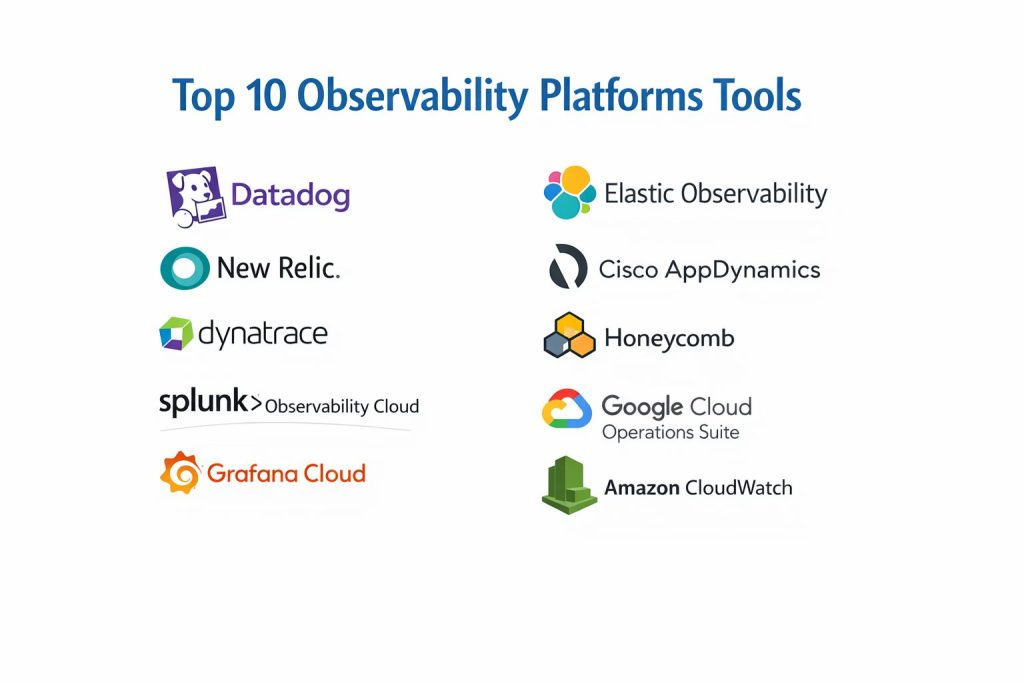
Top 10 Observability Platforms
1 — Datadog
Datadog is a broad observability platform that brings infrastructure monitoring, APM, logs, traces, dashboards, and alerting into a single workflow. It is widely used by product teams that want fast onboarding, strong integrations, and a consistent troubleshooting experience.
Key Features
- Unified metrics, logs, and traces with correlation-driven investigation
- Extensive integrations across cloud services, containers, and common frameworks
- Dashboards, alerting, and service-focused views for ongoing operations
Pros
- Strong “single place to investigate” experience for incidents
- Large ecosystem that reduces setup time across common stacks
Cons
- Costs can rise with high telemetry volume and retention needs
- Advanced customization may require governance to keep things clean
Platforms / Deployment
Web
Cloud
Security & Compliance
Not publicly stated
Integrations & Ecosystem
Datadog is known for broad integrations and fast time-to-value when connecting cloud platforms, container platforms, databases, and common application frameworks.
- APIs and agent-based collection patterns
- Integrations with common incident and collaboration tools
- Extensibility: Varies / N/A
Support & Community
Strong documentation and a large user community. Support tiers: Varies / Not publicly stated.
2 — New Relic
New Relic focuses on full-stack observability with APM, infrastructure monitoring, logs, traces, and dashboards. It suits teams that want an all-in-one platform with strong application performance visibility and practical developer workflows.
Key Features
- Application performance monitoring with tracing and dependency visibility
- Central dashboards and alerting for services and infrastructure
- Log and trace correlation for faster root cause workflows
Pros
- Strong APM-driven troubleshooting for modern applications
- Practical onboarding for teams standardizing observability
Cons
- Costs and data management need attention at scale
- Some advanced use cases need careful query and data modeling
Platforms / Deployment
Web
Cloud
Security & Compliance
Not publicly stated
Integrations & Ecosystem
New Relic supports broad collection options and fits well when you want app-first visibility with supporting infrastructure context.
- Agent-based instrumentation patterns
- Integrations with popular cloud and container stacks
- APIs and automation: Varies / N/A
Support & Community
Good documentation and established community. Support options: Varies / Not publicly stated.
3 — Dynatrace
Dynatrace is an enterprise-focused observability platform known for automation, topology awareness, and large-scale monitoring. It fits organizations that want deep visibility with strong operational workflows and consistent governance.
Key Features
- Automated dependency mapping and service topology visibility
- Advanced alerting and problem correlation workflows
- End-to-end monitoring across applications and infrastructure
Pros
- Strong at large-scale environments with many services
- Helpful correlation workflows for complex incidents
Cons
- Enterprise rollout can be heavier than simpler tools
- Teams may need enablement to use advanced features well
Platforms / Deployment
Web
Cloud / Hybrid (Varies / N/A)
Security & Compliance
Not publicly stated
Integrations & Ecosystem
Dynatrace commonly integrates into enterprise environments that require consistent visibility across many teams and services.
- Broad integration set across common enterprise stacks
- Automation and APIs: Varies / N/A
- Extensibility: Varies / N/A
Support & Community
Strong enterprise support patterns. Community strength: Varies / Not publicly stated.
4 — Splunk Observability Cloud
Splunk Observability Cloud provides observability for metrics, traces, and infrastructure with workflows designed for fast troubleshooting. It suits teams that want strong analytics roots and a platform approach to operations.
Key Features
- Metrics and tracing workflows for service health and performance
- Alerting and investigation features designed for incident response
- Integrations across cloud and container ecosystems
Pros
- Useful for teams that value analytics-driven operations
- Strong fit for organizations standardizing monitoring workflows
Cons
- Complex environments may need careful data design
- Pricing and packaging details: Not publicly stated
Platforms / Deployment
Web
Cloud
Security & Compliance
Not publicly stated
Integrations & Ecosystem
Splunk Observability Cloud fits environments where teams need reliable dashboards, alerting, and workflow-based investigations.
- Integrations across common infrastructure and app stacks
- API and automation options: Varies / N/A
- Ecosystem breadth: Varies / N/A
Support & Community
Documentation and enterprise support options exist. Details vary by plan.
5 — Grafana Cloud
Grafana Cloud builds on the popular Grafana experience for dashboards and can unify metrics, logs, and traces depending on your setup. It fits teams that want flexible observability with strong visualization and an ecosystem-friendly approach.
Key Features
- Dashboards and visualization for many data sources
- Metrics, logs, and traces workflows depending on configured services
- Alerting with reusable rules and team-friendly views
Pros
- Strong visualization and flexible integrations across many tools
- Good fit for teams that prefer configurable and modular setups
Cons
- Requires thoughtful setup for consistent standards across teams
- Some capabilities depend on chosen components and configuration
Platforms / Deployment
Web
Cloud
Security & Compliance
Not publicly stated
Integrations & Ecosystem
Grafana Cloud is strong when you have multiple data sources and want a unified view without forcing everything into one proprietary format.
- Large integration ecosystem via dashboards and data sources
- APIs and automation: Varies / N/A
- Extensibility: Strong, but depends on configuration
Support & Community
Very strong community around Grafana. Support tiers: Varies / Not publicly stated.
6 — Elastic Observability
Elastic Observability is often chosen by teams that already rely on Elastic for search and log analytics and want to extend into broader observability signals. It suits teams that value search-driven exploration and flexible analytics.
Key Features
- Log analytics and search-driven investigation workflows
- APM and tracing features depending on setup
- Dashboards and alerting for service and infrastructure visibility
Pros
- Powerful search and filtering for large log volumes
- Flexible analytics patterns for troubleshooting
Cons
- Requires good data hygiene and field conventions at scale
- Deployment and tuning effort can be higher depending on environment
Platforms / Deployment
Web
Cloud / Self-hosted / Hybrid (Varies / N/A)
Security & Compliance
Not publicly stated
Integrations & Ecosystem
Elastic Observability is often used where teams want strong search, enrichment, and exploration across events and logs, plus APM signals where needed.
- Ingestion and parsing pipelines: Varies / N/A
- Integrations with common stacks: Varies / N/A
- APIs and automation: Varies / N/A
Support & Community
Large community and many learning resources. Support tiers vary.
7 — Cisco AppDynamics
Cisco AppDynamics focuses strongly on application performance monitoring for enterprise environments. It fits organizations that need stable APM, transaction visibility, and business-impact tracking across critical applications.
Key Features
- Transaction and application performance monitoring workflows
- Dependency visibility across services and external calls
- Alerting and dashboards designed for enterprise operations
Pros
- Strong fit for enterprise APM and business-critical applications
- Helpful for understanding application transaction performance
Cons
- Broader observability coverage may need additional components
- Some details depend on licensing and deployment choices
Platforms / Deployment
Web
Cloud / Self-hosted / Hybrid (Varies / N/A)
Security & Compliance
Not publicly stated
Integrations & Ecosystem
AppDynamics integrates into enterprise application stacks and operational tooling to track performance and application health.
- Integrations with common enterprise stacks: Varies / N/A
- APIs and automation: Varies / N/A
- Ecosystem: Varies / N/A
Support & Community
Enterprise support patterns are common. Community strength varies by region and use case.
8 — Honeycomb
Honeycomb is known for event-based observability and deep debugging workflows that help engineers ask precise questions during incidents. It fits teams building modern services who want fast investigation and high-cardinality analysis.
Key Features
- Fast exploratory querying for debugging complex production behavior
- Strong workflows for understanding distributed traces and service behavior
- Helpful approaches for reducing “guess and check” during incidents
Pros
- Excellent for deep debugging and engineering-led investigations
- Works well for teams focused on modern service architectures
Cons
- Requires discipline in instrumentation and event design
- May not be the simplest choice for basic monitoring-only needs
Platforms / Deployment
Web
Cloud
Security & Compliance
Not publicly stated
Integrations & Ecosystem
Honeycomb fits best when teams invest in clean instrumentation and structured events so investigations are faster and more precise.
- Open telemetry collection patterns: Varies / N/A
- Integrations with modern stacks: Varies / N/A
- APIs and extensibility: Varies / N/A
Support & Community
Strong documentation and an active community focused on observability practices. Support tiers vary.
9 — Google Cloud Operations Suite
Google Cloud Operations Suite provides monitoring, logging, and tracing workflows for workloads running on Google Cloud and hybrid setups depending on configuration. It fits teams that want cloud-native observability aligned to Google Cloud services.
Key Features
- Monitoring and alerting for cloud services and workloads
- Central logging and log-based investigation workflows
- Tracing and performance visibility depending on setup
Pros
- Strong fit for teams primarily operating on Google Cloud
- Practical integration with cloud services and managed workloads
Cons
- Multi-cloud parity depends on setup and environment choices
- Some advanced cross-platform workflows may require extra design
Platforms / Deployment
Web
Cloud
Security & Compliance
Not publicly stated
Integrations & Ecosystem
This platform is strongest when your infrastructure and services are heavily aligned to Google Cloud services and you want tight operational integration.
- Native integrations with Google Cloud services
- Export and interoperability patterns: Varies / N/A
- Ecosystem coverage beyond Google Cloud: Varies / N/A
Support & Community
Documentation is strong. Support depends on cloud support plan.
10 — Amazon CloudWatch
Amazon CloudWatch is a core monitoring and observability service for workloads on AWS. It fits teams running primarily on AWS that want native metrics, logs, alarms, and operational visibility integrated with AWS services.
Key Features
- Metrics and alarms integrated with AWS services
- Log collection and analysis workflows depending on configuration
- Operational dashboards and event-driven automation patterns
Pros
- Very strong default choice for AWS-first environments
- Tight integration with AWS services and operational tooling
Cons
- Cross-platform observability needs extra design for multi-cloud
- Advanced APM-style workflows may require additional components
Platforms / Deployment
Web
Cloud
Security & Compliance
Not publicly stated
Integrations & Ecosystem
CloudWatch works best as the foundational observability layer for AWS services, often paired with other tools for deeper APM or cross-platform needs.
- Native AWS service integrations
- Export and interoperability patterns: Varies / N/A
- Ecosystem beyond AWS: Varies / N/A
Support & Community
Strong documentation and large user base. Support depends on AWS support tier.
Comparison Table
| Tool Name | Best For | Platform(s) Supported | Deployment | Standout Feature | Public Rating |
|---|---|---|---|---|---|
| Datadog | Unified full-stack visibility | Web | Cloud | Fast correlation workflows | N/A |
| New Relic | App-first observability | Web | Cloud | Strong APM experience | N/A |
| Dynatrace | Enterprise-scale operations | Web | Cloud / Hybrid (Varies / N/A) | Automated topology insights | N/A |
| Splunk Observability Cloud | Analytics-driven operations | Web | Cloud | Investigation workflows | N/A |
| Grafana Cloud | Flexible dashboards + signals | Web | Cloud | Broad integrations and dashboards | N/A |
| Elastic Observability | Search-driven investigation | Web | Cloud / Self-hosted / Hybrid (Varies / N/A) | Powerful log search | N/A |
| Cisco AppDynamics | Enterprise APM | Web | Cloud / Self-hosted / Hybrid (Varies / N/A) | Transaction visibility | N/A |
| Honeycomb | Deep debugging | Web | Cloud | High-cardinality exploration | N/A |
| Google Cloud Operations Suite | Google Cloud-first teams | Web | Cloud | Native cloud integration | N/A |
| Amazon CloudWatch | AWS-first teams | Web | Cloud | Native AWS integration | N/A |
Evaluation & Scoring of Observability Platforms
This scoring is a comparative framework to help you shortlist tools. It is not a public rating and it is not a promise of outcomes. A higher score generally means the tool fits more common observability scenarios with less friction. If your environment is cloud-native, enterprise-heavy, or multi-cloud, your internal weights may differ. Use the weighted total to narrow to two or three candidates, then validate with a pilot using real telemetry volume, real services, and real incident scenarios.
Weights used
Core features 25%
Ease of use 15%
Integrations and ecosystem 15%
Security and compliance 10%
Performance and reliability 10%
Support and community 10%
Price and value 15%
| Tool Name | Core (25%) | Ease (15%) | Integrations (15%) | Security (10%) | Performance (10%) | Support (10%) | Value (15%) | Weighted Total (0–10) |
|---|---|---|---|---|---|---|---|---|
| Datadog | 9 | 8 | 9 | 6 | 8 | 8 | 7 | 8.2 |
| New Relic | 8 | 8 | 8 | 6 | 8 | 7 | 7 | 7.7 |
| Dynatrace | 9 | 7 | 8 | 6 | 9 | 7 | 6 | 7.7 |
| Splunk Observability Cloud | 8 | 7 | 8 | 6 | 8 | 7 | 6 | 7.3 |
| Grafana Cloud | 7 | 7 | 9 | 5 | 7 | 9 | 8 | 7.6 |
| Elastic Observability | 8 | 6 | 8 | 5 | 8 | 7 | 7 | 7.2 |
| Cisco AppDynamics | 8 | 6 | 7 | 5 | 8 | 6 | 6 | 6.8 |
| Honeycomb | 7 | 6 | 7 | 5 | 8 | 6 | 7 | 6.8 |
| Google Cloud Operations Suite | 7 | 7 | 7 | 6 | 7 | 7 | 8 | 7.1 |
| Amazon CloudWatch | 7 | 7 | 7 | 6 | 7 | 7 | 8 | 7.1 |
Which Observability Platform Is Right for You
Solo / Freelancer
If you need basic production visibility without heavy overhead, start with a cloud-native option that matches where you run workloads. If you want more polished dashboards and unified workflows, Grafana Cloud is often a practical step up.
SMB
Small teams typically need speed to value and easy correlation during incidents. Datadog and New Relic often fit when you want fast onboarding, strong integrations, and a consistent investigation flow. Grafana Cloud can be strong if you want flexibility and prefer configurable standards.
Mid-Market
Mid-sized organizations often need standardization, role-based workflows, and predictable scaling. Datadog, New Relic, and Splunk Observability Cloud are common shortlist options. If you want deep debugging based on structured events, Honeycomb can be a strong choice when instrumentation discipline is in place.
Enterprise
Enterprises usually care about governance, large environment visibility, and consistent operations across many teams. Dynatrace and Cisco AppDynamics are often evaluated for enterprise APM and operational depth. Splunk Observability Cloud is often considered where analytics-driven operations are already a cultural fit.
Budget vs Premium
Budget-sensitive teams often start cloud-native and add focused tools only as needed. Premium choices are often driven by correlation depth, enterprise governance, and ecosystem maturity, not just features.
Feature Depth vs Ease of Use
If you want fast “single screen” investigations, Datadog and New Relic are common picks. If you want strong automation and topology-style insights, Dynatrace is often shortlisted. If you want flexible visualization across many sources, Grafana Cloud is often preferred.
Integrations & Scalability
Choose a platform that matches your runtime and toolchain. If you are AWS-first, Amazon CloudWatch is a natural foundation. If you are Google Cloud-first, Google Cloud Operations Suite is strong. If you are multi-cloud and want broad third-party integrations, Datadog or Grafana Cloud often fit better.
Security & Compliance Needs
Many tool-level compliance details are not publicly stated in a way that is safe to generalize. If you need strict controls, focus on your overall operating model: identity access policies, RBAC, auditability around dashboards and alerts, data retention rules, and safe handling of sensitive logs.
Frequently Asked Questions (FAQs)
1. What is the difference between monitoring and observability
Monitoring tells you known signals like CPU, latency, and error rates. Observability helps you explain unknown failures by connecting metrics, logs, and traces to reveal root causes.
2. Do I need logs, metrics, and traces together
If you run distributed services, yes, it usually saves time during incidents. If your system is simple, metrics plus limited logs may be enough.
3. How do I reduce alert noise
Use fewer high-quality alerts, add grouping and deduplication, and align alerts to service objectives. Also create separate “investigation dashboards” so alerts do not carry all context.
4. What is the biggest mistake teams make
Collecting too much data without a plan. This increases cost and complexity while making it harder to find what matters during incidents.
5. How should I evaluate a platform before buying
Run a pilot on a few real services, test your top incident scenarios, confirm dashboards and alerting workflows, and validate query speed on real telemetry volume.
6. Can I use multiple tools together
Yes, but it can create confusion if ownership is unclear. If you do it, define which tool is the source of truth for alerts, dashboards, and incident workflows.
7. How do sampling and retention affect results
Sampling reduces volume and cost but can hide rare issues if done poorly. Retention affects long-term trend analysis and compliance needs, so choose policies carefully.
8. What should security teams care about in observability
Access controls, sensitive data in logs, audit trails for changes, and retention policies. Tool-level compliance details are often not publicly stated, so validate directly.
9. What is the role of open telemetry
It provides consistent collection patterns and reduces lock-in risk. It also helps standardize instrumentation across teams and services.
10. Which tools are best for cloud-native environments
Amazon CloudWatch and Google Cloud Operations Suite are strong foundations for their respective clouds. For broader multi-cloud coverage, Datadog, New Relic, and Grafana Cloud are common shortlists.
Conclusion
Observability platforms help teams move from guessing to knowing by connecting telemetry signals into a single investigation workflow. The best choice depends on your environment, team size, and operational maturity. Datadog and New Relic often suit teams that want quick onboarding and unified troubleshooting. Dynatrace and Cisco AppDynamics are common enterprise options where governance and large-scale visibility matter. Grafana Cloud and Elastic Observability can work well when you want flexibility and strong analysis patterns. Cloud-native options like Google Cloud Operations Suite and Amazon CloudWatch are strong foundations when you are primarily on those clouds. Shortlist two or three tools, run a pilot on real services, validate alerts, dashboards, and query speed, and confirm data controls before standardizing.