Introduction
An SBOM (Software Bill of Materials) is a structured inventory of what is inside your software. It lists the components you ship, such as open-source libraries, packages, and sometimes container layers, along with useful identifiers and metadata. SBOM generation tools automate this so you can produce repeatable, auditable outputs from builds, source code, container images, and CI pipelines.
SBOM generation matters because modern software supply chains are complex. Even small applications can pull hundreds of transitive dependencies. When security teams need to confirm exposure to a vulnerability, or compliance teams need to prove what was shipped, SBOMs reduce guesswork and shorten response time. SBOMs also help with license review, vendor risk checks, and internal governance for multi-team platforms.
Typical use cases include dependency visibility for security response, generating SBOMs during CI for every release, validating open-source license obligations, producing vendor deliverables for regulated customers, and creating SBOM baselines for containers and Kubernetes deployments.
Buyer criteria to evaluate include: supported SBOM formats (CycloneDX, SPDX), input coverage (source, containers, binaries), accuracy and completeness, handling of transitive dependencies, build reproducibility, automation and CI friendliness, performance on large repos, policy integration, export options, and overall developer experience.
Best for: platform teams, security teams, DevOps teams, and product teams that ship software at scale and need repeatable visibility.
Not ideal for: teams that ship no third-party dependencies and do not distribute software artifacts, or teams that only need a one-time manual inventory.
Key Trends
- SBOMs moving from “one-time report” to “always-on artifact” generated per build
- Strong preference for standard formats and predictable identifiers for automation
- More focus on container image SBOMs and multi-stage build visibility
- Increased demand for governance workflows: approval, exceptions, and audit trails
- SBOM outputs being connected to vulnerability and license processes downstream
- More attention on accuracy signals: provenance, build context, and dependency resolution
How We Selected These Tools
We selected tools that are widely used or broadly recognized for generating SBOMs across common workflows. We prioritized practical coverage for source code and container images, support for common SBOM formats, automation fit in CI/CD, and ecosystem readiness for real pipelines. We also included a mix of open-source-first tools and enterprise platforms, because many teams need both: a fast generator for developers and a governance layer for security and compliance. When a detail is uncertain or vendor-specific, it is marked as Not publicly stated or Varies / N/A.
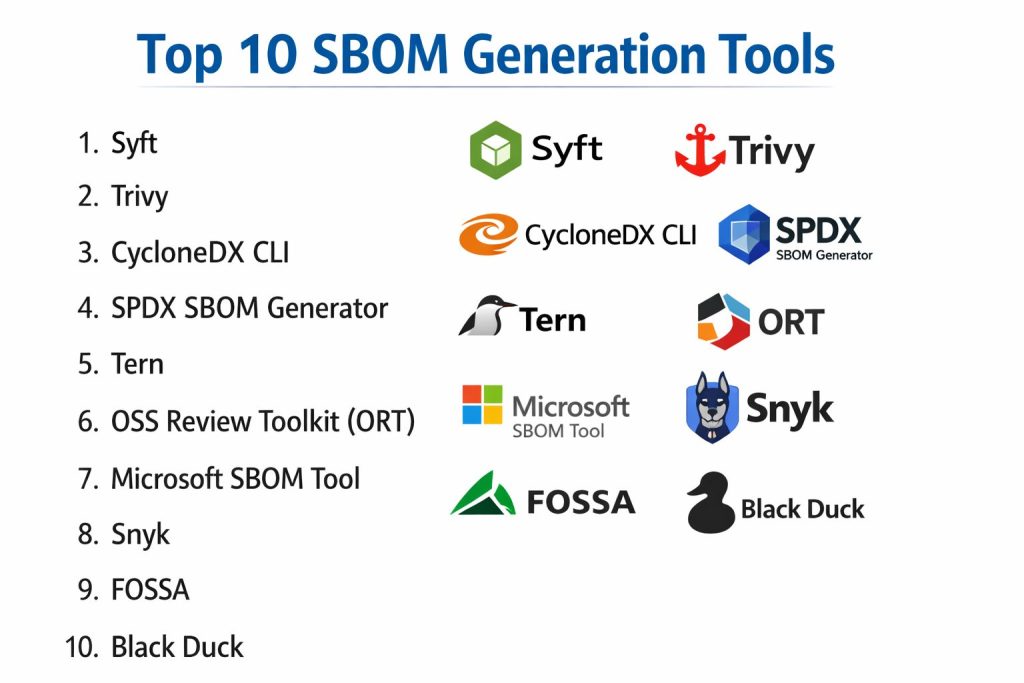
Top 10 Tools
1 — Syft
Syft is a popular SBOM generator designed for speed and automation. It is commonly used to generate SBOMs from container images and file systems, and it fits well into CI pipelines where you want a consistent SBOM artifact per build.
Key features
- Strong support for generating SBOMs from container images and directories
- Practical format outputs for common SBOM standards: Varies / N/A
- Automation-friendly workflow suitable for CI and release pipelines
Pros
- Fast to adopt and easy to operationalize in build workflows
- Useful baseline SBOM generator for container-heavy environments
Cons
- Coverage depends on what the scanner can observe in the artifact
- Some advanced enterprise governance needs require additional tooling
Platforms and deployment
Windows / macOS / Linux, Self-hosted
Security and compliance
Not publicly stated
Integrations and ecosystem
Syft fits best when paired with CI steps and artifact storage, and when you standardize how SBOMs are produced per repository.
- Common CI usage patterns: Varies / N/A
- Output handoff into security tools: Varies / N/A
Support and community
Strong community usage and documentation presence. Support options vary by distribution and organizational setup.
2 — Trivy
Trivy is widely used for container security workflows and can also generate SBOM outputs as part of scanning. It is especially useful when you want the SBOM generation step close to container scanning and you need a simple, repeatable command in pipelines.
Key features
- Strong container and artifact scanning coverage in common workflows
- SBOM generation integrated into typical security checks
- Practical for CI pipelines that already use Trivy for scanning
Pros
- Convenient when you want both scanning and SBOM generation together
- Good fit for container-first teams and platform engineering workflows
Cons
- SBOM completeness depends on artifact visibility and configuration
- Advanced policy workflows often require separate governance layers
Platforms and deployment
Windows / macOS / Linux, Self-hosted
Security and compliance
Not publicly stated
Integrations and ecosystem
Trivy commonly plugs into CI and container registries, where SBOMs become build artifacts alongside scan results.
- Registry and CI pipeline patterns: Varies / N/A
- Exports for downstream systems: Varies / N/A
Support and community
Large community footprint and active usage in security pipelines. Support depends on deployment approach.
3 — CycloneDX CLI
CycloneDX CLI is a practical option when you want to produce SBOMs aligned to the CycloneDX standard, especially for teams standardizing on that format across multiple languages and build systems. It can be useful as a normalization or conversion step in a broader SBOM workflow.
Key features
- Focused on producing and working with CycloneDX outputs
- Useful for format consistency across teams and repositories
- Helpful in pipelines where SBOM normalization is important
Pros
- Strong for standardization when CycloneDX is your chosen format
- Useful as part of a multi-tool pipeline where you unify outputs
Cons
- Often used alongside other scanners for deeper discovery
- Coverage and depth depend on the input sources and setup
Platforms and deployment
Windows / macOS / Linux, Self-hosted
Security and compliance
Not publicly stated
Integrations and ecosystem
CycloneDX CLI is commonly positioned as a standard output layer that teams rely on for compatibility downstream.
- SBOM processing and validation flows: Varies / N/A
- Toolchain integration depends on repo languages: Varies / N/A
Support and community
Community and documentation vary by usage context. Typically used by teams already committed to CycloneDX.
4 — SPDX SBOM Generator
SPDX SBOM Generator is a helpful tool when your organization prefers SPDX outputs and wants a straightforward generator that can run in automation. It fits well for teams that need SPDX as a deliverable for customers or internal governance.
Key features
- SPDX-focused SBOM generation outputs
- Simple automation fit for builds and CI steps
- Useful for compliance-driven SBOM deliverables
Pros
- Good choice when SPDX is required across your organization
- Straightforward to run as a repeatable build step
Cons
- Some ecosystems may need extra configuration for completeness
- Advanced governance and policy workflows usually need additional tools
Platforms and deployment
Windows / macOS / Linux, Self-hosted
Security and compliance
Not publicly stated
Integrations and ecosystem
Most teams use it as a generator step and then pass outputs to storage, review, or policy tools.
- CI automation patterns: Varies / N/A
- Downstream consumption tooling: Varies / N/A
Support and community
Community strength varies. Documentation and support depend on the broader SPDX ecosystem.
5 — Tern
Tern is focused on container images and aims to help produce an understanding of what is inside an image, including layers and packages, which can feed SBOM generation workflows. It is useful for teams that want deeper visibility into container composition.
Key features
- Container image analysis designed around layers and packaging
- Useful for container SBOM workflows and image transparency
- Helpful for teams that want more insight into image contents
Pros
- Good fit for container-focused build pipelines
- Useful for understanding composition beyond top-level dependencies
Cons
- Often requires more setup compared to simpler generators
- Best results depend on how images are built and what metadata exists
Platforms and deployment
Windows / macOS / Linux, Self-hosted
Security and compliance
Not publicly stated
Integrations and ecosystem
Tern is commonly used as part of container pipeline tooling, paired with registries, CI, and artifact storage.
- Container pipeline integration: Varies / N/A
- Output handling depends on chosen SBOM format: Varies / N/A
Support and community
Community usage exists but may be narrower than the most common SBOM generators. Support varies by deployment.
6 — OSS Review Toolkit (ORT)
ORT is a broader open-source governance toolkit that can produce SBOM-related outputs as part of a wider compliance and policy process. It is useful when you need not only SBOM generation, but also structured review workflows around dependencies.
Key features
- Broad dependency analysis across multiple ecosystems
- Useful in governance workflows that include review and policy steps
- Can support SBOM outputs as part of a larger compliance process
Pros
- Strong fit for organizations that want governance plus automation
- Helpful for teams managing many repositories and dependency types
Cons
- Setup can be more involved than lightweight generators
- Best value comes when you use the broader workflow, not only SBOM output
Platforms and deployment
Windows / macOS / Linux, Self-hosted
Security and compliance
Not publicly stated
Integrations and ecosystem
ORT is typically integrated into CI and governance processes where SBOM is one artifact among many compliance outputs.
- Policy and review workflows: Varies / N/A
- Export formats and handoffs: Varies / N/A
Support and community
Community and documentation are available, but adoption is strongest in teams that need governance depth.
7 — Microsoft SBOM Tool
Microsoft SBOM Tool is designed to generate SBOMs for software artifacts and build outputs in a repeatable way. It is often used in build pipelines where organizations want a consistent SBOM artifact aligned to internal standards.
Key features
- SBOM generation designed for build and release automation
- Useful for standardizing SBOM creation across projects
- Works well as a consistent pipeline step
Pros
- Good fit for organizations that want a standardized build artifact process
- Practical for teams already using structured build pipelines
Cons
- Coverage depends on how dependencies are resolved and discovered
- Some ecosystems may require careful configuration to reduce gaps
Platforms and deployment
Windows / macOS / Linux, Self-hosted
Security and compliance
Not publicly stated
Integrations and ecosystem
Commonly integrated into CI pipelines where SBOMs are produced and stored per release.
- Build pipeline integration: Varies / N/A
- Output consumption patterns: Varies / N/A
Support and community
Documentation and usage patterns exist, and support depends on organizational tooling and operational model.
8 — Snyk
Snyk is an application security platform that can generate SBOM outputs as part of broader vulnerability and dependency workflows. It is useful when your goal is not only generating SBOMs, but also connecting them to ongoing risk management practices.
Key features
- SBOM generation connected to dependency analysis workflows
- Useful for organizations that want SBOM plus vulnerability context
- Integrations into common developer platforms: Varies / N/A
Pros
- Practical for teams that want SBOMs tied to security workflows
- Strong integration story for developer and CI environments
Cons
- Some details depend on subscription tiers and configuration
- SBOM governance depth varies by organizational setup
Platforms and deployment
Web, Cloud
Security and compliance
Not publicly stated
Integrations and ecosystem
Snyk is typically chosen when SBOMs must feed directly into security triage and developer remediation loops.
- CI and repo integrations: Varies / N/A
- Export and automation options: Varies / N/A
Support and community
Documentation is generally strong. Support tiers and onboarding experience vary by plan.
9 — FOSSA
FOSSA is commonly used for open-source management and can help produce SBOM outputs while supporting license and compliance workflows. It is useful when SBOM generation is part of a broader compliance and approval process across many repos.
Key features
- SBOM generation aligned with open-source governance workflows
- License and policy workflows commonly paired with SBOM outputs
- Integrations into developer workflows: Varies / N/A
Pros
- Strong fit for organizations prioritizing license and compliance outcomes
- Useful for multi-repo visibility and governance consistency
Cons
- Details may depend on plan and configuration
- Teams may still use lightweight generators for local developer workflows
Platforms and deployment
Web, Cloud
Security and compliance
Not publicly stated
Integrations and ecosystem
FOSSA is typically positioned as a governance layer where SBOM outputs support policy enforcement and reporting.
- Repo and CI integration patterns: Varies / N/A
- Export formats and reporting: Varies / N/A
Support and community
Support varies by plan. Often adopted by compliance-driven teams with strong governance needs.
10 — Black Duck
Black Duck is an established platform used for software composition analysis and governance, often in enterprise settings. It can help generate SBOM-related outputs while supporting broader compliance, inventory, and risk processes.
Key features
- Enterprise-scale component inventory and governance workflows
- Useful for large organizations with many projects and teams
- SBOM outputs positioned within broader risk and compliance practices
Pros
- Strong for enterprise governance and reporting needs
- Useful for centralized visibility across a large portfolio
Cons
- Setup and operations can be heavier than lightweight tools
- Value is strongest when you need governance depth, not only SBOM output
Platforms and deployment
Varies / N/A
Security and compliance
Not publicly stated
Integrations and ecosystem
Black Duck is often integrated into enterprise build and governance systems where outputs feed compliance and security workflows.
- Enterprise integrations: Varies / N/A
- Output handoffs and reporting: Varies / N/A
Support and community
Enterprise support models exist, and onboarding is typically guided. Community varies compared to open-source-first tools.
Comparison Table
| Tool Name | Best For | Platform(s) Supported | Deployment | Standout Feature | Public Rating |
|---|---|---|---|---|---|
| Syft | Fast SBOMs for containers and artifacts | Windows / macOS / Linux | Self-hosted | Simple CI-friendly SBOM generation | N/A |
| Trivy | SBOM plus scanning in container pipelines | Windows / macOS / Linux | Self-hosted | Combined scan and SBOM workflows | N/A |
| CycloneDX CLI | Standardized CycloneDX SBOM outputs | Windows / macOS / Linux | Self-hosted | Format standardization and processing | N/A |
| SPDX SBOM Generator | SPDX-focused SBOM deliverables | Windows / macOS / Linux | Self-hosted | SPDX output alignment | N/A |
| Tern | Container image composition visibility | Windows / macOS / Linux | Self-hosted | Layer and package insight for images | N/A |
| OSS Review Toolkit (ORT) | Governance plus SBOM-oriented outputs | Windows / macOS / Linux | Self-hosted | Policy and review workflows | N/A |
| Microsoft SBOM Tool | SBOM artifact generation in builds | Windows / macOS / Linux | Self-hosted | Standard SBOM build step | N/A |
| Snyk | SBOM tied to security workflows | Varies / N/A | Cloud | SBOM with security context workflows | N/A |
| FOSSA | Compliance and license-driven SBOM use | Varies / N/A | Cloud | OSS governance with SBOM outputs | N/A |
| Black Duck | Enterprise inventory and governance | Varies / N/A | Varies / N/A | Portfolio-scale component governance | N/A |
Evaluation and Scoring
Weights used: Core features 25%, Ease of use 15%, Integrations and ecosystem 15%, Security and compliance 10%, Performance and reliability 10%, Support and community 10%, Price and value 15%.
| Tool Name | Core (25%) | Ease (15%) | Integrations (15%) | Security (10%) | Performance (10%) | Support (10%) | Value (15%) | Weighted Total (0–10) |
|---|---|---|---|---|---|---|---|---|
| Syft | 9 | 8 | 8 | 6 | 8 | 8 | 9 | 8.20 |
| Trivy | 8 | 8 | 8 | 6 | 8 | 8 | 9 | 7.95 |
| CycloneDX CLI | 7 | 7 | 7 | 5 | 7 | 7 | 8 | 6.95 |
| SPDX SBOM Generator | 7 | 7 | 6 | 5 | 7 | 6 | 8 | 6.70 |
| Tern | 7 | 6 | 6 | 5 | 6 | 6 | 7 | 6.30 |
| OSS Review Toolkit (ORT) | 8 | 6 | 8 | 6 | 7 | 7 | 8 | 7.30 |
| Microsoft SBOM Tool | 7 | 7 | 7 | 6 | 7 | 6 | 8 | 6.95 |
| Snyk | 8 | 8 | 8 | 7 | 8 | 8 | 7 | 7.75 |
| FOSSA | 8 | 8 | 8 | 7 | 8 | 8 | 7 | 7.75 |
| Black Duck | 9 | 6 | 8 | 7 | 8 | 8 | 6 | 7.55 |
How to interpret scores: Higher totals suggest broader fit across typical SBOM generation needs, not a universal winner. If you prioritize governance over speed, enterprise platforms may outperform in your environment even if ease scores look lower. If you prioritize developer speed, lightweight generators can win even without deep policy controls. Treat the table as a shortlist guide, then validate with a small pilot on real repositories and images.
Which Tool Is Right for You
Solo or Freelancer
If you want a simple generator you can run locally and attach to builds, Syft or Trivy are usually the easiest starting points. If your customer requires a specific SBOM format, choose the tool that outputs it reliably and consistently for your ecosystem.
SMB
Most small teams benefit from a lightweight generator plus a simple storage and release workflow. Syft or Trivy can generate SBOMs per build, while ORT becomes valuable if you also need structured compliance review across multiple repos.
Mid Market
Mid-sized organizations often want standardization across many repos and teams. Pair a generator that developers can run in CI with a governance layer that can enforce policies. Snyk or FOSSA can help when SBOM output must connect to ongoing security or compliance operations.
Enterprise
Large organizations usually need portfolio-wide inventory, approvals, reporting, and auditability. Black Duck, FOSSA, or Snyk may fit when you need centralized governance. You can still use Syft or Trivy at the edge for fast build-time SBOM creation.
Budget vs Premium
For budget-first workflows, start with Syft or Trivy and focus on consistent CI generation and storage. For premium governance needs, adopt an enterprise platform, then standardize how SBOMs are produced and consumed across the organization.
Feature depth vs ease of use
Syft and Trivy are commonly preferred for simplicity. ORT is stronger when you want a larger workflow that includes review and policy. Enterprise platforms can reduce manual governance work but may add onboarding overhead.
Integrations and scalability
If you need SBOMs to feed multiple downstream systems, prioritize stable outputs, repeatable identifiers, and automation hooks. Platforms like Snyk or FOSSA are often selected for integrated workflows, while open-source generators excel as fast pipeline steps.
Security and compliance needs
Many details are not publicly stated at the tool level, and security often depends on your CI environment, storage controls, and access policies. If audits matter, focus on reproducibility, artifact retention, and clear governance processes around SBOM publication and approvals.
Frequently Asked Questions
1. What is the difference between CycloneDX and SPDX
Both are SBOM standards. CycloneDX is commonly used in security toolchains, and SPDX is widely used for compliance and licensing contexts. Many organizations support both to satisfy different stakeholders.
2. Should SBOMs be generated from source code or built artifacts
Ideally both. Source analysis can capture declared dependencies, while artifact analysis can reveal what actually shipped. Teams often generate an SBOM during build and also validate the final container or binary.
3. How often should we generate SBOMs
Generate SBOMs for every release artifact and, for fast-moving teams, for every build in CI. This creates reliable traceability and simplifies incident response.
4. What is the biggest mistake teams make with SBOMs
Treating SBOMs as a one-time report. The real value comes when SBOMs are produced consistently, stored, and connected to vulnerability and compliance workflows.
5. Do SBOM tools automatically guarantee accuracy
No. Accuracy depends on ecosystem support, build practices, and what data the tool can observe. You should validate outputs with known test projects and compare results across tools.
6. How do we handle transitive dependencies
Choose tools that resolve dependency graphs well for your languages and packaging systems. Then standardize build steps so the tool sees the same dependency state each time.
7. Can an SBOM replace vulnerability scanning
No. An SBOM is an inventory. Vulnerability scanning uses that inventory plus vulnerability data to assess risk. The best setup links SBOMs to scanning and remediation workflows.
8. How do we store and distribute SBOMs
Many teams store SBOMs as build artifacts, attach them to releases, and keep them in artifact repositories. Distribution practices depend on customer requirements and internal governance.
9. How do we choose between open-source generators and enterprise platforms
Open-source generators are great for fast CI adoption and cost control. Enterprise platforms help with centralized governance, reporting, approvals, and portfolio visibility. Many organizations use both.
10. What should we pilot before standardizing a tool
Pilot on a few representative repos and container images. Check completeness, format compatibility, performance, CI integration effort, and how easily downstream teams can consume the SBOMs.
Conclusion
SBOM generation tools are most valuable when they become a repeatable part of your build process, not an occasional report. Lightweight generators like Syft and Trivy are excellent for producing consistent SBOM artifacts quickly, especially for container-first workflows. Format-focused tools help when you must standardize outputs across teams, while governance-oriented solutions like ORT and enterprise platforms can add policy controls, reporting, and portfolio visibility. The best approach is to shortlist two or three tools, run a pilot on real repositories and container images, compare completeness and consistency, and then standardize one SBOM format and one storage process. That makes SBOMs actionable for security, compliance, and engineering teams.