Introduction
Test data management tools help organizations create, mask, subset, and manage realistic data for software testing without exposing sensitive production information. These platforms ensure development and QA teams can validate applications using safe, compliant, and high-quality datasets that reflect real-world scenarios.
As digital transformation accelerates, reliable testing has become critical for application quality, security, and compliance. Modern delivery pipelines demand faster releases, automated testing, and strict data privacy controls. Test data management solutions now support synthetic data generation, privacy masking, DevOps integration, and scalable environments that allow teams to test continuously without risking confidential information.
Common use cases include application testing, regulatory compliance validation, performance testing, training simulations, and analytics development. Buyers typically evaluate automation capability, data masking strength, environment provisioning speed, scalability, privacy compliance, integration with testing pipelines, ease of use, governance controls, and overall cost efficiency.
Best for QA teams, DevOps engineers, developers, security teams, and enterprises managing sensitive data across testing environments.
Not ideal for very small projects using only mock or manually created datasets where full governance and automation are unnecessary.
Key Trends in Test Data Management Tools
- Growing adoption of synthetic data generation to avoid production exposure
- Stronger privacy masking aligned with regulatory expectations
- Integration with automated testing and continuous delivery pipelines
- Self-service data provisioning for faster developer productivity
- Cloud-native architectures supporting scalable environments
- Data subsetting to reduce storage and infrastructure cost
- AI-assisted data discovery and classification improving governance
- Centralized policy management for security and compliance control
- Increased focus on auditability and traceability of test datasets
- Expansion of hybrid deployment across on-premises and cloud systems
How These Tools Were Selected
- Proven adoption across enterprise and mid-market environments
- Comprehensive support for masking, subsetting, and synthetic data
- Reliability in large-scale testing and delivery pipelines
- Signals of security maturity and governance capability
- Integration flexibility with DevOps, QA, and database ecosystems
- Usability for both technical and non-technical stakeholders
- Availability of documentation, onboarding, and support resources
- Balanced representation of commercial and open ecosystem solutions
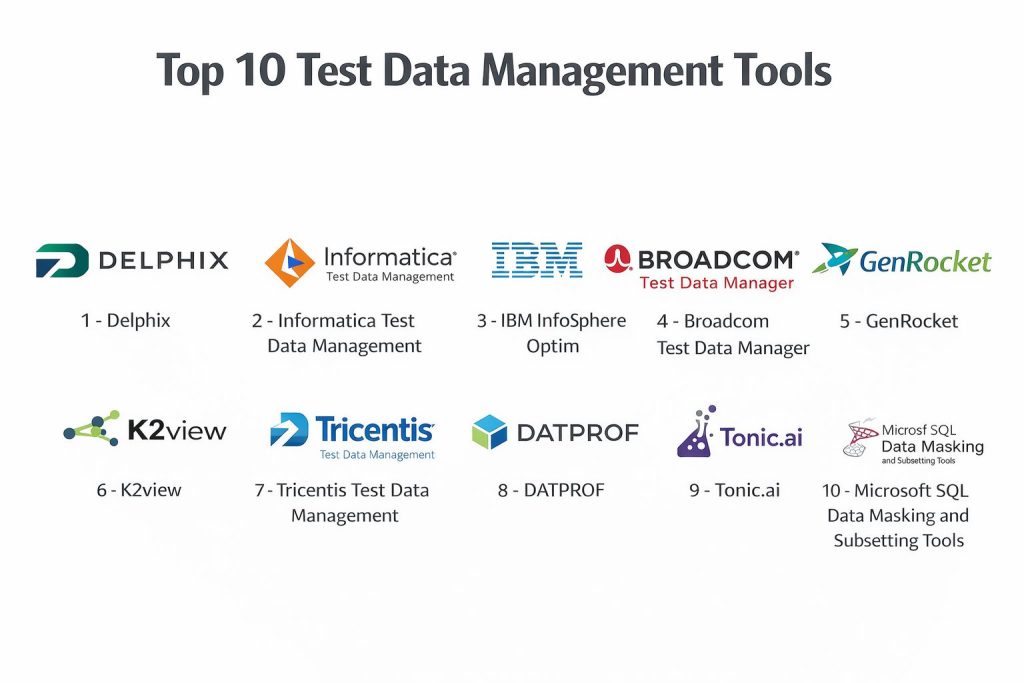
Top 10 Test Data Management Tools
1 — Delphix
Enterprise platform focused on secure data delivery and virtualization for development and testing.
Key Features
- Data virtualization and rapid environment provisioning
- Sensitive data masking and compliance controls
- Automated data refresh across environments
- Scalable infrastructure support
- Integration with DevOps workflows
Pros
- Strong enterprise governance
- Fast provisioning capability
Cons
- Complex implementation
- Premium pricing
Platforms / Deployment
Cloud or Self-hosted
Security & Compliance
Not publicly stated
Integrations & Ecosystem
- CI/CD pipeline integration
- Database platform connectivity
- Automation tooling support
Support & Community
Enterprise-grade support with structured onboarding.
2 — Informatica Test Data Management
Comprehensive solution for data masking, subsetting, and synthetic data creation.
Key Features
- Persistent and dynamic data masking
- Synthetic data generation
- Data discovery and classification
- Subsetting for efficient storage
- Policy-driven governance
Pros
- Strong compliance focus
- Broad enterprise capability
Cons
- Learning curve
- Licensing complexity
Platforms / Deployment
Cloud or Self-hosted
Security & Compliance
Not publicly stated
Integrations & Ecosystem
- Enterprise data platforms
- Automation pipelines
- Governance tooling
Support & Community
Professional documentation and enterprise support programs.
3 — IBM InfoSphere Optim
Data lifecycle and privacy management platform supporting compliant testing.
Key Features
- Data archiving and subsetting
- Privacy masking controls
- Test data provisioning
- Lifecycle governance
- Enterprise scalability
Pros
- Mature enterprise reliability
- Strong governance features
Cons
- Complex setup
- Higher operational overhead
Platforms / Deployment
Self-hosted or Hybrid
Security & Compliance
Not publicly stated
Integrations & Ecosystem
- Enterprise databases
- Governance frameworks
- Testing environments
Support & Community
Long-standing enterprise user base and documentation.
4 — Broadcom Test Data Manager
Centralized management platform for secure and automated test data handling.
Key Features
- Data masking and generation
- Environment provisioning
- Synthetic dataset creation
- Compliance monitoring
- Workflow automation
Pros
- Broad testing integration
- Strong governance visibility
Cons
- Enterprise-focused cost
- Configuration complexity
Platforms / Deployment
Cloud or Self-hosted
Security & Compliance
Not publicly stated
Integrations & Ecosystem
- DevOps pipeline tools
- Database systems
- Automation frameworks
Support & Community
Enterprise training and structured support availability.
5 — GenRocket
Synthetic test data generation platform designed for rapid, realistic dataset creation.
Key Features
- High-volume synthetic data generation
- Scenario-driven test data modeling
- Integration with automated testing
- Scalable execution engine
- Compliance-friendly datasets
Pros
- Eliminates production data exposure
- Fast data generation
Cons
- Requires modeling effort
- Limited traditional masking focus
Platforms / Deployment
Cloud or Self-hosted
Security & Compliance
Not publicly stated
Integrations & Ecosystem
- CI/CD integration
- Test automation tools
- API connectivity
Support & Community
Active vendor support and onboarding guidance.
6 — K2view
Data product platform enabling secure, real-time test data provisioning.
Key Features
- Data masking and subsetting
- Real-time provisioning
- Micro-database architecture
- Governance controls
- Scalable performance
Pros
- Fast environment delivery
- Strong privacy handling
Cons
- Specialized architecture learning
- Enterprise pricing model
Platforms / Deployment
Cloud, Self-hosted, or Hybrid
Security & Compliance
Not publicly stated
Integrations & Ecosystem
- Enterprise systems
- Automation pipelines
- Data services integration
Support & Community
Enterprise customer support with technical onboarding.
7 — Tricentis Test Data Management
Testing-focused data orchestration aligned with continuous testing strategies.
Key Features
- Automated data provisioning
- Data masking and compliance
- Integration with testing suites
- Reusable data sets
- Governance visibility
Pros
- Strong QA ecosystem alignment
- Improves test automation speed
Cons
- Best suited to existing platform users
- Licensing considerations
Platforms / Deployment
Cloud or Self-hosted
Security & Compliance
Not publicly stated
Integrations & Ecosystem
- Testing automation platforms
- CI/CD pipelines
- Enterprise data sources
Support & Community
Professional support and learning resources.
8 — DATPROF
Privacy-driven test data management emphasizing masking and subsetting.
Key Features
- Data discovery and masking
- Subsetting automation
- Compliance monitoring
- Synthetic data support
- Lightweight deployment
Pros
- Strong privacy protection
- Easier implementation
Cons
- Smaller ecosystem
- Limited advanced automation
Platforms / Deployment
Cloud or Self-hosted
Security & Compliance
Not publicly stated
Integrations & Ecosystem
- Database integrations
- Testing workflows
- Automation connectivity
Support & Community
Focused vendor support and documentation.
9 — Tonic.ai
Synthetic data platform designed for privacy-safe analytics and testing.
Key Features
- AI-driven synthetic data
- Privacy preservation controls
- Dataset versioning
- Scalable generation
- Developer-friendly workflows
Pros
- Strong privacy protection
- Modern architecture
Cons
- Synthetic-only focus
- Enterprise pricing tiers
Platforms / Deployment
Cloud or Self-hosted
Security & Compliance
Not publicly stated
Integrations & Ecosystem
- Data warehouses
- Development pipelines
- API integrations
Support & Community
Growing community and vendor support.
10 — Microsoft SQL Data Masking and Subsetting Tools
Database-centric capabilities supporting secure testing within SQL environments.
Key Features
- Built-in masking capabilities
- Data subsetting support
- Integration with development tools
- Policy configuration
- Enterprise database compatibility
Pros
- Native ecosystem integration
- Familiar workflow for database teams
Cons
- Limited cross-platform scope
- Feature depth varies
Platforms / Deployment
Self-hosted or Cloud
Security & Compliance
Not publicly stated
Integrations & Ecosystem
- Development environments
- Database services
- Automation scripts
Support & Community
Extensive documentation and enterprise support channels.
Comparison Table
| Tool Name | Best For | Platforms | Deployment | Standout Feature | Public Rating |
|---|---|---|---|---|---|
| Delphix | Enterprise data delivery | Multi | Hybrid | Data virtualization | N/A |
| Informatica | Compliance governance | Multi | Hybrid | Masking and synthetic data | N/A |
| IBM Optim | Data lifecycle control | Multi | Hybrid | Archiving and privacy | N/A |
| Broadcom | Centralized governance | Multi | Hybrid | Automated provisioning | N/A |
| GenRocket | Synthetic generation | Multi | Hybrid | Scenario modeling | N/A |
| K2view | Real-time provisioning | Multi | Hybrid | Micro-database approach | N/A |
| Tricentis | Continuous testing | Multi | Hybrid | QA integration | N/A |
| DATPROF | Privacy masking | Multi | Hybrid | Lightweight deployment | N/A |
| Tonic.ai | AI synthetic data | Multi | Hybrid | Privacy-safe datasets | N/A |
| Microsoft SQL | Database testing | Multi | Hybrid | Native masking | N/A |
Evaluation & Scoring
| Tool | Core | Ease | Integrations | Security | Performance | Support | Value | Total |
|---|---|---|---|---|---|---|---|---|
| Delphix | 9 | 6 | 8 | 8 | 9 | 8 | 6 | 8.0 |
| Informatica | 9 | 6 | 8 | 9 | 8 | 8 | 6 | 8.1 |
| IBM Optim | 8 | 5 | 7 | 9 | 8 | 8 | 6 | 7.6 |
| Broadcom | 8 | 6 | 7 | 8 | 8 | 7 | 6 | 7.5 |
| GenRocket | 8 | 7 | 7 | 8 | 8 | 7 | 7 | 7.7 |
| K2view | 8 | 6 | 8 | 8 | 9 | 7 | 6 | 7.8 |
| Tricentis | 8 | 7 | 8 | 8 | 8 | 8 | 7 | 7.9 |
| DATPROF | 7 | 7 | 6 | 8 | 7 | 7 | 7 | 7.1 |
| Tonic.ai | 8 | 7 | 7 | 8 | 8 | 7 | 6 | 7.5 |
| Microsoft SQL | 7 | 8 | 7 | 7 | 7 | 8 | 8 | 7.4 |
Scores provide comparative guidance rather than absolute measurement.
Higher totals indicate balanced capability across enterprise needs.
Organizations should prioritize governance, scalability, and integration fit.
Pilot testing remains the most reliable validation approach.
Which Test Data Management Tool Is Right for You
Solo teams often choose lightweight or database-native solutions.
Growing teams benefit from automation and synthetic generation.
Mid-size organizations require governance and integration balance.
Large enterprises prioritize compliance, scalability, and provisioning speed.
Budget constraints influence long-term sustainability.
Ease of use must align with operational complexity.
Integration depth determines DevOps efficiency.
Security requirements drive final enterprise selection.
Frequently Asked Questions
1. What is a test data management tool?
It is software that creates, masks, and manages safe datasets for application testing while protecting sensitive information.
2. Why is synthetic data important?
Synthetic data removes dependency on production data and reduces privacy risk during testing.
3. Do these tools support automation pipelines?
Most modern platforms integrate with automated testing and delivery workflows.
4. Are they required for small teams?
Small projects may rely on manual datasets, but growth increases the need for governance.
5. How long does implementation take?
Deployment time varies based on infrastructure complexity and integration scope.
6. Do they help with compliance?
Many solutions support privacy masking and governance aligned with regulations.
7. Can they work in cloud environments?
Yes, most platforms support cloud, on-premises, or hybrid deployment.
8. What skills are required to use them?
Knowledge of databases, testing workflows, and automation improves effectiveness.
9. Is switching tools difficult?
Migration may require data remapping, retraining, and integration updates.
10. What is the biggest benefit?
Secure, realistic testing that improves quality without exposing sensitive data.
Conclusion
Selecting the right test data management tool is a strategic decision that directly influences software quality, compliance readiness, and development speed. Different platforms specialize in virtualization, masking, synthetic generation, or governance, so the best option depends on organizational priorities rather than feature quantity alone. Teams should evaluate how well a solution integrates with testing pipelines, protects sensitive information, scales across environments, and supports long-term operational efficiency. Running a controlled pilot with real workflows, validating privacy controls, and confirming performance under load can significantly reduce adoption risk. A thoughtful, requirement-driven approach ensures the chosen platform delivers measurable value across development, security, and compliance objectives.