Introduction
Performance testing tools help organizations measure how applications behave under different levels of load, stress, and real-world usage. These tools simulate user activity, monitor system responsiveness, and identify bottlenecks before software reaches production. In simple terms, they ensure that digital products remain fast, stable, and reliable when many users interact at the same time.
Modern software delivery depends heavily on performance validation because slow or unstable applications directly impact revenue, customer trust, and operational efficiency. Teams now use performance testing across web platforms, mobile apps, APIs, cloud services, and enterprise systems to prevent outages and maintain consistent user experience.
Common use cases include load testing during product launches, stress testing infrastructure limits, validating scalability in cloud environments, testing API throughput, and ensuring stability during peak traffic events. Buyers typically evaluate scripting flexibility, protocol support, reporting depth, scalability, ease of integration with CI/CD, monitoring capability, licensing model, security handling, and community maturity.
Best for QA engineers, DevOps teams, SREs, developers, and enterprises operating high-traffic applications or mission-critical systems.
Not ideal for very small projects, static websites, or internal tools with minimal concurrent usage where lightweight monitoring alone may be sufficient.
Key Trends in Performance Testing Tools
- Growing adoption of cloud-based load generation and distributed testing
- Integration with continuous integration and delivery pipelines
- Real-time observability combining metrics, logs, and traces
- AI-assisted anomaly detection and root-cause identification
- Shift toward API-first and microservices performance validation
- Support for containerized and orchestration-driven environments
- Flexible usage-based pricing replacing fixed licensing
- Increased focus on security during test data handling
- Scalable reporting dashboards for cross-team collaboration
- Convergence of testing, monitoring, and reliability engineering
How These Tools Were Selected
- Strong industry recognition and production usage
- Coverage of multiple protocols and testing scenarios
- Reliability in large-scale load simulation
- Indicators of enterprise readiness and governance awareness
- Integration with development, monitoring, and cloud ecosystems
- Usability for both scripting experts and beginners
- Availability of documentation, training, and support
- Balanced mix of open-source and commercial solutions
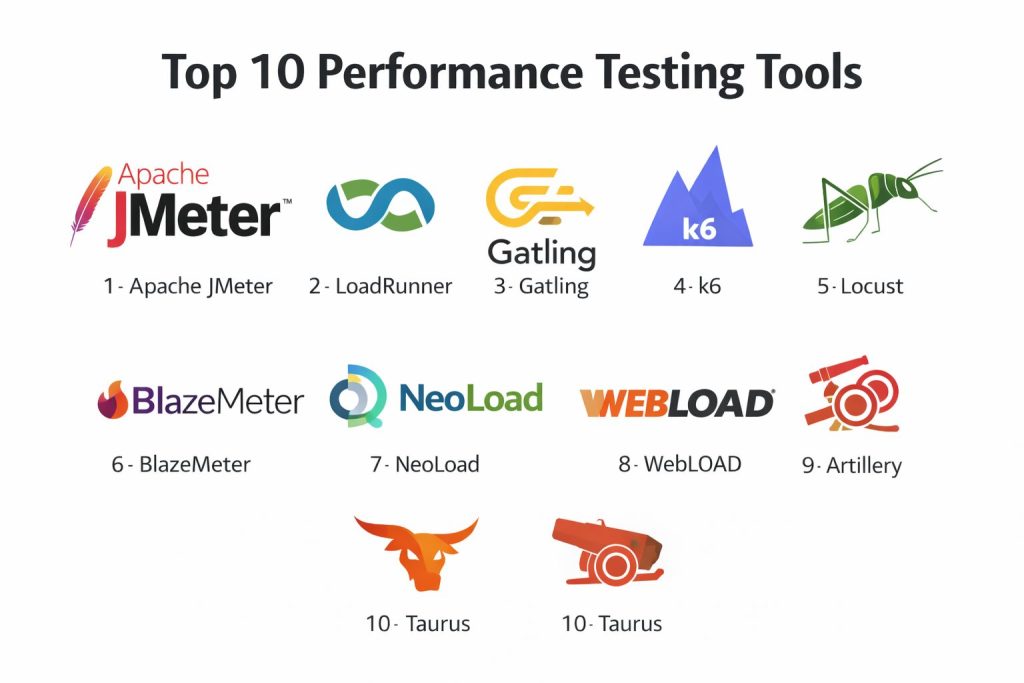
Top 10 Performance Testing Tools
1 — Apache JMeter
Widely used open-source load testing platform designed for web applications, APIs, and services.
Key Features
- Scriptable load and stress testing
- Multiple protocol support
- Detailed reporting dashboards
- Distributed load generation
- Plugin extensibility
Pros
- No licensing cost
- Large community ecosystem
Cons
- Resource intensive at scale
- Interface less intuitive for beginners
Platforms / Deployment
Windows, macOS, Linux — Self-hosted
Security & Compliance
Not publicly stated
Integrations & Ecosystem
- CI/CD integrations
- Monitoring tools
- Plugin extensions
Support & Community
Extensive global community and documentation.
2 — LoadRunner
Enterprise-grade performance testing suite designed for complex and large-scale environments.
Key Features
- Broad protocol coverage
- Realistic user simulation
- Advanced analytics and reporting
- Cloud and on-premise execution
- Enterprise scalability
Pros
- Highly mature platform
- Deep enterprise capabilities
Cons
- High licensing cost
- Steeper learning curve
Platforms / Deployment
Windows — Cloud or Self-hosted
Security & Compliance
Not publicly stated
Integrations & Ecosystem
- CI/CD pipelines
- Monitoring integrations
- Enterprise reporting
Support & Community
Professional enterprise support and training resources.
3 — Gatling
Developer-focused load testing framework emphasizing performance automation and scalability.
Key Features
- Code-based test scripting
- High-performance load engine
- Real-time metrics
- CI/CD compatibility
- Protocol extensibility
Pros
- Efficient resource usage
- Strong automation alignment
Cons
- Requires coding knowledge
- Limited graphical interface
Platforms / Deployment
Windows, macOS, Linux — Self-hosted or Cloud
Security & Compliance
Not publicly stated
Integrations & Ecosystem
- Build pipeline integration
- Metrics platforms
- Plugin extensions
Support & Community
Active developer community and documentation.
4 — k6
Modern performance testing tool focused on scripting simplicity and cloud scalability.
Key Features
- Scriptable load scenarios
- Cloud execution options
- API and web testing
- Real-time insights
- Automation-friendly design
Pros
- Simple scripting model
- Scales easily in cloud environments
Cons
- Advanced features may require paid tiers
- Smaller ecosystem than legacy tools
Platforms / Deployment
Windows, macOS, Linux — Cloud or Self-hosted
Security & Compliance
Not publicly stated
Integrations & Ecosystem
- CI/CD tools
- Observability platforms
- Cloud integrations
Support & Community
Growing community and documentation.
5 — Locust
Open-source load testing framework using distributed execution and scripting flexibility.
Key Features
- Python-based scripting
- Distributed load generation
- Real-time web interface
- Scalable execution
- Extensible architecture
Pros
- Flexible customization
- Lightweight framework
Cons
- Requires coding skills
- Limited built-in analytics
Platforms / Deployment
Windows, macOS, Linux — Self-hosted
Security & Compliance
Not publicly stated
Integrations & Ecosystem
- Monitoring integrations
- CI/CD pipelines
- Custom scripting
Support & Community
Active open-source community.
6 — BlazeMeter
Cloud-based performance testing platform designed for scalable and collaborative testing.
Key Features
- Cloud load generation
- Compatibility with open-source scripts
- Real-time reporting
- API testing support
- Team collaboration features
Pros
- Scales without infrastructure setup
- Supports multiple testing frameworks
Cons
- Subscription pricing
- Internet dependency for execution
Platforms / Deployment
Cloud
Security & Compliance
Not publicly stated
Integrations & Ecosystem
- CI/CD tools
- Monitoring platforms
- Script compatibility
Support & Community
Commercial support and documentation available.
7 — NeoLoad
Automated performance testing solution optimized for enterprise and continuous testing.
Key Features
- Rapid test design
- Continuous testing integration
- Scalable load execution
- Real-time analytics
- Broad protocol support
Pros
- Fast test creation
- Enterprise-ready scalability
Cons
- Commercial licensing
- Limited open-source flexibility
Platforms / Deployment
Windows, Linux — Cloud or Self-hosted
Security & Compliance
Not publicly stated
Integrations & Ecosystem
- CI/CD systems
- Monitoring tools
- Reporting platforms
Support & Community
Enterprise support and onboarding services.
8 — WebLOAD
Performance and load testing platform built for complex enterprise environments.
Key Features
- High-scale load simulation
- Script automation
- Detailed analytics
- Cloud execution
- Monitoring integration
Pros
- Handles heavy traffic scenarios
- Rich analytics
Cons
- Paid licensing
- Smaller community presence
Platforms / Deployment
Windows — Cloud or Self-hosted
Security & Compliance
Not publicly stated
Integrations & Ecosystem
- Monitoring tools
- CI/CD integration
- Reporting systems
Support & Community
Commercial support availability.
9 — Artillery
Modern lightweight performance testing toolkit focused on APIs and microservices.
Key Features
- Simple configuration
- Real-time metrics
- Cloud compatibility
- Automation support
- Extensible plugins
Pros
- Easy setup
- Developer-friendly workflow
Cons
- Limited enterprise analytics
- Smaller ecosystem
Platforms / Deployment
Windows, macOS, Linux — Self-hosted or Cloud
Security & Compliance
Not publicly stated
Integrations & Ecosystem
- CI/CD pipelines
- Monitoring dashboards
- Plugin support
Support & Community
Growing open-source community.
10 — Taurus
Automation-focused testing framework that simplifies execution of multiple performance tools.
Key Features
- Unified configuration
- Integration with existing tools
- CI/CD execution
- Reporting automation
- Script orchestration
Pros
- Simplifies complex workflows
- Supports multiple engines
Cons
- Requires understanding of underlying tools
- Limited standalone capability
Platforms / Deployment
Windows, macOS, Linux — Self-hosted
Security & Compliance
Not publicly stated
Integrations & Ecosystem
- CI/CD systems
- Reporting tools
- Multi-engine execution
Support & Community
Open-source documentation and contributors.
Comparison Table
| Tool Name | Best For | Platforms | Deployment | Standout Feature | Public Rating |
|---|---|---|---|---|---|
| Apache JMeter | Open testing | Desktop | Self-hosted | Plugin ecosystem | N/A |
| LoadRunner | Enterprise scale | Windows | Hybrid | Protocol coverage | N/A |
| Gatling | Developer automation | Desktop | Hybrid | Code scripting | N/A |
| k6 | Cloud scalability | Desktop | Hybrid | Simple scripting | N/A |
| Locust | Python testing | Desktop | Self-hosted | Distributed load | N/A |
| BlazeMeter | Cloud testing | Cloud | Cloud | Script compatibility | N/A |
| NeoLoad | Continuous testing | Desktop | Hybrid | Rapid design | N/A |
| WebLOAD | Heavy traffic | Windows | Hybrid | Advanced analytics | N/A |
| Artillery | API testing | Desktop | Hybrid | Lightweight setup | N/A |
| Taurus | Test orchestration | Desktop | Self-hosted | Multi-tool execution | N/A |
Evaluation & Scoring
| Tool | Core | Ease | Integrations | Security | Performance | Support | Value | Total |
|---|---|---|---|---|---|---|---|---|
| Apache JMeter | 9 | 6 | 8 | 5 | 8 | 9 | 10 | 8.2 |
| LoadRunner | 10 | 5 | 9 | 6 | 9 | 8 | 6 | 8.1 |
| Gatling | 8 | 6 | 8 | 5 | 8 | 7 | 8 | 7.6 |
| k6 | 8 | 7 | 8 | 5 | 8 | 7 | 8 | 7.8 |
| Locust | 7 | 6 | 7 | 5 | 7 | 7 | 9 | 7.2 |
| BlazeMeter | 8 | 7 | 8 | 6 | 8 | 8 | 7 | 7.8 |
| NeoLoad | 9 | 7 | 8 | 6 | 8 | 8 | 7 | 8.0 |
| WebLOAD | 8 | 6 | 7 | 6 | 8 | 7 | 7 | 7.3 |
| Artillery | 7 | 8 | 7 | 5 | 7 | 7 | 8 | 7.4 |
| Taurus | 7 | 6 | 8 | 5 | 7 | 7 | 8 | 7.3 |
Scores represent comparative guidance rather than absolute measurement.
Higher totals indicate balanced capability across evaluation areas.
Teams should prioritize workflow compatibility and scalability needs.
Enterprise environments should weigh integrations and governance more heavily.
Which Performance Testing Tool Is Right for You
Solo users often prefer open-source or lightweight scripting tools.
Small teams benefit from easy automation and cloud execution.
Growing organizations require scalability and CI/CD integration.
Enterprises prioritize governance, analytics, and protocol coverage.
Budget considerations influence open versus commercial selection.
Ease of use must balance with scripting flexibility.
Integration depth supports long-term DevOps maturity.
Security validation becomes critical for regulated environments.
Frequently Asked Questions
1. What is the main purpose of performance testing tools?
They measure speed, stability, and scalability of applications under simulated user load.
2. Are open-source tools reliable for production testing?
Yes, many organizations successfully use them when properly configured and scaled.
3. Do these tools support cloud environments?
Most modern solutions provide cloud execution or integration capabilities.
4. How long does implementation usually take?
Basic setup may take days, while enterprise-level testing strategies take longer planning.
5. Can performance testing be automated in pipelines?
Yes, integration with CI/CD workflows is now common practice.
6. What skills are required to use these tools?
Some require scripting knowledge, while others provide graphical interfaces.
7. Is monitoring required alongside testing?
Yes, combining testing with observability improves root-cause analysis.
8. How often should performance tests run?
Regular execution during development and before major releases is recommended.
9. Can these tools test APIs and microservices?
Many modern platforms specialize in API-level performance validation.
10. What is the biggest mistake teams make?
Testing too late in the release cycle instead of integrating testing early.
Conclusion
Performance testing tools play a critical role in ensuring applications remain stable, responsive, and scalable under real-world demand. The right choice depends on technical complexity, automation maturity, infrastructure scale, and organizational budget rather than popularity alone. Open-source platforms provide flexibility and cost efficiency, while commercial solutions deliver enterprise governance, analytics depth, and large-scale simulation. Teams should begin by identifying performance risks, selecting a small group of suitable tools, and validating them through controlled pilot testing integrated with development workflows. A structured evaluation approach helps organizations maintain reliability, protect user experience, and support long-term digital growth.