Introduction
A service mesh is a platform layer that manages service-to-service communication inside modern microservices and Kubernetes environments. In simple terms, it helps your services talk to each other safely and reliably, without you having to build the same networking logic into every application.
Why it matters now: as teams scale microservices, they face repeat problems—mTLS, retries, timeouts, traffic shifting, observability, and policy enforcement—and these get harder when services span multiple clusters, multiple teams, or hybrid environments. Modern service meshes also reflect newer priorities like sidecarless patterns, Kubernetes Gateway APIs, zero-trust defaults, and automation-ready policies.
Real-world use cases:
- Securing internal traffic with mTLS and identity-based access controls
- Canary releases and safe rollouts using traffic shifting and retries
- Improving reliability with timeouts, circuit breaking, and rate limiting
- Centralizing observability with distributed tracing, metrics, and logs hooks
- Multi-cluster governance with consistent policies across teams and environments
What buyers should evaluate:
- Data plane architecture (sidecar vs sidecarless / ambient patterns)
- mTLS model (default on/off, certificate management, identity integration)
- Traffic management depth (L7 routing, retries, timeouts, mirroring, failover)
- Policy model (RBAC, authorization, rate limits, auditability)
- Observability features (telemetry quality, tracing compatibility, dashboards fit)
- Operational complexity (upgrades, config ergonomics, failure domains)
- Performance overhead (latency, CPU/memory footprint, scaling behavior)
- Multi-cluster and multi-tenant support (separation, governance, boundaries)
- Ecosystem compatibility (Kubernetes-native, gateways, ingress/egress patterns)
- Support maturity (docs, enterprise support, community health)
Best for: platform engineering teams, SREs, DevOps teams, and security teams managing microservices on Kubernetes, especially when they need consistent security + traffic control + observability at scale.
Not ideal for: small deployments where a simple ingress controller and basic Kubernetes network policies already meet needs; also not ideal if teams can’t allocate time for mesh operations and governance.
Key Trends in Service Mesh Platforms
- Growing interest in sidecarless / ambient patterns to reduce per-pod overhead
- Increased focus on zero-trust defaults (mTLS-first, identity-based policies)
- Stronger alignment with Kubernetes Gateway API and modern gateway designs
- More emphasis on multi-cluster governance and policy portability
- eBPF-based networking acceleration becoming more common in cloud-native stacks
- More “platform product” thinking: self-service onboarding and guardrails
- Better cost awareness: footprint, telemetry volume, and operational staffing
- More integration expectations: service catalogs, policy engines, and SIEM pipelines
- Wider adoption of progressive delivery approaches (canary, blue/green, mirroring)
- Stronger demand for “safe by default” configs to reduce misconfiguration risk
How We Selected These Tools
- Included platforms with strong adoption or mindshare in Kubernetes microservices
- Balanced open-source and enterprise-oriented options across segments
- Prioritized mesh solutions with mature mTLS, traffic management, and telemetry
- Considered operational realities: upgrades, day-2 operations, and failure handling
- Looked for multi-cluster and platform-team fit (governance, policy, tenancy)
- Evaluated ecosystem strength: documentation, community, integrations, extensibility
- Avoided unverified claims for compliance and public ratings; used “Not publicly stated” or “N/A” where needed
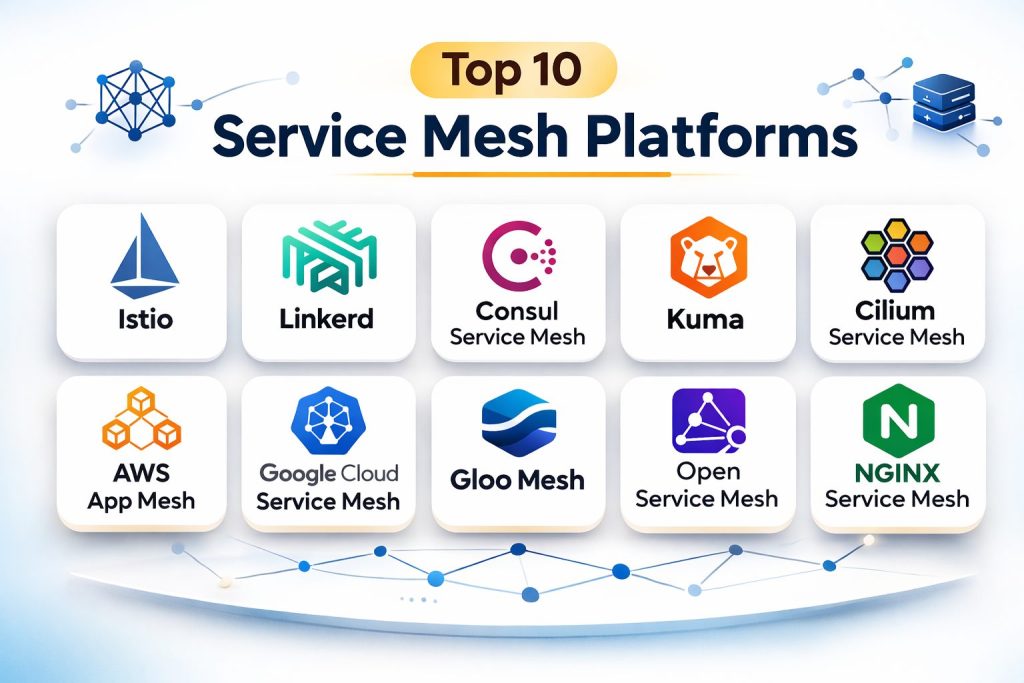
Top 10 Service Mesh Platforms
1 — Istio
A widely adopted service mesh for Kubernetes that provides deep traffic management, security, and observability controls. Often chosen by teams that need strong L7 routing and policy controls at scale.
Key Features
- mTLS service-to-service encryption with policy-based controls
- Advanced traffic routing (splits, mirroring, retries, timeouts)
- Authorization policy patterns and identity-based access controls
- Strong telemetry integration patterns (metrics, tracing hooks, logs)
- Multi-cluster deployment patterns (implementation varies)
- Extensibility through filters and policy integrations (Varies)
- Strong support for progressive delivery workflows
Pros
- Very feature-complete for enterprise-grade traffic control
- Large ecosystem and broad production usage
- Strong fit for complex microservices environments
Cons
- Operational complexity can be high for small teams
- Requires careful configuration governance to avoid drift
- Resource overhead depends on data plane model and scale
Platforms / Deployment
Kubernetes / Linux (typical)
Hybrid (depends on architecture)
Security & Compliance
mTLS, policy-based access control, traffic encryption, and identity concepts are core. Compliance certifications: Not publicly stated (implementation and compliance depend on your environment).
Integrations & Ecosystem
Istio commonly integrates with Kubernetes-native tools, gateways, and observability stacks.
- Kubernetes Gateway patterns (Varies)
- Tracing systems (Varies)
- Metrics stacks (Varies)
- Policy engines and OPA-style patterns (Varies)
- CI/CD progressive delivery tooling (Varies)
Support & Community
Large community, extensive docs, broad knowledge base. Enterprise support: Varies (often via vendors or managed offerings).
2 — Linkerd
A lightweight, Kubernetes-native service mesh focused on simplicity, reliability, and secure defaults. Often chosen by teams that want a smoother operational experience with strong baseline features.
Key Features
- mTLS by default with service identity concepts
- Traffic reliability features like retries and timeouts (scope varies)
- Strong observability focus with practical telemetry
- Kubernetes-native design and operational ergonomics
- Low overhead compared to heavier meshes (Varies by workload)
- Clear upgrade and lifecycle guidance patterns (Varies)
- Strong fit for teams prioritizing simplicity
Pros
- Easier to operate for many teams
- Good performance and lower complexity in common scenarios
- Strong baseline security posture for internal traffic
Cons
- Some advanced L7 traffic controls may be less extensive than larger meshes
- Multi-cluster patterns vary by environment and setup
- Ecosystem breadth can be smaller than the biggest platforms
Platforms / Deployment
Kubernetes / Linux (typical)
Hybrid (depends on architecture)
Security & Compliance
mTLS and secure service communication are core. Compliance certifications: Not publicly stated.
Integrations & Ecosystem
Integrates well in Kubernetes environments and common observability stacks.
- Metrics and tracing tooling (Varies)
- Kubernetes policy and RBAC alignment (Varies)
- Progressive delivery tools (Varies)
- Service dashboards and SRE tooling (Varies)
- Extensibility patterns (Varies)
Support & Community
Strong community and clear documentation; enterprise support options: Varies.
3 — Consul Service Mesh
A service mesh capability within Consul that supports service discovery plus service-to-service security and routing policies. Often used by organizations that already rely on Consul for service discovery.
Key Features
- Service discovery and service identity patterns (Varies by setup)
- mTLS support for service communication
- Centralized policy definitions for service connectivity
- Multi-environment patterns (Kubernetes and non-Kubernetes) (Varies)
- Service segmentation and access controls (Varies)
- Observability integration patterns (Varies)
- Good fit for hybrid infrastructure strategies
Pros
- Strong option for hybrid environments beyond Kubernetes
- Unified approach when Consul is already standard
- Useful for service discovery + connectivity governance
Cons
- Operational complexity depends heavily on deployment model
- Mesh capabilities and UX vary by environment
- May feel heavier if you only need Kubernetes-only mesh features
Platforms / Deployment
Kubernetes / Linux (typical) and non-Kubernetes environments (Varies)
Hybrid (depends on architecture)
Security & Compliance
mTLS and access policies supported. Compliance certifications: Not publicly stated.
Integrations & Ecosystem
Often used with service discovery and platform governance tooling.
- Service discovery integrations (Varies)
- Kubernetes integration patterns (Varies)
- Network policy coordination patterns (Varies)
- Observability tooling integration (Varies)
- Policy-driven segmentation patterns (Varies)
Support & Community
Community + enterprise support options: Varies depending on licensing and deployment.
4 — Kuma
A mesh platform designed for Kubernetes and multi-environment setups, focusing on policy-driven connectivity and multi-zone patterns. Often used when teams want a consistent mesh control plane across environments.
Key Features
- Policy-based traffic and security configuration model
- mTLS support and secure service communication patterns
- Multi-zone or multi-cluster deployment approaches (Varies)
- Support for ingress and egress traffic control patterns (Varies)
- Observability hooks and telemetry integration patterns (Varies)
- Strong fit for platform-team governance designs
- Config model aimed at clarity and portability
Pros
- Good balance of features and operational structure
- Helpful for multi-zone and multi-cluster thinking
- Policy-driven configuration fits platform governance
Cons
- Ecosystem and mindshare can be smaller than the biggest meshes
- Advanced features may depend on environment and setup
- Operational maturity depends on team practices and rollout discipline
Platforms / Deployment
Kubernetes / Linux (typical)
Hybrid (depends on architecture)
Security & Compliance
mTLS and policy-based security patterns. Compliance: Not publicly stated.
Integrations & Ecosystem
Designed to integrate with Kubernetes platforms and standard telemetry tools.
- Metrics and tracing integrations (Varies)
- Ingress and gateway patterns (Varies)
- Policy management tooling (Varies)
- Multi-cluster platform workflows (Varies)
- Extensibility through ecosystem components (Varies)
Support & Community
Community is active; enterprise support: Varies.
5 — Cilium Service Mesh
A service mesh approach built around Cilium’s networking and eBPF foundations, often appealing to teams that want strong networking observability and performance-focused designs.
Key Features
- eBPF-based networking visibility and enforcement patterns (Varies)
- Service-to-service security patterns including encryption concepts (Varies)
- Traffic control capabilities depending on architecture (Varies)
- Strong Kubernetes networking integration story
- Observability patterns through network-level telemetry (Varies)
- Policy-driven security aligned with Kubernetes operations
- Focus on performance and modern cloud-native networking
Pros
- Strong network observability and performance posture
- Good fit when Cilium is already the networking standard
- Appeals to platform teams wanting fewer moving parts
Cons
- Feature set depends on deployment approach and components
- Some advanced L7 controls may differ from classic service meshes
- Requires careful design decisions to match desired mesh outcomes
Platforms / Deployment
Kubernetes / Linux (typical)
Hybrid (depends on architecture)
Security & Compliance
Security features vary by configuration and components. Compliance: Not publicly stated.
Integrations & Ecosystem
Often integrates tightly with Kubernetes networking and security workflows.
- Kubernetes NetworkPolicy-aligned workflows (Varies)
- Observability integrations (Varies)
- Identity and access patterns (Varies)
- Gateway and ingress coordination (Varies)
- Platform security tooling (Varies)
Support & Community
Strong community in cloud-native networking; enterprise support: Varies.
6 — AWS App Mesh
A managed mesh approach designed to control service-to-service communications in AWS environments. Often chosen by teams heavily invested in AWS compute and deployment patterns.
Key Features
- Service-to-service traffic controls within AWS environments (Varies)
- mTLS and encryption patterns (Varies by configuration)
- Integrations with AWS-native observability and ops tooling (Varies)
- Fits teams that want managed control-plane patterns
- Supports common microservices traffic management needs (Varies)
- Works well for AWS-centric operational models
- Governance aligned with cloud-native permissions (Varies)
Pros
- Strong fit for AWS-first teams
- Managed components can reduce operational burden
- Integrates with AWS operations and monitoring patterns
Cons
- Best suited for AWS-centric deployments
- Portability to other environments may be limited
- Feature depth depends on AWS service integrations
Platforms / Deployment
Cloud (AWS) / Kubernetes or compute (Varies)
Cloud
Security & Compliance
Security features: Varies by setup and AWS environment configuration. Compliance: Not publicly stated in a mesh-specific way.
Integrations & Ecosystem
Commonly used with AWS-native service and monitoring patterns.
- AWS observability tooling integrations (Varies)
- IAM-based governance alignment (Varies)
- Container orchestration integrations (Varies)
- Service discovery patterns (Varies)
- Deployment automation patterns (Varies)
Support & Community
Support depends on AWS support plans; community resources: Varies.
7 — Google Cloud Service Mesh
A managed service mesh offering typically aligned with Google Cloud Kubernetes environments. Often selected by teams that want managed mesh operations with cloud-native integration.
Key Features
- Managed mesh operations patterns (Varies)
- Secure service communication models (Varies)
- Integrations with Google Cloud observability and policy tooling (Varies)
- Multi-cluster management patterns (Varies)
- Traffic routing and rollout support patterns (Varies)
- Strong fit for Google Cloud platform teams
- Supports enterprise governance workflows (Varies)
Pros
- Good fit for Google Cloud-centric Kubernetes environments
- Managed features can reduce day-2 operational load
- Integrates with cloud-native governance tooling
Cons
- Best suited to Google Cloud operational models
- Portability depends on architecture decisions
- Feature availability varies by region and setup
Platforms / Deployment
Cloud (Google Cloud) / Kubernetes (typical)
Cloud
Security & Compliance
Security features: Varies by configuration. Compliance: Not publicly stated in a mesh-specific way.
Integrations & Ecosystem
Often integrates with cloud-native logging, metrics, and identity workflows.
- Cloud observability integrations (Varies)
- Policy and access workflows (Varies)
- Multi-cluster platform tooling (Varies)
- Gateway patterns (Varies)
- CI/CD rollout tooling (Varies)
Support & Community
Support depends on cloud support tiers; documentation is typically strong. Details: Varies.
8 — Gloo Mesh
A platform-focused service mesh management and governance layer, often used by teams that want multi-cluster controls and centralized policy management across environments.
Key Features
- Multi-cluster governance and policy distribution (Varies)
- Centralized visibility and control patterns for platform teams
- Traffic management and routing workflows (Varies)
- Security policy and identity integration patterns (Varies)
- Works across mesh deployments depending on architecture (Varies)
- Supports progressive delivery and operational workflows (Varies)
- Strong focus on platform-team self-service enablement
Pros
- Strong for multi-cluster governance and visibility
- Helpful for standardizing policies across teams
- Designed with platform teams and enterprise workflows in mind
Cons
- Value depends on scale and multi-cluster complexity
- Requires platform maturity to fully benefit
- Feature set depends on environment and chosen architecture
Platforms / Deployment
Kubernetes / Linux (typical)
Hybrid (depends on architecture)
Security & Compliance
Security capabilities vary by configuration. Compliance: Not publicly stated.
Integrations & Ecosystem
Often integrates with platform tooling and gateway patterns.
- Gateway and ingress ecosystems (Varies)
- Observability integrations (Varies)
- Policy management workflows (Varies)
- Multi-cluster platform automation (Varies)
- CI/CD progressive delivery tooling (Varies)
Support & Community
Support tiers: Varies. Community information varies depending on deployment and plan.
9 — Open Service Mesh
A Kubernetes-focused service mesh emphasizing core mesh capabilities with an approachable operational model. Often used by teams that want a mesh that fits Kubernetes patterns and governance.
Key Features
- mTLS for service-to-service security
- Traffic management fundamentals (scope varies)
- Policy-based access control patterns (Varies)
- Observability integration hooks (Varies)
- Kubernetes-native configuration approaches
- Suitable for teams wanting a simpler mesh footprint
- Designed to align with common Kubernetes workflows
Pros
- Kubernetes-native approach can reduce friction
- Useful for teams wanting core mesh features without maximum complexity
- Good entry point for learning service mesh governance
Cons
- Ecosystem and adoption may be smaller than leading meshes
- Advanced traffic or multi-cluster needs may require more tooling
- Feature maturity varies by environment and use case
Platforms / Deployment
Kubernetes / Linux (typical)
Hybrid (depends on architecture)
Security & Compliance
mTLS supported; compliance: Not publicly stated.
Integrations & Ecosystem
Integrates through standard Kubernetes and telemetry patterns.
- Metrics and tracing integrations (Varies)
- Policy and access workflows (Varies)
- Gateway coordination patterns (Varies)
- CI/CD rollout tooling (Varies)
- Platform automation patterns (Varies)
Support & Community
Community support: Varies; documentation quality varies by version and ecosystem activity.
10 — NGINX Service Mesh
A mesh option aligned with NGINX-based networking ecosystems. Often considered by organizations that standardize on NGINX for ingress and want mesh-aligned traffic visibility and controls.
Key Features
- Service-to-service traffic control patterns (Varies)
- Support for secure service communication models (Varies)
- Works well in environments using NGINX networking patterns
- Observability hooks and monitoring integrations (Varies)
- Practical deployment and configuration patterns (Varies)
- Aligns with gateway and edge traffic thinking
- Useful for teams who already trust NGINX operational models
Pros
- Natural fit for NGINX-centric networking teams
- Can align mesh governance with existing traffic tooling
- Practical option when consistency with NGINX ecosystem matters
Cons
- Feature depth depends on version and architecture choices
- Ecosystem adoption varies compared to the biggest meshes
- Multi-cluster governance may require additional tooling
Platforms / Deployment
Kubernetes / Linux (typical)
Hybrid (depends on architecture)
Security & Compliance
Not publicly stated (mesh-specific compliance claims may not be consistently published).
Integrations & Ecosystem
Typically fits best in NGINX-centric networking and gateway stacks.
- Gateway and ingress ecosystem alignment (Varies)
- Observability integrations (Varies)
- Policy workflows (Varies)
- Deployment automation patterns (Varies)
- Platform tooling integrations (Varies)
Support & Community
Support: Varies by plan and environment. Community resources exist but breadth varies.
Comparison Table
| Tool Name | Best For | Platform(s) Supported | Deployment | Standout Feature | Public Rating |
|---|---|---|---|---|---|
| Istio | Advanced L7 traffic control at scale | Kubernetes / Linux (typical) | Hybrid | Deep routing and policy controls | N/A |
| Linkerd | Simpler mesh operations with strong defaults | Kubernetes / Linux (typical) | Hybrid | Lightweight, Kubernetes-native ergonomics | N/A |
| Consul Service Mesh | Hybrid service discovery + connectivity governance | Kubernetes + non-Kubernetes (Varies) | Hybrid | Service discovery + mesh alignment | N/A |
| Kuma | Policy-driven mesh with multi-zone patterns | Kubernetes / Linux (typical) | Hybrid | Multi-zone governance model | N/A |
| Cilium Service Mesh | Networking-first mesh patterns with eBPF foundations | Kubernetes / Linux (typical) | Hybrid | Network visibility and performance posture | N/A |
| AWS App Mesh | AWS-centric managed mesh patterns | AWS / Kubernetes or compute (Varies) | Cloud | Cloud-native integration in AWS | N/A |
| Google Cloud Service Mesh | Managed mesh aligned to Google Cloud Kubernetes | Google Cloud / Kubernetes (typical) | Cloud | Managed operations + platform integration | N/A |
| Gloo Mesh | Multi-cluster governance and centralized policy | Kubernetes / Linux (typical) | Hybrid | Multi-cluster management focus | N/A |
| Open Service Mesh | Core Kubernetes mesh capabilities | Kubernetes / Linux (typical) | Hybrid | Straightforward Kubernetes-first approach | N/A |
| NGINX Service Mesh | Mesh aligned with NGINX networking ecosystems | Kubernetes / Linux (typical) | Hybrid | NGINX ecosystem alignment | N/A |
Evaluation & Scoring of Service Mesh Platforms
Scoring model
- Each criterion is scored 1–10
- Weighted total is 0–10 using the weights below
- Scores are comparative within this shortlist and should guide shortlisting, not replace testing
- Security scores are conservative because real outcomes depend on identity, certificates, and governance
Weights
- Core features – 25%
- Ease of use – 15%
- Integrations & ecosystem – 15%
- Security & compliance – 10%
- Performance & reliability – 10%
- Support & community – 10%
- Price / value – 15%
| Tool Name | Core (25%) | Ease (15%) | Integrations (15%) | Security (10%) | Performance (10%) | Support (10%) | Value (15%) | Weighted Total (0–10) |
|---|---|---|---|---|---|---|---|---|
| Istio | 10 | 6 | 9 | 8 | 7 | 9 | 7 | 8.25 |
| Linkerd | 8 | 8 | 7 | 8 | 8 | 8 | 8 | 7.85 |
| Consul Service Mesh | 8 | 6 | 7 | 8 | 7 | 7 | 6 | 7.05 |
| Kuma | 8 | 7 | 7 | 8 | 7 | 7 | 7 | 7.30 |
| Cilium Service Mesh | 7 | 7 | 7 | 7 | 9 | 8 | 7 | 7.35 |
| AWS App Mesh | 7 | 7 | 7 | 7 | 7 | 7 | 6 | 6.85 |
| Google Cloud Service Mesh | 7 | 7 | 7 | 7 | 7 | 7 | 6 | 6.85 |
| Gloo Mesh | 8 | 6 | 8 | 7 | 7 | 7 | 6 | 7.10 |
| Open Service Mesh | 6 | 7 | 6 | 7 | 7 | 6 | 7 | 6.55 |
| NGINX Service Mesh | 6 | 7 | 6 | 7 | 7 | 6 | 6 | 6.40 |
How to interpret the scores:
- If you need deep L7 routing and policy control, emphasize Core + Integrations
- If you need operational simplicity, emphasize Ease + Performance
- If you need multi-cluster governance, emphasize Integrations + Core
- Always validate with a pilot because mesh outcomes depend on workload patterns and governance
Which Service Mesh Platform Is Right for You?
Solo / Freelancer
If you are a single engineer or a very small team running one Kubernetes cluster, you typically need simple security + basic traffic reliability, not maximum complexity.
- Strong picks: Linkerd, Open Service Mesh
- If you need advanced traffic routing: Istio (only if you can invest in operations)
Practical approach: start small, enable mTLS, learn the telemetry, and expand gradually.
SMB
SMBs need predictable operations and guardrails while teams ship features fast.
- Strong picks: Linkerd for simplicity, Kuma for policy structure
- If AWS-first: AWS App Mesh
- If Google Cloud-first: Google Cloud Service Mesh
Practical approach: standardize policies, define defaults (timeouts, retries), and keep configuration ownership clear.
Mid-Market
Mid-market teams often have multiple squads, more services, and a need for consistent governance.
- Strong picks: Istio for deep capabilities, Gloo Mesh for multi-cluster governance
- If hybrid beyond Kubernetes: Consul Service Mesh can fit better than Kubernetes-only meshes
Practical approach: create a platform playbook for onboarding, policy reviews, and upgrades.
Enterprise
Enterprise environments typically require multi-cluster governance, strict identity controls, and repeatable operations.
- Strong picks: Istio (capability depth), Gloo Mesh (governance patterns)
- If networking stack is standardized on eBPF and you prioritize performance: Cilium Service Mesh
- If hybrid environments are common: Consul Service Mesh
Practical approach: treat the mesh as a product—define SLAs, policy guardrails, and change management.
Budget vs Premium
- Budget-focused: meshes with simpler ops footprints often reduce staffing costs—Linkerd and Open Service Mesh can be practical starting points.
- Premium/complex needs: advanced routing, policy, and multi-cluster often pushes teams toward Istio plus governance tooling (Varies by strategy).
Feature Depth vs Ease of Use
- Maximum depth: Istio
- Balance: Kuma, Cilium Service Mesh
- Ease-first: Linkerd, Open Service Mesh
Recommendation: match the tool to your team’s operational capacity, not only the feature list.
Integrations & Scalability
- Best for broad ecosystem fit: Istio
- Best for multi-cluster governance layer: Gloo Mesh
- Best for hybrid discovery + connectivity: Consul Service Mesh
- Best for cloud-native managed patterns: AWS App Mesh, Google Cloud Service Mesh
Recommendation: evaluate your “must-have” integrations first (gateways, telemetry, identity, CI/CD).
Security & Compliance Needs
Service mesh security success depends on identity, certificates, and governance.
- If you need strict access control: prefer platforms with clear policy models and strong mTLS support
- If auditability is required: ensure your telemetry and policy changes are logged in your platform processes
- If compliance is a requirement: treat compliance as an environment and process outcome, not a vendor label
Recommendation: build a simple “security baseline profile” and enforce it consistently.
Frequently Asked Questions
1) What problem does a service mesh solve that Kubernetes alone doesn’t?
Kubernetes handles basic networking, but a mesh adds consistent mTLS, traffic control, retries/timeouts, and policy enforcement between services without changing each application.
2) Do I always need a service mesh for microservices?
No. If your system is small and stable, a mesh may add complexity. Mesh benefits increase when you have many services, multiple teams, or strong security and rollout needs.
3) What is the biggest risk of adopting a service mesh?
Operational complexity. If ownership is unclear or upgrades are not planned, the mesh becomes a fragile dependency. Governance and a rollout plan reduce this risk.
4) What are sidecars, and why do people want sidecarless designs?
Sidecars run alongside each app pod and intercept traffic. Sidecarless designs aim to reduce overhead and simplify operations by moving interception to other layers (implementation varies).
5) Does a service mesh replace an API gateway or ingress controller?
Not usually. A mesh focuses on east-west traffic (service-to-service). Gateways handle north-south traffic (external to internal). Many teams use both.
6) How do I measure whether a mesh is worth it?
Track improvements in rollout safety (fewer incidents), reduced MTTR via better telemetry, fewer security exceptions, and fewer app-level networking libraries to maintain.
7) Will a service mesh slow down my services?
There is overhead, but real impact depends on data plane choice, telemetry settings, and workload patterns. Pilot tests with real traffic are the safest way to validate.
8) What should I standardize first when rolling out a mesh?
Start with a baseline: mTLS posture, default timeouts, retry strategy, telemetry sampling, and ownership rules for policy changes.
9) Can I run multiple meshes in one organization?
It’s possible, but it increases complexity and fragmentation. Most organizations benefit from standardizing on one approach unless strong business reasons exist.
10) What is the safest rollout approach for a new mesh?
Start with a low-risk namespace, enable telemetry, apply a small set of baseline policies, then expand gradually. Validate operational tasks like upgrades, incident response, and policy rollback early.
Conclusion
Service mesh platforms can bring real value when you need consistent security, reliability controls, and observability across microservices—especially in Kubernetes and multi-cluster environments. However, the “best” choice depends on your team’s operational capacity and your real requirements. If you need maximum traffic control depth and ecosystem breadth, Istio often stands out. If you want a simpler operational path with strong defaults, Linkerd is a practical choice. If your environment is hybrid or discovery-centric, Consul Service Mesh may fit better, and if multi-cluster governance is the hard part, Gloo Mesh can be a strong layer.