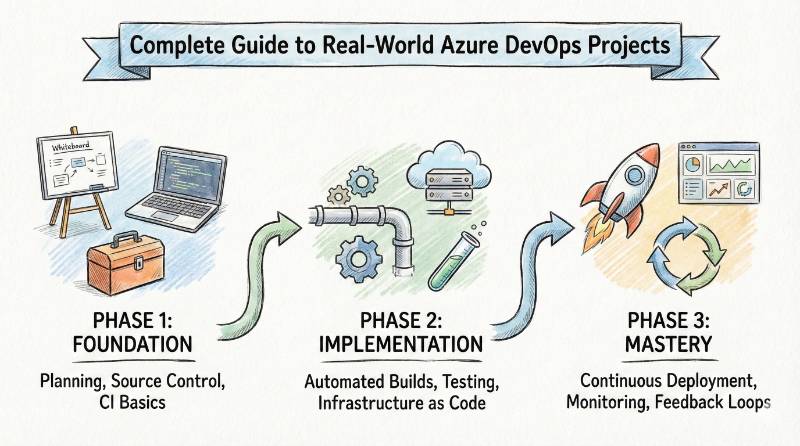
In the current tech landscape, simply knowing how to write code or manage a server isn’t enough. The industry has shifted toward a model where speed must be balanced with stability and security. Azure DevOps has become the backbone for many of the world’s most successful engineering teams. Whether you are an engineer on the ground or a manager looking to optimize your team’s output, mastering this ecosystem is a career-defining move.
This guide is designed to help you navigate the Master in Azure DevOps certification program. We will break down what you need to learn, how to prepare, and which career path best fits your goals.
What is the Master in Azure DevOps Certification?
The Master in Azure DevOps is a comprehensive certification program that validates your expertise in designing and implementing DevOps processes on Microsoft Azure. It isn’t just a single exam; it is a structured journey that covers the foundational elements of cloud computing, the complexities of Azure administration, and the advanced automation required for modern software delivery.
Certification Details at a Glance
| Track | Level | Who it’s for | Prerequisites | Skills Covered | Recommended Order |
| Azure Fundamentals | Foundational | Beginners, Non-tech managers | None | Cloud concepts, Azure services, Security | 1st |
| Azure Administrator | Associate | System Admins, Cloud Engineers | Basic IT knowledge | Storage, Virtual Networking, Identities | 2nd |
| Azure DevOps Engineer | Expert | DevOps/SRE Engineers, Developers | AZ-104 or AZ-204 | CI/CD, IaC, Security, Compliance | 3rd |
Deep Dive: Master in Azure DevOps
What it is
The Master in Azure DevOps program is an expert-level training and certification path. It bridges the gap between traditional operations and modern, automated software delivery by teaching you how to use Azure’s full suite of tools to manage the entire application lifecycle.
Who should take it
This is ideal for Software Engineers, System Administrators, and IT Managers who want to transition into a DevOps or SRE role. It is also highly recommended for leads who need to oversee cloud transformations in their organizations.
Skills you’ll gain
- Mastery of Azure Pipelines for automated builds and releases.
- Hands-on experience with Infrastructure as Code (IaC) using ARM templates and Terraform.
- Deep understanding of Azure Boards for Agile project management.
- Ability to manage secure secrets using Azure Key Vault.
- Expertise in container orchestration with Azure Kubernetes Service (AKS).
Real-world projects you should be able to do
- Build a fully automated Multi-stage CI/CD Pipeline for a web application.
- Deploy a Microservices Architecture on AKS with automated scaling.
- Implement a Self-healing Infrastructure that detects and recovers from failures.
- Design a Zero-trust Security model within your automation workflows.
Preparation Plan
- 7–14 days (Fast Track): For experienced cloud engineers. Focus on YAML syntax for pipelines and the specific nuances of Azure Repos and Boards.
- 30 days (Working Professional): Dedicate 10 hours a week. Focus on hands-on labs for Networking, RBAC, and multi-container deployments.
- 60 days (Comprehensive): For those new to Azure. Spend the first 20 days on fundamental cloud concepts and basic administration before moving to advanced automation.
Common Mistakes
- Manual Over-Clicking: Trying to do everything in the Portal instead of learning YAML and CLI.
- Ignoring Costs: Setting up resources without understanding the financial impact.
- Skipping Security: Treating security as a “later” task instead of integrating it into the pipeline from day one.
Best next certification after this
Once you have mastered Azure DevOps, the natural progression is to move toward Master in DevOps Engineering (MDE) or specialized tracks like DevSecOps Certified Professional.
Choose Your Path: 6 Learning Directions
Depending on your interest, you can pivot your Azure DevOps knowledge into these specialized domains:
- DevOps: The standard path. Focus on speed, automation, and the CI/CD lifecycle.
- DevSecOps: The security path. You focus on building “security gates” directly into the automation pipeline.
- SRE (Site Reliability Engineering): The stability path. You use Azure Monitor and automation to ensure 99.9% uptime.
- AIOps/MLOps: The intelligent path. You automate the training and deployment of AI models using Azure Machine Learning.
- DataOps: The data flow path. You apply DevOps principles to data pipelines, ensuring clean and fast data delivery.
- FinOps: The financial path. You focus on optimizing cloud spend and ensuring every dollar spent on Azure delivers value.
Role → Recommended Certifications Mapping
- DevOps Engineer: Master in Azure DevOps + Certified Kubernetes Administrator (CKA).
- SRE: Master in Azure DevOps + Site Reliability Engineering Certified Professional.
- Platform Engineer: Master in Azure DevOps + HashiCorp Certified: Terraform Associate.
- Cloud Engineer: Master in Azure DevOps + Azure Solutions Architect Expert.
- Security Engineer: Master in Azure DevOps + DevSecOps Certified Professional.
- Data Engineer: Master in Azure DevOps + DataOps Certified Professional.
- FinOps Practitioner: Master in Azure DevOps + Certified FinOps Professional.
- Engineering Manager: Master in Azure DevOps + Certified DevOps Manager.
Top Institutions for Training & Certification
Choosing the right partner for your certification journey is critical. Here are the top institutions that provide specialized training for the Master in Azure DevOps:
- DevOpsSchool: A global leader known for its practical, lab-heavy approach. They provide lifetime access to learning materials and dedicated technical support.
- Cotocus: Focuses on high-end consulting and technical training, helping professionals master complex cloud architectures.
- Scmgalaxy: A massive community-driven platform offering extensive resources, guides, and troubleshooting tips for DevOps enthusiasts.
- BestDevOps: Known for breaking down complex technical topics into easy-to-digest lessons, making it perfect for beginners.
- Devsecopsschool: The go-to institution for those wanting to specialize in the security aspects of the DevOps lifecycle.
- Sreschool: Dedicated to the principles of Site Reliability Engineering, focusing on building systems that are highly available.
- Aiopsschool: Teaches how to integrate machine learning and AI into IT operations for smarter automation.
- Dataopsschool: Focuses on the intersection of data engineering and DevOps principles.
- Finopsschool: The best place to learn the art of cloud cost optimization and financial management in the cloud.
Next Certifications to Consider
Once you’ve achieved Master in Azure DevOps, you can pursue the following certifications for further advancement:
- Certified Kubernetes Administrator (CKA): Deepen your expertise in container orchestration and management.
- Azure Solutions Architect Expert: Transition into a role where you design and implement complex cloud-based solutions.
- Certified Cloud Security Professional (CCSP): Specialize in securing cloud environments with a focus on DevOps practices.
FAQs on Master in Azure DevOps
1. How difficult is it to achieve a Master in Azure DevOps? It is a rigorous path because it requires a dual mindset: understanding infrastructure (Ops) and automation/coding (Dev). While the individual steps are manageable, the expert-level AZ-400 exam requires you to think like an architect rather than just a technician.
2. What is the total time commitment required? For a working professional, a realistic timeline is 3 to 6 months. This allows for roughly 10–12 hours of study per week, ensuring you have enough time for the critical hands-on labs that theory alone cannot replace.
3. Do I really need prerequisites if I have experience? Yes, Microsoft has strict requirements. You cannot jump directly to the Expert (AZ-400) level without first earning either the Azure Administrator (AZ-104) or Azure Developer (AZ-204) associate certification.
4. What is the recommended sequence of exams? The most logical and successful path is: AZ-900 (Fundamentals) → AZ-104 (Administrator) → AZ-400 (DevOps Expert). This sequence builds a rock-solid foundation of cloud concepts before moving into complex automation.
5. What is the market value of this certification? It is exceptionally high. Azure is the leading cloud provider for enterprise-level companies. Having this “Master” status on your profile signals to recruiters that you can manage end-to-end delivery for large-scale, complex environments.
6. What are the immediate career outcomes? Graduates typically move into high-impact roles such as Senior DevOps Engineer, Site Reliability Engineer (SRE), or Cloud Architect. In the Indian and global markets, these positions command some of the highest salary brackets in tech.
7. Can a non-coder pass the Azure DevOps Master track? While you don’t need to be a full-stack developer, you must be comfortable with “low-code” automation. You will need to learn YAML for pipelines and basic scripting (PowerShell or Bash) to be successful.
8. How does this compare to AWS or GCP certifications? While AWS has a large market share, Azure is dominant in the corporate and enterprise space due to its integration with Microsoft 365 and Active Directory. It is often considered the preferred certification for those working in established multinational corporations.
9. Is there a focus on security in this program? Absolutely. Modern DevOps is actually DevSecOps. The program covers integrating security gates, managing secrets via Azure Key Vault, and ensuring compliance throughout the delivery pipeline.
10. How much hands-on practice is needed? I recommend a 70/30 split: 70% of your time should be spent in the Azure portal or CLI building things, and 30% spent reading documentation. You cannot “memoize” your way through a production outage; you need muscle memory.
11. Does this certification expire? Microsoft certifications generally require a free online renewal every year to ensure your skills stay current with the rapidly evolving Azure platform.
12. Will this help me transition into a Management role? Yes. Understanding the “Master” level of DevOps gives you the technical authority to lead engineering teams. It allows you to speak the language of both the developers and the business stakeholders.
General FAQs: Master in Azure DevOps Program
1. What exactly is the “Master in Azure DevOps”? It is a comprehensive professional program that bundles the training and certification required to master the entire Microsoft Azure DevOps ecosystem, from cloud administration to advanced CI/CD.
2. Who is the primary provider of this program? The program is provided by DevOpsSchool, an industry-leading institution specializing in DevOps, SRE, and Cloud training.
3. Where can I find the official syllabus and registration? You can access all official details and the curriculum at: Mastering Azure DevOps.
4. Are the projects based on real-world scenarios? Yes. The program is designed to be practical. You will work on projects like setting up multi-stage pipelines, containerizing apps with AKS, and automating infrastructure with Terraform.
5. Is there a community or mentor support? When taken through authorized partners like DevOpsSchool or Scmgalaxy, you gain access to a community of experts and lifetime technical support to help you through tricky labs.
6. Is this certification valid for global job applications? Yes. The Master in Azure DevOps is recognized by tech hubs worldwide, including India, the US, UK, and Singapore, making it an excellent choice for those looking for international opportunities.
7. What is the difference between a regular certificate and this “Master” program? A regular certificate usually covers one exam. This program is a holistic “Career Path” that ensures you have all the prerequisite skills (Admin, Cloud, Automation) to actually do the job.
8. How do I start the journey? The best way is to visit the official provider’s link, review the upcoming batch schedules, and start with the Fundamentals module to build your momentum.
Conclusion
Mastering Azure DevOps is about more than just passing an exam; it’s about adopting a mindset of continuous improvement and automation. By following this guide and choosing the right learning path, you are positioning yourself at the forefront of the IT industry. Whether you want to stay technical as an SRE or move into leadership as a Manager, this certification is the foundation you need.