Introduction
Interactive Voice Response (IVR) and Voice Bot platforms are automated telephony systems that interact with callers, gather information, and route calls to the appropriate recipients. While traditional IVR systems relied on simple keypad inputs (DTMF), modern platforms utilize Natural Language Understanding (NLU) and Generative AI to create fluid, human-like conversations. These “Voice Bots” can resolve complex customer queries, schedule appointments, and process payments without ever involving a human agent.
In today’s landscape, these platforms are critical for managing high call volumes while maintaining a high level of customer satisfaction. Organizations are moving away from rigid “press 1 for sales” menus toward open-ended prompts like “How can I help you today?” This shift is driven by the need for 24/7 availability and the integration of voice data into broader CRM and analytics ecosystems.
Real-World Use Cases:
- Customer Support: Automating password resets or order status inquiries.
- Healthcare: Automating appointment reminders and prescription refills.
- Banking: Securely verifying identities and checking account balances.
- Travel: Handling flight rebookings and hotel reservations during peak times.
- Collections: Sending automated payment reminders with interactive payment options.
Evaluation Criteria for Buyers:
- Natural Language Processing (NLP) Accuracy: How well the bot understands accents and intent.
- Ease of Integration: Compatibility with existing CRMs like Salesforce or Zendesk.
- Latency: The speed of the voice response to ensure a natural conversation flow.
- Security: Compliance with HIPAA, PCI-DSS, and GDPR standards.
- Scalability: The ability to handle thousands of concurrent calls.
- Omnichannel Support: Consistency across voice, chat, and SMS.
Mandatory Paragraph
- Best for: Large enterprises, financial institutions, and e-commerce companies that handle massive inbound call volumes and require high-level automation.
- Not ideal for: Small businesses with very low call volumes or boutique services where a personal, human touch is the primary selling point.
Key Trends in IVR & Voice Bot Platforms
- Generative AI Integration: Using Large Language Models (LLMs) to provide more nuanced and less scripted responses.
- Biometric Authentication: Replacing security questions with voiceprint recognition for instant identity verification.
- Emotional Intelligence: AI that can detect caller frustration and automatically escalate the call to a human supervisor.
- Low-Code/No-Code Builders: Visual drag-and-drop interfaces that allow non-technical staff to design call flows.
- Predictive Routing: Using historical data to predict why a customer is calling and routing them before they even speak.
- Hyper-Regional Accents: AI voices trained on specific local dialects to improve user trust and clarity.
- Zero-Latency Processing: Edge computing used to eliminate the awkward pauses in AI voice interactions.
- Regulatory Compliance Automation: Built-in tools that automatically redact sensitive data (like credit card numbers) from call recordings.
How We Selected These Tools (Methodology)
- Market Adoption: Selection based on tools currently dominating the enterprise and mid-market sectors.
- Feature Completeness: Evaluation of both traditional DTMF capabilities and modern AI Voice Bot features.
- Reliability Signals: Analysis of uptime records and performance during high-traffic periods.
- Security Posture: Prioritization of platforms with rigorous global compliance certifications.
- Ecosystem Connectivity: How well the platforms interact with third-party software and APIs.
- Innovation Roadmap: Preference for vendors consistently releasing advanced AI and automation updates.
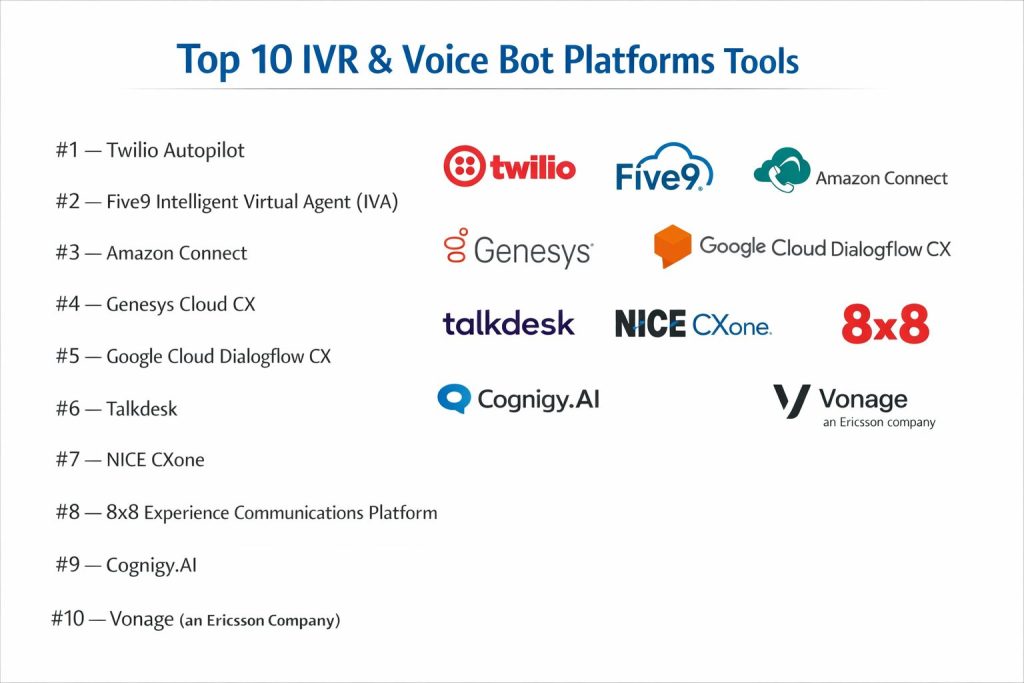
Top 10 IVR & Voice Bot Platforms
#1 — Twilio Autopilot
A powerful, developer-first platform for building sophisticated NLU-powered voice bots that integrate deeply with web applications.
Key Features
- Programmable Voice: Granular control over call routing and recording via API.
- Natural Language Understanding: Built-in engine to identify user intent and extract data.
- Task-Based Logic: Structures conversations into “tasks” for easier management.
- Style Sheets: Customize the voice, pitch, and tempo of the bot.
- Omnichannel Sync: Deploy the same bot logic across SMS, WhatsApp, and Voice.
Pros
- Ultimate flexibility for developers to build custom workflows.
- Pay-as-you-go pricing model is highly scalable.
Cons
- Requires significant technical expertise to set up.
- Lacks a robust out-of-the-box UI for non-developers.
Platforms / Deployment
- Web / Cloud
- Cloud
Security & Compliance
- SSO, MFA, Encryption, RBAC
- SOC 2, ISO 27001, GDPR, HIPAA
Integrations & Ecosystem
Twilio is built for integration, acting as the backbone for many custom-built customer service tools.
- Salesforce
- Segment
- Google Cloud
- AWS
Support & Community
Extensive developer documentation and a massive global community of engineers.
#2 — Five9 Intelligent Virtual Agent (IVA)
A cloud-native solution designed specifically for contact centers to reduce agent workload through high-level automation.
Key Features
- Self-Service Automation: Resolves routine queries without human intervention.
- Seamless Escalation: Transfers callers to agents with full context and transcripts.
- Visual Flow Designer: No-code tool for building complex IVR menus.
- Real-Time Analytics: Dashboards showing containment rates and drop-off points.
- Multilingual Support: Supports over 100 languages and dialects.
Pros
- Very high containment rates for standard customer service queries.
- Excellent user interface for contact center managers.
Cons
- Higher entry price point compared to developer-only tools.
- Can be complex to configure for multi-layered enterprises.
Platforms / Deployment
- Web / Cloud
- Cloud
Security & Compliance
- SSO, MFA, RBAC
- PCI-DSS, SOC 2, HIPAA
Integrations & Ecosystem
Integrates deeply with major CRM and helpdesk platforms to provide a unified agent desktop.
- Salesforce
- Oracle
- Microsoft Teams
- Zendesk
Support & Community
Strong enterprise-grade support with dedicated account managers for large clients.
#3 — Amazon Connect
A self-service, cloud-based contact center service that makes it easy for any business to deliver better customer service at lower cost.
Key Features
- Contact Lens: AI-powered speech analytics and sentiment analysis.
- Lex Integration: Uses the same technology as Alexa for conversational interfaces.
- Voice ID: Real-time caller authentication using voice biometrics.
- Dynamic Routing: Changes call flows based on real-time data from CRMs.
- High-Quality Audio: Crystal clear voice processing via the AWS global network.
Pros
- Tight integration with the entire AWS ecosystem.
- Extremely cost-effective for high-volume users.
Cons
- The interface can be daunting for those not familiar with AWS.
- Customizing complex flows often requires Lambda function coding.
Platforms / Deployment
- Web / Cloud
- Cloud
Security & Compliance
- SSO/SAML, MFA, IAM
- HIPAA, PCI, SOC 1/2/3
Integrations & Ecosystem
As an AWS service, it connects natively to hundreds of other cloud services.
- AWS Lambda
- Amazon S3
- Salesforce
- Kinesis
Support & Community
Backed by AWS professional support and a vast library of whitepapers and tutorials.
#4 — Genesys Cloud CX
An all-in-one contact center platform that prioritizes empathy and personalized customer journeys through AI.
Key Features
- Predictive Engagement: Uses AI to identify the best time to intervene in a customer journey.
- Native Voice Bots: Built-in NLU for handling complex inquiries.
- Workforce Engagement: Tools for managing and optimizing agent performance.
- Unified Workspace: Agents see all interactions (voice, chat, social) in one place.
- Architect Flow Builder: A robust tool for designing omnichannel customer flows.
Pros
- Industry leader in customer experience innovation.
- Highly reliable with a strong global presence.
Cons
- Implementation can take longer than simpler cloud tools.
- Premium features come at a high cost.
Platforms / Deployment
- Web / Windows / macOS
- Cloud
Security & Compliance
- SSO, MFA, RBAC
- GDPR, HIPAA, ISO 27001
Integrations & Ecosystem
Features a large marketplace (AppFoundry) with hundreds of pre-built integrations.
- Microsoft Dynamics
- Adobe
- Zoom
- SAP
Support & Community
Professional global support network and extensive online training via Genesys Beyond.
#5 — Google Cloud Dialogflow CX
An advanced development suite for creating conversational AI, specifically designed for large, complex enterprise-level projects.
Key Features
- Visual State Machine: Manage complex conversation paths with a visual graph.
- Vertex AI Integration: Leverage Google’s latest LLMs for natural responses.
- Advanced NLU: Best-in-class intent recognition and entity extraction.
- One-Click Deployment: Deploy bots across voice and digital channels simultaneously.
- Analytics & Insights: Detailed reporting on bot performance and user paths.
Pros
- Superior natural language processing capabilities.
- Highly scalable and part of the reliable Google Cloud infrastructure.
Cons
- Requires technical knowledge to maximize its potential.
- Pricing can become complex based on request volume.
Platforms / Deployment
- Web / Cloud
- Cloud
Security & Compliance
- IAM, MFA, Encryption
- SOC 2, HIPAA, GDPR
Integrations & Ecosystem
Natively integrates with Google’s telephony partners and broader workspace tools.
- Avaya
- Cisco
- Genesys
- Google Workspace
Support & Community
Massive documentation and community support through Google Cloud forums.
#6 — Talkdesk
A cloud contact center platform that emphasizes “AI for every step” of the customer journey.
Key Features
- Talkdesk Builder: Low-code tools for customizing the contact center experience.
- AI Trainer: Allows non-technical staff to improve bot accuracy easily.
- Virtual Agent: Intelligent voice self-service for common requests.
- Interaction Analytics: Automatically transcribes and analyzes 100% of calls.
- Knowledge Management: Surfaces the right information to bots and agents instantly.
Pros
- Fast deployment and user-friendly design.
- Strong focus on industry-specific solutions (Healthcare, Retail).
Cons
- Some users report occasional bugs in the visual builder.
- Mobile app features are less robust than the desktop version.
Platforms / Deployment
- Web / Windows / macOS / iOS / Android
- Cloud
Security & Compliance
- SSO, MFA, RBAC
- SOC 2, ISO 27001, HIPAA
Integrations & Ecosystem
Extensive integrations through the Talkdesk AppConnect marketplace.
- Slack
- Microsoft Teams
- Shopify
- BigCommerce
Support & Community
Known for excellent customer success teams and proactive support.
#7 — NICE CXone
A comprehensive, integrated platform that combines omni-channel routing with AI-driven analytics and workforce optimization.
Key Features
- SmartAssist: A conversational AI bot powered by Amelia.
- Enlighten AI: Predictive models that score every interaction for quality.
- Self-Service SDK: Embed voice and chat bots into mobile apps easily.
- IEX Workforce Management: Advanced scheduling and forecasting for agents.
- Personalized IVR: Tailors the menu based on the caller’s identity and history.
Pros
- Extremely deep feature set for large-scale operations.
- World-class analytics and reporting capabilities.
Cons
- Can be overwhelming for smaller organizations.
- The user interface is more “traditional” and complex.
Platforms / Deployment
- Web / Windows
- Cloud
Security & Compliance
- SSO, MFA, RBAC
- PCI-DSS, SOC 2, HITRUST
Integrations & Ecosystem
Integrates with almost all major enterprise software suites.
- Oracle
- SAP
- Microsoft Dynamics 365
- Salesforce
Support & Community
Extensive professional services and training programs for enterprise clients.
#8 — 8×8 Experience Communications Platform
A unified platform that combines contact center, voice, video, and chat into a single cloud solution.
Key Features
- Intelligent IVR: Flexible call routing with speech recognition.
- Self-Service Bots: Automated handling of routine tasks.
- Expert Connect: Quickly find and connect callers to internal experts.
- Global Reach: High-quality voice service in over 50 countries.
- Unified Analytics: Cross-channel reporting in a single dashboard.
Pros
- Good value for companies needing both UCaaS and CCaaS.
- Reliable global call quality.
Cons
- AI bot features are less advanced than specialist NLU tools.
- Interface consistency can vary across different modules.
Platforms / Deployment
- Web / Windows / macOS / iOS / Android
- Cloud
Security & Compliance
- SSO, MFA
- FISMA, HIPAA, GDPR
Integrations & Ecosystem
Focuses on productivity and CRM connectivity.
- Microsoft Teams
- NetSuite
- Bullhorn
- HubSpot
Support & Community
Solid online documentation and 24/7 global support.
#9 — Cognigy.AI
A leading enterprise conversational AI platform that automates customer and employee communications.
Key Features
- Cognigy Voice Gateway: Connects AI bots to any phone system via SIP.
- Low-Code Conversation Designer: Intuitive flow management.
- Cognigy Insights: Advanced tracking of bot conversations and ROI.
- Live Agent Takeover: Seamlessly hand off to human staff.
- Cognigy Extension Marketplace: Pre-built nodes for connecting to other services.
Pros
- Very fast time-to-market for complex AI bots.
- Highly flexible deployment options.
Cons
- Primarily a bot layer; requires a separate telephony provider.
- Smaller community than the giant cloud providers.
Platforms / Deployment
- Web / Cloud / Self-hosted
- Hybrid / Cloud
Security & Compliance
- SSO, MFA, Encryption
- ISO 27001, GDPR, SOC 2
Integrations & Ecosystem
Designed to sit on top of existing infrastructure.
- Avaya
- Cisco
- Salesforce
- ServiceNow
Support & Community
Excellent technical documentation and a growing user base in Europe and the US.
#10 — Vonage (an Ericsson Company)
A flexible communications platform that leverages APIs to add voice bot capabilities to any application.
Key Features
- AI Virtual Assistant: Intelligent, natural-sounding voice interactions.
- Vonage Video API: Easily escalate voice calls to video.
- Voice API: Global reach for programmatic calling and control.
- Sentiment Analysis: Real-time insights into the caller’s mood.
- Programmable SIP: Connect your existing PBX to Vonage’s cloud AI.
Pros
- Excellent developer tools and API flexibility.
- Strong global telecommunications infrastructure.
Cons
- Out-of-the-box reporting could be more detailed.
- Pricing can fluctuate based on regional carrier rates.
Platforms / Deployment
- Web / Cloud
- Cloud
Security & Compliance
- SSO, MFA, RBAC
- GDPR, HIPAA, SOC 2
Integrations & Ecosystem
Highly focused on integrating voice into modern web and mobile apps.
- Slack
- Microsoft Dynamics
- Salesforce
- Zendesk
Support & Community
Strong developer support and a well-regarded API documentation suite.
Comparison Table (Top 10)
| Tool Name | Best For | Platform(s) Supported | Deployment | Standout Feature | Public Rating |
| Twilio Autopilot | Developers | Web / Cloud | Cloud | Programmable NLU | 4.6 |
| Five9 IVA | Contact Centers | Web / Cloud | Cloud | Visual Flow Designer | 4.7 |
| Amazon Connect | AWS Users | Web / Cloud | Cloud | Lex/Alexa Tech | 4.5 |
| Genesys Cloud | Enterprise CX | Web / Windows | Cloud | Predictive Engagement | 4.8 |
| Dialogflow CX | High-end AI | Web / Cloud | Cloud | Visual State Machine | 4.8 |
| Talkdesk | Mid-Market | All Platforms | Cloud | AI Trainer | 4.7 |
| NICE CXone | Massive Enterprise | Web / Windows | Cloud | Enlighten AI | 4.6 |
| 8×8 Platform | Unified Comms | All Platforms | Cloud | Expert Connect | 4.3 |
| Cognigy.AI | Specialized Bots | Web / Cloud | Hybrid | Voice Gateway | 4.9 |
| Vonage | API Integration | Web / Cloud | Cloud | AI Virtual Assistant | 4.4 |
Evaluation & Scoring of IVR & Voice Bot Platforms
| Tool Name | Core (25%) | Ease (15%) | Integrations (15%) | Security (10%) | Performance (10%) | Support (10%) | Value (15%) | Weighted Total |
| Twilio Autopilot | 9 | 5 | 10 | 9 | 10 | 8 | 9 | 8.50 |
| Five9 IVA | 9 | 9 | 9 | 9 | 9 | 9 | 7 | 8.60 |
| Amazon Connect | 9 | 6 | 10 | 10 | 10 | 8 | 10 | 8.85 |
| Genesys Cloud | 10 | 8 | 10 | 10 | 10 | 9 | 7 | 9.10 |
| Dialogflow CX | 10 | 5 | 9 | 10 | 10 | 8 | 8 | 8.55 |
| Talkdesk | 9 | 10 | 9 | 9 | 9 | 10 | 8 | 8.95 |
| NICE CXone | 10 | 7 | 9 | 10 | 10 | 9 | 7 | 8.75 |
| 8×8 Platform | 8 | 9 | 8 | 9 | 8 | 8 | 9 | 8.30 |
| Cognigy.AI | 10 | 9 | 9 | 9 | 9 | 9 | 8 | 9.05 |
| Vonage | 8 | 8 | 10 | 9 | 9 | 8 | 9 | 8.55 |
The scoring provided is comparative and based on the tool’s performance within its intended market niche. A high score in “Core” reflects feature richness, while a high “Value” score often indicates a favorable price-to-performance ratio for the target user base.
Which IVR & Voice Bot Platform Tool Is Right for You?
Solo / Freelancer
Twilio or Amazon Connect are the best options due to their pay-as-you-go models. If you have coding skills, Twilio offers the most freedom.
SMB
Talkdesk is highly recommended for its ease of use and fast deployment. 8×8 is also a strong choice if you need a standard office phone system combined with a contact center.
Mid-Market
Five9 and Talkdesk offer the best balance of sophisticated AI features without requiring a massive IT department.
Enterprise
Genesys Cloud CX and NICE CXone are the industry leaders for large-scale operations requiring deep analytics and workforce management.
Budget vs Premium
Amazon Connect is the budget leader for high-volume users. Genesys and NICE are premium options that provide white-glove service and more extensive features.
Feature Depth vs Ease of Use
Dialogflow CX offers the most depth in AI but is harder to use. Talkdesk offers the best ease of use while still providing professional features.
Integrations & Scalability
Twilio and Vonage lead in integration flexibility through their APIs. Amazon Connect leads in pure cloud scalability.
Security & Compliance Needs
All platforms listed are secure, but NICE CXone and Genesys have the longest track records in meeting complex global compliance standards like HITRUST and ISO.
Frequently Asked Questions (FAQs)
What is the difference between IVR and a Voice Bot?
IVR usually refers to menu-based systems (press 1, press 2), while a Voice Bot uses AI to understand spoken language and carry on a conversation.
Can these platforms integrate with my existing CRM?
Yes, most top-tier platforms have native integrations with Salesforce, Zendesk, and Microsoft Dynamics to share data.
Is it difficult to switch from an old IVR to a new Voice Bot?
While the technology shift is significant, most modern platforms offer “SIP trunking” to connect your old hardware to their new cloud AI.
How much do these platforms typically cost?
Pricing varies from pay-as-you-go (cents per minute) to monthly per-seat licenses ranging from $75 to $200+.
Can Voice Bots handle payments securely?
Yes, leading platforms are PCI-DSS compliant and can redact credit card info from recordings to ensure security.
Do I need a developer to set these up?
For “low-code” tools like Talkdesk or Five9, you don’t. For “API-first” tools like Twilio, a developer is highly recommended.
Can Voice Bots detect when a customer is angry?
Yes, many platforms now include sentiment analysis that triggers an automatic transfer to a human manager if a customer is upset.
Are these systems available in multiple languages?
Most professional platforms support at least 50+ languages, with some like Five9 and Google supporting over 100.
How do Voice Bots help with high call volumes?
They act as a “digital front door,” resolving the majority of simple questions so that only complex issues reach human agents.
What happens if the AI bot doesn’t understand the caller?
All professional setups include a “fallback” path that automatically routes the caller to a live human if the bot is confused.
Conclusion
Modern IVR and Voice Bot platforms have evolved far beyond the frustrating menus of the past. Today’s leaders, such as Genesys, Talkdesk, and Amazon Connect, provide sophisticated AI that truly understands customer intent. Selecting the right platform requires a clear understanding of your call volume, technical resources, and security needs. We recommend starting with a small-scale pilot of 2–3 tools to measure containment rates and customer satisfaction before a full rollout.