Introduction
IT Asset Management (ITAM) is a mission-critical business practice that involves a set of business processes designed to manage the lifecycle and inventory of an organization’s IT environment. ITAM has evolved from simple spreadsheet tracking into a complex, AI-driven discipline that covers hardware (HAM), software (SAM), and cloud assets. Modern ITAM tools provide the “source of truth” required for security, compliance, and financial optimization in an increasingly decentralized work environment.
The relevance of ITAM has skyrocketed due to the explosion of SaaS sprawl and the integration of specialized AI hardware. Organizations no longer just track laptops; they manage thousands of micro-subscriptions and hybrid cloud resources. A robust ITAM strategy ensures that every asset is accounted for, secure, and yielding maximum return on investment (ROI). Without these tools, enterprises face significant risks including failed audits, security vulnerabilities from “shadow IT,” and massive financial waste on unused licenses.
Real-world use cases include:
- Audit Defense: Preparing for software vendor audits (e.g., Microsoft, Oracle) by providing precise usage data.
- Hardware Refresh Cycles: Automating the identification and replacement of aging hardware based on warranty and performance data.
- SaaS Optimization: Identifying and reclaiming unused licenses for high-cost platforms like Salesforce or Adobe.
- Security Incident Response: Providing security teams with the exact configuration and owner details of a compromised device.
- Mergers & Acquisitions: Rapidly discovering and normalizing the IT estate of a newly acquired company to assess value and risk.
What buyers should evaluate (Criteria):
- Discovery Depth: Does it use agent-based, agentless, or hybrid discovery across all network segments?
- Software Recognition Library: The quality of the underlying database that translates raw file data into recognizable software titles.
- Cloud & SaaS Visibility: Ability to track consumption in AWS/Azure/GCP and manage “Shadow AI” subscriptions.
- Lifecycle Automation: Native workflows for the entire “cradle-to-grave” asset journey.
- Compliance Reporting: Pre-built templates for industry standards like SOC2, HIPAA, and GDPR.
- Total Cost of Ownership (TCO): Balancing the initial license cost against implementation time and administrative overhead.
- Scalability: The tool’s ability to maintain performance while scanning 50,000+ endpoints simultaneously.
- Integrations: Compatibility with existing ITSM (Service Desk), HR, and Procurement systems.
Best for: IT Operations Managers, Procurement Officers, and Chief Information Security Officers (CISOs) who need total visibility and financial control over the technology stack.
Not ideal for: Very small businesses with fewer than 50 assets, where simple inventory spreadsheets or free open-source trackers may suffice without the high cost of enterprise-grade automation.
Key Trends in IT Asset Management Software
The ITAM landscape is defined by three pillars: Automation, Sustainability, and Intelligence.
- The Rise of “Shadow AI”: ITAM tools now feature specialized discovery engines to find unauthorized generative AI subscriptions and browser-based AI extensions that may leak corporate data.
- ITAM-FinOps Convergence: The silos between IT asset management and cloud financial management are disappearing, with platforms offering a unified view of “Total Technology Spend.”
- ESG and Sustainability Tracking: Modern ITAM platforms now calculate the carbon footprint of hardware assets and track electronic waste (e-waste) disposal certificates to meet environmental regulations.
- Autonomous Remediation: Advanced tools can now automatically “harvest” (remove) a software license from a user who hasn’t opened the application in 30 days, reassigning it to someone on a waitlist.
- Digital Experience Monitoring (DEM): ITAM is merging with employee experience, using asset performance data (CPU lag, battery health) to proactively offer hardware upgrades before the user complains.
- Zero-Trust Discovery: With the end of traditional network perimeters, discovery now happens via cloud-native agents that report back over secure HTTPS, even without a VPN.
- Contract Intelligence: AI models within ITAM tools can now “read” uploaded PDF contracts to extract renewal dates, termination clauses, and pricing tiers automatically.
- Standardized Asset Ontologies: The industry is moving toward a universal data language for assets, making it easier to migrate data between different management platforms.
How We Selected These Tools (Methodology)
To determine the top 10 ITAM solutions, we applied a standardized SaaS evaluation methodology:
- Market Presence: We prioritized tools with significant adoption in mid-market and enterprise sectors.
- Depth of Discovery: Preference was given to tools that provide “multi-modal” discovery (agentless, agent-based, and API-based).
- AI Integration: We evaluated how natively AI is used for data normalization and predictive analytics rather than just as a chatbot interface.
- Security Posture: Only tools with modern encryption, SSO support, and recognized compliance certifications were included.
- Financial Logic: We looked for tools that go beyond inventory and include robust depreciation, contract management, and budgeting features.
- User Feedback: We analyzed verified user reviews from late 2025 and early 2026 to gauge real-world performance and support quality.
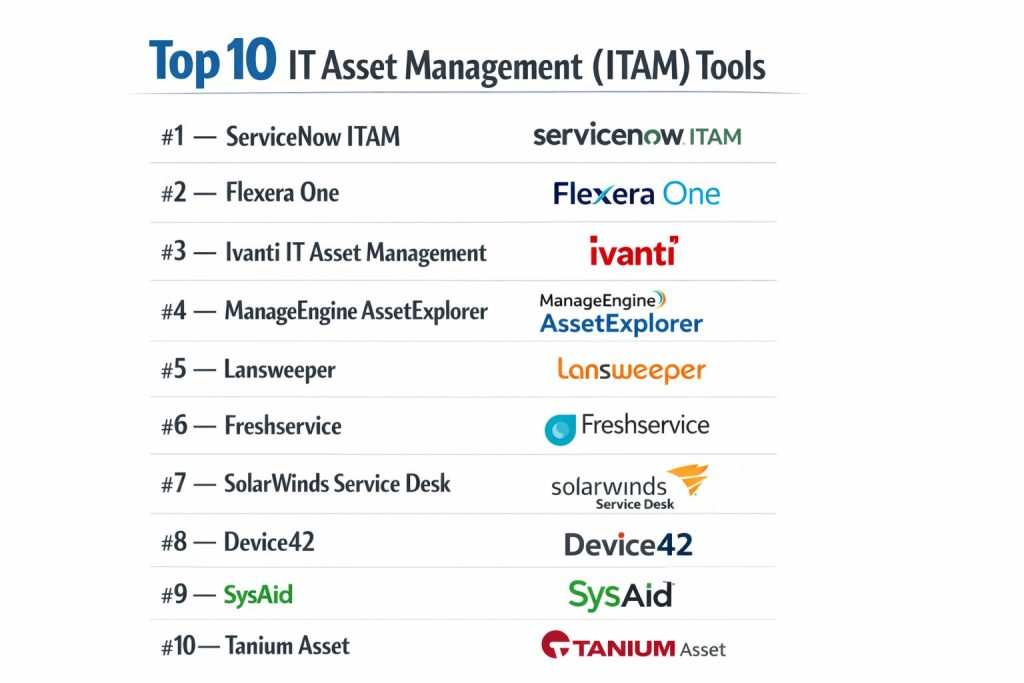
Top 10 IT Asset Management (ITAM) Tools
#1 — ServiceNow ITAM
Often considered the industry “Gold Standard,” ServiceNow ITAM is an enterprise-grade platform that unifies Hardware Asset Management (HAM), Software Asset Management (SAM), and Cloud Insights on a single “Workstream” platform.
Key Features
- Native CMDB Integration: Direct link between asset data and the configuration management database for seamless ITSM.
- Content Service Library: A massive, crowd-sourced library that automatically normalizes millions of software and hardware data points.
- Cloud Cost Management: Real-time visibility into multi-cloud spend and automated recommendations for rightsizing.
- Asset Lifecycle Automation: Pre-built workflows for onboarding, offboarding, and asset reclamation.
- Mobile Agent App: Allows field technicians to scan barcodes and update asset records from their smartphones.
- SaaS License Management: Direct API connections to major SaaS vendors to track actual usage, not just assigned seats.
Pros
- Ultimate Scalability: Built to handle millions of assets for the world’s largest organizations.
- Unified Ecosystem: No need for manual data syncs if you already use ServiceNow for Service Desk or HR.
Cons
- High Complexity: Requires specialized developers or consultants for initial setup and ongoing maintenance.
- Premium Pricing: One of the most expensive options on the market, usually reserved for large budgets.
Platforms / Deployment
- Web / iOS / Android
- Cloud-native (SaaS)
Security & Compliance
- FedRAMP, SOC 1 & 2, ISO 27001, HIPAA.
- Advanced encryption at rest and in transit.
Integrations & Ecosystem
ServiceNow offers the most extensive integration hub in the ITAM space.
- Microsoft 365 & Azure
- AWS & Google Cloud
- Salesforce & Adobe
- SAP & Oracle
Support & Community
Extensive “ServiceNow Community” forums, formal certification programs, and 24/7 global enterprise support tiers.
#2 — Flexera One
Flexera One (incorporating the legacy Snow License Manager) is the specialized leader in Software Asset Management and License Optimization, designed specifically for complex, multi-vendor environments.
Key Features
- Hybrid Discovery: Deep scanning of on-premises data centers, desktop environments, and public cloud providers.
- Advanced License Logic: Handles the most complex license models (IBM PVU, Oracle Processor, SAP Named User).
- FinOps Integration: Unified view of SaaS, IaaS, and on-prem software spend to prevent overspending.
- Automated Vendor Portal: A centralized hub to manage contracts and renewals for hundreds of vendors.
- SaaS Spend Management: Pinpoints redundant SaaS applications and identifies “Shadow IT” via browser discovery.
- Normalization Engine: Automatically cleans and categorizes raw inventory data into actionable insights.
Pros
- Best-in-Class SAM: Unmatched for audit defense against “aggressive” software vendors.
- Granular Reporting: Highly customizable dashboards that satisfy both IT and Finance requirements.
Cons
- Learning Curve: The interface can be technical and overwhelming for non-specialist users.
- Setup Time: Deep license optimization requires a significant “data cleanup” phase during implementation.
Platforms / Deployment
- Web / Windows (Agents) / Linux (Agents)
- Cloud / Hybrid
Security & Compliance
- SOC 2 Type II, GDPR compliant.
- Single Sign-On (SSO) and Multi-Factor Authentication (MFA).
Integrations & Ecosystem
Focuses heavily on the “Big 4” vendors and major cloud providers.
- Microsoft (Azure/365)
- Oracle & IBM
- SAP
- ServiceNow (as a data source)
Support & Community
Dedicated success managers for large accounts and a robust online documentation portal.
#3 — Ivanti IT Asset Management
Ivanti provides a “Unified Endpoint Management” (UEM) approach to ITAM, focusing on discovering every device that touches the corporate network and automating its security and lifecycle.
Key Features
- Ivanti Neurons: An AI-powered “Self-Healing” engine that detects and fixes asset performance issues automatically.
- Agentless Discovery: Rapidly scans the network for IP-based devices including IoT and printers.
- Asset Lifecycle Manager: Tracks the financial, contractual, and physical aspects of assets in one view.
- Consolidated Dashboards: Merges asset health, security vulnerabilities, and license status.
- Automated Patching: Automatically updates software on discovered assets to maintain security compliance.
- Barcode Scanning: Native mobile app support for physical inventory audits in warehouses.
Pros
- Security Focused: Better than competitors at linking asset management to vulnerability management.
- Flexible Licensing: Modular structure allows you to pay only for the features you need.
Cons
- Modular Complexity: Some users find the separation between “Neurons” and the core ITAM product confusing.
- UI Inconsistency: Elements of the interface can feel dated compared to newer “SaaS-native” tools.
Platforms / Deployment
- Web / Windows / macOS / iOS / Android
- Cloud / On-Premise
Security & Compliance
- ISO 27001, SOC 2, Common Criteria.
- Role-based access control (RBAC).
Integrations & Ecosystem
Strong native connectors for IT infrastructure and security tools.
- Microsoft Intune
- CrowdStrike
- Splunk
- Okta
Support & Community
Ivanti Global Support and a professional services network for large-scale deployments.
#4 — ManageEngine AssetExplorer
Part of the Zoho family, AssetExplorer is a high-value, comprehensive ITAM tool that offers enterprise features at a mid-market price point, focusing on ease of use and rapid deployment.
Key Features
- Multi-Scan Discovery: Uses Windows Domain, Network, and Agent-based scanning to find every asset.
- Software License Management: Tracks license usage, handles “downgrade” rights, and alerts on over-licensing.
- Purchase Order Tracking: Full procurement module to manage POs and link them directly to assets.
- Contract Management: Tracks renewals and sends automated alerts before expiration dates.
- CMDB Relationship Mapping: Visualizes the dependencies between assets and business services.
- Native Remote Control: Allows admins to take control of an asset directly from the management console.
Pros
- Exceptional Value: Offers a very high feature-to-price ratio compared to ServiceNow.
- Ease of Implementation: Can be fully operational in days rather than months.
Cons
- Advanced SAM Limits: May struggle with extremely complex enterprise license models like IBM or SAP.
- Report Styling: Built-in reports are functional but lack the “modern” aesthetic of top-tier SaaS tools.
Platforms / Deployment
- Windows / Linux / Web
- Cloud / On-Premise
Security & Compliance
- GDPR, AES-256 Encryption, MFA.
- Not publicly stated (FedRAMP).
Integrations & Ecosystem
Tight integration with the ManageEngine and Zoho suites.
- ServiceDesk Plus
- OpManager
- Desktop Central
- Zoho Analytics
Support & Community
Active user forums, 24/5 phone support, and a vast library of “how-to” videos.
#5 — Lansweeper
Lansweeper is a “Discovery-First” platform that prides itself on being able to find assets that other tools miss, creating a “Technology Asset Intelligence” foundation for IT and Security teams.
Key Features
- Agentless Deep Scan: Uses 20+ protocols (WMI, SSH, SNMP, etc.) to discover assets without installing software.
- IoT & OT Discovery: Specifically designed to find non-standard IT assets like security cameras and factory sensors.
- Vulnerability Monitoring: Maps discovered software against the NIST CVE database in real-time.
- Lifecycle Insights: Automatically provides end-of-life (EOL) and end-of-support (EOS) data for thousands of models.
- Cloud Discovery: Scans AWS, Azure, and Google Cloud environments to identify “Ghost” instances.
- SQL-Based Reporting: Allows for near-infinite customization of data exports using standard SQL queries.
Pros
- Unbeatable Discovery: Widely considered the best at finding “everything” on a network.
- Low Maintenance: Once the scan is configured, it runs reliably with minimal intervention.
Cons
- SQL Knowledge Required: Building complex custom reports requires someone who knows SQL.
- Limited Financials: Lacks the deep procurement and depreciation logic of more “business-focused” ITAM tools.
Platforms / Deployment
- Web / Windows (Scanner)
- Cloud-Connected / Hybrid
Security & Compliance
- SOC 2 Type II, GDPR.
- Encrypted credential vault for scanning.
Integrations & Ecosystem
Acts as a “Data Feed” for many other enterprise platforms.
- Power BI & Tableau
- Jira Service Management
- Freshservice
- Microsoft SCCM
Support & Community
Strong technical documentation and a responsive support team via email and community forums.
#6 — Freshservice
Part of the Freshworks suite, Freshservice is an ITIL-aligned service desk with a built-in, highly modern ITAM module designed for ease of use and employee delight.
Key Features
- Freddy AI: Native AI assistant that suggests asset owners and predicts hardware failure risks.
- Visual Relationship Maps: Drag-and-drop CMDB interface to visualize how assets impact services.
- SaaS Management Module: Tracks application usage, redundant apps, and renewal timelines.
- Integrated Inventory: Assets are directly linked to incident, problem, and change management tickets.
- Mobile Asset Tracking: Native apps for iOS and Android with built-in QR/barcode scanning.
- Asset Depreciation Logic: Automatically calculates straight-line or double-declining balance depreciation.
Pros
- Superior UI/UX: The cleanest and most modern interface in the ITAM category.
- Rapid Onboarding: Very low “Time to Value”; teams can start tracking assets in hours.
Cons
- Enterprise Depth: May lack some of the “hardcore” data center management features found in Device42.
- AI Costs: Some advanced AI features are only available in the highest pricing tiers.
Platforms / Deployment
- Web / iOS / Android
- Cloud-native
Security & Compliance
- ISO 27001, SOC 2, GDPR, HIPAA.
- Data residency options in multiple regions.
Integrations & Ecosystem
Modern, API-first approach with hundreds of marketplace apps.
- Slack & Microsoft Teams
- Okta & Azure AD
- QuickBooks
- Zapier
Support & Community
24/7 email support, “Freshworks Academy” training, and a global network of implementation partners.
#7 — SolarWinds Service Desk
SolarWinds offers an integrated service desk and ITAM platform that excels at linking asset data to performance monitoring, making it ideal for IT Ops teams.
Key Features
- Automated Discovery: Continuously scans the network for new hardware and software installations.
- Risk Detection: Alerts admins if an asset is running unauthorized software or outdated firmware.
- SaaS Spend Visibility: Identifies “Shadow IT” and tracks the usage frequency of key SaaS platforms.
- Asset Lifecycle Tracking: Detailed history of every change, repair, and assignment for an asset.
- Purchasing & Procurement: Centralizes vendors, contracts, and POs in one searchable database.
- Inventory Alerts: Custom triggers for low-stock items or upcoming warranty expirations.
Pros
- Monitoring Synergy: Best integrated with wider network and server monitoring (if using the SolarWinds stack).
- Transparent Pricing: Simple, per-agent pricing that is easy to budget for.
Cons
- Search Limitations: The search function for specific asset fields can be less flexible than competitors.
- Customization Cap: Less “pliable” than ServiceNow for building highly custom non-IT workflows.
Platforms / Deployment
- Web / iOS / Android
- Cloud-native
Security & Compliance
- SOC 2, GDPR.
- Enhanced focus on software supply chain security.
Integrations & Ecosystem
Focuses on common IT and business productivity tools.
- Microsoft Teams
- Jira
- Azure AD
- SolarWinds Orion (via API)
Support & Community
Access to the massive “THWACK” community and professional 24/7 technical support.
#8 — Device42
Device42 is the premier choice for organizations with heavy data center footprints or complex cloud architectures, offering world-class dependency mapping.
Key Features
- Auto-Discovery: Powerful, agentless discovery for physical, virtual, cloud, and storage assets.
- Application Dependency Mapping: Visually shows which applications rely on which servers and databases.
- DCIM (Data Center Infrastructure Management): Visual rack maps, power monitoring, and heat maps.
- IP Address Management (IPAM): Built-in tool to manage and track IP space across the enterprise.
- Password Vault: Securely stores and manages administrative credentials for discovered devices.
- Cloud Migration Planning: Analyzes asset data to suggest the best cloud instances for migration.
Pros
- Deep Infrastructure Insight: Superior for data center moves, migrations, and disaster recovery planning.
- Comprehensive: Replaces multiple tools (IPAM, DCIM, ITAM) with a single platform.
Cons
- Infrastructure Focused: Not as strong on “end-user” SaaS management as Freshservice or Flexera.
- UI/UX: The interface is technical and functional but lacks the “polish” of newer SaaS tools.
Platforms / Deployment
- Web / Windows / Linux
- On-Premise / Cloud-hosted
Security & Compliance
- Role-based access, SSH Key management.
- Varies / N/A (Contact vendor for specific certs).
Integrations & Ecosystem
Integrates deeply with automation and configuration tools.
- Puppet, Chef, Ansible
- ServiceNow & Jira
- VMware & Nutanix
- Splunk
Support & Community
Responsive 24/7 support and a technical blog focused on infrastructure management.
#9 — SysAid
SysAid is a “Next-Gen” ITSM and ITAM platform that leverages heavy AI automation to reduce the manual workload of asset managers and service agents.
Key Features
- AI-Driven Asset Sync: Automatically updates CI (Configuration Item) dependencies using machine learning.
- Patch Management: Built-in engine to deploy security updates to discovered Windows assets.
- Software Usage Metering: Tracks how many minutes per day an application is actually being used.
- Custom Usage Alerts: Triggers notifications if an asset is used outside of “working hours.”
- Advanced Developer API: High-level controls for building custom asset integrations and syncs.
- End-User Chatbot: Allows employees to check out assets or report issues via an AI agent.
Pros
- Heavy Automation: One of the best at reducing manual “data entry” for IT teams.
- Customer Support: Frequently praised for high responsiveness and helpful technical staff.
Cons
- Reporting Learning Curve: Some users find the advanced report builder difficult to master.
- Mobile App: The mobile experience is functional but has fewer features than the desktop version.
Platforms / Deployment
- Web / iOS / Android
- Cloud / On-Premise
Security & Compliance
- SOC 2, GDPR, ISO 27001.
- Secure API access controls.
Integrations & Ecosystem
Strong connectivity with standard business and identity platforms.
- Microsoft 365 & Active Directory
- Slack
- Zapier
- Salesforce
Support & Community
SysAid “Pathfinders” community and 24/7 support channels.
#10 — Tanium Asset
Tanium Asset is part of the Tanium “Endpoint Management” platform, known for its ability to provide real-time data at massive scale using a unique linear-chain architecture.
Key Features
- Real-Time Discovery: Can provide an accurate inventory of 100,000+ endpoints in seconds, not hours.
- Historical Data Tracking: Keeps a detailed record of an asset’s configuration even when it is offline.
- Vulnerability Interrogation: Directly links asset inventory to active security threats.
- Linear-Chain Architecture: Minimizes network traffic while scanning massive global environments.
- Software Reclamation: Real-time harvesting of unused software via the Tanium agent.
- Usage Benchmarking: Compares your asset utilization against industry standards.
Pros
- Speed and Scale: Unmatched performance for organizations with more than 50,000 endpoints.
- Security Integration: The best tool for teams that want ITAM to be a direct extension of their Cyber Defense.
Cons
- Complexity: Requires a sophisticated IT team to manage the Tanium infrastructure.
- Resource Intensive: The Tanium agent is powerful but requires careful configuration to avoid performance impact.
Platforms / Deployment
- Windows / macOS / Linux / Solaris / AIX
- Cloud / On-Premise
Security & Compliance
- FIPS 140-2, SOC 2, ISO 27001.
- Built for high-security government and financial environments.
Integrations & Ecosystem
Integrates with the world’s largest enterprise data systems.
- ServiceNow
- Splunk
- Microsoft Intune
- Google Cloud (Chronicle)
Support & Community
Tiered enterprise support and specialized “Tanium Academy” training.
Comparison Table (Top 10)
| Tool Name | Best For | Platform(s) Supported | Deployment | Standout Feature | Public Rating |
| ServiceNow ITAM | Enterprise Unified IT | Web, iOS, Android | Cloud | CMDB Integration | 4.6 / 5 |
| Flexera One | License Optimization | Web, Win, Linux | Cloud/Hybrid | Advanced SAM Engine | 4.5 / 5 |
| Ivanti ITAM | Security & UEM | Web, Win, Mac, Mob | Cloud/On-Prem | AI Self-Healing | 4.3 / 5 |
| ManageEngine | Mid-Market Value | Web, Win, Linux | Cloud/On-Prem | PO & Procurement | 4.4 / 5 |
| Lansweeper | Network Discovery | Web, Win | Cloud/Hybrid | Deep Agentless Scan | 4.7 / 5 |
| Freshservice | Modern UX / SMB | Web, iOS, Android | Cloud | Freddy AI Assistant | 4.5 / 5 |
| SolarWinds SD | IT Ops Efficiency | Web, iOS, Android | Cloud | Monitoring Synergy | 4.2 / 5 |
| Device42 | Data Center/Cloud | Web, Win, Linux | On-Prem/Cloud | Dependency Mapping | 4.6 / 5 |
| SysAid | Service Automation | Web, iOS, Android | Cloud/On-Prem | AI Asset Sync | 4.4 / 5 |
| Tanium Asset | Real-Time/Scale | Win, Mac, Linux, AIX | Cloud/On-Prem | Linear-Chain Speed | 4.5 / 5 |
Evaluation & Scoring of IT Asset Management Tools
The following scoring model evaluates these tools based on their performance levels and feature sets.
| Tool Name | Core (25%) | Ease (15%) | Int. (15%) | Sec. (10%) | Perf. (10%) | Supp. (10%) | Value (15%) | Weighted Total |
| ServiceNow ITAM | 10 | 4 | 10 | 10 | 9 | 10 | 6 | 8.60 |
| Flexera One | 10 | 5 | 9 | 9 | 9 | 9 | 7 | 8.40 |
| Ivanti ITAM | 9 | 6 | 8 | 10 | 8 | 9 | 8 | 8.20 |
| ManageEngine | 8 | 9 | 8 | 8 | 8 | 9 | 10 | 8.50 |
| Lansweeper | 10 | 8 | 8 | 9 | 9 | 8 | 9 | 8.80 |
| Freshservice | 8 | 10 | 9 | 9 | 9 | 9 | 8 | 8.75 |
| SolarWinds SD | 7 | 8 | 8 | 8 | 8 | 8 | 9 | 7.85 |
| Device42 | 9 | 6 | 8 | 9 | 10 | 9 | 8 | 8.30 |
| SysAid | 8 | 8 | 8 | 8 | 8 | 10 | 9 | 8.20 |
| Tanium Asset | 10 | 5 | 8 | 10 | 10 | 9 | 7 | 8.40 |
How to interpret these scores:
- Weighted Total: Scores above 8.5 represent top-tier options for their respective markets.
- Core (25%): Measures the depth of discovery and software recognition accuracy.
- Value (15%): High scores here mean the tool offers enterprise features without an enterprise price tag.
Which IT Asset Management Tool Is Right for You?
Global Enterprise
If you have 10,000+ employees and a complex global footprint, ServiceNow ITAM is the logical choice, provided you have the budget for implementation. If your primary concern is preventing a $10M audit fine from Oracle or IBM, Flexera One is the more specialized and superior option for license logic.
Scaling Mid-Market
For companies with 500–2,000 employees, Freshservice or ManageEngine AssetExplorer provide the best balance. Freshservice is better for teams prioritizing modern UX and employee experience, while ManageEngine is the go-to for teams needing deep procurement and PO tracking on a budget.
Infrastructure & Cloud-Heavy
Organizations with massive server rooms or complex hybrid-cloud architectures should prioritize Device42. Its ability to map dependencies and manage IP space (IPAM) makes it far more useful than a standard “desktop-focused” ITAM tool.
Security-First Organizations
If your ITAM strategy is driven by the CISO rather than the CFO, Tanium Asset or Lansweeper are the winners. Tanium provides the real-time response needed for incident handling, while Lansweeper ensures that no “unknown” IoT device remains hidden on the network.
Frequently Asked Questions (FAQs)
What is the difference between ITAM and ITSM?
ITSM (IT Service Management) is about managing services (how users get help, e.g., tickets), whereas ITAM is about managing assets (the physical and digital things the company owns). Modern tools often integrate both to show which asset is causing a specific ticket.
Can I manage cloud assets with these tools?
Yes, most top-tier tools feature “Cloud Insights” or “SaaS Management” modules. They use APIs to connect to AWS, Azure, and SaaS vendors to track spend and usage directly.
Do I need an agent on every computer?
Not necessarily. Tools like Lansweeper and Device42 use “agentless” discovery through network protocols. However, for “off-network” laptops (like remote workers), an agent is usually required to report data back over the internet.
What is “License Harvesting”?
It is the process of automatically identifying a software license that is not being used (e.g., someone has Visio but hasn’t opened it in 6 months) and removing the license so it can be given to someone else, saving the company from buying a new one.
How does ITAM help with cybersecurity?
You cannot secure what you cannot see. ITAM provides the inventory that security tools use to identify unpatched software, unauthorized devices, and “shadow IT” that could be an entry point for hackers.
Is ITAM software expensive?
Costs vary wildly. Free versions of Lansweeper or ManageEngine exist for small asset counts, while enterprise platforms like ServiceNow can cost hundreds of thousands of dollars annually.
Does ITAM track mobile phones?
Yes, most modern ITAM tools integrate with MDM (Mobile Device Management) platforms like Intune or Jamf to pull in data about corporate-owned mobile devices.
What is normalized data?
Normalization is the process of taking messy, raw data (e.g., “MSFT”, “Microsoft Corp”, “Microsoft”) and turning it into a single, clean record (“Microsoft”) using a reference library.
How often should discovery scans run?
For dynamic environments, daily scans are the standard in 2026. High-security environments or those using Tanium may run scans in near real-time.
What is an “Asset Lifecycle”?
It refers to the stages an asset goes through: Request -> Procurement -> Deployment -> Maintenance -> Retirement -> Disposal. A good ITAM tool tracks data at every stage.
Conclusion
IT Asset Management is the cornerstone of a mature IT organization. Whether you prioritize the rapid discovery of Lansweeper, the enterprise breadth of ServiceNow, or the modern automation of Freshservice, the goal remains the same: total visibility and optimized spend. As technology continues to decentralize, the “source of truth” provided by these tools is the only way to maintain control over your organization’s digital and physical estate.