Introduction
Interactive Voice Response (IVR) and Voice Bot platforms have undergone a radical transformation. Traditional, rigid “press 1 for sales” menus have been replaced by Intelligent Virtual Agents (IVAs) that utilize Large Language Models (LLMs) to understand intent, sentiment, and complex queries in real-time. These platforms serve as the frontline for modern customer experience (CX), bridging the gap between automated self-service and high-touch human interaction.
The landscape is defined by “Zero-Latency” voice streaming and “Hyper-Personalization.” Voice bots no longer just route calls; they resolve them autonomously by accessing back-end systems to process refunds, schedule appointments, or troubleshoot technical issues without human intervention. For organizations, these tools represent a critical lever for operational efficiency, capable of reducing contact center costs by up to 60% while maintaining 24/7 availability across global markets.
Real-world use cases include:
- Autonomous Support: Resolving Tier-1 queries like order tracking, password resets, and billing inquiries.
- Smart Lead Qualification: Outbound voice bots calling prospects to verify interest before a warm handoff to sales.
- Emergency Dispatch: Using high-availability IVR systems for utility outages or medical appointment reminders.
- Multilingual CX: Providing instant, native-tongue support across 40+ languages without hiring localized staff.
- Transactional IVR: Securely collecting payments and processing sensitive data via PCI-compliant voice gateways.
What buyers should evaluate (Criteria):
- NLU Accuracy: The platform’s ability to correctly identify caller intent even with accents or background noise.
- Latency (TTFB): The speed of the “Time to First Byte”—crucial for a natural-sounding conversation.
- No-Code/Low-Code Builders: The ease of designing complex call flows without a team of developers.
- Omnichannel Continuity: How well the voice bot hands off data to web chat or human agents.
- Security & Compliance: Essential certifications like HIPAA, SOC 2, and PCI-DSS for regulated industries.
- Integration Depth: Native connectors for CRMs like Salesforce, HubSpot, and Zendesk.
- Voice Realism: The quality of Text-to-Speech (TTS) and the ability to clone brand-specific voices.
- Predictive Analytics: AI that identifies “hot spots” where customers drop off in the call flow.
Best for: Enterprise contact centers, high-growth SaaS companies, and service-based industries (healthcare, finance, travel) looking to scale support without proportional headcount increases.
Not ideal for: Very small businesses with low call volumes (under 50 calls/day), where a standard VoIP auto-attendant is sufficient and more cost-effective.
Key Trends in IVR & Voice Bot Platforms
The market is moving away from “voice response” toward “voice intelligence.”
- Generative Dynamic Agents: Bots that don’t follow scripts but instead use a company’s knowledge base to “improvise” helpful, accurate responses.
- Emotional Intelligence (EQ): AI that detects frustration in a caller’s voice and automatically escalates to a human manager before a complaint is even voiced.
- Zero-Trust Voice Biometrics: Replacing passwords with voiceprint authentication for secure account access.
- Low-Latency Streaming: Average response times have dropped below 400ms, making AI conversations indistinguishable from human ones.
- Outcome-Based Pricing: A shift from “per-minute” billing to “per-resolution” billing models for high-end AI agents.
- Edge-AI Processing: Moving voice processing closer to the user to eliminate the “lag” associated with global cloud routing.
- Visual IVR Expansion: The “Mobile-First” trend where callers receive a link to a visual menu on their smartphone while on the call.
- Self-Improving Feedback Loops: Platforms that automatically suggest flow optimizations based on transcript analysis of abandoned calls.
How We Selected These Tools (Methodology)
Our selection process for focuses on technical architecture and proven enterprise ROI:
- Conversational Fluidity: We tested for the ability to handle interruptions and “digressions” in natural speech.
- Enterprise Scalability: Ability to handle 1,000+ concurrent calls without performance degradation.
- Deployment Speed: We prioritized “Fast-to-Value” platforms with pre-built templates for specific industries.
- Accuracy Benchmarking: Evaluation of NLU performance against industry-standard datasets (like BANKING77).
- API Flexibility: For developer-led teams, the robustness of the REST APIs and SDKs.
- Human-in-the-Loop Capabilities: The smoothness of the “warm transfer” to human agents with full context.
- Global Infrastructure: Availability of local carrier points-of-presence (PoPs) to ensure audio quality.
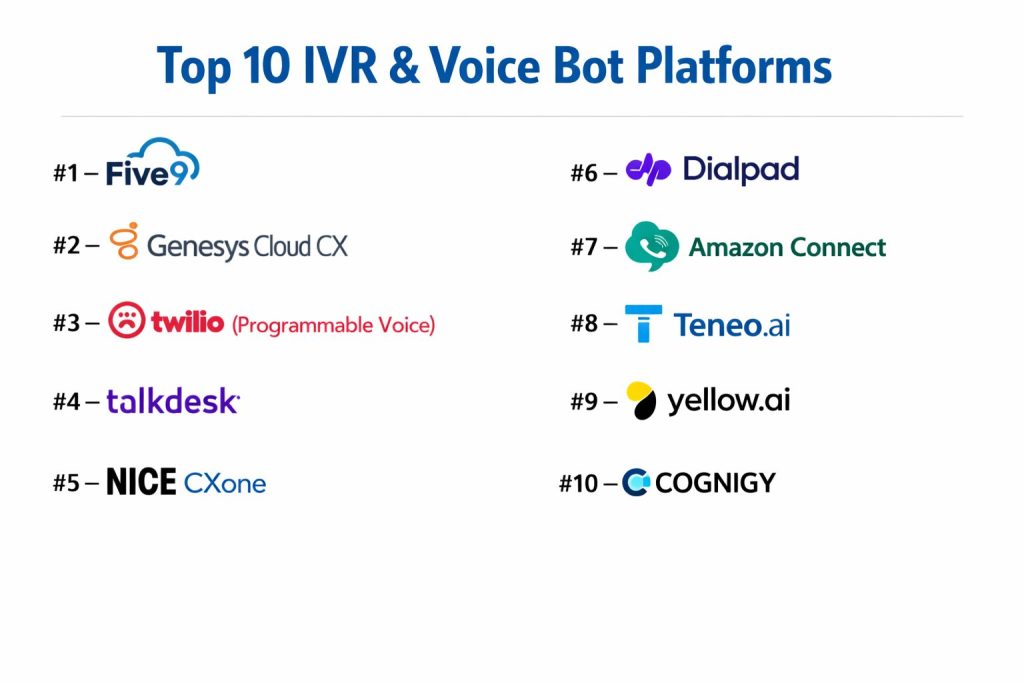
Top 10 IVR & Voice Bot Platforms
#1 — Five9
A cloud contact center pioneer famous for its “Intelligent Virtual Provider” (IVA) that uses multiple NLU engines to provide human-like self-service.
Key Features
- IVA (Intelligent Virtual Agent): Handles routine calls using high-end NLU to mimic human agents.
- Visual IVR: Optimized mobile prompts that allow users to interact with a menu on their screens.
- Agent Assist: Real-time AI guidance for human agents based on the voice bot’s initial interaction.
- Workflow Automation: Deep “out-of-the-box” integrations with Salesforce and ServiceNow.
- Call Summarization: Native Gen-AI that creates concise post-call notes for the CRM.
- Predictive Dialer: Sophisticated outbound engine for sales and proactive notifications.
Pros
- Rapid Deployment: Known for one of the fastest enterprise setup times in the CCaaS space.
- Omnichannel Excellence: Seamlessly transitions voice interactions to SMS or email.
Cons
- Cost: Can be expensive when adding multiple advanced AI and WFM modules.
- Complex Dashboards: The variety of administrative tools can have a steep learning curve.
Platforms / Deployment
- Web-based / Cloud
- Native iOS/Android apps for monitoring
Security & Compliance
- SOC 2, ISO 27001, GDPR, HIPAA, PCI-DSS.
Integrations & Ecosystem
- Salesforce, Microsoft Dynamics, Zendesk, ServiceNow.
Support & Community
- 24/7 technical support, dedicated account managers, and “Five9 University” for training.
#2 — Genesys Cloud CX
The “gold standard” for enterprise-grade customer experience, featuring a highly composable API-first architecture.
Key Features
- Architect: A world-class visual design tool for building both simple IVRs and multi-layered bots.
- Predictive Engagement: Uses AI to determine the best time to intervene in a customer journey.
- Native NLU: High-accuracy engine that supports complex intent libraries.
- Workforce Engagement (WEM): Fully integrated tools for scheduling and quality assurance.
- AppFoundry: A massive marketplace for third-party voice and CX tools.
- Global Low Latency: A microservices architecture hosted on AWS with 99.999% uptime.
Pros
- Infinite Scalability: Designed to handle tens of thousands of agents across global regions.
- Customization: Highly programmable for teams with unique workflow requirements.
Cons
- High Barrier to Entry: Requires significant technical resources to fully optimize the platform.
- Pricing Transparency: Enterprise quotes are complex and vary widely based on usage.
Platforms / Deployment
- Web / Cloud-native (AWS-hosted)
Security & Compliance
- FedRAMP, HIPAA, GDPR, SOC 2 Type II.
Integrations & Ecosystem
- Deep integrations with Microsoft 365, Salesforce, and specialized ERPs.
Support & Community
- Extensive global partner network and professional services for enterprise onboarding.
#3 — Twilio (Programmable Voice)
A developer-first platform that provides maximum flexibility for building custom IVR and AI voice agents from scratch.
Key Features
- Twilio Studio: A visual application builder for rapid prototyping of IVR flows.
- Twilio Autopilot: A conversational AI platform that builds bots capable of learning over time.
- Global Infrastructure: Local phone numbers in over 100 countries with carrier-grade reliability.
- Media Streams: Allows developers to fork audio in real-time to third-party AI engines like Google or OpenAI.
- Flex: A fully programmable contact center platform that can be entirely customized.
- Usage-Based Billing: Pay only for the minutes and features you actually use.
Pros
- Unmatched Flexibility: If you can code it, you can build it on Twilio.
- Low Cost for Builders: No massive upfront license fees for early-stage development.
Cons
- Developer Dependent: Not suitable for non-technical teams; requires coding knowledge for advanced bots.
- Support Tiers: Quality support is often locked behind expensive monthly “Support Plans.”
Platforms / Deployment
- API-driven / Cloud
Security & Compliance
- SOC 2, ISO 27001, GDPR, HIPAA-ready.
Integrations & Ecosystem
- Connects to any system via REST APIs; massive developer community and documentation.
Support & Community
- Strong developer documentation and community forums; tiered professional support.
#4 — Talkdesk
A modern, cloud-native contact center focused on “clicks-not-code” automation and specialized industry solutions.
Key Features
- Talkdesk Studio: An intuitive low-code tool to design customer journeys across voice and digital.
- Experience.ai: Specialized voice bots pre-trained for industries like retail and healthcare.
- Visual Feedback: Heat maps that show exactly where callers get stuck in the IVR.
- Knowledge Management: Bots pull answers directly from a centralized company wiki.
- AppConnect: One-click marketplace for adding third-party voice biometrics or AI tools.
- Global Low Latency (GLL): Specialized architecture to reduce voice lag in international calls.
Pros
- Ease of Use: One of the most user-friendly interfaces for non-technical administrators.
- Industry Clouds: Offers pre-configured solutions that meet specific regulatory needs.
Cons
- Limited Reporting: Some users find the out-of-the-box reporting less granular than NICE or Genesys.
- Tiered Features: Many of the best AI features are only available on the “Elite” plan.
Platforms / Deployment
- Web / Cloud
Security & Compliance
- SOC 2, ISO 27001, GDPR, HIPAA, PCI-DSS.
Integrations & Ecosystem
- Over 60+ native integrations including Slack, Zendesk, and Salesforce.
Support & Community
- Talkdesk Academy and proactive Customer Success Managers (CSMs).
#5 — NICE CXone
Arguably the most technically advanced platform for workforce management and high-scale voice analytics.
Key Features
- Enlighten AI: Analyzes 100% of interactions to provide sentiment scores and compliance monitoring.
- CXone SmartAssist: An end-to-end conversational AI solution for voice and chatbots.
- Omnichannel Routing: Syncs voice interactions perfectly with digital touchpoints.
- Advanced WFM: Market-leading scheduling and forecasting for massive agent pools.
- Self-Service Builder: Drag-and-drop IVR management with built-in NLU.
- Real-time Interaction Guidance: AI that coaches agents on their “soft skills” during live calls.
Pros
- Data Depth: Exceptional for organizations that prioritize analytics and efficiency metrics.
- Scalability: Built for the world’s largest enterprises with complex global routing.
Cons
- Complexity: The platform is massive and can feel overwhelming for mid-market users.
- UI Consistency: Some parts of the suite feel less modern than the “Cloud-First” competitors.
Platforms / Deployment
- Web / Cloud
Security & Compliance
- FedRAMP, SOC 2, HIPAA, GDPR, PCI-DSS.
Integrations & Ecosystem
- Deep connections with Salesforce, Oracle, and SAP.
Support & Community
- Premium support models and a vast network of certified implementation partners.
#6 — Dialpad
A sleek, AI-first communication platform that integrates voice, messaging, and meetings with built-in intelligence.
Key Features
- Dialpad Ai: Proprietary engine providing real-time transcription and “Agent Assist.”
- Self-Service IVR: Web-based setup for multi-level menus that can be changed in seconds.
- CSAT AI: Automatically predicts customer satisfaction scores for voice bot interactions.
- Real-time Analytics: Tracks keyword mentions and sentiment as the call happens.
- Mobile-First Design: Full administrative control of IVR flows from a smartphone app.
- Voice Intelligence: Automatically identifies action items and follows up via email.
Pros
- Affordability: One of the most cost-effective “AI-included” platforms for SMBs.
- Modern UX: Extremely clean interface that requires almost zero training.
Cons
- Feature Depth: Lacks some of the “Heavy Enterprise” features found in NICE or Genesys.
- Transcription Limits: While good, transcription accuracy can vary with heavy technical jargon.
Platforms / Deployment
- Web / Windows / macOS / iOS / Android
Security & Compliance
- SOC 2 Type II, ISO 27001, GDPR, HIPAA.
Integrations & Ecosystem
- Google Workspace, Microsoft 365, Salesforce, HubSpot.
Support & Community
- 24/7 live chat and phone support; comprehensive online help center.
#7 — Amazon Connect
A pay-as-you-go contact center service from AWS that leverages the same technology used by Amazon’s own customer service.
Key Features
- Amazon Lex: The same NLU engine that powers Alexa, used to create sophisticated voice bots.
- Amazon Polly: High-quality TTS with dozens of realistic, human-sounding voices.
- Contact Lens: AI-powered analytics for sentiment analysis and automated call categorization.
- Serverless Architecture: Automatically scales to handle millions of calls without management.
- Pay-As-You-Go: No minimum monthly fees; you pay only for the minutes consumed.
- Contact Control Panel (CCP): A web-based interface that integrates easily into any application.
Pros
- Cost Efficiency: Perfect for businesses with highly variable or seasonal call volumes.
- AWS Synergy: Seamlessly integrates with Lambda, S3, and the rest of the AWS ecosystem.
Cons
- Setup Complexity: Requires AWS expertise to configure properly; not a “turnkey” solution.
- Minimal UI: Most configuration is done through the AWS console, which is technical.
Platforms / Deployment
- Web / Cloud (AWS)
Security & Compliance
- FedRAMP, HIPAA, GDPR, PCI-DSS, SOC 1/2/3.
Integrations & Ecosystem
- Total integration with AWS; Salesforce and Zendesk adapters available.
Support & Community
- Backed by AWS Enterprise Support; vast community of AWS developers.
#8 — Teneo.ai
A specialist conversational AI platform designed for high-accuracy, mission-critical enterprise deployments.
Key Features
- Hybrid AI Architecture: Combines LLMs with deterministic NLU for 99%+ accuracy.
- NLU Accuracy Booster: Specifically designed to prevent “hallucinations” in regulated industries.
- Multi-LLM Support: No vendor lock-in; supports OpenAI, Anthropic, and proprietary models.
- Teneo Linguistic Modeling: Allows for precise control over how the bot responds.
- Global Language Support: High-performance automation in over 80 languages.
- Advanced ROI Calculator: Built-in tools to track the financial impact of every interaction.
Pros
- Extreme Accuracy: The top-rated platform for reducing errors in complex healthcare or finance calls.
- Governance: Exceptional guardrails for enterprises that cannot risk incorrect AI responses.
Cons
- Technicality: Requires a specialized team to manage the linguistic modeling layers.
- Niche Focus: Primarily focused on the “Brain” (AI) rather than being a full phone system.
Platforms / Deployment
- Cloud / Hybrid / On-Premise
Security & Compliance
- SOC 2, HIPAA, GDPR, ISO 27001.
Integrations & Ecosystem
- Integrates with Genesys, Twilio, and Microsoft Bot Framework.
Support & Community
- High-touch vendor support; swept all vendor satisfaction categories in recent industry reports.
#9 — Yellow.ai
A leading “Dynamic AI” platform known for its multi-lingual automation and rapid bot deployment across 35+ channels.
Key Features
- Dynamic AI Agents: Generative agents that use LLMs to handle non-linear conversations.
- Zero-Setup Bot: Uses your website and documents to train the voice bot instantly.
- Proprietary NLP: High-accuracy engine optimized for various global dialects and accents.
- Voice Gateway: Low-latency infrastructure designed specifically for voice-first interactions.
- Workflow Orchestrator: Connects voice bots to back-end systems (ERPs/CRMs) for resolution.
- Omnichannel Inbox: Unifies voice, WhatsApp, and web chat for human agents.
Pros
- Multilingual: One of the best options for global companies requiring automation in 40+ languages.
- Speed: Can go from “Idea to Production” in less than 3 weeks using their pre-built templates.
Cons
- Dashboard Complexity: The sheer number of channels and features can be overwhelming.
- Support Response: Some mid-market users report slower response times compared to Five9.
Platforms / Deployment
- Web / Cloud
Security & Compliance
- ISO 27001, SOC 2, HIPAA, GDPR.
Integrations & Ecosystem
- 100+ native integrations including SAP, Oracle, and Salesforce.
Support & Community
- Global support presence; strong documentation for developer-led teams.
#10 — Cognigy
An enterprise-grade conversational AI platform that excels in automating complex service processes with a visual, low-code interface.
Key Features
- Cognigy.AI: A centralized platform to build, manage, and analyze voice and chatbots.
- Cognigy Voice Gateway: Connects any bot to the phone network with sub-200ms latency.
- Smart Handoff: Transitions calls to human agents with a full transcript and intent summary.
- LLM Orchestration: Easily switch between different AI models (GPT-4, Claude, etc.) for different tasks.
- Visual Flow Editor: One of the most powerful and flexible visual builders on the market.
- Enterprise Security: Built-in PII (Personally Identifiable Information) redaction and audit logs.
Pros
- Developer/Business Balance: Powerful enough for devs, yet intuitive enough for business analysts.
- Flexibility: Outstanding for building “Process Bots” that actually complete tasks in back-end systems.
Cons
- Infrastructure Needs: The Voice Gateway is a separate module that requires specific configuration.
- Market Awareness: Smaller global footprint than giants like Genesys or AWS.
Platforms / Deployment
- Cloud / On-Premise / Private Cloud
Security & Compliance
- SOC 2, GDPR, ISO 27001, HIPAA-compliant.
Integrations & Ecosystem
- Native connectors for major contact centers (Avaya, Cisco, Genesys).
Support & Community
- High-quality technical support; active community and “Cognigy Academy.”
Comparison Table (Top 10)
| Tool Name | Best For | Platform(s) Supported | Deployment | Standout Feature | Public Rating |
| Five9 | Fast Implementation | Web, iOS, Android | Cloud | Intelligent Virtual Agent | 4.6 / 5 |
| Genesys Cloud CX | Global Enterprise | Web | Cloud | Architect Flow Designer | 4.5 / 5 |
| Twilio | Developer Customization | API-only | Cloud | Twilio Studio (Visual) | 4.2 / 5 |
| Talkdesk | Ease of Use | Web | Cloud | Experience Clouds | 4.4 / 5 |
| NICE CXone | Advanced Analytics | Web | Cloud | Enlighten AI Engine | 4.3 / 5 |
| Dialpad | SMB & Budget AI | Web, Win, Mac, iOS | Cloud | Real-time Transcription | 4.5 / 5 |
| Amazon Connect | Usage-Based Scaling | Web | Cloud | Amazon Lex (Alexa NLU) | 4.1 / 5 |
| Teneo.ai | Mission-Critical Accuracy | Cloud, On-Prem | Hybrid | 99%+ Hybrid AI Accuracy | 4.8 / 5 |
| Yellow.ai | Multilingual Growth | Web | Cloud | Dynamic Gen-AI Agents | 4.6 / 5 |
| Cognigy | Process Automation | Web, On-Prem | Cloud/Hybrid | Low-Latency Voice Gateway | 4.7 / 5 |
Evaluation & Scoring of IVR & Voice Bot Platforms
This scoring model reflects the performance, reliability, and technical depth required.
| Tool Name | Core (25%) | Ease (15%) | Int. (15%) | Sec. (10%) | Perf. (10%) | Supp. (10%) | Value (15%) | Weighted Total |
| Five9 | 9 | 9 | 9 | 9 | 8 | 9 | 8 | 8.75 |
| Genesys Cloud CX | 10 | 6 | 10 | 10 | 10 | 9 | 7 | 8.85 |
| Twilio | 10 | 3 | 10 | 9 | 10 | 7 | 9 | 8.15 |
| Talkdesk | 9 | 10 | 9 | 9 | 8 | 9 | 8 | 8.75 |
| NICE CXone | 10 | 5 | 10 | 10 | 10 | 9 | 7 | 8.70 |
| Dialpad | 8 | 10 | 8 | 8 | 9 | 9 | 10 | 8.75 |
| Amazon Connect | 9 | 4 | 9 | 10 | 10 | 8 | 10 | 8.15 |
| Teneo.ai | 10 | 5 | 8 | 10 | 10 | 10 | 7 | 8.55 |
| Yellow.ai | 9 | 8 | 9 | 9 | 9 | 8 | 9 | 8.75 |
| Cognigy | 9 | 8 | 9 | 9 | 10 | 9 | 8 | 8.75 |
How to interpret these scores:
- Core (25%): Measures the baseline quality of NLU and voice synthesis.
- Value (15%): High scores here indicate a strong ROI relative to the total cost of ownership.
- Perf. (10%): Measures audio quality and the platform’s latency (speed of response).
Which IVR & Voice Bot Platform Is Right for You?
Startups & Early-Stage SaaS
For small teams, Dialpad is the most logical starting point. It offers enterprise-grade AI features (transcription, basic bots) at a price point that won’t drain your runway. If you have developers, Twilio is a great “build-your-own” alternative.
Mid-Market (50-500 Agents)
Five9 and Talkdesk are the leaders here. They provide a balance of advanced AI capabilities with an interface that doesn’t require an army of IT specialists to manage.
Global Enterprise
If you operate across continents and need high-end workforce management, Genesys Cloud CX or NICE CXone are the industry requirements. They offer the security certifications and data processing power that large organizations demand.
Regulated Industries (Health/Finance)
Teneo.ai is specifically designed for environments where a 1% error rate is unacceptable. Its hybrid AI model ensures that bots stay on-script when dealing with medical or financial advice while using LLMs for natural conversation.
Budget-Conscious / Variable Volume
Amazon Connect is the clear winner for organizations that have high seasonal peaks. You only pay for what you use, making it significantly cheaper during “slow” months than a traditional per-seat subscription.
Multilingual Requirements
If your primary challenge is supporting 20+ different languages, Yellow.ai has one of the most robust and fastest-to-deploy multilingual NLU engines on the market.
Frequently Asked Questions (FAQs)
What is the difference between a traditional IVR and a Voice Bot?
Traditional IVR is a “decision tree” where users navigate menus using a keypad. A Voice Bot (or IVA) is conversational; it uses AI to understand spoken sentences and can respond naturally without the user ever pressing a button.
How much does it cost to implement an AI Voice Bot?
Implementation costs vary. While some platforms like Dialpad include AI in their standard tiers ($25-$40/user), enterprise implementations for Genesys or Five9 can range from $5,000 to $50,000 in one-time setup fees, depending on complexity.
What is “Latency” and why does it matter?
Latency is the delay between a user finishing a sentence and the bot responding. In 2026, anything above 600ms feels “robotic.” The best platforms (Cognigy, Twilio) aim for sub-400ms to maintain a human-like conversation flow.
Can these bots handle accents and slang?
Yes. Modern NLU engines (like those from Google, Amazon, and Teneo) are trained on billions of voice samples and are highly capable of understanding varied accents and regional dialects.
Is my customer’s voice data secure?
Top-tier platforms offer “PII Redaction,” which automatically removes sensitive data from transcripts. Ensure your provider is SOC 2 compliant and offers encryption for both voice recordings and text data.
Do I need to hire developers to set this up?
Not necessarily. Platforms like Talkdesk and Monday.com (via integrations) use “no-code” visual builders. However, for deep integration into your company’s specific database, a small amount of developer time is usually required.
Can a voice bot transfer to a human?
Yes. This is called a “Warm Handoff.” The bot transfers the call to a human agent and simultaneously sends a screen-pop with the transcript and the customer’s intent, so the agent doesn’t have to ask “How can I help you?” again.
What is “Voice Biometrics”?
It’s a security feature offered by platforms like NICE and Nuance that identifies a person by their unique “voiceprint,” allowing them to access accounts without needing a password or mother’s maiden name.
Can I use these for outbound calling?
Yes. Many platforms (Five9, RingCentral) offer sophisticated outbound dialers for payment reminders, appointment confirmations, and lead qualification, all while staying compliant with TCPA regulations.
Does the bot sound like a robot?
Not anymore. With advances in Neural Text-to-Speech (TTS) from companies like ElevenLabs and Amazon Polly, you can choose voices that include natural breathing, intonation, and even specific brand-friendly personalities.
Conclusion
IVR and Voice Bot platforms are no longer “optional” add-ons; they are the core engine of scalable customer service. For most businesses, Five9 and Talkdesk offer the best blend of features and ease of use. However, for those requiring maximum precision in regulated sectors, Teneo.ai stands alone.
The shift toward autonomous voice agents is accelerating. Organizations that leverage these tools today will define the customer experience standards of tomorrow.