Introduction
Outbound dialer software is a specialized communication technology designed to automate the process of placing outgoing calls to customers or prospects. These systems have moved beyond simple auto-dialing; they now function as AI-driven engines that manage “call reputation,” predict the optimal time to reach a human, and eliminate the “telemarketer delay” through ultra-low latency technology. By automating the mechanical aspects of dialing, these tools allow sales and support teams to focus exclusively on the conversation.
The relevance of outbound dialers is fueled by the aggressive crackdown on spam by mobile carriers and the rise of AI-led sales motions. Organizations can no longer rely on volume alone; they must maintain a high “Attributed Trust Score” to ensure their calls even reach the recipient’s screen. Modern dialers now integrate “Identity Orchestration” to rotate verified numbers and use “Sentiment Analysis” to coach agents in real-time during live calls.
Real-world use cases include:
- High-Velocity Sales (BDR/SDR): Automating cold outreach to generate pipeline with parallel dialing capabilities.
- Debt Collection: Managing high-volume payment reminders while strictly adhering to compliance windows and state laws.
- Political & Non-Profit Campaigning: Scaling volunteer outreach for fundraising and “Get Out The Vote” initiatives.
- Proactive Customer Support: Reaching out to users about service outages or upcoming subscription renewals.
- Market Research: Conducting large-scale surveys where high connection rates and data logging are critical.
What buyers should evaluate (Criteria):
- Dialing Logic: Support for Predictive (AI-paced), Power (sequential), and Preview (manual review) modes.
- Latency (The “Hello” Gap): The speed at which an agent is connected once a human answers (ideally <100ms).
- Compliance Guardrails: Native features for TCPA, GDPR, and automated DNC (Do Not Call) list scrubbing.
- Caller ID Reputation Management: Tools to monitor and fix “Spam Risk” labels across major carriers.
- CRM Bi-directional Sync: How seamlessly call data, recordings, and outcomes flow into Salesforce, HubSpot, or Zoho.
- AI Coaching & Whisper: Real-time transcription and the ability for managers to “whisper” advice to agents.
- Local Presence: The ability to dynamically show a local area code to increase pick-up rates.
- Answering Machine Detection (AMD): The accuracy of the software in filtering out voicemails without dropping live humans.
Key Trends in Outbound Dialer Software
The landscape is defined by “Trust-Based Outreach” and “Latency Elimination.”
- Ultra-Low Latency Connections: Platforms now compete on “Time-to-Talk,” ensuring the agent hears the first “Hello” instantly to avoid the robotic silence that triggers hang-ups.
- Automated Identity Rotation: Software that automatically swaps out phone numbers if they are flagged as “Spam” by carriers like AT&T or Verizon.
- Generative Voice Agents: The rise of autonomous AI callers capable of handling basic qualification or scheduling before handing off to a human.
- STIR/SHAKEN Native Support: Built-in protocol compliance to verify caller identity and prevent number spoofing.
- Emotion & Sentiment Scoring: AI that analyzes the prospect’s tone in real-time to alert the agent to adjust their pitch.
- Asynchronous Voicemail Drops: High-fidelity pre-recorded messages that can be dropped with one click, appearing as a natural “missed call.”
- Predictive Lead Scoring: Linking the dialer to intent data to prioritize calling prospects who are currently active on your website.
- Hyper-Personalized Preview: AI-generated “icebreakers” appearing on the agent’s screen based on the prospect’s recent LinkedIn activity.
How We Selected These Tools (Methodology)
Our selection for the top 10 outbound dialers is based on a weighted evaluation of technical performance and compliance:
- Connection Success Rate: We prioritized tools with advanced AMD (Answering Machine Detection) and low drop rates.
- Reputation Shielding: Tools were favored if they offered native monitoring for Caller ID “Spam” labeling.
- Integration Depth: Evaluation of how well the dialer “lives” inside common CRMs to prevent context switching.
- Compliance Maturity: A focus on tools that provide automated audit trails and DNC management.
- Voice Quality & Latency: Measurement of the underlying VOIP infrastructure and global point-of-presence (PoP).
- User Feedback (2026): Aggregated sentiment from professional SDRs and call center managers on G2 and TrustRadius.
- Cost-to-Value Ratio: Assessment of whether the features provided justify the per-seat or per-minute cost.
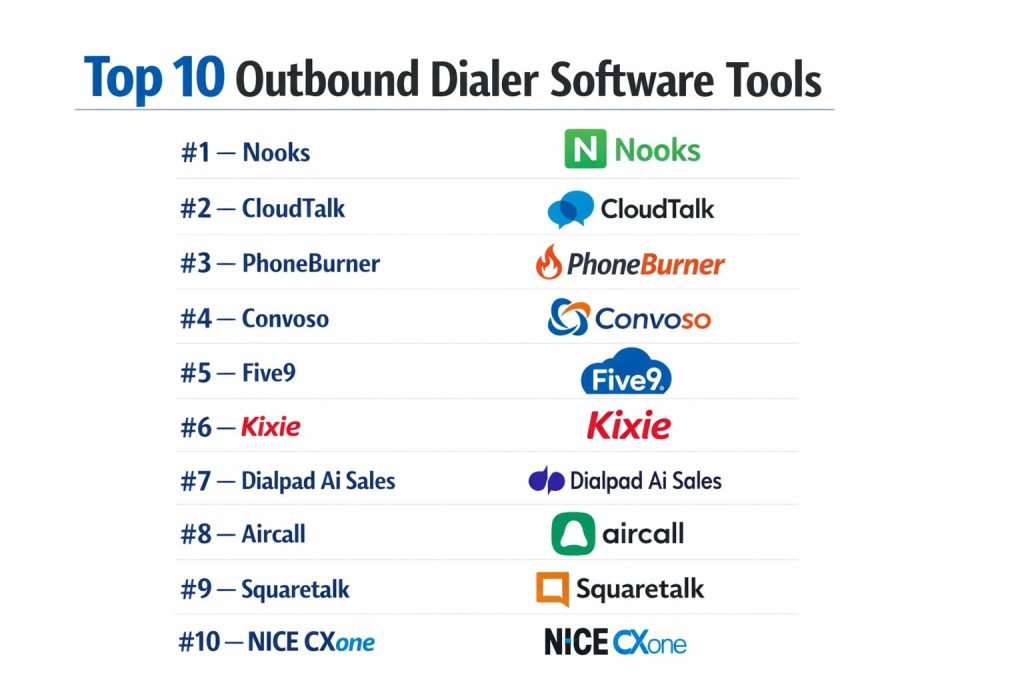
Top 10 Outbound Dialer Software Tools
#1 — Nooks
An AI-powered “Virtual Sales Floor” and dialer designed for high-growth sales teams. It focuses on reducing “dead time” between conversations using parallel dialing.
Key Features
- Parallel Dialer: Dials multiple lines simultaneously and connects the agent only when a human answers.
- Virtual Floor: A digital space where agents can see each other and “co-work” while the dialer runs.
- Automated Prospecting: Uses AI to identify which leads are most likely to pick up at any given hour.
- AI Call Summaries: Automatically writes call notes and updates the CRM once the call ends.
- Spam Protection: Real-time monitoring of number health across all major mobile carriers.
- Live Coaching: Allows managers to listen in and jump into the “floor” to give instant feedback.
Pros
- High Efficiency: Massive increase in talk time (often 3-5x) compared to manual dialing.
- Culture Builder: The virtual floor helps remote teams maintain a high-energy sales environment.
Cons
- Cost: Significantly more expensive than basic auto-dialers; geared toward high-revenue sales teams.
- Aggressive: Parallel dialing can lead to higher “dropped call” rates if not tuned correctly.
Platforms / Deployment
- Web / macOS / Windows / iOS / Android
- Cloud
Security & Compliance
- SOC 2 Type II, GDPR, TCPA tools, DNC scrubbing.
Integrations & Ecosystem
- Salesforce, HubSpot, Salesloft, Outreach, Apollo.io.
#2 — CloudTalk
A modern, cloud-based phone system built specifically for sales and customer service teams. It excels at international reach and ease of use.
Key Features
- Power Dialer: Automatically moves to the next contact in a campaign list after a call is completed.
- Smart Detection: Filters out busy signals, voicemails, and disconnected numbers.
- 160+ Country Numbers: Instant access to local numbers in almost every global market.
- Call Workflow Automation: Drag-and-drop builder to create custom logic for call routing and follow-ups.
- Speech-to-Text: Native transcription of all outbound calls for quality assurance.
- Real-time Analytics: Visual dashboards tracking agent performance and campaign success.
Pros
- Intuitive UI: One of the easiest platforms to set up; requires minimal agent training.
- Global Reach: Exceptional call quality for international outbound campaigns.
Cons
- Advanced Features Gated: Predictive dialing features are only available in the highest-tier plans.
- Reporting Lag: Occasional delays in dashboard data refreshing during peak hours.
Platforms / Deployment
- Web / Windows / macOS / Linux / iOS / Android
- Cloud
Security & Compliance
- ISO 27001, SOC 2, GDPR, HIPAA (Specific plans).
Integrations & Ecosystem
- Pipedrive, Zoho CRM, Intercom, Zendesk, Slack.
#3 — PhoneBurner
A “Power Dialer” that prioritizes simplicity and 100% human-to-human connection. It is the top choice for solo agents and small teams.
Key Features
- Zero Connection Delay: No “telemarketer pause” because the agent is already on the line when the prospect answers.
- One-Click Voicemail: Drops a pre-recorded, personalized voicemail with a single button.
- Smart Lead Distribution: Automatically routes leads to the next available agent based on performance.
- Email & SMS Follow-up: Send multi-channel follow-ups instantly after a call concludes.
- Lead Tracking: Built-in mini-CRM for users who don’t already have one.
- Local ID: Displays a local area code for every call to boost pick-up rates.
Pros
- User Experience: Very low friction; agents can start calling within minutes of signing up.
- Reliability: Known for extremely high uptime and consistent voice quality.
Cons
- Single Line only: Does not offer parallel or predictive dialing for massive volume.
- Limited Automation: Less sophisticated “if-then” logic compared to Monday-integrated tools.
Platforms / Deployment
- Web / iOS / Android
- Cloud
Security & Compliance
- SOC 2 Type II, TCPA compliance focus, GDPR.
Integrations & Ecosystem
- Salesforce, HubSpot, Zoho, Zapier.
#4 — Convoso
A heavy-duty “Lead Penetration” platform designed for high-volume call centers focused on maximum ROI and compliance.
Key Features
- Advanced Predictive Dialer: Algorithmically adjusts the dialing rate based on agent availability and lead quality.
- ClearControl: A proprietary suite that protects your caller IDs from being flagged as “Spam.”
- Omnichannel Outreach: Seamlessly switch between voice, SMS, and email within one campaign.
- Dynamic Scripting: Interactive scripts that change based on the prospect’s answers.
- Workflow Automation: Automatically moves leads to different campaigns based on call outcomes.
- PCI Compliance: Securely handle payment information during outbound collections.
Pros
- Lead Conversion: Market leader in getting through to “hard-to-reach” leads.
- Compliance: Extensive features to prevent TCPA lawsuits and carrier blocking.
Cons
- Complex Setup: Requires a dedicated admin to manage the intricate settings and campaigns.
- Legacy Feel: The UI is more technical and less “sleek” than modern SaaS competitors.
Platforms / Deployment
- Web
- Cloud
Security & Compliance
- SOC 2, PCI DSS, TCPA focus, HIPAA.
Integrations & Ecosystem
- Salesforce, Leadspedia, Veloxity, API access.
#5 — Five9
An enterprise-grade Intelligent Contact Center (ICC) that provides sophisticated outbound dialing for large-scale operations.
Key Features
- Triple Mode Dialer: Switch between Predictive, Power, and Progressive dialing within the same platform.
- Five9 Genius AI: Analyzes every interaction to provide real-time guidance to agents.
- Visual IVR: Allows customers to interact with menus on their mobile screens during an outbound call.
- Workforce Management (WFM): Advanced scheduling to ensure the right number of agents are online.
- Pre-built Templates: Industry-specific workflows for healthcare, finance, and retail.
- Agent Desktop: A unified interface that pulls data from multiple backend systems.
Pros
- Scale: Can handle tens of thousands of agents across multiple global locations.
- Enterprise Support: Dedicated technical account managers and 24/7 global support.
Cons
- High Barrier to Entry: Steep pricing and long implementation times make it unsuitable for small teams.
- Rigid UI: Less flexible customization for agents compared to newer platforms like Nooks.
Platforms / Deployment
- Web / Windows / macOS / iOS / Android
- Cloud
Security & Compliance
- FedRAMP, SOC 2 Type II, PCI DSS Level 1, HIPAA, GDPR.
Integrations & Ecosystem
- Oracle, SAP, Microsoft Dynamics 365, Salesforce, ServiceNow.
#6 — Kixie
A sales-focused dialer that integrates deeply into CRMs to provide a “one-click” calling experience for high-velocity teams.
Key Features
- Multi-line Power Dialer: Dials up to 10 lines at once for maximum outreach.
- Auto-SMS on Missed Call: Automatically texts a prospect if they don’t answer the call.
- Bi-directional CRM Sync: Every note, recording, and outcome is synced to the CRM in real-time.
- Local Presence: Enterprise-grade local presence to ensure high connection rates.
- Leaderboards: Gamification features to keep sales teams motivated.
- Voicemail Drop: High-speed delivery of pre-recorded messages.
Pros
- CRM Power User Favorite: The integration with HubSpot and Pipedrive is arguably the best in the industry.
- Fast Implementation: Can be fully integrated and running in under an hour.
Cons
- Feature Focus: Lacks the deep workforce management features found in enterprise tools like Five9.
- Browser Dependent: Performance is best in Chrome; other browsers can experience minor issues.
Platforms / Deployment
- Web / Chrome Extension / iOS / Android
- Cloud
Security & Compliance
- SOC 2 (via AWS), GDPR, TCPA tools.
Integrations & Ecosystem
- HubSpot, Salesforce, Pipedrive, Zoho CRM, Copper.
#7 — Dialpad Ai Sales
A communications platform that uses proprietary AI to provide real-time transcriptions and sales coaching.
Key Features
- Real-time Assist Cards: AI-driven pop-ups that tell agents what to say when a prospect mentions a competitor.
- Live Sentiment Tracking: Visual indicators showing if a call is going well or poorly.
- Automatic Post-Call Summaries: Generates a short summary and action items immediately after the call.
- Built-in Power Dialer: Streamlined calling for high-volume sales outreach.
- Manager Alerts: Notifies managers if a call has an unusually long silence or negative sentiment.
- Unified Comms: Includes video meetings and messaging in the same app.
Pros
- Intelligence: The most “smart” tool on the list regarding live conversation analysis.
- Ease of Use: Very modern and intuitive interface that agents enjoy using.
Cons
- AI Accuracy: Transcription and sentiment can struggle with heavy accents or industry-specific jargon.
- Predictive Missing: Focused on Power/Preview dialing rather than mass predictive dialing.
Platforms / Deployment
- Web / Windows / macOS / iOS / Android
- Cloud
Security & Compliance
- SOC 2 Type II, ISO 27001, HIPAA, GDPR.
Integrations & Ecosystem
- Salesforce, Google Workspace, Microsoft 365, Slack.
#8 — Aircall
A cloud-based call center solution designed for businesses that want a balance of simplicity, reliability, and CRM connectivity.
Key Features
- Power Dialer Extension: Allows agents to compile a list and dial through them without leaving their browser.
- Call Tagging & Notes: Standardized tags to help with post-campaign analysis.
- Shared Inbox: Allows a team to manage a pool of outbound and inbound calls collectively.
- Warm Transfers: Easily hand off a prospect to a senior closer with a quick internal briefing.
- Detailed Analytics: Advanced filtering for call volume, duration, and agent activity.
- Mobile App: One of the most stable mobile calling experiences in the SaaS market.
Pros
- Reliability: Exceptional uptime and call quality due to a global network of data centers.
- Integration Library: Connects with over 100+ business tools with one-click setup.
Cons
- Advanced Dialing: Lacks parallel or predictive dialing; strictly a one-at-a-time power dialer.
- Pricing: The “Professional” tier required for the power dialer can be pricey for small teams.
Platforms / Deployment
- Web / Windows / macOS / iOS / Android
- Cloud
Security & Compliance
- SOC 2 Type II, GDPR, HIPAA.
Integrations & Ecosystem
- Monday.com, HubSpot, Salesforce, Zendesk, Front.
#9 — Squaretalk
A comprehensive communication platform that excels at AI-driven predictive dialing and multi-channel campaign management.
Key Features
- Matrix Predictive Dialer: A high-performance engine that optimizes agent talk time while minimizing idle time.
- Integrated SMS/WhatsApp: Carry out outbound messaging campaigns alongside voice calls.
- Smart Lead Scoring: Ranks leads in the dialer based on their interaction history.
- Custom IVR Designer: Build complex outbound voice menus for surveys or automated notifications.
- Agent Performance Tracking: In-depth metrics on average handle time and conversion per agent.
- Global DID Coverage: Local phone numbers in 100+ countries with low latency.
Pros
- Flexibility: Great for companies that need both high-volume dialing and digital messaging.
- Value: Competitive pricing for the level of AI features provided.
Cons
- Support: Response times can vary depending on the region and plan level.
- Interface: Some users find the administrative backend a bit cluttered compared to Dialpad.
Platforms / Deployment
- Web
- Cloud
Security & Compliance
- SOC 2, GDPR, PCI DSS.
Integrations & Ecosystem
- Zoho, Salesforce, Freshworks, Pipedrive.
#10 — NICE CXone
The industry-leading CX platform for massive enterprises requiring total control over workforce and outbound operations.
Key Features
- Personal Connection Dialer: Uses patented technology to eliminate the “dialer delay” for a natural greeting.
- Unified CCaaS Suite: Integrates outbound dialing with inbound, digital, and self-service channels.
- Enlighten AI: Predictive AI that identifies the best “personality match” between agent and prospect.
- Workforce Intelligence: Automatically adjusts staffing and campaign pacing based on real-time KPIs.
- Compliance Management: Automated tools to manage complex global regulatory requirements.
- Real-time Dashboards: Highly customizable executive-level reporting for massive data sets.
Pros
- Power: Unmatched in its ability to handle complex, global enterprise requirements.
- Innovation: Constantly pioneers new technologies like behavioral routing.
Cons
- Learning Curve: Requires significant expertise and time to configure and master.
- Implementation Cost: Professional services are usually required for setup, adding to the initial investment.
Platforms / Deployment
- Web / Windows
- Cloud
Security & Compliance
- FedRAMP, SOC 2 Type II, ISO 27001, HIPAA, PCI DSS Level 1.
Integrations & Ecosystem
- Major CRM/ERP systems (Salesforce, SAP, Oracle, Microsoft).
Comparison Table (Top 10)
| Tool Name | Best For | Platform(s) Supported | Deployment | Standout Feature | Public Rating |
| Nooks | High-Growth Sales | Web, Mac, Win, iOS | Cloud | Virtual Sales Floor | 4.8 / 5 |
| CloudTalk | International SMBs | Web, Win, Mac, iOS | Cloud | 160+ Country Numbers | 4.5 / 5 |
| PhoneBurner | Simple Power Dialing | Web, iOS, Android | Cloud | Zero Connection Delay | 4.7 / 5 |
| Convoso | Lead Penetration | Web | Cloud | ClearControl (Spam Mgmt) | 4.4 / 5 |
| Five9 | Enterprise Scale | Web, Win, Mac, iOS | Cloud | Genius AI Coaching | 4.2 / 5 |
| Kixie | CRM Power Users | Web, Chrome, iOS | Cloud | Multi-line Power Dialer | 4.6 / 5 |
| Dialpad Ai Sales | Conversation Intel | Web, Win, Mac, iOS | Cloud | Real-time Assist Cards | 4.7 / 5 |
| Aircall | Reliability & UX | Web, Win, Mac, iOS | Cloud | 100+ Native Integrations | 4.3 / 5 |
| Squaretalk | Predictive AI | Web | Cloud | Matrix Dialer Engine | 4.4 / 5 |
| NICE CXone | Enterprise PMO | Web, Win | Cloud | Personal Connection (Low Latency) | 4.1 / 5 |
Evaluation & Scoring of Outbound Dialer Software
The following scoring model evaluates these tools based on their performance levels and feature sets.
| Tool Name | Core (25%) | Ease (15%) | Int. (15%) | Sec. (10%) | Perf. (10%) | Supp. (10%) | Value (15%) | Weighted Total |
| Nooks | 10 | 8 | 9 | 9 | 10 | 9 | 7 | 8.90 |
| CloudTalk | 8 | 10 | 9 | 8 | 8 | 8 | 9 | 8.45 |
| PhoneBurner | 7 | 10 | 8 | 8 | 10 | 9 | 8 | 8.40 |
| Convoso | 10 | 5 | 8 | 9 | 9 | 8 | 7 | 7.95 |
| Five9 | 10 | 4 | 10 | 10 | 9 | 10 | 6 | 8.35 |
| Kixie | 9 | 9 | 10 | 8 | 9 | 9 | 8 | 8.90 |
| Dialpad Ai Sales | 8 | 9 | 9 | 9 | 9 | 8 | 8 | 8.45 |
| Aircall | 7 | 10 | 10 | 9 | 10 | 9 | 7 | 8.55 |
| Squaretalk | 9 | 7 | 8 | 8 | 8 | 8 | 9 | 8.15 |
| NICE CXone | 10 | 3 | 10 | 10 | 10 | 9 | 6 | 8.10 |
How to interpret these scores:
- Weighted Total: Scores above 8.5 (Nooks, Kixie, Aircall) are the current gold standards for modern business.
- Perf. (10%): A 10/10 indicates the platform has industry-leading “Zero Latency” connection technology.
- Core (25%): Measures the robustness of the dialing algorithms and lead management.
Which Outbound Dialer Software Tool Is Right for You?
Solo / Individual Professional
If you are a solo real estate agent or a freelancer, PhoneBurner is the most logical choice. It offers the professional “one-click” dialing you need without the technical overhead of a complex CRM-integrated system.
Small Sales Team (2-10 Agents)
For a tight-knit sales team, Kixie or CloudTalk provide the best balance. They allow for rapid setup and deep integration into the tools you likely already use, such as HubSpot or Pipedrive.
Mid-Market Sales Org (10-50 Agents)
High-growth teams with aggressive targets should look at Nooks or Dialpad Ai Sales. These tools provide the “Virtual Floor” energy and real-time AI coaching necessary to ramp up new reps and maintain high call volume.
Large Enterprise / BPO
Global operations with massive lead lists require Five9 or NICE CXone. These platforms provide the governance, workforce management, and multi-country compliance that smaller SaaS tools cannot match.
Budget vs Premium
- Budget: Squaretalk and CloudTalk often offer more competitive per-user pricing for standard features.
- Premium: Nooks is a premium investment for teams where “speed-to-lead” and “talk time” are the primary drivers of revenue.
High-Volume Collections
If you are in a highly regulated industry like debt collection or telemarketing, Convoso is specifically engineered for “lead penetration” while staying within the strict guardrails of the TCPA.
Knowledge & Documentation Focused
If your team requires heavy recording, transcription, and “keyword tracking” for training, Dialpad Ai Sales is the leader in conversation intelligence.
International Campaigns
If your strategy involves calling multiple different countries daily, CloudTalk and Aircall offer the most seamless experience for procuring and managing international DIDs (Direct Inward Dialing).
Frequently Asked Questions (FAQs)
What is the difference between a Power Dialer and a Predictive Dialer?
A Power Dialer dials numbers one by one for an agent who is already on the line. A Predictive Dialer uses AI to dial multiple numbers at once and connects an agent only when a live human answers, predicting when the next agent will be free.
Is outbound dialer software legal?
Yes, but it is highly regulated. In the US, the TCPA (Telephone Consumer Protection Act) governs how and when you can call people. Most top-tier software includes “Safe Mode” features to ensure you stay compliant.
What is “Telemarketer Delay”?
This is the 1-2 second pause after a person says “Hello” before an agent is connected. In 2026, modern dialers like Nooks and PhoneBurner have eliminated this to ensure the agent is heard the moment the recipient answers.
What does “Local Presence” mean?
Local Presence allows the software to display a phone number with the same area code as the person you are calling. This can increase pick-up rates by up to 300% because people are more likely to answer local calls.
Can these tools detect answering machines?
Yes. Most modern dialers use AMD (Answering Machine Detection) to identify if a human or a machine picked up. High-quality tools can do this in under 500ms with over 95% accuracy.
Do I need special hardware to use an outbound dialer?
No, all major outbound dialers are cloud-based and run in a standard web browser (like Chrome) or a lightweight desktop app. A high-quality USB or Bluetooth headset is the only hardware required.
How do I prevent my numbers from being flagged as “Spam”?
Top-tier dialers (like Convoso or Nooks) include “Reputation Management.” They monitor your numbers across carriers and automatically rotate them if they start getting flagged by carrier-level AI filters.
Can I leave a pre-recorded voicemail?
Yes, this is called a “Voicemail Drop.” It allows an agent to click a button to leave a high-quality, pre-recorded message while they immediately move on to the next call.
Does the software integrate with my CRM?
Almost all professional dialers integrate with Salesforce and HubSpot. However, the “depth” of integration varies—some just log the call, while others (like Kixie) allow you to dial directly from inside the CRM.
What is a “Parallel Dialer”?
A parallel dialer is a type of auto-dialer that dials multiple phone lines simultaneously for a single agent. It is designed to maximize talk time by skipping through no-answers, busy signals, and voicemails in parallel.
Conclusion
The outbound dialer software you choose will be the engine of your revenue generation. For teams focused on sales speed and culture, Nooks and Kixie represent the cutting edge of productivity. If your organization prioritizes enterprise stability and global scale, Five9 or NICE CXone remain the heavyweights of the industry.
Regardless of the tool you choose, the focus must be on “trust.” In a world of aggressive spam filtering, the ability to maintain a clean caller reputation and provide a high-quality human interaction is what will ultimately separate successful outreach from ignored noise.