Introduction
Call center software, also known as Contact Center as a Service (CCaaS) , refers to the technology suites that manage inbound and outbound customer communications. Unlike traditional phone systems, these platforms unify voice, SMS, email, and social messaging into a single interface. In the current landscape, call center software has transitioned from a simple “dialer” into an AI-orchestration hub that manages customer journeys and agent productivity in real-time.
The relevance of call center software is centered on “Zero-Latency Service.” Customers no longer tolerate long hold times or repeating their issues across channels. Modern software solves this by using AI to predict caller intent and routing them to the best-fit resource instantly. Furthermore, the rise of “Super Agents”—human agents augmented by real-time AI prompts—allows companies to maintain high service quality despite increasing complexity in customer inquiries.
Real-world use cases include:
- Technical Support: Using screen-sharing and AI-guided troubleshooting to resolve complex IT issues.
- Proactive Outbound Sales: Leveraging predictive dialers that connect agents only to live prospects, maximizing “talk time.”
- Emergency Dispatch & Healthcare: Ensuring high-reliability voice connections and HIPAA-compliant data handling for sensitive interactions.
- Global E-commerce: Managing multi-language support across WhatsApp, Chat, and Voice for a worldwide customer base.
- Financial Services: Utilizing voice biometrics for identity verification and secure transaction processing.
What buyers should evaluate (Criteria):
- Omnichannel Continuity: The ability to see a customer’s full history across all digital and voice channels.
- AI & Automation Depth: Quality of native AI features like sentiment analysis, auto-summarization, and voice bots.
- Global Infrastructure: Availability of local carrier-grade connections and 99.999% uptime guarantees.
- Workforce Engagement (WEM): Tools for shift scheduling, quality assurance, and agent coaching.
- Compliance Posture: Support for industry-specific standards like PCI-DSS, HIPAA, and GDPR.
- CRM Synergy: How deeply the software syncs with platforms like Salesforce, HubSpot, or Zendesk.
- Supervisor Visibility: Real-time dashboards that flag sentiment drops or long wait times as they happen.
- Developer Extensibility: Availability of robust APIs and SDKs for building custom workflows.
Key Trends in Call Center Software
The call center environment is defined by “Agentic AI” and “Predictive Engagement.”
- Generative AI Coaching: Systems now listen to live calls and provide agents with “Next Best Action” prompts and instant knowledge base lookups.
- Sentiment-Based Routing: Calls are automatically escalated to senior managers if the AI detects high levels of caller frustration in real-time.
- Voice Biometrics: Replacing traditional security questions with unique voiceprint technology for faster, more secure authentication.
- Post-Call Automation: AI now generates 100% of call summaries and updates CRM records instantly, saving agents up to 5 minutes per interaction.
- Omnichannel Orchestration: Moving beyond “multi-channel” to a unified state where a customer can switch from chat to voice without losing context.
- Proactive Outreach: AI identifies potential issues (like a shipping delay) and calls the customer before they realize there is a problem.
- Virtual Agent Maturity: Voice bots now handle 60% of routine inquiries (e.g., “Where is my order?”) with human-like natural language understanding.
- Remote-First Workforces: Advanced security guardrails that allow agents to work securely from any location without specialized hardware.
How We Selected These Tools (Methodology)
Our selection of the top 10 call center software tools is based on a structured evaluation of technical maturity and market performance:
- Reliability & Uptime: We prioritized “five-nines” (99.999%) availability and global carrier-grade voice quality.
- AI Innovation: Preference was given to platforms that offer native, proprietary AI rather than simple third-party plugins.
- Integration Density: We analyzed the breadth and depth of native connections to major CRM and ERP systems.
- User Experience (UX): We evaluated both the agent “workspace” and the supervisor “dashboard” for clarity and speed.
- Security & Governance: Each tool was vetted for modern compliance certifications and data residency options.
- Scalability: We selected tools capable of growing from 10-person startups to 10,000-seat global enterprises.
- Market Reputation: Inclusion was influenced by G2 ratings, Gartner Magic Quadrant positioning, and enterprise peer reviews.
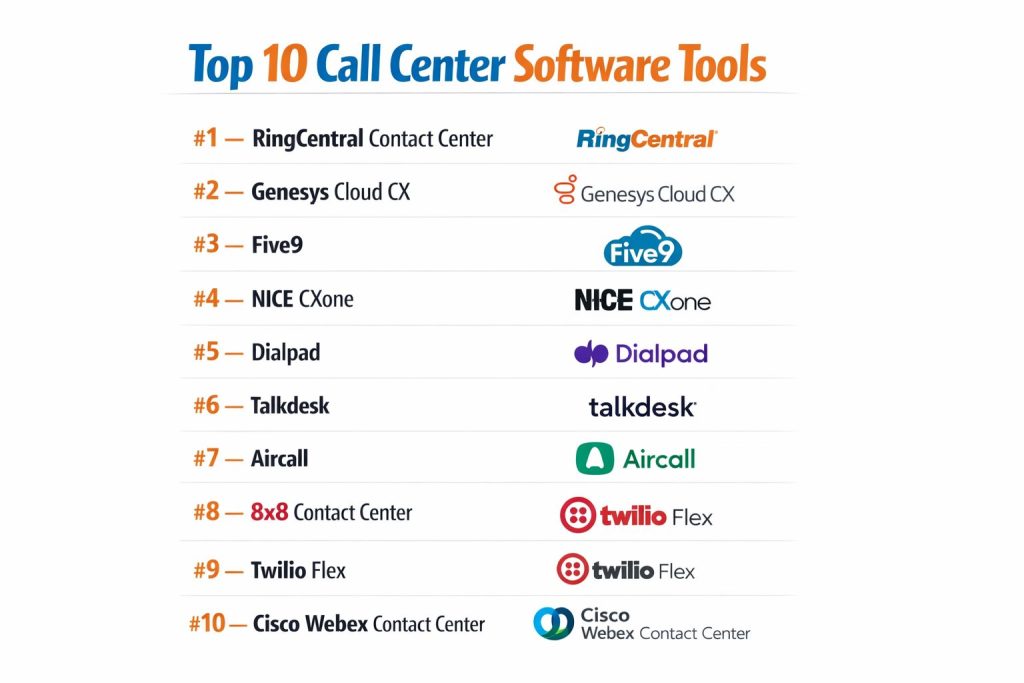
Top 10 Call Center Software Tools
#1 — RingCentral Contact Center
A leading CCaaS provider that combines industry-standard telephony with a robust, AI-powered contact center engine. It is ideal for companies that want a unified communications (UCaaS) and contact center (CCaaS) stack.
Key Features
- RingCX AI: Native AI that handles call summaries, sentiment analysis, and agent coaching.
- Omnichannel Routing: Syncs interactions from 30+ digital channels and voice into one inbox.
- Integrated Video: Allows agents to elevate a voice call to a video/screen-share session instantly.
- Workforce Management: Built-in tools for scheduling, forecasting, and quality management.
- Advanced IVR: Visual drag-and-drop builder for creating complex self-service menus.
- Analytics Global View: Real-time reporting across global teams with customizable KPIs.
Pros
- Unmatched Reliability: Known for industry-leading 99.999% uptime and call clarity.
- Single Vendor Strategy: Simplifies billing and support by combining office phones and the call center.
Cons
- Advanced AI Costs: Some of the more powerful AI features require premium tier add-ons.
- Complex Configuration: Initial setup for complex global routing can be time-consuming.
Platforms / Deployment
- Web / Windows / macOS / iOS / Android
- Cloud
Security & Compliance
- SSO, MFA, TLS/AES Encryption.
- SOC 2 Type II, ISO 27001, HIPAA, GDPR, PCI-DSS.
Integrations & Ecosystem
Over 300+ native integrations.
- Salesforce & Microsoft Dynamics
- ServiceNow & Zendesk
- Microsoft Teams & Slack
Support & Community
24/7 global support, dedicated account managers for enterprise, and extensive online training via RingCentral University.
#2 — Genesys Cloud CX
Often cited as the most “composable” platform, Genesys Cloud CX is built for large enterprises requiring extreme customization and global scale.
Key Features
- Predictive Engagement: Uses AI to identify when a website visitor needs help and offers proactive chat/voice.
- Composable Architecture: API-first design that allows IT teams to build entirely custom agent workflows.
- Native AI Bots: Sophisticated virtual agents that handle complex, multi-turn conversations.
- Workforce Engagement (WEM): Comprehensive suite including gamification to keep remote agents motivated.
- Unified Journey Analytics: Visualizes every touchpoint a customer has across the entire company.
- Regional Data Residency: Extensive options for where data is stored to meet local privacy laws.
Pros
- Scalability: Built on microservices (AWS), making it incredibly stable for massive call volumes.
- Customization: Almost every aspect of the platform can be tailored via API.
Cons
- Technical Depth: Typically requires a dedicated admin or developer to maximize its potential.
- Pricing: Generally sits at the higher end of the market price range.
Platforms / Deployment
- Web / iOS / Android
- Cloud-Native (AWS)
Security & Compliance
- EKM (Enterprise Key Management), SSO.
- SOC 2, ISO 27001, HIPAA, GDPR, FedRAMP Authorized.
Integrations & Ecosystem
Genesys AppFoundry offers a massive marketplace of 3rd-party specialized apps.
- Salesforce
- Adobe Experience Cloud
- Microsoft Teams
Support & Community
Premium support models, a global partner network, and a highly technical developer community.
#3 — Five9
Known as the “AI-first” contact center, Five9 specializes in automating the customer journey through advanced Virtual Agents (IVAs) and seamless CRM integration.
Key Features
- Intelligent Virtual Agent (IVA): Uses multiple NLU engines to provide human-like self-service.
- Agent Assist: Real-time “cheat sheets” that pop up during calls to help agents resolve issues.
- Deep CRM Sync: One of the most mature Salesforce integrations in the industry.
- Predictive Dialer: Advanced outbound algorithms that maximize lead conversion for sales teams.
- Interaction Analytics: Analyzes the “tone” of voice calls, not just the keywords.
- Workflow Automation: Low-code tools to automate manual data entry across different apps.
Pros
- Fast Deployment: Often faster to set up than other enterprise-grade competitors.
- Ease of Use: Highly intuitive agent interface that requires minimal training.
Cons
- Reporting Granularity: While good, it trails Genesys in deep custom reporting options.
- Mobile Experience: The supervisor mobile experience is slightly less feature-rich than the desktop version.
Platforms / Deployment
- Web / Windows / macOS / iOS / Android
- Cloud
Security & Compliance
- 2FA, SSO, Encryption at rest.
- SOC 2 Type II, HIPAA, PCI-DSS, GDPR.
Integrations & Ecosystem
Extensive “out-of-the-box” CRM connections.
- Salesforce
- ServiceNow
- Oracle & NetSuite
Support & Community
24/7 technical support, customer success managers, and an active “Five9 University” portal.
#4 — NICE CXone
A titan in the contact center space, NICE CXone is the platform of choice for organizations where data analytics and workforce efficiency are the primary drivers.
Key Features
- Enlighten AI: Proprietary AI that scores 100% of interactions for quality and compliance automatically.
- Smart Self-Service: Advanced conversational AI for IVR and digital messaging.
- Workforce Management: The gold standard for scheduling thousands of agents across time zones.
- Interaction Recording: Enterprise-grade recording and archiving with advanced search.
- Performance Dashboards: High-density data visualizations for operations managers.
- Omnichannel Desktop: A single, consolidated view for agents to manage all customer data.
Pros
- Analytical Power: Provides the deepest insights into agent performance and customer sentiment.
- Feature Depth: There is virtually no call center requirement that NICE cannot handle natively.
Cons
- Complexity: The interface can feel overwhelming due to the sheer number of options.
- Implementation Time: Large-scale deployments can take months to fully optimize.
Platforms / Deployment
- Web / Windows / iOS / Android
- Cloud
Security & Compliance
- SSO/SAML, SCIM, Advanced Audit Logs.
- SOC 2, ISO 27001, HIPAA, GDPR, PCI-DSS Level 1.
Integrations & Ecosystem
Strong focus on enterprise IT and CX stacks.
- Microsoft Dynamics
- Salesforce
- Zendesk
Support & Community
Global professional services, expert consulting, and a massive library of enterprise documentation.
#5 — Dialpad
An AI-native communications platform that leverages proprietary “Voice Intelligence” (Vi) to provide real-time transcriptions and insights for every call.
Key Features
- Built-in Vi (Voice Intelligence): Live transcription and automated post-call summaries for every user.
- Real-Time Assist: Suggests answers to agents as they hear questions on the live call.
- Unified Workspace: Combines business phone, meetings, and contact center in one app.
- AI CSAT: Automatically calculates customer satisfaction scores for every call using AI.
- Custom Routing: Simple interface for routing calls based on agent skill or caller ID.
- Instant Deployment: Users can be added and numbers provisioned in seconds.
Pros
- AI Inclusion: AI isn’t an “add-on” here; it’s built into the core of the product.
- Modern UX: One of the most attractive and easy-to-use interfaces on the market.
Cons
- Enterprise Features: Lacks some of the more complex WFM features found in NICE or Genesys.
- Global Carrier Reach: While good, it has a smaller global carrier footprint than RingCentral.
Platforms / Deployment
- Web / Windows / macOS / iOS / Android
- Cloud
Security & Compliance
- SSO, MFA, AES-256 Encryption.
- SOC 2 Type II, HIPAA, GDPR.
Integrations & Ecosystem
Strong focus on the modern SaaS ecosystem.
- Google Workspace & Microsoft 365
- Salesforce
- HubSpot
Support & Community
24/7 support across all channels, simple knowledge base, and community-led forums.
#6 — Talkdesk
Known for its “CX Cloud,” Talkdesk provides a sleek, modern platform that is particularly strong in industry-specific solutions like healthcare and retail.
Key Features
- Industry Experience Clouds: Pre-configured workflows for Healthcare, Finance, and Retail.
- Talkdesk Builder: A suite of low-code tools for creating custom agent experiences.
- AI Trainer: Allows non-technical managers to “train” the AI to better understand customer intent.
- Guardian AI: Monitors calls for compliance and flags unauthorized data sharing.
- Visual Flow Designer: Intuitive drag-and-drop tool for managing customer journeys.
- Mobile Agent: Full-featured mobile app for agents working on the move.
Pros
- Ease of Implementation: One of the fastest “large-scale” tools to deploy.
- Vertical Expertise: Their specialized healthcare and banking versions are best-in-class.
Cons
- Pricing Structure: Can become expensive as you add specialized “experience” modules.
- Reporting UI: Some users find the advanced reporting interface less flexible than competitors.
Platforms / Deployment
- Web / iOS / Android
- Cloud (AWS)
Security & Compliance
- SSO, MFA, Data Masking.
- SOC 2, ISO 27001, HIPAA, GDPR, PCI-DSS.
Integrations & Ecosystem
AppConnect marketplace provides 80+ pre-built integrations.
- Salesforce
- Zendesk
- Slack
Support & Community
24/7 support, dedicated technical account managers, and “Talkdesk Academy” certification.
#7 — Aircall
A user-friendly, cloud-based call center platform designed specifically for sales and support teams that live within their CRM.
Key Features
- CRM Focus: Deep, two-way sync that makes the CRM the “source of truth.”
- Power Dialer: Speeds up outbound calling campaigns for sales teams.
- Call Whispering: Allows supervisors to coach agents during a live call without the customer hearing.
- Insight Cards: Displays critical customer data from the CRM as soon as the phone rings.
- Simple Dashboard: Easy-to-read metrics for missed calls, wait times, and agent productivity.
- IVR & Routing: straightforward setup for departments and ring groups.
Pros
- Simplicity: Perhaps the easiest tool to set up on this entire list.
- Integration Quality: The HubSpot and Pipedrive integrations are exceptionally smooth.
Cons
- Channel Depth: Primarily a “voice-first” tool; less powerful for complex omnichannel needs.
- Enterprise Scale: Not designed for 1,000+ seat centers with complex WFM requirements.
Platforms / Deployment
- Web / Windows / macOS / iOS / Android
- Cloud
Security & Compliance
- SSO, MFA.
- SOC 2 Type II, GDPR.
Integrations & Ecosystem
Works seamlessly with modern sales and support stacks.
- HubSpot & Salesforce
- Pipedrive & Zoho
- Intercom & Gorgias
Support & Community
Standard live support, extensive documentation, and a focus on SMB customer success.
#8 — 8×8 Contact Center
A global communication leader that offers a tightly integrated UCaaS and CCaaS platform, focusing on high-quality international calling and value.
Key Features
- Global Reach: One of the largest native carrier networks covering 50+ countries.
- Expert Connect: Allows agents to see the availability of subject matter experts across the company.
- Speech Analytics: Uncovers trends and compliance issues across all voice interactions.
- Omnichannel Digital: Native support for social, chat, and email within the agent app.
- Post-Call Surveys: Automated feedback collection that syncs back to the customer record.
- Quality Management: Integrated tools for call scoring and agent performance tracking.
Pros
- Value for Money: Offers enterprise-level features at a more accessible price point for mid-market teams.
- Consolidated Billing: Great for companies that want to manage all global communications in one place.
Cons
- Interface Design: The UI is functional but feels slightly dated compared to Dialpad or Talkdesk.
- Configuration Depth: Certain advanced settings can be difficult to navigate for non-admins.
Platforms / Deployment
- Web / Windows / macOS / iOS / Android
- Cloud
Security & Compliance
- SSO, MFA, FISMA compliant.
- SOC 2, ISO 27001, HIPAA, GDPR, PCI-DSS.
Integrations & Ecosystem
Strong support for major productivity and CRM suites.
- Microsoft Teams (Direct Routing)
- Salesforce
- NetSuite
Support & Community
24/7 support, global deployment services, and an active online community.
#9 — Twilio Flex
The world’s most programmable contact center platform. It is a “developer-first” solution for organizations that want to build a completely unique customer experience.
Key Features
- Complete Programmability: Every part of the UI and workflow can be modified via code.
- Omnichannel API: Native support for WhatsApp, SMS, Voice, and Facebook Messenger.
- Flex UI: A React-based framework for building the custom agent workspace.
- Plugin Architecture: Allows developers to add features without affecting the core system.
- TaskRouter: Highly advanced logic engine for routing any “task” (not just calls).
- Pay-as-you-go Pricing: Flexible cost models based on usage rather than flat seat fees.
Pros
- Limitless Flexibility: If you can code it, Flex can do it.
- No Vendor Lock-in: You own the customer experience logic entirely.
Cons
- Engineering Intensive: Requires a development team to build and maintain.
- Complexity: Not a “plug-and-play” solution for teams without technical resources.
Platforms / Deployment
- Web / API-based
- Cloud
Security & Compliance
- Fully customizable security layers.
- SOC 2, ISO 27001, HIPAA, GDPR (when configured correctly).
Integrations & Ecosystem
Powered by the broader Twilio ecosystem (Segment, SendGrid).
- Anything with an API
- Salesforce
- Custom Proprietary Databases
Support & Community
Developer-focused documentation, “Twilio Signal” community, and enterprise support tiers.
#10 — Cisco Webex Contact Center
A highly secure, enterprise-grade cloud contact center that is the natural evolution for organizations already utilizing the Cisco ecosystem.
Key Features
- Webex Connect: Low-code orchestration layer for managing digital customer journeys.
- Deep Noise Removal: Uses hardware-software integration for crystal-clear audio quality.
- FedRAMP Authorized: One of the few platforms with the highest level of government security clearance.
- Integrated Hardware: Seamless experience with Cisco headsets and desk phones.
- AI-Powered Insights: Advanced reporting through the Webex Control Hub.
- Multi-Cloud Scalability: Reliable performance across global regions.
Pros
- Security & Trust: The gold standard for highly regulated industries (Government, Finance).
- Audio Quality: Industry-leading noise cancellation technology for open-plan offices.
Cons
- Ecosystem Dependence: Most effective when paired with other Cisco products.
- Setup Complexity: Can be difficult to navigate for teams not familiar with the Cisco environment.
Platforms / Deployment
- Web / Windows / iOS / Android
- Cloud / Hybrid
Security & Compliance
- FedRAMP, SSO, MFA.
- SOC 2 Type II, ISO 27001, HIPAA, GDPR, PCI-DSS.
Integrations & Ecosystem
Deeply integrated with the Cisco and Microsoft stacks.
- Microsoft Teams
- Salesforce
- ServiceNow
Support & Community
Global enterprise support, massive partner network, and technical documentation for IT pros.
Comparison Table (Top 10)
| Tool Name | Best For | Platform(s) Supported | Deployment | Standout Feature | Public Rating |
| RingCentral | Reliability & UCaaS | Web, Win, Mac, Mobile | Cloud | 99.999% Uptime | 4.6 / 5 |
| Genesys Cloud | Enterprise Scalability | Web, Mobile | Cloud-Native | Composable CX | 4.5 / 5 |
| Five9 | AI & CRM Sync | Web, Win, Mac, Mobile | Cloud | IVA Automation | 4.4 / 5 |
| NICE CXone | WFM & Analytics | Web, Win, Mobile | Cloud | Enlighten AI | 4.3 / 5 |
| Dialpad | AI-Native Insights | Web, Win, Mac, Mobile | Cloud | Real-time Transcription | 4.7 / 5 |
| Talkdesk | Vertical Solutions | Web, Mobile | Cloud | Industry Clouds | 4.4 / 5 |
| Aircall | SMB & Sales | Web, Win, Mac, Mobile | Cloud | CRM Card Insights | 4.3 / 5 |
| 8×8 | Global Value | Web, Win, Mac, Mobile | Cloud | Global Carrier Network | 4.2 / 5 |
| Twilio Flex | Custom Development | Web, API | Cloud | Fully Programmable | 4.4 / 5 |
| Cisco Webex | High Security | Web, Win, Mobile | Cloud/Hybrid | FedRAMP Security | 4.2 / 5 |
Evaluation & Scoring of Call Center Software
The following scoring model evaluates these tools based on the demands of the market.
| Tool Name | Core (25%) | Ease (15%) | Int. (15%) | Sec. (10%) | Perf. (10%) | Supp. (10%) | Value (15%) | Weighted Total |
| RingCentral | 9 | 8 | 10 | 10 | 10 | 9 | 7 | 8.85 |
| Genesys Cloud | 10 | 5 | 9 | 10 | 10 | 9 | 6 | 8.35 |
| Five9 | 9 | 8 | 10 | 9 | 9 | 9 | 8 | 8.80 |
| NICE CXone | 10 | 4 | 9 | 10 | 10 | 9 | 6 | 8.20 |
| Dialpad | 9 | 10 | 8 | 8 | 9 | 8 | 9 | 8.70 |
| Talkdesk | 9 | 7 | 8 | 9 | 9 | 9 | 7 | 8.15 |
| Aircall | 6 | 10 | 9 | 7 | 9 | 8 | 8 | 7.80 |
| 8×8 | 8 | 7 | 8 | 9 | 9 | 8 | 9 | 8.15 |
| Twilio Flex | 10 | 2 | 10 | 10 | 10 | 7 | 8 | 8.05 |
| Cisco Webex | 9 | 5 | 8 | 10 | 10 | 9 | 7 | 8.10 |
How to interpret these scores:
- Core (25%): Measures voice quality, routing logic, and native omnichannel support.
- Ease (15%): Indicates how quickly an agent can learn the tool (10 = no training needed).
- Sec. (10%): A score of 10 indicates high-level government-grade compliance (e.g., FedRAMP).
Which Call Center Software Tool Is Right for You?
SMB / Startups
If you are a small team that needs to get up and running today, Aircall or Dialpad are the best choices. They offer simple setup and modern interfaces that require almost no training.
High-Growth Sales Teams
For teams focused on outbound calling and lead conversion, Five9 and Aircall provide the best predictive dialers and CRM syncing features to maximize productivity.
Global Enterprises
Organizations with thousands of agents across multiple continents should look at Genesys Cloud CX or NICE CXone. These platforms are built to handle massive scale and offer the most advanced workforce management (WFM) suites.
Technical / Engineering Led Teams
If your product is unique and you want your call center to feel like a native part of your app, Twilio Flex is the only choice that offers total programmable control.
Highly Regulated Industries
For Government, Healthcare, or Finance, Cisco Webex and RingCentral offer the most robust security certifications, including FedRAMP and deep HIPAA compliance.
Budget Conscious
8×8 and Aircall tend to offer the best “feature-to-price” ratio for teams that need core functionality without the extreme enterprise overhead.
Frequently Asked Questions (FAQs)
What is the difference between Call Center and Contact Center software?
Call center software traditionally handles only voice calls. “Contact Center” (or CCaaS) software is the modern standard, handling voice, email, SMS, social media, and chat in one unified interface.
How much does call center software cost per user?
Pricing typically ranges from $70 to $150 per user, per month for enterprise-grade tools. Smaller, voice-centric tools for SMBs can start as low as $25 to $50 per user.
Does call center software require special hardware?
No. Most modern CCaaS tools are “software-only” and run in a web browser or a desktop app. You only need a stable internet connection and a high-quality USB or Bluetooth headset.
What is “Predictive Dialing”?
It is an AI-powered outbound calling method that dials multiple numbers at once and only connects an agent when a live human answers, filtering out busy signals and answering machines.
Can I keep my existing phone numbers?
Yes. All major providers offer “Number Porting,” which allows you to move your current business and toll-free numbers over to their platform.
What is “Sentiment Analysis”?
This is an AI feature that analyzes the caller’s tone of voice and keywords in real-time to determine if they are happy, neutral, or frustrated, allowing supervisors to intervene if necessary.
How does AI help agents during a call?
AI “Agent Assist” tools listen to the conversation and automatically surface relevant knowledge base articles, suggest responses, or even draft the post-call summary so the agent doesn’t have to.
What is 99.999% uptime?
Often called “five-nines,” this is a reliability standard that means the service is guaranteed to be operational for all but 5.26 minutes per year. This is critical for 24/7 mission-critical operations.
Can these tools integrate with my CRM?
Yes. Most leading tools have “native” integrations with Salesforce, HubSpot, Zendesk, and Microsoft Dynamics, allowing for “Click-to-Dial” and automatic data syncing.
Is my data secure in the cloud?
Modern CCaaS providers utilize advanced encryption (AES-256) and meet strict compliance standards like SOC 2 and ISO 27001. If you are in healthcare, ensure the provider offers a BAA for HIPAA compliance.
Conclusion
The selection of call center software is a strategic decision that affects both customer satisfaction and operational costs. For most businesses, RingCentral and Five9 offer the best balance of reliability and AI innovation. However, for those requiring extreme customization, Twilio Flex remains the developer’s gold standard.
Prioritize tools that offer a unified view of the customer and robust AI assistance. In a world where customer expectations are higher than ever, your software should be the engine that empowers your agents to be “Super Agents.”