Introduction
A Contact Center Platform is an enterprise-grade software suite that manages omnichannel customer interactions, including voice, email, chat, SMS, and social media. Unlike traditional call centers that focused solely on telephony, modern platforms are “AI-first” ecosystems. They leverage Agentic AI and Natural Language Understanding (NLU) to orchestrate complex customer journeys, automate routine resolutions, and provide real-time guidance to human agents.
The relevance of these platforms has shifted from basic connectivity to “customer experience (CX) automation.” As digital-native consumers demand instant, personalized support across a dozen different apps, a unified contact center platform acts as the central intelligence hub. It bridges the gap between raw customer data and actionable service outcomes, ensuring that a conversation started on Instagram can be seamlessly resolved via a voice call without the customer ever repeating their issue.
Real-world use cases include:
- Global Support Operations: Managing 24/7 follow-the-sun support with AI-driven translation and smart routing.
- Proactive Outbound Sales: Using predictive dialers and intent data to reach leads at the exact moment of interest.
- Financial Services Security: Implementing voice biometrics and real-time fraud detection to secure high-value transactions.
- Healthcare Patient Engagement: Automating appointment scheduling and HIPAA-compliant patient reminders.
- Emergency Dispatch & Utilities: Utilizing high-availability cloud infrastructure to manage critical communication during peak surges.
What buyers should evaluate (Criteria):
- Omnichannel Continuity: The ability to maintain context as customers switch between digital and voice channels.
- Agentic AI Capabilities: Native AI that can autonomously resolve tier-1 issues and summarize calls.
- Workforce Engagement Management (WEM): Tools for scheduling, gamification, and real-time coaching.
- Security & Fraud Prevention: Presence of voice biometrics, end-to-end encryption, and global compliance.
- Global Elasticity: A cloud-native architecture that scales instantly across regions without latency.
- Integration Depth: Pre-built connectors for major CRMs like Salesforce, HubSpot, and ServiceNow.
- Real-time Analytics: Sentiment analysis and supervisor dashboards that update in milliseconds.
- Total Cost of Ownership (TCO): Balancing per-seat licensing with usage-based AI costs.
Best for: Customer-centric enterprises, e-commerce giants, and service-based organizations looking to reduce operational costs through AI while improving CSAT scores.
Not ideal for: Small businesses with extremely low call volumes (under 5 calls/day), where a standard business phone system or a shared email inbox is more cost-effective.
Key Trends in Contact Center Platforms
The contact center landscape is defined by the shift from “Human-Led” to “Hybrid Intelligence.”
- Agentic AI Agents: Move beyond simple chatbots to AI agents that can actually execute tasks like processing refunds or updating shipping addresses.
- AI-to-AI Interactions: Systems are now optimized to talk to the “personal AI assistants” that consumers use to navigate IVRs on their behalf.
- Emotionally Intelligent Voice AI: Voicebots now detect frustration or urgency in a caller’s tone and escalate to human managers instantly.
- Hyper-Personalized Routing: Routing callers not just by “skill,” but by “personality matching” and historical lifetime value (LTV).
- Zero-Trust Voice Security: Mandatory voice biometrics to prevent “deepfake” social engineering attacks on high-security accounts.
- Composable CX: A move toward modular APIs that allow IT teams to “plug in” specialized AI models into their existing CCaaS stack.
- Native Video Escalation: The ability to move from a standard voice call to a high-definition video session for visual troubleshooting.
- Sustainability Tracking: Platforms now report on the carbon footprint of their data center usage for corporate ESG reporting.
How We Selected These Tools (Methodology)
Our selection of the top 10 Contact Center platforms is based on a rigorous evaluation of the CCaaS (Contact Center as a Service) market:
- AI Maturity: We prioritized platforms that embed Generative AI natively into the agent workspace and the customer IVR.
- Omnichannel Breadth: Tools were ranked based on how seamlessly they integrate “digital-first” channels (WhatsApp, Social) with traditional voice.
- Reliability & Uptime: We only selected platforms capable of 99.99% or 99.999% “five-nines” availability on global cloud infrastructure.
- Ease of Implementation: Evaluation of “low-code” flow builders that allow business users to change IVR paths without a developer.
- Security Posture: Preference given to vendors with a “fortress” approach to data, including SOC 2, HIPAA, and PCI-DSS Level 1.
- Market Presence: Analysis of Gartner Peer Insights and Forrester Wave standings for 2025/2026.
- Scalability: The ability to handle both 50-agent startups and 50,000-agent global enterprises.
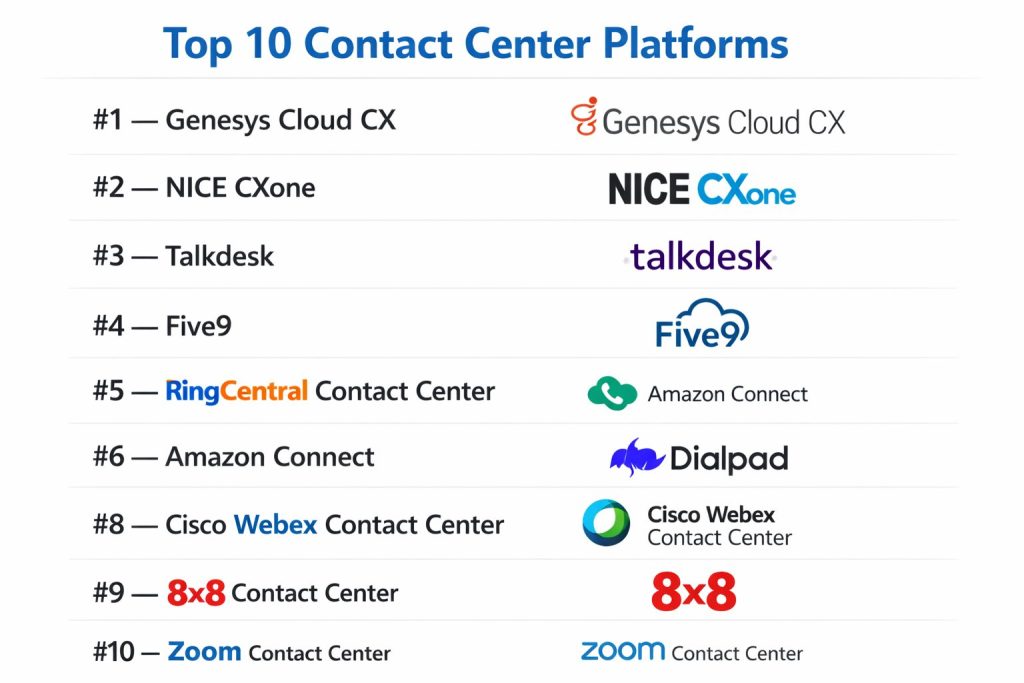
Top 10 Contact Center Platforms
#1 — Genesys Cloud CX
A market-leading, cloud-native platform known for its “Composable CX” philosophy, allowing enterprises to build highly customized customer journeys.
Key Features
- AI Experience Orchestration: Uses AI to predict the best next step for every customer interaction.
- Architect Tool: A powerful, visual drag-and-drop flow builder for IVR and digital routing.
- Native Workforce Engagement: Built-in tools for quality management, recording, and agent scheduling.
- Predictive Engagement: Identifies high-value website visitors and triggers proactive chats.
- Unified Agent Desktop: A single pane of glass for all channels, including specialized AI coaching prompts.
- Open API Framework: Thousands of public APIs for deep enterprise customization.
Pros
- Unmatched Flexibility: Can be molded to virtually any enterprise requirement.
- Global Scale: Reliable performance across every major geographic region.
Cons
- Cost: One of the more expensive options, especially when adding premium AI modules.
- Complexity: Requires a trained administrator to unlock its full potential.
Platforms / Deployment
- Web / Windows / macOS / iOS / Android
- Cloud (AWS native)
Security & Compliance
- SOC 2 Type II, ISO 27001, GDPR, HIPAA, FedRAMP.
- PCI-DSS Level 1, Voice Biometrics.
Integrations & Ecosystem
Genesys AppFoundry offers over 500+ pre-built integrations.
- Salesforce & Microsoft Dynamics
- ServiceNow
- Zendesk
- Microsoft Teams
Support & Community
Extensive professional services, a global partner network, and a robust “Genesys University” for certification.
#2 — NICE CXone
An enterprise powerhouse focusing heavily on data analytics and workforce optimization. It is widely considered the most technically deep platform on the market.
Key Features
- Enlighten AI: Analyzes 100% of interactions to provide sentiment scores and behavioral coaching.
- Mpower Platform: A specialized AI layer that automates agent summaries and knowledge retrieval.
- Smart Self-Service: Advanced conversational bots that handle complex, multi-turn dialogs.
- Advanced WFM: The industry standard for complex agent scheduling and capacity planning.
- Interaction Channels: Supports over 30+ digital channels out of the box.
- Real-time Interaction Guidance: Live prompts that tell agents exactly how to handle difficult callers.
Pros
- Superior Analytics: Best-in-class for organizations that prioritize data-driven decision-making.
- Market Maturity: Highly refined features developed over decades in the industry.
Cons
- Legacy Feel: Despite being cloud-native, some parts of the admin UI can feel technical and dated.
- Implementation Time: Large-scale deployments can take longer than “lighter” cloud competitors.
Platforms / Deployment
- Web / Windows / iOS / Android
- Cloud
Security & Compliance
- SOC 2, ISO 27001, GDPR, HIPAA.
- FedRAMP Authorized, PCI-DSS.
Integrations & Ecosystem
Deep integration with enterprise CRM and ERP systems via CXone DevOne.
- Salesforce
- Oracle Service Cloud
- SAP
- Microsoft 365
Support & Community
Global enterprise support teams, dedicated technical account managers, and an active user community.
#3 — Talkdesk
A modern, “cloud-native” leader that emphasizes ease of use and rapid deployment through its specialized “Industry Experience Clouds.”
Key Features
- Experience Clouds: Specialized versions for Healthcare, Retail, and Financial Services with pre-built flows.
- Talkdesk Builder: A no-code set of tools for customizing workspaces and automations.
- AI Trainer: Allows non-technical staff to “teach” the AI bots using real conversation data.
- Talkdesk Guardian: Built-in AI security that monitors for abnormal agent behavior or data leaks.
- Virtual Agent: High-resolution conversational AI for voice and digital channels.
- Screen Recording: High-fidelity recording for quality assurance and training.
Pros
- User Experience: One of the most intuitive and modern interfaces for both agents and admins.
- Speed to Value: Known for very fast implementation cycles compared to legacy peers.
Cons
- Customization Limits: While flexible, it offers slightly less “raw” coding depth than Genesys.
- Feature Parity: Some specialized enterprise features (like advanced outbound) were added more recently.
Platforms / Deployment
- Web / Windows / macOS / iOS / Android
- Cloud
Security & Compliance
- SOC 2 & 3, ISO 27001, ISO 42001 (AI Governance).
- HIPAA, GDPR, PCI-DSS Level 1.
Integrations & Ecosystem
Talkdesk AppConnect features a “one-click” installation for many popular SaaS tools.
- Salesforce (AppExchange Leader)
- Slack
- Zendesk
- Microsoft Teams
Support & Community
24/7 global support, an online academy, and a very strong focus on customer success management.
#4 — Five9
A pioneer in the CCaaS space known for its aggressive focus on AI-driven automation and “Intelligent Virtual Agents” (IVA).
Key Features
- Intelligent Virtual Provider: Uses multiple NLU engines to provide human-like self-service.
- Five9 Genius: An AI engine that routes interactions based on customer intent and sentiment.
- Agent Assist: Real-time transcription and “next-best-action” suggestions during live calls.
- Predictive Dialer: One of the industry’s most powerful engines for outbound sales teams.
- Workflow Automation: Connects the contact center to the rest of the business via low-code triggers.
- Global Voice: High-quality, low-latency voice infrastructure across the globe.
Pros
- Outbound Excellence: Particularly strong for teams that do high-volume proactive outreach.
- Practical AI: Focuses on AI features that provide immediate, measurable ROI.
Cons
- Admin UX: The administrative interface can be more complex to navigate than “modern” rivals.
- Digital Integration: While strong, its focus has traditionally been voice-first.
Platforms / Deployment
- Web / Windows / iOS / Android
- Cloud
Security & Compliance
- SOC 2, ISO 27001, GDPR, HIPAA.
- PCI-DSS, STIR/SHAKEN Compliance.
Integrations & Ecosystem
Known for exceptionally deep native integrations with Salesforce and ServiceNow.
- Salesforce (Deepest integration in class)
- ServiceNow
- Oracle
- Microsoft Teams
Support & Community
Strong professional services, a 24/7 help desk, and an extensive knowledge base for self-service.
#5 — RingCentral Contact Center
A unified communications giant that combines world-class office phone systems (UCaaS) with a powerful, AI-driven contact center (CCaaS).
Key Features
- Unified Platform: One app for internal team messaging, video, and external customer support.
- RingCX AI: A native AI solution that provides automated summaries and coaching.
- Omnichannel Routing: Manages voice, digital, and social channels in a single queue.
- Smart Dialers: Multiple modes (Preview, Progressive, Predictive) for sales efficiency.
- Video Collaboration: Allows agents to start a video session or screen share with a single click.
- Global Reach: Presence in 45+ countries with localized PSTN services.
Pros
- Consolidation: Perfect for companies that want to buy their entire communication stack from one vendor.
- Pricing: Often very competitive when bundled with their UCaaS (MVP) platform.
Cons
- Platform Depth: For the absolute highest-end enterprise needs, Genesys or NICE may offer more depth.
- Shared Architecture: Some features are powered by partners (NICE), which can occasionally lead to separate admin portals.
Platforms / Deployment
- Web / Windows / macOS / iOS / Android
- Cloud
Security & Compliance
- SOC 2, ISO 27001, GDPR, HIPAA.
- 99.999% Uptime Guarantee.
Integrations & Ecosystem
RingCentral has one of the largest developer ecosystems in the communications space.
- Microsoft 365 & Google Workspace
- Salesforce
- Zendesk
- HubSpot
Support & Community
Extensive online documentation, 24/7 phone support, and a massive community of certified partners.
#6 — Amazon Connect
A pay-as-you-go, highly programmable contact center from AWS. It is the “developer’s choice” for building custom customer experiences.
Key Features
- Pay-as-you-go Pricing: No upfront costs or long-term contracts; you only pay for what you use.
- Contact Lens: AI-powered speech analytics and sentiment detection built natively.
- Lex Integration: Uses the same AI technology that powers Alexa for conversational IVR.
- Amazon Q in Connect: An AI assistant that helps agents find answers in company wikis.
- Customer Profiles: Aggregates data from multiple sources to give agents a 360-degree view.
- Voice ID: Real-time caller authentication using machine learning voice analysis.
Pros
- Cost Efficiency: Can be significantly cheaper for businesses with fluctuating volumes.
- Innovation Speed: Features are updated constantly by the AWS engineering team.
Cons
- Technical Requirement: Requires an AWS engineer or partner to set up; not a “turnkey” solution.
- No Native WFM: Requires third-party tools or “Amazon Connect WFM” add-ons for complex scheduling.
Platforms / Deployment
- Web
- Cloud (AWS)
Security & Compliance
- Full AWS Security Suite, SOC, ISO, HIPAA, GDPR.
- FedRAMP High, PCI-DSS.
Integrations & Ecosystem
Deeply integrated with the entire AWS ecosystem and Salesforce.
- Salesforce (Strategic Partnership)
- AWS Lambda (for custom logic)
- S3 (for storage)
- Kinesis (for data streaming)
Support & Community
Supported by the massive AWS support network and a global community of AWS developers.
#7 — Dialpad
A “born-in-the-AI-era” platform that specializes in real-time intelligence and automated transcription for small-to-mid-sized enterprises.
Key Features
- Ai CSAT: Automatically predicts customer satisfaction scores for 100% of calls.
- Real-time Transcripts: Displays live text of the conversation to help agents follow along.
- Ai Recaps: Generates bulleted summaries and action items immediately after a call ends.
- Live Coaching: Sends agents “pop-up” cards with answers when specific keywords are mentioned.
- Digital Engagement: Unified inbox for SMS, WhatsApp, and Facebook Messenger.
- Global Voice Exchange: Proprietary carrier network for high-definition audio quality.
Pros
- Innovation: Leading the market in “useful” AI that agents actually enjoy using.
- Simplicity: One of the easiest platforms to set up and manage without IT support.
Cons
- Enterprise Features: Lacks some of the “deep” legacy features found in NICE or Genesys.
- Reporting: While good, it is less customizable than the heavy-duty enterprise platforms.
Platforms / Deployment
- Web / Windows / macOS / iOS / Android
- Cloud
Security & Compliance
- SOC 2 Type II, GDPR, HIPAA.
- AES-256 Encryption.
Integrations & Ecosystem
Focused on modern SaaS tools and CRM systems.
- Google Workspace & Microsoft 365
- Salesforce
- HubSpot
- Zendesk
Support & Community
24/7 support across all channels and a modern, searchable help center.
#8 — Cisco Webex Contact Center
A robust, security-focused platform ideal for organizations that already utilize the Cisco ecosystem and require government-grade compliance.
Key Features
- Webex Connect: A low-code orchestration layer for complex digital interactions.
- Deep Noise Removal: Uses AI to eliminate background noise for agents working in busy environments.
- FedRAMP Authorization: Ideal for government agencies and regulated industries.
- Unified Admin: A single control hub for both contact center and office collaboration.
- Customer Journey Data: Tracks a customer’s entire history across all Webex-powered touchpoints.
- Hardware Integration: Native support for Cisco headsets and specialized desk phones.
Pros
- Security: Often the first choice for banks and government due to Cisco’s security reputation.
- Audio Quality: Proprietary tech ensures the clearest voice quality in the industry.
Cons
- Legacy Transition: Some users find the transition from on-premise Cisco (UCCE) to Cloud to be complex.
- Agility: Updates can sometimes move slower than the pure-play cloud competitors.
Platforms / Deployment
- Web / Windows / macOS / iOS / Android
- Cloud / Hybrid
Security & Compliance
- SOC 2, ISO 27001, GDPR, HIPAA.
- FedRAMP Authorized, FIPS 140-2.
Integrations & Ecosystem
Strongest for teams using the Microsoft or Cisco hardware stacks.
- Microsoft Teams & Dynamics
- Salesforce
- ServiceNow
- AppDynamics (for monitoring)
Support & Community
Global enterprise-grade support and the massive “Cisco Live” community and training programs.
#9 — 8×8 Contact Center
A reliable, cost-effective platform that excels in international voice coverage and unified employee communications.
Key Features
- Expert Connect: Allows agents to see the “presence” of back-office experts and consult them instantly.
- 8×8 Intelligent Customer Assistant: A conversational AI for self-service across all channels.
- Global Reach: Guaranteed call quality in 50+ countries via their patented Global Reach network.
- Integrated Analytics: Unified reporting across both office phones and the contact center.
- Video Interaction: Built-in video conferencing for high-touch customer support.
- Secure Payment Processing: Native PCI-compliant tools for taking credit cards over the phone.
Pros
- Global Connectivity: Best-in-class for organizations with a dispersed international workforce.
- Value for Money: Offers an enterprise feature set at a more accessible price point.
Cons
- AI Depth: While improving, their native AI isn’t as “advanced” as Dialpad or Genesys.
- UI Modernity: The interface is functional but lacks the “slickness” of newer competitors.
Platforms / Deployment
- Web / Windows / macOS / iOS / Android
- Cloud
Security & Compliance
- SOC 2, ISO 27001, GDPR, HIPAA.
- FISMA, 99.999% Uptime SLA.
Integrations & Ecosystem
Certified for Microsoft Teams and integrates with major CRMs.
- Microsoft Teams (Direct Routing)
- Salesforce
- NetSuite
- Bullhorn (for staffing)
Support & Community
24/7 global support, an online university, and specialized onboarding for global teams.
#10 — Zoom Contact Center
A fast-growing, video-first contact center that leverages the familiarity of the Zoom interface to simplify agent training and customer interactions.
Key Features
- Video-First Architecture: The native ability to transition any voice or chat to a high-def Zoom meeting.
- Zoom AI Companion: Summarizes interactions and provides real-time agent suggestions.
- Visual IVR: Allows customers to interact with a visual menu on their smartphone while on a call.
- Remote Agent Monitoring: High-fidelity video tools for supervisors to manage remote teams.
- Omnichannel Inbox: Supports voice, SMS, web chat, and video in a unified view.
- Workflow Orchestration: A drag-and-drop builder for designing customer and agent flows.
Pros
- User Familiarity: Almost no training required for agents who already know how to use Zoom.
- Video Quality: Unmatched performance for visual support and “high-touch” consulting.
Cons
- Market Recency: As a newer player in CCaaS, it lacks some of the deep “legacy” features for massive PMOs.
- Ecosystem Maturity: Smaller marketplace of third-party apps compared to Genesys or Salesforce.
Platforms / Deployment
- Web / Windows / macOS / iOS / Android
- Cloud
Security & Compliance
- SOC 2 Type II, ISO 27001, GDPR, HIPAA.
- End-to-End Encryption (E2EE) available.
Integrations & Ecosystem
Rapidly expanding its “App Marketplace” for contact center specific tools.
- Salesforce
- ServiceNow
- Zendesk
- Microsoft 365
Support & Community
Standard Zoom support levels, an online learning center, and a growing community of CX professionals.
Comparison Table (Top 10)
| Tool Name | Best For | Platform(s) Supported | Deployment | Standout Feature | Public Rating |
| Genesys Cloud CX | Global Enterprises | Web, Win, Mac, iOS, Android | Cloud | Composable CX | 4.6 / 5 |
| NICE CXone | Deep Analytics | Web, Win, iOS, Android | Cloud | Enlighten AI | 4.7 / 5 |
| Talkdesk | Modern UX / Retail | Web, Win, Mac, iOS, Android | Cloud | Industry Clouds | 4.4 / 5 |
| Five9 | Outbound Sales | Web, Win, iOS, Android | Cloud | Intelligent IVA | 4.5 / 5 |
| RingCentral | Unified Comms | Web, Win, Mac, iOS, Android | Cloud | UCaaS + CCaaS Hub | 4.4 / 5 |
| Amazon Connect | Devs / Pay-as-you-go | Web, iOS, Android | Cloud | Usage Pricing | 4.5 / 5 |
| Dialpad | Small-Mid AI | Web, Win, Mac, iOS, Android | Cloud | Real-time Transcripts | 4.4 / 5 |
| Cisco Webex CC | High Security/Gov | Web, Win, Mac, iOS, Android | Hybrid | Noise Removal | 4.3 / 5 |
| 8×8 CC | Global Mid-Market | Web, Win, Mac, iOS, Android | Cloud | Global Reach Net | 4.2 / 5 |
| Zoom CC | Video-First CX | Web, Win, Mac, iOS, Android | Cloud | Native Video Escalation | 4.4 / 5 |
Evaluation & Scoring of Contact Center Platforms
This weighted scoring model reflects the performance requirements for enterprise communication.
| Tool Name | Core (25%) | AI (20%) | Int. (15%) | Sec. (15%) | Perf. (10%) | Supp. (5%) | Value (10%) | Weighted Total |
| Genesys Cloud CX | 10 | 9 | 10 | 9 | 10 | 9 | 7 | 9.15 |
| NICE CXone | 10 | 10 | 9 | 10 | 9 | 9 | 6 | 9.10 |
| Talkdesk | 9 | 9 | 9 | 9 | 9 | 10 | 8 | 8.95 |
| Five9 | 9 | 9 | 10 | 9 | 9 | 9 | 8 | 8.95 |
| RingCentral | 9 | 8 | 9 | 9 | 10 | 9 | 9 | 8.90 |
| Amazon Connect | 8 | 10 | 10 | 10 | 10 | 7 | 10 | 9.10 |
| Dialpad | 8 | 10 | 8 | 8 | 9 | 9 | 9 | 8.55 |
| Cisco Webex CC | 9 | 7 | 8 | 10 | 10 | 9 | 7 | 8.55 |
| 8×8 CC | 8 | 7 | 9 | 9 | 9 | 9 | 10 | 8.50 |
| Zoom CC | 8 | 8 | 8 | 9 | 9 | 9 | 9 | 8.40 |
How to interpret these scores:
- Core (25%): Measures omnichannel breadth and basic call handling.
- AI (20%): Reflects the sophistication of agent assist and automated resolution.
- Value (10%): A high score here (Amazon Connect) indicates a disruptive or usage-based pricing model.
Which Contact Center Platform Is Right for You?
Small-to-Mid Business (SMB)
If you have under 50 agents and need to get started quickly with AI, Dialpad or Talkdesk are the best choices. They offer modern, intuitive interfaces that don’t require an army of IT specialists to manage.
Large Global Enterprise
For massive operations with thousands of agents across multiple continents, Genesys Cloud CX or NICE CXone are the only true options. Their depth of workforce management and global “five-nines” reliability are unmatched.
Developer-Focused / High Customization
If your team wants to build a completely unique, proprietary customer experience from scratch, Amazon Connect is the standard. It provides the “Lego blocks” of communication (AI, storage, routing) at a usage-based price point.
Unified Workspace (UCaaS + CCaaS)
If you want your office staff (HR, Finance) and your support agents on the same platform to encourage collaboration, RingCentral or 8×8 provide the most seamless experience for a “unified” bill and user directory.
High-Security / Government
Organizations with extreme compliance needs should look at Cisco Webex Contact Center or Smartsheet-integrated flows. Cisco’s history with FedRAMP and military-grade encryption makes it a safe harbor for regulated data.
Video-Based Support
If your product requires “seeing” the issue (e.g., medical consulting, technical hardware repair), Zoom Contact Center offers the best native video experience without requiring the customer to download separate software.
Frequently Asked Questions (FAQs)
What is the difference between CCaaS and CPaaS?
CCaaS (Contact Center as a Service) is a finished software product you buy to run a contact center. CPaaS (Communications Platform as a Service) is a set of APIs (like Twilio) that developers use to build communication features into other apps.
How much does it cost per agent?
Typical pricing ranges from $75/month for basic voice to $250+/month for “all-in” enterprise packages with advanced AI, WEM, and omnichannel digital features.
Do I need a special phone line for these platforms?
No. These platforms are cloud-native and use VoIP (Voice over IP). You only need a stable high-speed internet connection and a headset or a computer with a microphone.
What is “Agentic AI” in a contact center?
Unlike simple bots that just provide links, Agentic AI can perform actions. It can log into your CRM, verify a customer’s identity, and process a transaction or refund without human intervention.
Can I keep my existing phone numbers?
Yes. All major providers offer “Porting” services that allow you to move your existing 1-800 or local numbers to their cloud platform.
How does AI help reduce agent burnout?
AI reduces burnout by handling the repetitive “boring” questions (e.g., “Where is my order?”), providing real-time notes so agents don’t have to type as much, and offering coaching to handle stressful callers.
Is voice still the most important channel?
While digital channels are growing, voice remains the “escalation channel.” When a problem is complex or emotional, customers still prefer to speak to a human. Voice accounts for roughly 50-60% of total interaction volume.
What is “Sentiment Analysis”?
This is an AI feature that listens to the tone and words of a caller in real-time. It can alert a supervisor if a call is “going south” (negative sentiment) so they can intervene before the customer hangs up.
Can these platforms translate in real-time?
Yes. Many platforms (like Genesys and Dialpad) now offer real-time text translation, allowing an English-speaking agent to chat with a Spanish-speaking customer in their native languages simultaneously.
What is an SLA for uptime?
An SLA (Service Level Agreement) is a guarantee of reliability. “Five-Nines” (99.999%) means the system is guaranteed to be down for less than 6 minutes per year.
Conclusion
The selection of a Contact Center Platform is a strategic decision that impacts your company’s reputation and bottom line. While Genesys Cloud CX and NICE CXone lead in enterprise depth, newer players like Dialpad and Zoom are proving that ease of use and native AI can be just as valuable.
Ultimately, your choice should depend on your “technical appetite”—whether you want a turnkey solution like Talkdesk or a programmable engine like Amazon Connect.