Introduction
In simple terms, a performance management platform is a digital space where companies and employees work together to track progress, set goals, and share feedback. Gone are the days when “performance” only meant a stressful once-a-year meeting in a closed office. Today, these platforms are about building a continuous conversation. They help everyone stay on the same page, ensuring that the work people do every day actually helps the company reach its bigger goals.
These platforms are more important than ever because of how we work. With more teams spread across different cities and time zones, managers can’t just “see” how someone is doing by looking across the room. These tools bridge that gap. They turn performance from a scary administrative task into a helpful map for career growth.
Real-World Use Cases
- Goal Alignment: Making sure a developer in India and a marketer in the US are working toward the same product launch target.
- Continuous Feedback: A manager giving a quick “great job” or a helpful tip immediately after a project, rather than waiting six months.
- Professional Development: Identifying that an employee wants to learn a new skill and tracking their progress toward that certification.
- Fair Promotions: Using real data and peer feedback to decide who is ready for a move up, rather than relying on a manager’s gut feeling.
- Team Health: Using surveys to see if a team is feeling burnt out before it leads to people leaving.
What Buyers Should Evaluate
- Ease of Use: If it’s too hard to navigate, people simply won’t use it.
- Integration: Does it talk to the tools you already use, like Slack, Teams, or your payroll system?
- Flexibility: Can you change the review questions to fit your unique company culture?
- Goal Tracking Style: Does it support OKRs (Objectives and Key Results), SMART goals, or both?
- Mobile Access: Can employees give feedback or check goals on their phones?
- AI Assistance: Can the tool help managers write more helpful, less biased feedback?
- Data Security: Is the sensitive employee data protected by strong encryption and login rules?
- Support Quality: Is there a human ready to help when you have a technical question?
Best for: Companies of all sizes that want to move away from old-school annual reviews and toward a culture of growth, clear communication, and transparency.
Not ideal for: Very small teams (under 5 people) that already talk every day and don’t need formal tracking, or companies that prefer a strictly top-down, “command and control” style of management.
Key Trends in Performance Management Platforms
- AI-Guided Feedback: Tools now use AI to help managers turn a few notes into a professional, encouraging review that avoids common biases.
- Real-Time Dashboards: Instead of waiting for a report, leaders can see a “live” view of how teams are performing against their goals.
- Skills-Based Focus: Platforms are moving away from just “job titles” and instead tracking specific skills that employees are gaining over time.
- In-the-Flow Recognition: You can now give “high-fives” or public praise directly within chat apps like Slack or Microsoft Teams.
- Holistic Wellness Integration: Many platforms now include check-ins for mental health and burnout, recognizing that a stressed employee cannot perform well.
- Predictive Insights: Advanced tools can now flag when an employee’s performance is slipping, allowing a manager to step in and offer support early.
- Dynamic OKRs: Goals are no longer set in stone; they can be updated instantly as market conditions or company priorities change.
- Transparent Growth Paths: Employees can see exactly what skills or milestones they need to hit to reach the next level in their careers.
How We Selected These Tools (Methodology)
To pick the top 10 platforms, we used a clear set of rules to ensure they represent the best of what is available today:
- Market Reliability: We looked for platforms that have a strong track record and are trusted by thousands of companies globally.
- User Experience: We prioritized tools that feel modern, simple, and don’t require a 50-page manual to understand.
- Feature Depth: The tools had to offer more than just a digital form; they needed to support goals, feedback, and analytics.
- Security Posture: Only platforms with clear commitments to data protection and industry-standard security were considered.
- Adaptability: We looked for software that works just as well for a 50-person startup as it does for a 5,000-person corporation.
- Continuous Innovation: We chose companies that are actively adding new features, especially in AI and mobile accessibility.
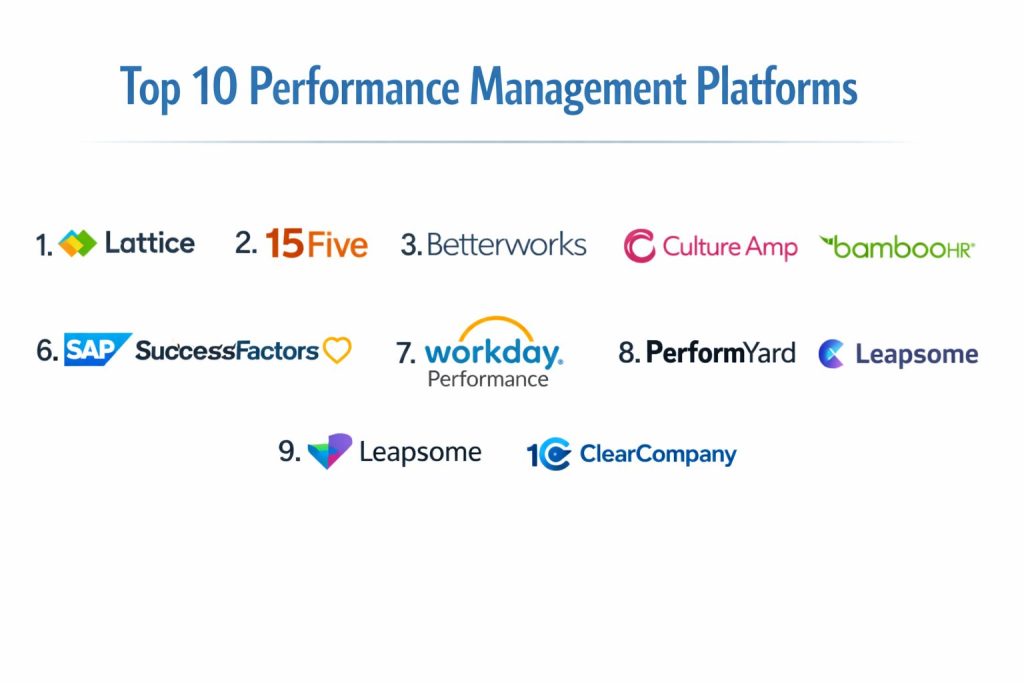
Top 10 Performance Management Platforms
1. Lattice
A unified platform that combines performance reviews, goal tracking, and employee engagement surveys into one clean interface. It is built to help companies grow their people alongside their business.
Key Features
- 360-Degree Reviews: Collect feedback from managers, peers, and direct reports for a full picture.
- OKR and Goal Tracking: Connect individual tasks directly to the company’s high-level objectives.
- Grow Modules: Clear career paths that show employees exactly how to move up.
- AI-Powered Insights: Quickly summarizes feedback themes so managers can act faster.
- Pulse Surveys: Short, frequent surveys to check the “temperature” of the team’s morale.
Pros
- One of the most intuitive and beautiful interfaces on the market.
- Excellent at connecting different data points (like engagement and performance).
- Very strong at helping managers hold better 1-on-1 meetings.
Cons
- Can be more expensive than basic HR tools.
- The depth of features might be overwhelming for very small teams.
Platforms / Deployment
- Web / iOS / Android
- Cloud
Security & Compliance
- SSO/SAML, MFA, and data encryption.
- SOC 2, GDPR, and ISO 27001 compliant.
Integrations & Ecosystem
Lattice is designed to live where your team works. It has deep connections that make it easy to manage performance without leaving your daily tools.
- Slack and Microsoft Teams for feedback.
- Major HRIS tools like BambooHR, Rippling, and Workday.
- Jira and Salesforce for tracking goal progress.
Support & Community
Offers a massive library of “University” content and a very active community of HR professionals. Customer support is known for being responsive and helpful.
2. 15Five
A platform centered on “manager enablement.” It uses a weekly check-in model to ensure that managers and employees stay connected and productive every single week.
Key Features
- Weekly Check-ins: A 15-minute routine for employees to share wins and challenges.
- High Fives: A social recognition tool for public praise.
- Manager Coaching: Built-in tips and training to help managers become better leaders.
- OKR Management: Visual tracking for team and individual goals.
- Performance Reviews: Streamlined cycles that use data from the weekly check-ins.
Pros
- Excellent for building a culture of consistent, open communication.
- Strong focus on manager training and development.
- Very easy for employees to adopt as a weekly habit.
Cons
- The “weekly” focus might feel too frequent for some company cultures.
- Pricing can get high if you want the full suite of coaching tools.
Platforms / Deployment
- Web / iOS / Android
- Cloud
Security & Compliance
- SSO, MFA, and audit logs.
- SOC 2 and GDPR compliant.
Integrations & Ecosystem
15Five integrates with the most common workplace tools to reduce administrative friction.
- Slack and Microsoft Teams integration.
- HRIS sync with ADP, BambooHR, and others.
- Google Calendar for 1-on-1 scheduling.
Support & Community
Highly regarded for their “Transform” training programs. They offer robust documentation and a dedicated customer success team.
3. Betterworks
An enterprise-grade platform that specializes in OKRs and strategic alignment. It is built for large organizations that need to stay agile and connected at scale.
Key Features
- Strategic Alignment: Visual maps showing how every goal connects to the top.
- Continuous Check-ins: Structured conversations to keep projects moving forward.
- Anytime Feedback: Allows anyone in the company to give feedback at any time.
- Calibration Tools: Ensures that performance ratings are fair across different departments.
- Advanced Analytics: Predictive data to show which teams are at risk of missing goals.
Pros
- Best-in-class for managing complex OKRs in large companies.
- Very strong focus on transparency and accountability.
- Highly scalable for tens of thousands of users.
Cons
- The interface can feel more “corporate” than some of the newer, more creative tools.
- Requires a significant amount of setup and strategy to get the most value.
Platforms / Deployment
- Web / iOS / Android
- Cloud
Security & Compliance
- Enterprise-grade SSO/SAML and encryption.
- SOC 2 Type II, ISO 27001, and HIPAA (where applicable).
Integrations & Ecosystem
Betterworks is built to be a central hub for strategy, integrating with the most powerful enterprise tools.
- Microsoft Teams, Slack, and Outlook.
- Deep HRIS integrations with SAP, Oracle, and Workday.
- Performance data can be exported for custom BI reporting.
Support & Community
Provides dedicated account managers for large enterprises and a professional services team to help with OKR strategy.
4. Culture Amp
Known primarily as an employee experience platform, it combines deep engagement analytics with performance tools to show how culture drives results.
Key Features
- Engagement Surveys: Science-backed surveys to understand the “why” behind performance.
- 360 Feedback: Comprehensive feedback loops for individuals and teams.
- Skills Tracking: Identify and develop the specific competencies your team needs.
- Manager Effectiveness: Tools specifically for helping managers lead better.
- Benchmarking: Compare your team’s performance data against industry standards.
Pros
- The most powerful data and analytics of any tool on this list.
- Science-based approach to questions and feedback.
- Excellent at showing the link between “happy employees” and “high performance.”
Cons
- Can be complex for smaller HR teams to manage.
- Some users find the performance modules less intuitive than the survey tools.
Platforms / Deployment
- Web / iOS / Android
- Cloud
Security & Compliance
- SSO, MFA, and role-based access control.
- SOC 2 Type II, GDPR, and ISO 27001.
Integrations & Ecosystem
Integrates with standard HR tech to ensure data flows smoothly between systems.
- Slack, Microsoft Teams, and Workplace.
- HRIS sync with Workday, BambooHR, and HiBob.
- Open API for custom data connections.
Support & Community
Offers the “Culture First” community, which is a global network of HR leaders. Support is highly professional and research-driven.
5. BambooHR
A complete HR platform for small and medium businesses that includes a surprisingly effective and simple performance management module.
Key Features
- Simple Appraisals: Short, meaningful questions that don’t take hours to answer.
- Goal Tracking: Visual progress bars for individual and department goals.
- Self-Assessments: Employees can reflect on their own work before the review.
- Peer Feedback: Quick way to gather opinions from coworkers.
- Performance Reports: Easy-to-read charts for managers and HR.
Pros
- Best option if you want performance, payroll, and time-off in one tool.
- Incredibly easy to use for both managers and employees.
- Very affordable for small to mid-sized businesses.
Cons
- Performance features are more basic compared to “specialist” tools like Lattice.
- Not ideal for companies that need complex, highly customized review cycles.
Platforms / Deployment
- Web / iOS / Android
- Cloud
Security & Compliance
- SSO, data encryption, and regular security audits.
- SOC 2 Type II and GDPR compliant.
Integrations & Ecosystem
BambooHR acts as the “source of truth” for many other tools, making integrations very reliable.
- 15Five, Lattice, and Culture Amp (if you want to use them instead).
- Slack for basic notifications.
- Hundreds of marketplace apps for extra functionality.
Support & Community
Legendary for their friendly and helpful customer support. Documentation is clear, simple, and written for non-experts.
6. SAP SuccessFactors
A world-leading, enterprise-grade Human Experience Management (HXM) suite that offers massive power for global corporations.
Key Features
- Continuous Performance Management: Real-time tracking of activities and achievements.
- Goal Management: Massive library of pre-built goal templates for every industry.
- 360-Degree Reviews: Enterprise-level feedback loops with deep customization.
- Succession Planning: Identify who is ready to take over key roles in the future.
- Calibration: Advanced visual tools to ensure fair ratings across global offices.
Pros
- Unmatched scalability for the world’s largest companies.
- Incredibly deep features for every possible HR and performance need.
- Strong global compliance and localization in dozens of languages.
Cons
- Very high cost and complex implementation process.
- The interface can feel overwhelming due to the sheer number of options.
Platforms / Deployment
- Web / iOS / Android
- Cloud / Hybrid
Security & Compliance
- Best-in-class security with SSO/SAML and multi-layered encryption.
- ISO 27001, SOC 1 & 2, HIPAA, and global data privacy standards.
Integrations & Ecosystem
As part of the SAP family, it integrates perfectly with the world’s most common enterprise software.
- Native integration with SAP ERP and S/4HANA.
- Microsoft Teams and Outlook integration.
- Extensive partner ecosystem for custom extensions.
Support & Community
Global support network with 24/7 availability. Access to a massive community of enterprise HR experts.
7. Workday Performance
Part of the famous Workday suite, this tool focuses on providing a unified view of talent data to help leaders make better people decisions.
Key Features
- Talent Insights: Uses data to predict performance trends and retention risks.
- Agile Goal Setting: Goals that can be adjusted as quickly as the business changes.
- Calibration Tools: Ensure consistency in reviews across thousands of managers.
- Development Planning: Connects performance directly to learning and growth.
- Mobile Reviews: A very strong mobile experience for on-the-go feedback.
Pros
- Perfect if your company already uses Workday for HR and Finance.
- Very strong focus on data-driven decision-making.
- High level of security and reliability for large organizations.
Cons
- Can be very expensive as a standalone option; best bought as part of the suite.
- Implementation usually requires specialized consultants.
Platforms / Deployment
- Web / iOS / Android
- Cloud
Security & Compliance
- Enterprise-level SSO/SAML and advanced auditing.
- ISO 27001, SOC 2, and GDPR compliant.
Integrations & Ecosystem
Workday is often the “center” of a company’s software stack, offering deep hooks into other tools.
- Microsoft Teams and Slack.
- Salesforce and specialized industry tools.
- Robust API for custom business process automation.
Support & Community
Extensive professional support and a very active community of “Workday Pros.”
8. PerformYard
A highly flexible performance management tool that allows companies to build exactly the review process they want without being forced into a specific “philosophy.”
Key Features
- Customizable Reviews: Build any type of form or cycle (annual, quarterly, project-based).
- Goal Management: Supports OKRs, KPIs, and individual milestones.
- Continuous Feedback: Simple tools for giving and receiving praise or tips.
- Reporting & Dashboards: Visual views of how the whole company is performing.
- Reference Notes: Managers can keep private notes throughout the year to help with final reviews.
Pros
- Best choice for companies with very unique or traditional review processes.
- Excellent customer support that helps you build your custom cycles.
- Very straightforward pricing with no hidden fees.
Cons
- The design is clean but lacks some of the “fanciness” of newer competitors.
- Lacks some of the advanced AI features found in other platforms.
Platforms / Deployment
- Web / iOS / Android
- Cloud
Security & Compliance
- SSO/SAML support and data encryption.
- SOC 2 Type II and GDPR compliant.
Integrations & Ecosystem
PerformYard focuses on making sure your employee data stays in sync with your payroll or HRIS.
- ADP, BambooHR, Gusto, and Rippling.
- Microsoft Teams and Slack for notifications.
- Open API for custom connections.
Support & Community
Well-known for their “white-glove” onboarding where they help you set up your first review cycle for free.
9. Leapsome
An all-in-one platform for performance, engagement, and learning, specifically designed for fast-growing companies that want to scale their culture.
Key Features
- Review Cycles: Automated workflows for 360, manager, and self-reviews.
- Learning Paths: Create training courses and track completion alongside performance.
- Meeting Tools: Structured agendas for 1-on-1s and team meetings.
- Praise Wall: A public space for employees to recognize each other’s work.
- Competency Frameworks: Clearly define the skills needed for every role.
Pros
- Excellent “all-in-one” feel; everything is connected.
- Very strong at linking learning and development to performance.
- Modern, fast-loading interface that employees enjoy using.
Cons
- Pricing can be a bit confusing as it is modular (you pay for what you use).
- Some advanced features are only available in the higher tiers.
Platforms / Deployment
- Web / iOS / Android
- Cloud
Security & Compliance
- SSO/SAML, MFA, and audit logs.
- GDPR (built in Germany) and SOC 2 compliant.
Integrations & Ecosystem
Leapsome integrates with most modern productivity and HR tools.
- Slack and Microsoft Teams.
- BambooHR, Personio, and HiBob.
- Google Calendar and Outlook sync.
Support & Community
Offers excellent onboarding and a library of best-practice templates for reviews and goals.
10. ClearCompany
A talent management suite that bridges the gap between hiring (ATS) and performance, ensuring that high-performing hires stay high-performing employees.
Key Features
- Goal Alignment: Connects new hire goals directly to the company’s mission.
- Performance Reviews: Clean, automated cycles for any frequency.
- Real-time Feedback: Mobile-friendly tools for instant recognition.
- Analytics & Reporting: Powerful insights into quality-of-hire and performance trends.
- Social Recognition: Peer-to-peer shouting-out to boost morale.
Pros
- Unique ability to track an employee’s journey from the first interview to their first promotion.
- Very easy to set up for mid-market companies.
- Excellent for ensuring that company values are woven into reviews.
Cons
- The performance module is part of a larger suite; might be “too much” for some.
- Lacks some of the highly specialized OKR tools of competitors like Betterworks.
Platforms / Deployment
- Web / iOS / Android
- Cloud
Security & Compliance
- SSO, MFA, and encrypted data storage.
- SOC 2 compliant.
Integrations & Ecosystem
Designed to be a full talent suite, but plays well with existing payroll systems.
- Integrates with major payroll providers like ADP and Paylocity.
- Slack integration for performance alerts.
- Standard export options for data analysis.
Support & Community
Provides dedicated implementation managers and a solid knowledge base for self-service.
Comparison Table (Top 10)
| Tool Name | Best For | Platform(s) Supported | Deployment | Standout Feature | Public Rating |
| Lattice | Mid-market & Growth | Web, iOS, Android | Cloud | Career growth paths | N/A |
| 15Five | Manager Development | Web, iOS, Android | Cloud | Weekly check-in ritual | N/A |
| Betterworks | Enterprise OKRs | Web, iOS, Android | Cloud | Strategic goal mapping | N/A |
| Culture Amp | Analytics-driven teams | Web, iOS, Android | Cloud | Science-backed surveys | N/A |
| BambooHR | Small-Medium Business | Web, iOS, Android | Cloud | All-in-one HR simplicity | N/A |
| SAP SuccessFactors | Global Multinationals | Web, iOS, Android | Hybrid | Massive global scale | N/A |
| Workday | Data-centric Enterprises | Web, iOS, Android | Cloud | Predictive talent insights | N/A |
| PerformYard | Custom Workflows | Web, iOS, Android | Cloud | Flexibility of reviews | N/A |
| Leapsome | Performance + Learning | Web, iOS, Android | Cloud | Learning path integration | N/A |
| ClearCompany | Talent Alignment | Web, iOS, Android | Cloud | Hiring-to-performance link | N/A |
Evaluation & Scoring of Performance Management Platforms
The scores below are comparative, showing how these platforms stack up against each other based on current 2026 market expectations. Scores are out of 10.
| Tool Name | Core (25%) | Ease (15%) | Integrations (15%) | Security (10%) | Performance (10%) | Support (10%) | Value (15%) | Weighted Total |
| Lattice | 9 | 9 | 9 | 8 | 9 | 9 | 8 | 8.8 |
| 15Five | 8 | 9 | 8 | 8 | 8 | 9 | 8 | 8.3 |
| Betterworks | 10 | 6 | 9 | 9 | 9 | 8 | 7 | 8.2 |
| Culture Amp | 9 | 7 | 8 | 9 | 9 | 9 | 7 | 8.1 |
| BambooHR | 7 | 10 | 8 | 8 | 8 | 10 | 9 | 8.2 |
| SAP SuccessFactors | 10 | 4 | 10 | 10 | 9 | 8 | 5 | 8.0 |
| Workday | 9 | 5 | 9 | 10 | 9 | 8 | 6 | 7.9 |
| PerformYard | 8 | 8 | 8 | 8 | 8 | 10 | 9 | 8.3 |
| Leapsome | 9 | 8 | 8 | 8 | 9 | 8 | 8 | 8.3 |
| ClearCompany | 8 | 8 | 7 | 8 | 8 | 8 | 8 | 7.8 |
How to Interpret These Scores
- Core features: The depth of goal tracking, reviews, and feedback tools.
- Ease of use: How quickly an average employee can learn to use the tool.
- Weighted Total: This score reflects the overall strength as an all-around choice. Keep in mind that for a massive global company, a “10” in Security and Integrations (like SAP) is much more important than a high score in Ease of Use.
Which Performance Management Platform Tool Is Right for You?
Solo / Freelancer
While most of these tools are for teams, if you are a solo operator looking to track your own goals, Blender (for 3D work) or a simple task manager is better. However, for a very small startup (1-5 people), BambooHR or a basic PerformYard setup is the most accessible.
SMB
For businesses with 20-200 employees, BambooHR is the clear winner if you want simplicity. If you want to build a high-performance culture early, 15Five or Lattice provide the best balance of features and ease of use.
Mid-Market
Companies with 200-1,000 employees often find their “sweet spot” with Lattice, Leapsome, or Culture Amp. These platforms offer the analytics and structure needed to manage growing teams without the massive complexity of an enterprise suite.
Enterprise
For large organizations (1,000+ employees), Betterworks, Workday, or SAP SuccessFactors are the industry standards. They provide the necessary compliance, global security, and deep integration into other business systems.
Budget vs Premium
- Budget: PerformYard and BambooHR offer some of the most transparent and affordable entry points.
- Premium: Workday and SuccessFactors are expensive but provide unmatched power and data security for complex organizations.
Feature Depth vs Ease of Use
- Deep Tools: Betterworks and Houdini (in the 3D world, similar to Houdini’s technical depth) require time to master but offer incredible control.
- Easy Tools: 15Five and BambooHR prioritize the user experience so everyone actually enjoys using the software.
Frequently Asked Questions (FAQs)
What is the typical cost for these platforms?
Most tools charge on a “per user, per month” basis. This can range from $4 for basic check-ins to over $15 for full-suite performance and engagement platforms. Enterprise tools usually require a custom quote.
How long does implementation take?
For a simple tool like BambooHR, you can be up and running in a few days. For enterprise suites like Workday or SAP, the process can take 3 to 9 months and often requires a dedicated implementation team.
Can these tools handle hybrid and remote teams?
Yes, this is where they shine. They provide a central “digital office” for goals and feedback, making it easy for managers to stay connected to employees regardless of their physical location.
Do these tools replace the annual review?
Not necessarily, but they change it. Instead of one big “surprise” meeting, the annual review becomes a summary of the 52 weeks of feedback already recorded in the platform.
Is employee data safe?
Reputable platforms use bank-level encryption and follow strict laws like GDPR and SOC 2. However, you should always check the security settings to ensure only the right people can see sensitive feedback.
Can I integrate these with my payroll software?
Most modern platforms (like PerformYard and BambooHR) have built-in “bridges” to common payroll tools like ADP, Gusto, and Rippling, ensuring your employee list is always up to date.
What is the biggest mistake companies make when starting?
The most common error is buying a complex tool and then not training the managers on how to give good feedback. The software is just a tool; the culture of communication is what makes it work.
Are these tools suitable for non-desk workers?
Yes, many platforms now have excellent mobile apps specifically designed for workers in retail, manufacturing, or healthcare who don’t spend their day in front of a computer.
How do these tools help with employee retention?
By providing clear career paths and regular recognition, these tools make employees feel valued and show them exactly how they can grow within the company, which reduces the chance of them leaving.
Can I switch platforms if I’m not happy?
Most platforms allow you to export your data in CSV or Excel formats. However, moving the “history” of every feedback comment can be tricky, so it’s best to run a pilot project before committing.
Conclusion
The “best” performance management platform is the one that your team will actually use. For small businesses, BambooHR offers the easiest start. For mid-sized companies focused on growth, Lattice and 15Five are the leaders. Large global enterprises will find the power they need in Betterworks or Workday.