Introduction
In the modern workplace, keeping a team motivated and connected is no longer just a “nice-to-have” human resources task; it is a core business strategy. An Employee Engagement Platform is a digital tool designed to help organizations understand, measure, and improve the relationship between the company and its workers. Think of it as a continuous listening loop where employees can share how they feel, and leaders can take action to fix problems before people decide to leave.
As we move into a new era of work, these platforms have evolved. They are no longer just for annual surveys. Today, they focus on real-time feedback, mental well-being, and building a sense of belonging in teams that might be spread across the globe. Whether your team is in an office, working from home, or on the front lines, these tools ensure that every voice is heard and every contribution is recognized.
Real-World Use Cases
- Reducing Turnover: Identifying departments where stress is high and intervening before employees quit.
- Building Remote Culture: Using digital “shout-outs” to help team members feel connected even when they don’t see each other in person.
- Improving Diversity and Inclusion: Collecting anonymous data to see if all groups feel equally supported and included.
- Manager Training: Providing direct insights to managers about how their specific leadership style is impacting their team’s morale.
- Goal Alignment: Ensuring everyone in the company understands the big-picture mission and how their daily work contributes to it.
What Buyers Should Evaluate
- Survey Frequency: Does it support “pulse” surveys (short, frequent checks) or just long annual ones?
- Anonymity Controls: How does the platform protect employee identity to ensure honest feedback?
- Actionable Insights: Does it just give you data, or does it tell you exactly what to do next?
- Ease of Use: Is it simple enough for employees to use without a manual?
- Integration: Can it plug into tools you already use like Slack, Teams, or your payroll system?
- Mobile Accessibility: Is there a good app for employees who don’t work at a desk?
- Recognition Features: Does it include a way for peers to reward each other with points or public praise?
- Security: Does it meet enterprise standards for protecting sensitive personal data?
Best for: Companies of all sizes that want to lower their turnover rates, improve their culture, and make data-driven decisions about their people.
Not ideal for: Very small teams (under 10 people) where face-to-face communication is already highly effective and a digital platform might feel unnecessary.
Key Trends in Employee Engagement Software
- AI-Driven Sentiment Analysis: Modern platforms now use artificial intelligence to read through thousands of open-ended survey comments to find hidden patterns of frustration or excitement.
- Nudge Theory: Instead of just reporting data, software now “nudges” managers with small, specific tasks—like “Remember to thank Gemi for their help on that project”—to improve daily engagement.
- Focus on Holistic Well-being: Engagement is now tied to mental and physical health, with platforms offering wellness challenges and stress-tracking tools.
- The “Flow of Work” Integration: Tools are moving away from standalone websites and into the apps people already use, like Slack or Microsoft Teams, making it easier to give feedback instantly.
- Real-Time Benchmarking: Companies can now see how their engagement scores compare to others in their specific industry in real-time, rather than waiting for annual reports.
- Personalized Growth Paths: AI helps suggest specific learning and development opportunities for employees based on their feedback and career goals.
- Predictive Analytics: Advanced systems can now flag “flight risks”—predicting which employees are likely to leave in the next 3 to 6 months based on changes in their engagement patterns.
- Frontline-First Design: A massive shift toward making these tools accessible for workers who don’t have a company email address, using QR codes and SMS-based surveys.
How We Selected These Tools (Methodology)
To select the top tools for this category, we followed a rigorous evaluation process:
- Adoption and Reputation: We looked for platforms that are trusted by leading global brands and have high user satisfaction scores.
- Depth of Analytics: We prioritized tools that provide deep, science-backed insights rather than just surface-level data.
- User Experience: We evaluated how “human” the interface feels and how easy it is for a non-technical person to navigate.
- Manager Enablement: Special attention was given to tools that empower middle managers to take action, rather than just giving data to HR.
- Ecosystem Integration: We checked how well these tools connect with standard business software like HRIS and communication apps.
- Security Posture: We only included tools that demonstrate a clear commitment to data privacy and modern security standards.
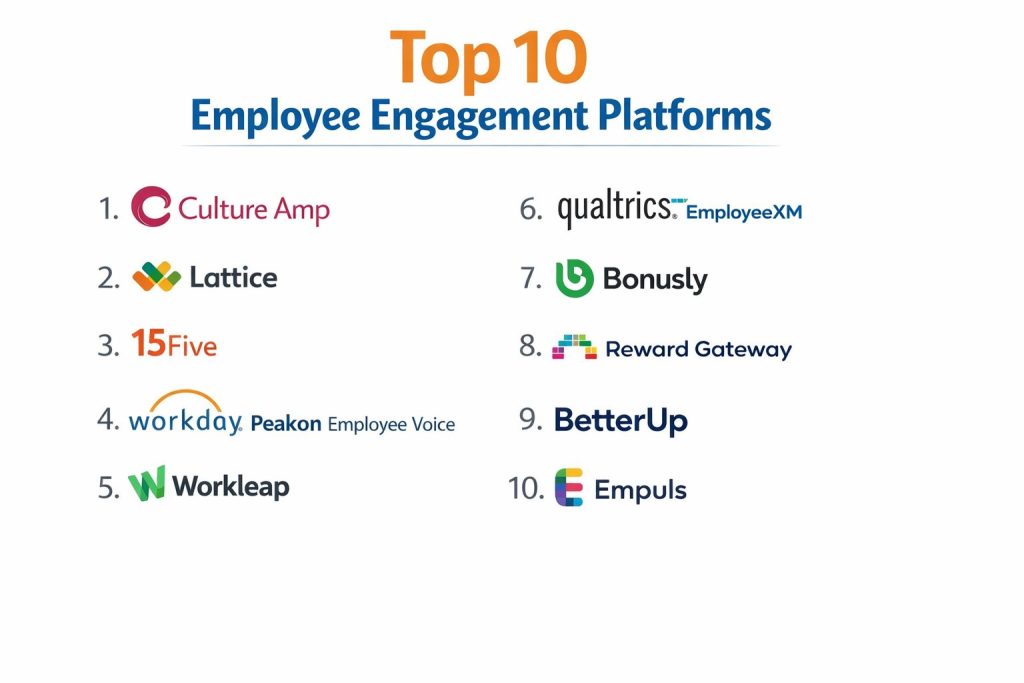
Top 10 Employee Engagement Platforms
1. Culture Amp
A leading platform that combines powerful science-backed surveys with performance management to help companies build a “culture-first” organization.
Key Features
- Science-Backed Templates: Expertly designed surveys for engagement, onboarding, and exit interviews.
- Predictive Analytics: Identifies which factors are most likely to cause employees to leave.
- Focus Framework: Uses algorithms to tell you the one or two things you should focus on to have the biggest impact.
- Action Planning: Built-in tools that guide managers through the process of improving their team scores.
- Benchmarking: Compare your results against thousands of other companies in your specific industry.
Pros
- Extremely deep and meaningful data analysis.
- Excellent educational resources for HR professionals.
- High levels of trust in their survey anonymity.
Cons
- Can be overwhelming for very small teams due to the amount of data.
- Pricing is on the higher end compared to simpler tools.
Platforms / Deployment
- Web / Windows / macOS / iOS / Android
- Cloud
Security & Compliance
- SSO/SAML, MFA, and data encryption.
- SOC 2 Type II, GDPR, and HIPAA compliant.
Integrations & Ecosystem
Culture Amp integrates deeply with your entire HR tech stack to ensure data flows smoothly.
- Integrates with Slack and Microsoft Teams.
- Syncs with HRIS like Workday, BambooHR, and HiBob.
- Open API for custom data connections.
Support & Community
Known for its “Culture First” community where thousands of HR leaders share best practices. 24/7 global support is available for enterprise clients.
2. Lattice
An all-in-one “People Success” platform that links employee engagement directly to performance reviews and career growth.
Key Features
- Integrated 1-on-1s: Tools for managers to lead meaningful conversations that are tracked alongside engagement data.
- Pulse Surveys: Frequent, short surveys that keep a constant finger on the pulse of the team.
- Goal and OKR Tracking: Keeps everyone aligned on company objectives.
- Growth Plans: Helps employees see a clear career path within the company.
- AI Sentiment Analysis: Automatically categorizes written feedback into themes like “Leadership” or “Compensation.”
Pros
- Beautiful, modern interface that employees actually enjoy using.
- Great for connecting employee feelings to their actual work goals.
- Strong focus on manager development.
Cons
- The platform is very feature-rich, which can lead to a slight learning curve.
- Some users find the notification system to be a bit noisy.
Platforms / Deployment
- Web / Windows / macOS / iOS / Android
- Cloud
Security & Compliance
- SSO, MFA, and role-based access control.
- SOC 2, GDPR, and ISO 27001.
Integrations & Ecosystem
Lattice is built to live in the “flow of work,” meaning you can use it without leaving your daily tools.
- Deep integration with Slack and Microsoft Teams.
- Integrates with Jira for developer-heavy teams.
- Seamless sync with most major payroll and HRIS platforms.
Support & Community
Provides excellent onboarding and a dedicated customer success manager for larger accounts. Their help center is very thorough.
3. 15Five
A platform centered around “manager enablement,” using weekly check-ins to drive engagement and high performance.
Key Features
- Weekly Check-ins: A quick 15-minute process for employees to share wins and challenges.
- High Five Recognition: A simple way for peers to send public praise to each other.
- Transform Training: In-platform coaching and training for managers.
- Engagement Surveys: Backed by positive psychology to measure the true drivers of work happiness.
- Manager Dashboards: Gives leaders a clear view of team health at a glance.
Pros
- Excellent for building a habit of regular communication.
- Strong focus on psychological safety and employee well-being.
- Very easy to set up for mid-market companies.
Cons
- Requires a strong commitment from managers to be effective.
- Not as deep in “Big Data” analytics as platforms like Qualtrics.
Platforms / Deployment
- Web / Windows / macOS / iOS / Android
- Cloud
Security & Compliance
- SSO, MFA, and secure data hosting.
- SOC 2 Type II and GDPR compliant.
Integrations & Ecosystem
15Five emphasizes simplicity and works well with the most common office tools.
- Slack and Microsoft Teams for check-in reminders.
- Integrations with BambooHR, Namely, and Workday.
- Google Calendar integration for scheduling 1-on-1s.
Support & Community
Offers a “Best-Self Management” community and extensive webinars. Support is responsive and friendly.
4. Workday Peakon Employee Voice
An enterprise-level listening platform that provides real-time insights into employee sentiment across massive, global workforces.
Key Features
- Continuous Listening: Automated surveys that adapt based on the individual employee’s journey.
- Real-Time Benchmarking: Compare your scores instantly against a live database of global companies.
- Manager Actions: Automatically suggests tasks for managers based on their team’s specific feedback.
- Global Reach: Supports over 50 languages for multinational teams.
- Advanced Privacy: Uses highly sophisticated techniques to ensure individual responses can never be identified.
Pros
- The most powerful benchmarking data in the world.
- Completely automated—once you set it up, it runs itself.
- Ideal for very large, complex organizations.
Cons
- Too complex and expensive for smaller businesses.
- The interface is professional but lacks the “fun” feel of some newer competitors.
Platforms / Deployment
- Web / iOS / Android
- Cloud / Hybrid
Security & Compliance
- Enterprise-grade security including SSO and MFA.
- SOC 2, ISO 27001, and GDPR compliant.
Integrations & Ecosystem
As part of the Workday family, it has unmatched integration with the Workday ecosystem.
- Native integration with Workday HCM.
- Works with Slack and Microsoft Teams.
- Robust API for custom enterprise integrations.
Support & Community
Professional-grade support with dedicated account teams. Extensive documentation for large-scale deployments.
5. Workleap
Formerly known as Officevibe, Workleap is a simple, approachable tool that helps managers build trust and have better conversations with their teams.
Key Features
- Pulse Surveys: 10 core metrics of engagement measured through fun, quick questions.
- Anonymous Feedback: A safe space for employees to send messages directly to their managers.
- Custom Polls: Allows you to dive deep into specific topics like a recent office move or a new benefit.
- Team Reports: Simple, colorful charts that are easy for any manager to understand.
- 1-on-1 Planner: Collaborative agendas to ensure meetings stay on track.
Pros
- One of the easiest tools to launch—you can start in minutes.
- Very affordable, making it perfect for smaller or budget-conscious teams.
- Employees actually enjoy the colorful, game-like survey interface.
Cons
- Lacks the advanced “predictive” features of enterprise tools.
- Reporting may be too simple for complex HR departments.
Platforms / Deployment
- Web / Windows / macOS / iOS / Android
- Cloud
Security & Compliance
- SSO support and data encryption at rest.
- GDPR and SOC 2 compliant.
Integrations & Ecosystem
Workleap focuses on the tools that modern, fast-moving teams use every day.
- Excellent Slack and Microsoft Teams integration.
- Syncs with Google and Office 365.
- Basic HRIS integrations for automated user management.
Support & Community
Offers great self-service help and a helpful blog for managers. Support is available via email and chat.
6. Qualtrics EmployeeXM
A high-end “Experience Management” platform that looks at the entire employee lifecycle, from the first interview to the final exit.
Key Features
- 360-Degree Feedback: Comprehensive reviews from peers, managers, and direct reports.
- Text iQ: Uses AI to read and categorize sentiment in thousands of employee comments.
- Predictive Driver Stats: Tells you exactly which factors are impacting your productivity and retention.
- Exit Discovery: Deep analysis into why people are leaving and how to stop it.
- Guided Action Planning: Standardized workflows to help leaders respond to feedback.
Pros
- Unmatched power for large-scale data analysis.
- Can connect employee engagement data to customer satisfaction data.
- Extremely customizable to fit any organization’s unique needs.
Cons
- Requires a significant investment of time and money.
- Usually requires a dedicated person or team to manage the platform.
Platforms / Deployment
- Web / iOS / Android
- Cloud
Security & Compliance
- High-level enterprise security including SSO and SAML.
- ISO 27001, SOC 2, HIPAA, and GDPR.
Integrations & Ecosystem
Qualtrics is designed to be a central “data hub” for your entire business experience.
- Integrates with Salesforce and SAP.
- Deep connections to most major HRIS platforms.
- Extensive marketplace for third-party “XM Solutions.”
Support & Community
World-class support and a massive “XM Institute” for learning the science of experience management.
7. Bonusly
A fun, social recognition platform that uses “micro-bonuses” to build a positive culture and keep employees engaged every day.
Key Features
- Peer-to-Peer Recognition: Every employee gets a monthly allowance of points to give to their coworkers.
- Reward Marketplace: Points can be traded for gift cards, company swag, or even charitable donations.
- Social Feed: A public wall where everyone can see and “celebrate” the wins of their colleagues.
- Automated Milestones: Automatically celebrates birthdays and work anniversaries.
- Engagement Analytics: Shows you which teams are most active and which individuals are your “culture drivers.”
Pros
- High adoption rates because it’s fun and rewarding.
- Builds immediate morale and reduces the feeling of being “invisible.”
- Very low administrative burden for HR.
Cons
- It is primarily a recognition tool, so the survey features are not as deep as others.
- Requires a budget for the actual rewards (gift cards, etc.).
Platforms / Deployment
- Web / iOS / Android
- Cloud
Security & Compliance
- SSO and MFA.
- SOC 2 Type II and GDPR compliant.
Integrations & Ecosystem
Bonusly is built to live where your employees already talk.
- Best-in-class Slack and Microsoft Teams integration.
- Integrates with Zapier for thousands of custom connections.
- Syncs with HRIS like BambooHR and Zenefits.
Support & Community
Great onboarding and a very helpful customer success team. Their “Bonusly University” helps you launch successfully.
8. Reward Gateway
A comprehensive “Employee Engagement Hub” that combines recognition, employee communications, and employee benefits in one place.
Key Features
- Employee Discounts: Gives employees access to thousands of discounts at major retailers.
- Custom Recognition: Tailored “e-cards” and awards that match your company’s values.
- Communication Tools: A central place for company news, videos, and leadership blogs.
- Well-being Center: Content and challenges focused on physical, mental, and financial health.
- Survey Tools: Includes pulse and NPS-style surveys to measure impact.
Pros
- Offers tangible financial value to employees through discounts.
- Great for consolidating multiple HR tools into one single “hub.”
- Highly customizable branding to make it feel like your own company app.
Cons
- The platform can feel quite large and complex to manage.
- Survey features are good but not as specialized as Culture Amp.
Platforms / Deployment
- Web / iOS / Android
- Cloud
Security & Compliance
- SSO/SAML 2.0 and encryption.
- ISO 27001 and GDPR compliant.
Integrations & Ecosystem
Reward Gateway focuses on being the central “front door” for your employees.
- Integrates with Microsoft 365 and Google Workspace.
- Connections to Slack and Teams.
- API available for HRIS syncing.
Support & Community
24/7/365 support for both employees and employers. They have a strong reputation for customer service.
9. BetterUp
A unique engagement platform that focuses on “Whole Person” development through 1-on-1 coaching for every employee.
Key Features
- 1-on-1 Professional Coaching: Connects employees with certified coaches to work on growth and resilience.
- BetterUp Care: Mental health support and coaching for well-being.
- Insights Dashboard: Aggregates data from coaching sessions to show leadership the general “mood” of the company.
- Assessments: Scientific tools to measure an employee’s mindset and potential.
- Micro-learning: Short, actionable content to build skills in between coaching sessions.
Pros
- Provides a level of personal care that other platforms cannot match.
- Drives massive shifts in leadership capability and employee resilience.
- Highly effective for preventing burnout in high-stress environments.
Cons
- Much more expensive than standard survey or recognition tools.
- Not a traditional “survey” platform; it’s a development platform.
Platforms / Deployment
- Web / iOS / Android
- Cloud
Security & Compliance
- Enterprise-grade security and data privacy.
- SOC 2 and GDPR compliant.
Integrations & Ecosystem
BetterUp focuses on individual growth but integrates with the broader HR world for data.
- Integrates with Slack and Microsoft Teams for reminders.
- Data sharing with major HRIS platforms.
- Calendar sync for coaching sessions.
Support & Community
Dedicated coaching support and high-level account management. They provide deep scientific research to their clients.
10. Empuls
A budget-friendly, all-in-one engagement platform that combines surveys, social recognition, and a rewards marketplace.
Key Features
- Social Intranet: A place for employees to join groups, share news, and chat.
- Pulse Surveys & eNPS: Measures employee loyalty and satisfaction with simple tools.
- Rewards Marketplace: A global catalog of gift cards and experiences.
- Gamification: Uses points, badges, and leaderboards to drive participation.
- Actionable Insights: Simple dashboards that tell HR which departments need attention.
Pros
- Excellent value for money; very cost-effective for growing companies.
- Covers almost every engagement need in a single tool.
- Very easy to navigate for employees.
Cons
- The “social” features might be too much for companies with a very formal culture.
- Analytics are helpful but not as deep as enterprise-level competitors.
Platforms / Deployment
- Web / iOS / Android
- Cloud
Security & Compliance
- SSO, MFA, and secure cloud infrastructure.
- SOC 2, ISO 27001, and GDPR compliant.
Integrations & Ecosystem
Empuls is built for small to mid-sized businesses that want simple connections.
- Integrates with Slack and Microsoft Teams.
- Syncs with HRIS like BambooHR and Darwinbox.
- Integrates with payroll systems to automate rewards.
Support & Community
Provides 24/7 support and extensive “Culture Kits” to help HR teams get started.
Comparison Table (Top 10)
| Tool Name | Best For | Platform(s) Supported | Deployment | Standout Feature | Public Rating |
| Culture Amp | Science-Based Growth | Web, Mobile | Cloud | Predictive Exit Analytics | N/A |
| Lattice | Performance Integration | Web, Mobile | Cloud | Integrated 1-on-1s | N/A |
| 15Five | Manager Development | Web, Mobile | Cloud | Weekly Check-in System | N/A |
| Workday Peakon | Large Enterprises | Web, Mobile | Hybrid | Real-time Benchmarking | N/A |
| Workleap | Ease of Use & SMBs | Web, Mobile | Cloud | Anonymous Feedback Loop | N/A |
| Qualtrics | Deep Data Analytics | Web, Mobile | Cloud | Text iQ AI Analysis | N/A |
| Bonusly | Peer Recognition | Web, Mobile | Cloud | Micro-bonus Marketplace | N/A |
| Reward Gateway | Consolidating HR Hubs | Web, Mobile | Cloud | Global Retailer Discounts | N/A |
| BetterUp | Individual Well-being | Web, Mobile | Cloud | 1-on-1 Human Coaching | N/A |
| Empuls | Budget-Friendly All-in-One | Web, Mobile | Cloud | Social Intranet Features | N/A |
Evaluation & Scoring of Employee Engagement Platforms
The scoring below reflects how these tools perform in a typical professional environment. Scores are out of 10.
| Tool Name | Core (25%) | Ease (15%) | Integrations (15%) | Security (10%) | Performance (10%) | Support (10%) | Value (15%) | Weighted Total |
| Culture Amp | 10 | 7 | 9 | 9 | 9 | 9 | 7 | 8.7 |
| Lattice | 9 | 9 | 9 | 9 | 9 | 8 | 8 | 8.8 |
| 15Five | 8 | 9 | 8 | 8 | 9 | 8 | 8 | 8.2 |
| Workday Peakon | 10 | 6 | 10 | 10 | 9 | 9 | 6 | 8.5 |
| Workleap | 7 | 10 | 8 | 8 | 9 | 8 | 9 | 8.2 |
| Qualtrics | 10 | 5 | 10 | 10 | 9 | 9 | 6 | 8.4 |
| Bonusly | 7 | 10 | 10 | 8 | 9 | 8 | 8 | 8.3 |
| Reward Gateway | 8 | 8 | 8 | 9 | 9 | 9 | 8 | 8.3 |
| BetterUp | 8 | 8 | 7 | 9 | 9 | 10 | 6 | 7.8 |
| Empuls | 8 | 9 | 8 | 8 | 9 | 8 | 10 | 8.5 |
How to Interpret These Scores
- Core features: Evaluates the depth of survey science, recognition tools, and analytics.
- Value: Measures the “bang for your buck” relative to the tool’s cost and business impact.
- Weighted Total: A high score indicates a well-balanced platform. However, choose based on your specific priority (e.g., Qualtrics for data, Bonusly for fun, BetterUp for coaching).
Which Employee Engagement Platforms Tool Is Right for You?
Solo / Freelancer
Solo users generally do not need these platforms, as they are designed for team dynamics. However, if you are a freelancer working within a large company, you may be invited to use their Bonusly or Workleap account.
SMB
For companies with 10–100 people, Workleap or Bonusly are the best starting points. They are easy to set up, affordable, and provide immediate visibility into how your small team is doing.
Mid-Market
Companies with 100–1,000 employees should look at Lattice or 15Five. These platforms are robust enough to handle multiple departments and provide the manager-level insights that growing organizations desperately need.
Enterprise
For global giants, Workday Peakon or Qualtrics EmployeeXM are the only tools with the necessary scale and data sophistication. They handle multiple languages, complex hierarchies, and massive data security requirements.
Budget vs Premium
- Budget: Empuls and Workleap provide the most comprehensive features for the lowest monthly cost.
- Premium: BetterUp and Culture Amp are high-investment but offer transformative results in leadership and culture.
Feature Depth vs Ease of Use
- Feature Depth: Qualtrics and Houdini (for data) are best for those who want to “drill down” into every single data point.
- Ease of Use: Bonusly and Workleap focus on getting people involved with zero training.
Frequently Asked Questions (FAQs)
Are employee surveys really anonymous?
Most platforms use “Anonymity Thresholds,” meaning if a team has fewer than 5 people, the manager cannot see the results. This ensures that individual identities are protected even in small groups.
How often should we run pulse surveys?
The best practice is “just enough to act.” Many companies find that a monthly or bi-weekly pulse check of 3-5 questions works best to stay current without causing “survey fatigue.”
What is eNPS?
It stands for Employee Net Promoter Score. It asks one simple question: “How likely are you to recommend this company as a place to work?” It’s the gold standard for measuring overall loyalty.
Can these tools really reduce turnover?
Yes. By identifying departments with low “belonging” or high “stress” scores early, HR can intervene with training or support before employees start looking for other jobs.
Do these platforms work for frontline workers?
Modern tools like Empuls or Reward Gateway are designed for mobile first. Workers in factories or retail can access surveys via QR codes or text messages without needing a computer.
How much do these platforms cost?
Pricing varies wildly, but most platforms cost between $3 and $12 per employee per month. Enterprise tools often have additional setup and annual licensing fees.
Is it hard to switch from one tool to another?
The hardest part is the historical data. Most platforms allow you to export your data, but comparing “apples to oranges” between different survey methodologies can be tricky.
Does the software suggest actions for managers?
Yes, high-end tools like Culture Amp and Peakon provide “Action Plans” that give managers specific, step-by-step instructions on how to improve their team’s engagement scores.
Can we customize the survey questions?
Almost all platforms allow you to add your own questions. However, experts recommend using their “science-backed” templates for at least 80% of your survey to ensure the data is reliable.
Is my data safe on these platforms?
Leading platforms use the same level of security as banks, including SSO, MFA, and SOC 2 compliance, to ensure that employee personal info and feedback remain private.
Conclusion
The “best” employee engagement platform is the one that your team will actually use. For many companies, starting with a simple recognition tool like Bonusly or a basic survey tool like Workleap is the best way to build a habit of feedback. If you are an enterprise looking for deep, predictive insights to drive a global strategy, Culture Amp or Peakon are the industry leaders.