Introduction
Candidate assessment tools are digital platforms designed to help hiring teams evaluate job seekers beyond the basic information found on a resume. In plain English, these tools act as a filter that measures specific skills, personality traits, and problem-solving abilities before a candidate ever reaches the interview stage. Instead of guessing if a person can code, write, or manage a team based on their past job titles, these platforms provide data-driven proof of their actual capabilities.
In the current professional landscape, these tools have become essential. The volume of job applications has increased significantly, and traditional screening methods can no longer keep up. Organizations now face the challenge of identifying top talent in a sea of AI-generated resumes. Assessment tools solve this by shifting the focus from “what someone says they did” to “what someone can actually do.” This reduces the risk of expensive hiring mistakes, which can cost a company thousands in lost productivity and turnover.
Real-world Use Cases
- High-Volume Screening: Quickly narrowing down 5,000 applicants for a retail or graduate role to the top 50 qualified individuals.
- Technical Validation: Ensuring a developer has the specific coding skills required for a specialized software project.
- Cultural Alignment: Assessing if a candidate’s work style and values match the existing team dynamics.
- Leadership Benchmarking: Identifying high-potential employees for internal promotions using psychometric data.
- Bias Reduction: Implementing “blind” testing where names and backgrounds are hidden to ensure fair evaluation based purely on merit.
What Buyers Should Evaluate
- Validity and Reliability: Does the test actually measure what it claims to measure?
- Candidate Experience: Is the test engaging and mobile-friendly, or will it cause high abandonment rates?
- Integration Capability: Can the tool sync directly with your existing Applicant Tracking System (ATS)?
- Anti-Cheating Measures: Does it include proctoring, plagiarism detection, or AI-resistant question banks?
- Content Library: Is there a broad range of pre-built tests, or will you have to create everything from scratch?
- Reporting Depth: Are the results easy for hiring managers to understand and act upon?
- Security and Compliance: Does the vendor meet global standards like GDPR and SOC 2?
- Scalability: Can the platform handle 10 candidates as easily as 10,000?
Best for: Recruitment agencies, corporate HR departments, and growing startups that need to improve the quality of hire while reducing time-to-fill.
Not ideal for: Very small businesses hiring for a single, non-technical role where a simple conversation and reference check might be sufficient.
Key Trends in Candidate Assessment Software
- AI-Resistant Questioning: As candidates use generative AI to assist in tests, assessment platforms are moving toward interactive simulations and live video responses that are harder for AI to replicate.
- Skills Intelligence Engines: Modern platforms are moving away from “pass/fail” scores toward mapping a candidate’s specific skills against the long-term strategic needs of the company.
- Soft-Skill Prioritization: There is a growing emphasis on measuring adaptability, critical thinking, and emotional intelligence, as these are harder to automate than technical tasks.
- Hyper-Personalized Assessments: Tools now allow recruiters to build “job-specific” simulations that mirror a day in the life of that specific company, providing a “virtual job tryout.”
- Global Compliance Focus: With new regulations regarding automated hiring decisions, tools are adding features for “bias auditing” and transparent scoring explanations.
- Mobile-First Engagement: Most candidates now complete assessments on mobile devices, leading to a shift toward shorter, gamified, and responsive test designs.
- Real-Time Skill Benchmarking: Comparing a candidate’s performance not just against other applicants, but against the global average for that specific role.
- Predictive Performance Modeling: Using data from a company’s top performers to create a “success profile” that the assessment tool uses to find similar new hires.
How We Selected These Tools (Methodology)
To select the top tools in this category, we evaluated a wide range of vendors based on the following logic:
- Market Mindshare: We prioritized platforms that are widely recognized as leaders in the recruitment technology space.
- Scientific Rigor: High value was placed on tools that use validated psychometric models or peer-reviewed testing methodologies.
- User Experience: We assessed both the recruiter dashboard’s ease of use and the candidate’s testing interface.
- Enterprise Readiness: Selection favored tools with robust security, SSO capabilities, and global data residency options.
- Feature Breadth: We looked for platforms that offer a mix of cognitive, behavioral, and technical testing.
- Ecosystem Connectivity: Priority was given to tools that integrate seamlessly with major ATS platforms like Greenhouse, Lever, and Workday.
- Modern Innovation: We included tools that are leading the way in AI-proctoring and real-time skill verification.
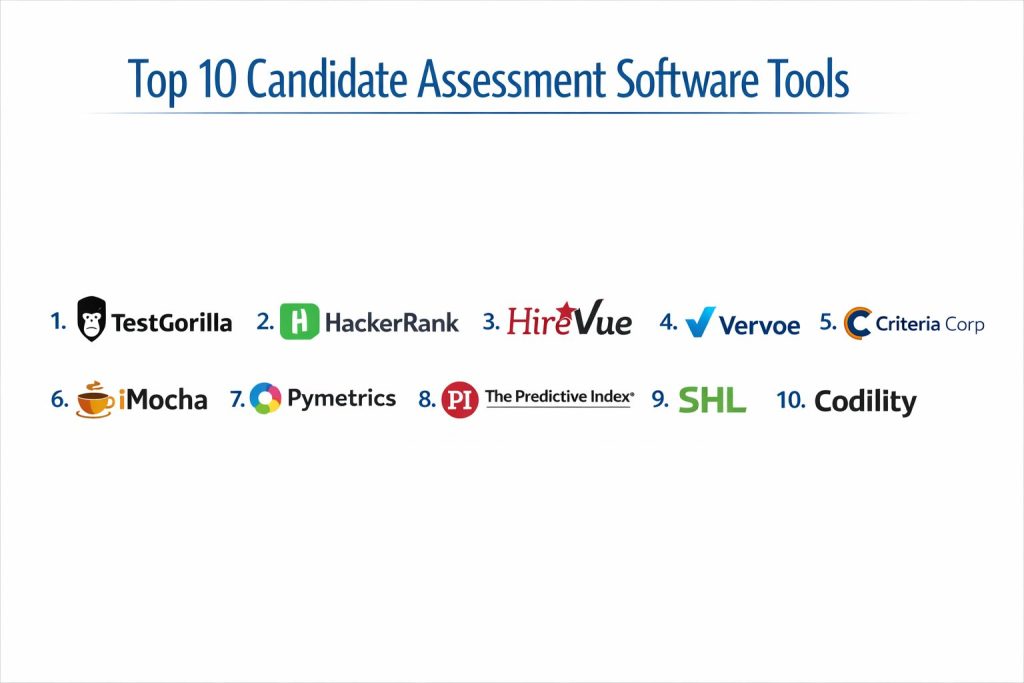
Top 10 Candidate Assessment Software Tools
1. TestGorilla
A versatile skills-based testing platform designed to replace the resume-screening phase. It is ideal for SMBs and mid-market companies that need a broad library of pre-built tests.
Key Features
- Massive Test Library: Access to over 300 tests covering coding, language, personality, and job-specific skills.
- Custom Question Creation: Ability to add your own video, multiple-choice, or open-ended questions.
- Anti-Cheating Suite: Includes webcam snapshots, full-screen detection, and time limits to ensure integrity.
- Multi-Measure Assessments: Combine up to five different tests into a single assessment link for candidates.
- One-Way Video Interviews: Allows candidates to record video responses to specific screening questions.
Pros
- Extremely easy to set up, even for teams without a technical background.
- Offers a “Free Forever” tier for basic screening needs.
- Excellent visual reporting that makes it easy to compare candidates at a glance.
Cons
- The pricing can scale quickly if you need to test a very high volume of candidates.
- Some advanced technical coding tests may lack the depth required for senior engineering roles.
Platforms / Deployment
- Web / Windows / macOS / iOS / Android
- Cloud
Security & Compliance
- SSO/SAML, MFA
- GDPR compliant, ISO 27001
Integrations & Ecosystem
TestGorilla is built to sit at the top of the hiring funnel. It connects with most modern recruitment stacks to automate the transition from “Applied” to “Tested.”
- Native integrations with Greenhouse, Lever, and SmartRecruiters.
- Zapier support for custom workflows.
- API access for enterprise data exports.
Support & Community
Extensive help center with video tutorials and live chat support for paid tiers. The community is active, frequently contributing to their test library suggestions.
2. HackerRank
The gold standard for technical and developer hiring. It provides an end-to-end platform for evaluating coding skills, from initial screening to live technical interviews.
Key Features
- Developer Skills Matrix: A detailed breakdown of a candidate’s proficiency in specific languages and frameworks.
- Integrated Development Environment (IDE): A robust, in-browser coding environment that supports over 40 programming languages.
- CodePair: A live, collaborative coding environment for remote technical interviews with real-time evaluation.
- Plagiarism Detection: Advanced algorithms that check code against millions of other submissions to detect cheating.
- Workforce Planning: Tools to benchmark your current engineering team’s skills against industry standards.
Pros
- Trusted by major tech giants, making it a “resume in itself” for many developers.
- Highly accurate technical assessments that reduce the burden on engineering managers.
- Strong candidate-facing brand that developers are already familiar with.
Cons
- Can be intimidating for junior candidates or those not used to “competitive” coding environments.
- The cost is significantly higher than general-purpose assessment tools.
Platforms / Deployment
- Web
- Cloud
Security & Compliance
- SSO, MFA, Audit Logs
- SOC 2 Type II, GDPR, ISO 27001
Integrations & Ecosystem
HackerRank is designed for high-performance engineering teams. It integrates deeply with tools used by developers and technical recruiters.
- Integrations with Workday, SuccessFactors, and Taleo.
- Slack integration for real-time team notifications.
- Robust API for custom internal dashboards.
Support & Community
Premium support with dedicated account managers for enterprise clients. They host a massive community of millions of developers who practice on the platform.
3. HireVue
An enterprise-grade platform focused on video interviews and game-based assessments. It is built for high-volume hiring and global organizations that need to screen thousands of candidates efficiently.
Key Features
- On-Demand Video Interviews: Candidates record responses to structured questions on their own time.
- Game-Based Assessments: Engaging, scientifically validated games that measure cognitive ability and behavioral traits.
- Conversational AI: An automated assistant that handles candidate scheduling and basic screening via chat.
- Structured Interview Builder: Helps hiring managers create consistent, unbiased interview guides.
- Evaluation Insights: AI-driven summaries of candidate responses to help recruiters prioritize their review.
Pros
- Massive time savings for high-volume roles (like retail, graduate, or call center).
- Strong focus on diversity and inclusion with features to mitigate unconscious bias.
- Provides a very professional, branded experience for large corporations.
Cons
- Some candidates may find the AI-driven video screening process impersonal.
- Implementation can be complex and requires significant buy-in from the organization.
Platforms / Deployment
- Web / iOS / Android
- Cloud
Security & Compliance
- SSO/SAML, Data Encryption, RBAC
- SOC 2, FedRAMP, GDPR, HIPAA
Integrations & Ecosystem
HireVue is built to be a primary pillar of an enterprise HR tech stack, focusing on heavy automation.
- Deep integrations with Oracle, SAP, and Workday.
- Partnership with major background check providers.
- Specialized APIs for large-scale data processing.
Support & Community
Enterprise-level support with 24/7 global helpdesks. They offer extensive training for recruiters on how to conduct fair video interviews.
4. Vervoe
A skill-simulation platform that focuses on “work samples” rather than traditional tests. It evaluates candidates by having them perform tasks that mirror the actual job.
Key Features
- AI-Powered Grading: An algorithm that learns from your grading patterns to automatically rank candidates.
- Realistic Job Previews: Immersive assessments where candidates might answer emails, fix bugs, or design a layout.
- Tailored Assessment Builder: Automatically generates a test based on the job description you provide.
- Anti-Cheating Controls: Includes geolocation tracking, time-boxing, and copy-paste blocking.
- Rich Media Questions: Supports audio, video, and document-based tasks to make the test feel more real.
Pros
- Highly practical; it shows you what a candidate can actually do on day one.
- Reduces bias by focusing on performance rather than background or education.
- Very flexible; can be used for almost any role from customer service to data science.
Cons
- AI grading requires a small initial set of manual grades to “train” the algorithm for your specific needs.
- Can be more time-consuming for candidates than a standard multiple-choice test.
Platforms / Deployment
- Web
- Cloud
Security & Compliance
- SSO, MFA
- GDPR compliant, ISO 27001
Integrations & Ecosystem
Vervoe is designed to fit into a modern, nimble recruitment process.
- Native integrations with Slack, Greenhouse, and Lever.
- Support for Webhooks to trigger external actions.
- Clean API for data sync with internal HR systems.
Support & Community
Good documentation and responsive email support. They offer a “Vervoe Academy” to help recruiters design better work-sample tests.
5. Criteria Corp
A research-led platform that provides scientifically validated aptitude, personality, and emotional intelligence tests. It is best for companies looking for deep psychological insights into candidate potential.
Key Features
- Cognitive Aptitude Tests: Measures problem-solving, critical thinking, and the ability to learn new information.
- Personality Assessments: Based on the “Big Five” model to predict job fit and workplace behavior.
- Emotional Intelligence (EI) Testing: Evaluates a candidate’s ability to perceive and manage emotions.
- Job Benchmarking: Allows you to create a “success profile” based on your current top-performing employees.
- Video Interviewing: Integrated one-way video screening to complement the psychological data.
Pros
- Very strong scientific backing; results are highly predictive of long-term job success.
- Clear, easy-to-read reports that don’t require a psychology degree to interpret.
- Excellent for identifying “high-potential” hires who can grow within the company.
Cons
- The interface, while functional, is more traditional and less “gamified” than some newer competitors.
- Focuses more on “potential” than specific technical skills (like coding).
Platforms / Deployment
- Web / Mobile Web
- Cloud
Security & Compliance
- SSO, Encryption at rest
- SOC 2, GDPR, HIPAA
Integrations & Ecosystem
Criteria Corp works well with established HR platforms, focusing on providing high-quality data points to the recruitment process.
- Integrations with Jobvite, BambooHR, and Workday.
- Secure data export for long-term talent analytics.
- Broad ecosystem of HR consulting partners.
Support & Community
Provides excellent training resources and dedicated customer success managers for larger accounts.
6. iMocha
A “skills intelligence” platform that offers one of the world’s largest libraries of technical and functional tests. It is designed for enterprise digital transformation and tech hiring.
Key Features
- Massive Skill Library: Over 2,500 tests covering everything from Cloud Computing to Finance and Soft Skills.
- AI-LogicBox: An innovative coding environment that allows candidates to focus on logic rather than just syntax.
- Skill Gap Analysis: Post-hire tools to see where new employees might need additional training.
- Remote Proctoring: AI-based image proctoring and window-violation tracking to prevent cheating.
- Global Language Support: Ability to deliver assessments in multiple languages for international teams.
Pros
- Incredible variety; if there is a niche technical skill, iMocha likely has a test for it.
- Excellent for large-scale upskilling and internal mobility projects.
- Fast, automated scoring that significantly speeds up the screening process.
Cons
- The sheer number of options can be overwhelming for smaller HR teams.
- Some pre-built tests may be too generic and require customization for specific roles.
Platforms / Deployment
- Web / Mobile Web
- Cloud
Security & Compliance
- SSO/SAML, MFA, Audit Trails
- SOC 2 Type II, GDPR, ISO 27001
Integrations & Ecosystem
iMocha acts as a comprehensive “skills hub” that connects to both recruitment and learning platforms.
- Deep integrations with iCIMS, Greenhouse, and SAP SuccessFactors.
- Connects to Learning Management Systems (LMS) for post-hire development.
- Robust API for custom enterprise integrations.
Support & Community
Offers 24/7 support and a dedicated success team for enterprise clients.
7. Pymetrics
A gamified assessment tool that uses neuroscience-based games and AI to match candidates to roles while actively removing demographic bias.
Key Features
- Neuroscience Games: Quick, engaging games that measure 91 different cognitive and social traits.
- Bias-Free Algorithms: AI that is regularly audited to ensure it does not discriminate based on gender, race, or age.
- Core Trait Profile: A visual map of a candidate’s unique strengths compared to the job requirements.
- Talent Redistribution: If a candidate isn’t a fit for one role, the system can suggest other open roles within your company where they would excel.
- Digital Interviews: Integrated video screening that connects game data with verbal responses.
Pros
- Extremely high candidate engagement; most people enjoy the “gaming” experience.
- The best-in-class tool for companies with a heavy focus on diversity and inclusion (DEI).
- Scientifically rigorous but feels modern and approachable.
Cons
- The “black box” nature of AI-driven traits can sometimes be hard for traditional hiring managers to trust.
- Not suitable for testing specific technical knowledge (like “Can they use Excel?”).
Platforms / Deployment
- iOS / Android / Web
- Cloud
Security & Compliance
- SSO, MFA, Data Anonymization
- SOC 2, GDPR
Integrations & Ecosystem
Pymetrics is often used by Fortune 500 companies as an early-stage “discovery” tool.
- Native integrations with Workday, Oracle, and Greenhouse.
- Data sharing with diversity auditing platforms.
- APIs for custom career-site integrations.
Support & Community
Strong emphasis on ethical AI. They provide extensive documentation on their “fairness” audits and community research.
8. The Predictive Index (PI)
A behavioral assessment tool focused on “talent optimization.” It helps companies understand how people work, not just what they know, to build high-performing teams.
Key Features
- Behavioral Assessment: A quick, 6-minute test that identifies a person’s natural workplace drives.
- Cognitive Assessment: A 12-minute test measuring the speed at which someone can learn and adapt.
- Job Profiling: Managers define the “ideal” behavioral profile for a role before hiring begins.
- Team Discovery: Tools to visualize how a new hire will impact the current team’s balance and dynamics.
- Management Strategy Reports: Provides the hiring manager with specific tips on how to manage the candidate if hired.
Pros
- Incredibly fast for candidates, leading to almost zero abandonment.
- Useful for the entire employee lifecycle (hiring, managing, and promoting).
- Creates a “common language” for personality and work style across the whole company.
Cons
- Requires training or certification for HR teams to fully interpret and use the data.
- Does not measure technical skills; must be paired with another tool for coding or specialized roles.
Platforms / Deployment
- Web / Mobile Web
- Cloud
Security & Compliance
- SSO, MFA
- SOC 2, GDPR
Integrations & Ecosystem
PI is designed to be a “layer” across the entire HR department.
- Integrations with over 50 ATS platforms including Lever and Greenhouse.
- Connects to HRIS systems like ADP and Workday.
- Large network of “Certified Partners” who provide local consulting and training.
Support & Community
Massive community of “PI practitioners.” They offer a robust online campus and local workshops.
9. SHL
One of the most established names in psychometric testing. SHL provides deep, enterprise-level assessments for everything from entry-level roles to C-suite leadership.
Key Features
- Psychometric Rigor: Decades of data used to build highly valid personality and ability tests.
- Leadership Assessments: Specialized tools to identify executive potential and management readiness.
- Real-Time Dashboards: Visual data showing candidate fit across multiple dimensions (skills, behavior, potential).
- Virtual Assessment Centers: A full digital environment for multi-day, complex candidate evaluations.
- Adaptive Testing: Questions that get harder or easier based on the candidate’s previous answers for more precision.
Pros
- Unbeatable scientific credibility; often used for the most critical executive hires.
- Global reach with tests available in dozens of languages and localized benchmarks.
- Very stable, enterprise-ready platform that can handle massive global organizations.
Cons
- The user interface can feel more “corporate” and less modern than startup-focused tools.
- Pricing is geared toward large organizations and may be prohibitive for small businesses.
Platforms / Deployment
- Web
- Cloud / Hybrid
Security & Compliance
- SSO/SAML, MFA, Advanced Audit Logs
- ISO 27001, SOC 2, GDPR, HIPAA
Integrations & Ecosystem
SHL is a core component of global enterprise recruitment stacks.
- Deep, pre-built integrations with SAP, Oracle, and Workday.
- Support for large-scale RPO (Recruitment Process Outsourcing) workflows.
- Custom API suite for specialized enterprise requirements.
Support & Community
Global professional services team available for custom assessment design and organizational consulting.
10. Codility
A technical assessment platform specifically for engineering teams. It emphasizes “evidence-based” hiring to help managers find the best coders without bias.
Key Features
- Coding Challenges: Real-world engineering tasks that go beyond simple “algorithm” puzzles.
- CodeCheck: Automated screening of hundreds of candidates at the start of the funnel.
- CodeLive: An online whiteboard and coding environment for technical interviews.
- Plagiarism & AI Checks: Monitors for “copy-paste” behavior and identifies if AI was used to solve the problem.
- Candidate Feedback Reports: Automatically provides candidates with a summary of how they performed.
Pros
- Designed by engineers for engineers; the tasks feel relevant to actual day-to-day work.
- Excellent at reducing time-spent-interviewing by filtering out unqualified technical candidates early.
- Very stable performance during live, high-pressure coding interviews.
Cons
- Focused strictly on technical roles; you’ll need a different tool for sales or HR hiring.
- The interface is functional but lacks the “gamified” polish of some newer competitors.
Platforms / Deployment
- Web
- Cloud
Security & Compliance
- SSO, MFA, Data Encryption
- SOC 2 Type II, GDPR
Integrations & Ecosystem
Codility is built for the modern DevOps and engineering recruitment pipeline.
- Integrations with Greenhouse, Lever, and SmartRecruiters.
- Slack integration for interview scheduling and results.
- API for syncing technical scores with internal developer databases.
Support & Community
Strong technical documentation and a responsive support team. They frequently host webinars on best practices for technical hiring.
Comparison Table (Top 10)
| Tool Name | Best For | Platform(s) Supported | Deployment | Standout Feature | Public Rating |
| TestGorilla | SMBs & Startups | Web, Mobile | Cloud | 300+ Pre-built skills tests | N/A |
| HackerRank | Technical Hiring | Web | Cloud | Live collaborative CodePair | N/A |
| HireVue | High-Volume Enterprise | Web, iOS, Android | Cloud | Game-based AI assessments | N/A |
| Vervoe | Work-Sample Simulation | Web | Cloud | AI-powered task grading | N/A |
| Criteria Corp | Psychometric Fit | Web, Mobile | Cloud | Research-validated aptitude | N/A |
| iMocha | Skills Intelligence | Web, Mobile | Cloud | Largest technical skill library | N/A |
| Pymetrics | Bias-Free / DEI | iOS, Android, Web | Cloud | Neuroscience-based games | N/A |
| The Predictive Index | Behavioral Mapping | Web, Mobile | Cloud | 6-minute behavioral test | N/A |
| SHL | Enterprise Leadership | Web | Hybrid | Virtual Assessment Centers | N/A |
| Codility | Engineering Teams | Web | Cloud | Evidence-based technical screen | N/A |
Evaluation & Scoring of Candidate Assessment Tools
The following scoring model compares these tools across key operational metrics. Scores are out of 10.
| Tool Name | Core (25%) | Ease (15%) | Integrations (15%) | Security (10%) | Performance (10%) | Support (10%) | Value (15%) | Weighted Total |
| TestGorilla | 8 | 9 | 8 | 8 | 8 | 8 | 9 | 8.3 |
| HackerRank | 10 | 6 | 9 | 9 | 9 | 9 | 7 | 8.6 |
| HireVue | 9 | 6 | 10 | 10 | 9 | 10 | 6 | 8.4 |
| Vervoe | 9 | 8 | 8 | 8 | 8 | 8 | 8 | 8.3 |
| Criteria Corp | 8 | 8 | 8 | 9 | 9 | 9 | 8 | 8.3 |
| iMocha | 9 | 7 | 9 | 9 | 9 | 8 | 8 | 8.4 |
| Pymetrics | 8 | 9 | 8 | 8 | 8 | 7 | 7 | 7.8 |
| Predictive Index | 7 | 10 | 8 | 8 | 9 | 9 | 8 | 8.2 |
| SHL | 10 | 5 | 10 | 10 | 9 | 10 | 6 | 8.5 |
| Codility | 9 | 7 | 8 | 9 | 9 | 8 | 7 | 8.1 |
How to Interpret the Scores
- Core (25%): Depth of the assessment library and the quality of the testing questions.
- Ease (15%): How quickly a recruiter can launch a test and how intuitive it is for the candidate.
- Weighted Total: This score represents the overall versatility and reliability of the platform. A tool with a score of 8.0+ is considered a market leader in its specific niche.
Which Candidate Assessment Tool Is Right for You?
Solo / Freelance Recruiter
If you are managing a small number of placements, TestGorilla or The Predictive Index offer the best combination of speed and low entry cost. They allow you to add value to your clients without needing a complex setup.
SMB (Small to Medium Business)
Growing companies that need to hire across multiple departments (Sales, Marketing, Admin) should look at Vervoe. Its ability to simulate different job tasks makes it highly versatile for a team that wears many hats.
Mid-Market
Companies with a steady hiring cadence and a need for technical talent will find the best balance in iMocha or Codility. These tools provide the depth needed for technical roles while remaining accessible for non-technical HR staff.
Enterprise
For global organizations with complex security needs and high hiring volumes, HireVue and SHL are the primary choices. They offer the necessary compliance frameworks, global support, and massive automation capabilities required at scale.
Budget vs Premium
- Budget-Friendly: TestGorilla (Free tier) and Predictive Index (Fast, affordable assessments) are excellent starting points.
- Premium Power: HackerRank and SHL offer the deepest insights and most robust platforms, but at a significantly higher price point.
Feature Depth vs Ease of Use
- Deep Analysis: Houdini-style depth can be found in Criteria Corp and SHL, where the psychological data is incredibly detailed.
- Plug-and-Play: TestGorilla and Pymetrics are designed to be used almost immediately with minimal training.
Frequently Asked Questions (FAQs)
How do assessment tools help with Diversity, Equity, and Inclusion (DEI)?
These tools reduce bias by focusing on objective data—such as skill scores or behavioral traits—rather than subjective resume details like candidate names, schools, or previous employers. Many platforms, like Pymetrics, use AI specifically audited to ensure equal opportunity for all demographics.
Can candidates use AI to cheat on these tests?
Most modern tools have “AI-resistant” features, such as plagiarism detection that flags if code or text matches known AI outputs. They also use webcam proctoring, time limits, and “locked” browsers to prevent candidates from looking up answers or using chatbots during the test.
How do these tools integrate with an Applicant Tracking System (ATS)?
Most vendors offer pre-built integrations with major ATS platforms. Once connected, a recruiter can trigger an assessment directly from the candidate’s profile in the ATS, and the results are automatically synced back once the candidate completes the test.
Is the data collected by these tools compliant with global privacy laws?
Leading tools are designed with “Privacy by Design” and comply with GDPR (EU), CCPA (California), and other regional laws. They offer features like data anonymization, secure encryption, and right-to-erasure requests to protect candidate information.
Do candidates find these assessments too time-consuming?
While some high-level technical tests can take an hour or more, the trend is toward shorter, more engaging assessments. Behavioral tools like PI take only 6 minutes, and gamified tools like Pymetrics feel more like a quick activity than a formal test.
What is the typical pricing model for these platforms?
Pricing varies widely. Some use a “pay-per-candidate” model, while others offer annual subscriptions based on company size or the number of recruiters. Enterprise tools often require custom quotes based on the specific modules and volume needed.
Can these tools predict how well a person will perform on the job?
While no tool is 100% perfect, scientifically validated assessments are much more predictive of job performance than resume screening or unstructured interviews alone. They provide a standardized baseline to compare all candidates fairly.
How quickly can a company see an ROI from an assessment tool?
ROI is often seen immediately through “time-to-hire” reductions—recruiters spend less time interviewing unqualified people. Long-term ROI comes from reduced turnover and higher employee productivity as a result of better quality hires.
Are there mobile-friendly options for candidates?
Yes, most modern assessment tools are “mobile-first” or “mobile-responsive.” This is crucial because a significant percentage of candidates today discover and apply for jobs entirely via their smartphones.
Should I use a skills test or a personality test?
Ideally, both. A skills test proves they can do the work today, while a personality or aptitude test shows their potential to grow and fit into your company culture. Most platforms allow you to combine both into a single assessment.
Conclusion
The “best” candidate assessment tool is the one that solves your specific hiring bottleneck—whether that is too many unqualified resumes, a lack of technical vetting, or high employee turnover. For general-purpose hiring, TestGorilla offers the most flexibility. For deep technical needs, HackerRank remains the leader, while HireVue is the standard for high-volume enterprise automation.