Introduction
Human Capital Management (HCM) Suites are integrated software platforms designed to manage an organization’s most valuable asset: its people. In plain English, these suites act as a “single source of truth” for everything related to an employee’s lifecycle. This includes hiring them, paying them, tracking their performance, managing their benefits, and eventually handling their retirement or departure. Instead of using separate spreadsheets for payroll and different apps for vacation requests, an HCM suite brings everything into one unified digital workspace.
The context of HCM has shifted from simple administrative record-keeping to strategic workforce intelligence. The modern workplace is no longer defined by a physical office; it is defined by distributed teams, hybrid schedules, and a growing reliance on artificial intelligence to predict hiring needs. Organizations now use HCM suites to not just “manage” employees, but to actively improve their well-being, map out their future career paths, and ensure global compliance in an increasingly complex legal landscape.
Real-World Use Cases
- Global Payroll Consolidation: Automatically calculating taxes and currencies for a team spread across 15 different countries.
- Predictive Retention: Using AI to identify employees who are at a high risk of “burnout” or leaving the company before they actually resign.
- Automated Onboarding: Sending digital offer letters, tax forms, and equipment requests to a new hire the moment they accept a position.
- Skills Gap Analysis: Mapping the existing skills of a 5,000-person workforce to identify what training is needed for future projects.
- Employee Self-Service: Allowing staff to update their banking details or request paternity leave directly from a mobile app without emailing HR.
What Buyers Should Evaluate
- Unified Data Model: Does the payroll talk to the performance module instantly, or are there delays?
- Global Compliance: Can the system handle the specific labor laws of every region where you operate?
- User Experience (UX): Is the interface intuitive enough for employees to use without constant support tickets?
- AI Integration: Does the platform offer generative AI for writing job descriptions or summarizing performance reviews?
- Scalability: Will the software remain stable as you grow from 500 to 5,000 employees?
- Security Framework: Does it offer enterprise-grade protections like Multi-Factor Authentication (MFA) and data encryption?
- Mobile Accessibility: Is the mobile app as powerful as the desktop version for field workers?
- Integration Ecosystem: How easily does it connect with your existing finance or Slack/Teams setups?
Best for: Mid-to-large enterprises, global corporations, and rapidly scaling organizations that need to centralize HR, payroll, and talent management into one secure system.
Not ideal for: Very small businesses (under 10 employees) with simple payroll needs, or companies that prefer highly fragmented, specialized “best-of-breed” apps for every single HR task.
Key Trends in Human Capital Management (HCM) Suites
- Generative AI Copilots: Standard HCM suites now include AI assistants that help managers write feedback, help recruiters screen resumes, and help employees find policy answers using natural language.
- Skills-First Architectures: Rather than just tracking job titles, suites are now mapping “skills taxonomies.” This allows companies to hire based on what someone can do rather than just where they worked.
- Hyper-Personalized Employee Experiences: Systems are moving toward a “Netflix-style” interface where the dashboard suggests specific training or benefits based on the individual’s career stage.
- Real-Time Pay Access: Integrated “Earned Wage Access” (EWA) allows employees to withdraw a portion of their earned salary before the official payday, a trend driven by the demand for financial flexibility.
- Wellness and Sentiment Tracking: Advanced suites now include “pulse surveys” and mood tracking to gauge organizational health and prevent mass turnover.
- Compliance-as-a-Service: With remote work laws changing weekly, HCM vendors are embedding automated compliance updates that adjust tax and labor settings in real-time.
- Augmented Analytics: HR leaders no longer need to be data scientists. Modern suites use AI to create “plain language” reports that explain why turnover is high in a specific department.
- Interoperable Data Standards: The adoption of standardized APIs has made it easier to swap data between HCM, Finance (ERP), and IT systems without manual imports.
How We Selected These Tools (Methodology)
To select the top 10 HCM suites, we utilized a multi-dimensional evaluation methodology:
- Enterprise Adoption: We prioritized suites that are recognized as market leaders and are currently used by Fortune 500 or major international firms.
- Completeness of Suite: We focused on “Full-Suite” providers—those offering Core HR, Payroll, Talent, and Workforce Management in one environment.
- Innovation Trajectory: Special weight was given to vendors who have successfully integrated AI and real-time data processing into their roadmaps.
- Global Reach: We evaluated the ability to handle multi-country payroll, diverse languages, and local legal requirements.
- System Reliability: Only platforms with a proven track record of high uptime and robust security postures were considered.
- Customer Satisfaction Signals: We reviewed sentiment across professional networks and software evaluation platforms to gauge real-world usability.
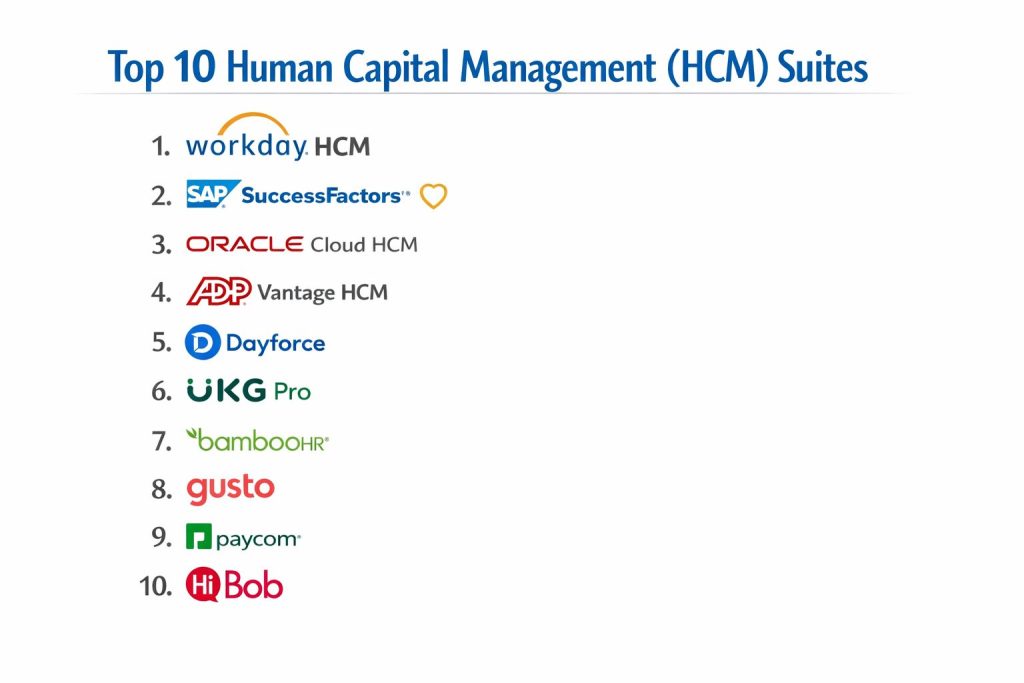
Top 10 Human Capital Management (HCM) Suites
1. Workday HCM
A cloud-native giant known for unifying HR, finance, and planning into a single system. It is the premier choice for large global enterprises seeking deep analytics and a unified data core.
Key Features
- Skills Cloud: Uses AI to identify and manage the skills of your entire workforce in real-time.
- Illuminate AI: A purpose-built AI engine that automates repetitive HR tasks and provides strategic insights.
- Continuous Payroll: Processes payroll in real-time, allowing for instant adjustments and error detection.
- VNDLY Integration: Manage your full-time employees and contingent (contract) workers in one place.
- Peakon Employee Voice: An integrated platform for real-time employee engagement and sentiment analysis.
Pros
- Unrivaled “Single Source of Truth” where HR and Finance data exist in the same database.
- Highly scalable and capable of handling hundreds of thousands of employees globally.
- Consistently leads the market in AI innovation and predictive workforce analytics.
Cons
- The implementation process is notoriously long, often taking 6 to 12 months.
- The high price point and complexity make it overkill for small-to-mid-sized businesses.
Platforms / Deployment
- Web / iOS / Android
- Cloud
Security & Compliance
- SSO/SAML, MFA, Data Encryption, RBAC
- SOC 2, ISO 27001, GDPR, HIPAA, FedRAMP
Integrations & Ecosystem
Workday offers an extensive integration cloud with pre-built connectors for major ERP, CRM, and collaboration tools.
- Deep integrations with Salesforce, Slack, and Microsoft Teams.
- Workday Extend allows developers to build custom apps within the Workday environment.
- Certified connectors for hundreds of third-party benefits and payroll providers.
Support & Community
Offers a massive “Workday Community” portal for peer-to-peer help and a dedicated “Workday Success” program for enterprise customers.
2. SAP SuccessFactors
A comprehensive, global-first HCM suite that excels in talent management and multi-country payroll. It is designed for large organizations that need high levels of customization and international reach.
Key Features
- Joule AI Copilot: A conversational AI that helps employees and managers complete HR tasks using natural language.
- Talent Intelligence Hub: A centralized system for managing skill taxonomies and individual growth paths.
- Employee Central: A robust core HR system that handles global people data with localized legal compliance.
- Opportunity Marketplace: Connects employees with internal projects, mentors, and learning opportunities.
- Continuous Performance Management: Moves away from yearly reviews toward ongoing feedback and coaching.
Pros
- Exceptional global localized support, processing payroll in over 100 countries.
- Deep integration with the broader SAP ERP ecosystem, making it ideal for SAP-heavy companies.
- Powerful talent acquisition and succession planning tools.
Cons
- The user interface can feel complex and “heavy” compared to newer, nimbler competitors.
- Requires significant technical expertise to configure and maintain.
Platforms / Deployment
- Web / iOS / Android
- Cloud
Security & Compliance
- SSO/SAML, MFA, Audit Logs, Data Masking
- SOC 1/2, ISO 27001, GDPR
Integrations & Ecosystem
As part of the SAP family, it has native links to SAP S/4HANA and a wide array of third-party extensions.
- Open APIs for connecting to external recruitment and benefit platforms.
- Built-in connectors for Microsoft 365.
- Access to the SAP Business Accelerator Hub for pre-built integrations.
Support & Community
Provides world-class enterprise support and a vast global network of implementation partners.
3. Oracle Cloud HCM
A complete cloud solution that connects every HR process from hire to retire. It is highly regarded for its embedded AI and the “Oracle ME” employee experience platform.
Key Features
- Oracle ME (My Experience): A personalized experience platform that guides employees through their unique professional journeys.
- Advanced HCM Controls: Automated security tools that monitor for potential fraud or compliance risks in real-time.
- Strategic Workforce Planning: Uses AI to model “what-if” scenarios for future hiring and organizational changes.
- Opportunity Marketplace: A portal for employees to find short-term internal “gigs” and development tasks.
- Integrated Learning: Native LMS (Learning Management System) that suggests courses based on current skill gaps.
Pros
- Seamless “one-stop-shop” for HR, Payroll, Talent, and Time tracking.
- The “Oracle ME” interface is one of the most modern and user-friendly in the enterprise space.
- Strong focus on data security and automated compliance monitoring.
Cons
- Best suited for companies already utilizing Oracle’s database or ERP infrastructure.
- Can be rigid in its workflows, requiring the company to adapt to the software’s logic.
Platforms / Deployment
- Web / iOS / Android
- Cloud
Security & Compliance
- SSO/SAML, MFA, Real-time Monitoring, Encryption at rest/transit
- SOC 2, ISO 27001, HIPAA, GDPR
Integrations & Ecosystem
Leverages the Oracle Cloud Infrastructure (OCI) for high-performance data exchange across the enterprise.
- Direct integration with Oracle Fusion Cloud Finance.
- Robust API library for third-party payroll and benefit providers.
- Collaborative tools built directly into the UI (messaging and tasks).
Support & Community
Extensive documentation and a highly active “Cloud Customer Connect” community with over 200,000 members.
4. ADP Vantage HCM
An enterprise-scale platform that combines ADP’s legendary payroll expertise with modern talent and benefits management. It is designed for large-market companies that want high-touch service and compliance.
Key Features
- Unified Payroll & Tax: Industry-leading compliance engine that handles complex tax filings and labor laws automatically.
- ADP DataCloud: Benchmarks your company’s pay and turnover against real-world industry data.
- Benefits Administration: A simplified portal for open enrollment and ongoing life-event management.
- Talent Acquisition: End-to-end recruitment tools with integrated background checks and drug testing.
- Mobile Solutions: A top-rated mobile app that allows for easy clock-ins and pay stub viewing.
Pros
- The “gold standard” for payroll accuracy and tax compliance in the United States.
- Excellent reporting tools that provide deep insights into labor costs and diversity.
- Offers “managed services” where ADP professionals can help run your payroll for you.
Cons
- The back-end configuration can feel a bit dated compared to cloud-first startups.
- Customer support can sometimes be slow for users on lower-tier service plans.
Platforms / Deployment
- Web / iOS / Android
- Cloud / Hybrid
Security & Compliance
- SSO, MFA, Advanced User Permissions, Encryption
- SOC 1/2, ISO 27001, HIPAA
Integrations & Ecosystem
ADP Marketplace is one of the largest in the industry, offering hundreds of pre-built app connections.
- Seamless links to popular accounting software like QuickBooks and Xero.
- Integrates with ERPs like NetSuite and SAP.
- API access for custom data exports.
Support & Community
Strong professional support model with dedicated account managers for large enterprise clients.
5. Dayforce
Formerly known as Ceridian, Dayforce is a unified global HCM platform that operates on a single database. It is famous for its real-time payroll and “Dayforce Wallet.”
Key Features
- Continuous Calculation: Payroll is always “running” in the background, so managers can see labor costs in real-time.
- Dayforce Wallet: Allows employees to access their earned wages on-demand via a mobile app.
- Global People Records: A single database architecture that eliminates the need to sync data between HR and Payroll.
- Predictive Analytics: AI tools that forecast future labor needs and identify turnover risks.
- Advanced Scheduling: Sophisticated tools for shift-based industries like retail and healthcare.
Pros
- Eliminates the “payroll cycle” stress because calculations happen every time a punch is recorded.
- Superior for companies with complex scheduling or hourly workforce needs.
- Truly unified data—no “batching” or manual syncing required between modules.
Cons
- The interface, while improving, can still feel more technical and less “polished” than Workday.
- Implementation is thorough but can be rigid and time-consuming.
Platforms / Deployment
- Web / iOS / Android
- Cloud
Security & Compliance
- MFA, Audit Trails, RBAC, Encryption
- SOC 1/2, ISO 27001, GDPR
Integrations & Ecosystem
Focuses on “preserving existing workflows” while adding real-time data power.
- Integrates with leading ATS and specialized recruiting tools.
- Open API for connecting to custom business applications.
- Partnerships with global tax and compliance agencies.
Support & Community
Comprehensive online help center and a growing community of users focused on real-time workforce management.
6. UKG Pro
A high-end HCM suite created through the merger of Ultimate Software and Kronos. It is particularly strong in workforce management and employee well-being.
Key Features
- UKG Bryte: An AI assistant that helps simplify complex workforce data for managers and employees.
- Advanced Time & Attendance: Inherited from Kronos, this is arguably the best time-tracking tool in the industry.
- Great Place To Work Hub: Integrated tools designed specifically to improve company culture and employee trust.
- Smart Scheduling: AI-driven scheduling that balances business needs with employee preferences.
- Global Payroll Hub: Centralized management for international teams with built-in compliance.
Pros
- Best-in-class workforce management and labor scheduling capabilities.
- A unique focus on the “human” side of HR, with deep culture-building features.
- Excellent for mid-to-large companies that prioritize employee engagement.
Cons
- Can be expensive due to the depth of its workforce management modules.
- The merger of two large platforms has occasionally led to minor UI inconsistencies.
Platforms / Deployment
- Web / iOS / Android
- Cloud
Security & Compliance
- SSO/SAML, MFA, Encryption, RBAC
- SOC 2, ISO 27001, GDPR
Integrations & Ecosystem
Offers a robust integration suite designed to keep HR at the center of the business.
- Pre-built connectors for major ERP and CRM systems.
- Extensive APIs for custom developer use.
- Direct link to various health and retirement benefits providers.
Support & Community
Known for its “Partner for Life” philosophy, offering very high levels of customer support and community engagement.
7. BambooHR
An intuitive, user-friendly HCM platform specifically designed for small-to-mid-sized businesses. It focuses on the “people” part of HR rather than just the paperwork.
Key Features
- Centralized Employee Database: A clean, searchable directory for all employee records and documents.
- Hiring & ATS: Simple, effective applicant tracking with automated offer letters and e-signatures.
- Employee Self-Service: A highly polished portal where staff can manage their own data and PTO.
- Performance Management: Focused on short, regular check-ins rather than long, annual reviews.
- Employee Satisfaction (eNPS): Built-in surveys to measure how employees feel about the company.
Pros
- Extremely easy to set up and use; requires very little training for new staff.
- Clean, modern interface that employees actually enjoy using.
- Highly affordable for growing businesses compared to enterprise suites.
Cons
- Payroll and Benefits administration are primarily focused on the United States.
- Lacks the deep “global” complexity needed by massive international corporations.
Platforms / Deployment
- Web / iOS / Android
- Cloud
Security & Compliance
- MFA, SSO, 256-bit Encryption
- SOC 2 Type II, GDPR
Integrations & Ecosystem
While simpler than the enterprise giants, it offers a great marketplace for SMB-friendly tools.
- Integrates with Slack, Google Workspace, and Microsoft 365.
- Connectors for various payroll providers (if not using BambooHR’s native payroll).
- Open API for developers to build custom connections.
Support & Community
Friendly, accessible customer support and a wealth of blog and video content for HR professionals.
8. Gusto
A modern, payroll-centric platform designed for startups and small businesses. It is best known for making payroll and benefits incredibly simple and “human.”
Key Features
- Full-Service Payroll: Automates all tax filings and payments at the local, state, and federal levels.
- Gusto Wallet: A dedicated app for employees to track their money, save, and access earned wages early.
- AI-Assisted Onboarding: Step-by-step guidance for setting up new hires and ensuring compliance.
- Benefits Integration: Health insurance and 401(k) sync automatically with the payroll system.
- ChatGPT Integration: Allows users to manage and review payroll tasks using an AI chat interface.
Pros
- Arguably the best user interface in the payroll/HR space—clean, fun, and intuitive.
- Excellent for startups that need to go from “zero” to “fully compliant” in minutes.
- Highly transparent pricing with no hidden fees for basic tax filings.
Cons
- Not designed for large enterprises or complex global workforces.
- The HR features, while growing, are not as deep as specialized talent suites.
Platforms / Deployment
- Web / iOS / Android
- Cloud
Security & Compliance
- MFA, SSO, HIPAA Compliance
- SOC 2 Type II
Integrations & Ecosystem
Focused on the small business ecosystem, connecting with tools that founders use daily.
- Seamless sync with QuickBooks Online and Xero.
- Integrates with TSheets and Deputy for time tracking.
- Open API for building custom startup workflows.
Support & Community
Offers a robust HR Resource Center with templates and legal guides. Support is generally fast and friendly.
9. Paycom
A comprehensive HCM suite that pioneered “employee-driven payroll.” It is built on a single database, eliminating the need for data re-entry.
Key Features
- Beti (Employee-Driven Payroll): Allows employees to review and approve their own payroll data before it is submitted.
- IWant AI Engine: A voice-driven AI that allows managers to ask for data and reports using their voice.
- GONE (Automated Time-Off): Automatically approves or denies time-off requests based on pre-set company rules.
- Manager on the Go: A specialized mobile experience that lets supervisors handle all approvals from their phones.
- Clue (Conflict Link and Universal Exchange): Automated compliance tools that flag issues before they become legal problems.
Pros
- “Beti” significantly reduces payroll errors because employees catch mistakes before they are paid.
- Strong focus on high-speed efficiency and reducing the manual burden on HR teams.
- Everything is built in-house on one database—no messy integrations or “bridged” modules.
Cons
- The security procedures can feel cumbersome (frequent password changes and lockouts).
- The reporting interface can be less intuitive for non-technical users compared to modern cloud apps.
Platforms / Deployment
- Web / iOS / Android
- Cloud
Security & Compliance
- MFA, SSO, Complex Login Procedures, Audit Trails
- SOC 1/2, ISO 27001, GDPR
Integrations & Ecosystem
Since it is a “closed loop” system, it prioritizes its own modules but does offer standard connectors.
- Standard APIs for data exchange with external finance systems.
- Secure direct deposit and tax filing integrations.
- Integrated background checking services.
Support & Community
Provides dedicated “Client Service Representatives” to ensure that companies get personalized attention.
10. HiBob
A modern, culture-first HCM platform (often called “Bob”) that focuses on employee engagement and global team management. It is very popular with fast-growing tech companies.
Key Features
- Bob Hiring (ATS): A visual, modern recruitment tool that flows directly into the employee record.
- People Analytics: Stunning, visual dashboards for diversity, equity, and inclusion (DEI) and turnover.
- Customizable Leave Policies: Easily manage complex PTO rules across dozens of different countries.
- Clubhouse Social Feed: A built-in social network to help employees stay connected and celebrate wins.
- Learning & Development: Integrated paths that tie individual growth to company-wide goals.
Pros
- One of the best “looking” platforms on the market, which helps with high employee adoption.
- Excellent for companies that operate in multiple countries but don’t want the “corporate” feel of SAP or Oracle.
- Very active product roadmap with frequent new feature releases.
Cons
- Pricing is not transparent and requires a custom quote.
- The mobile app currently lacks some of the advanced features found on the desktop version.
Platforms / Deployment
- Web / iOS / Android
- Cloud
Security & Compliance
- SSO/SAML, MFA, RBAC, Encryption
- SOC 2 Type II, GDPR
Integrations & Ecosystem
Built for the modern “stack,” connecting with the collaboration tools that teams use every day.
- Deep integration with Slack and Microsoft Teams.
- Payroll Hub connects to major providers like ADP, TriNet, and Xero.
- Native connectors for Greenhouse and Lever (ATS).
Support & Community
Friendly and modern support experience with a focus on “partnering” with growing HR teams.
Comparison Table (Top 10)
| Tool Name | Best For | Platform(s) Supported | Deployment | Standout Feature | Public Rating |
| Workday HCM | Global Enterprise | Web, iOS, Android | Cloud | Unified HR/Finance Core | N/A |
| SAP SuccessFactors | Multi-Country Talent | Web, iOS, Android | Cloud | Global Localized Payroll | N/A |
| Oracle Cloud HCM | Employee Experience | Web, iOS, Android | Cloud | Oracle ME Platform | N/A |
| ADP Vantage HCM | Payroll & Compliance | Web, iOS, Android | Hybrid | Managed Payroll Services | N/A |
| Dayforce | Real-Time Payroll | Web, iOS, Android | Cloud | Continuous Calculation | N/A |
| UKG Pro | Workforce Mgmt | Web, iOS, Android | Cloud | UKG Bryte AI assistant | N/A |
| BambooHR | Growing SMBs | Web, iOS, Android | Cloud | High-adoption UX | N/A |
| Gusto | Startups (US-centric) | Web, iOS, Android | Cloud | Gusto Wallet App | N/A |
| Paycom | Error-free Payroll | Web, iOS, Android | Cloud | Beti Employee-led Pay | N/A |
| HiBob | Culture-led Scaling | Web, iOS, Android | Cloud | Visual People Analytics | N/A |
Evaluation & Scoring of HCM Suites
Scoring is comparative and based on suitability for a modern, workforce environment.
| Tool Name | Core (25%) | Ease (15%) | Integrations (15%) | Security (10%) | Performance (10%) | Support (10%) | Value (15%) | Weighted Total |
| Workday HCM | 10 | 4 | 9 | 10 | 10 | 9 | 6 | 8.4 |
| SAP SuccessFactors | 10 | 4 | 9 | 9 | 9 | 9 | 6 | 8.1 |
| Oracle Cloud HCM | 9 | 6 | 9 | 9 | 9 | 8 | 7 | 8.1 |
| ADP Vantage HCM | 9 | 5 | 9 | 9 | 8 | 8 | 7 | 7.8 |
| Dayforce | 9 | 6 | 8 | 8 | 9 | 8 | 7 | 7.8 |
| UKG Pro | 9 | 6 | 8 | 8 | 9 | 9 | 7 | 8.0 |
| BambooHR | 7 | 10 | 8 | 8 | 8 | 9 | 9 | 8.3 |
| Gusto | 6 | 10 | 8 | 7 | 8 | 9 | 9 | 7.9 |
| Paycom | 8 | 7 | 7 | 8 | 8 | 8 | 8 | 7.7 |
| HiBob | 8 | 9 | 9 | 8 | 9 | 8 | 8 | 8.4 |
How to Interpret These Scores
- Core features: Measures the depth of payroll, HR, and talent modules.
- Ease of use: Evaluates how quickly an average employee or manager can master the UI.
- Weighted Total: A higher score reflects a well-rounded tool, though a specialized tool (like Dayforce for hourly workers) might be a better fit despite a lower overall score.
Which HCM Suite Tool Is Right for You?
Solo / Freelancer
Most full-suite HCM tools are overkill for a solo operator. However, if you are looking to hire your first 1–2 employees, Gusto is the easiest way to ensure you are meeting all legal and tax requirements.
SMB (Small to Mid-Sized Business)
For companies with 20 to 500 employees, BambooHR is the gold standard. It provides just enough power to professionalize your HR without the overwhelming complexity of an enterprise suite.
Mid-Market
If you are scaling quickly and care deeply about company culture and visual data, HiBob is a fantastic choice. If your workforce is primarily hourly or shift-based, Dayforce or UKG Pro will offer better labor management.
Enterprise
For global organizations with thousands of employees across multiple continents, Workday and SAP SuccessFactors are the only tools with the necessary “global muscle.” They handle the most complex tax, legal, and financial integrations in the world.
Budget vs Premium
- Budget: Gusto and BambooHR offer the best value for teams on a budget.
- Premium: Workday and Oracle are high-investment platforms designed for long-term ROI in massive organizations.
Frequently Asked Questions (FAQs)
What is the average implementation time for an HCM suite?
Small business tools like Gusto can be set up in a few hours. Mid-market tools like HiBob take 2–3 months, while enterprise suites like Workday often require 6–12 months for full global deployment.
Do HCM suites handle international payroll natively?
Some do (like SAP and Dayforce), while others (like HiBob or BambooHR) use “Payroll Hubs” to connect to local providers in each country. Always verify native support for your specific regions.
Can employees really run their own payroll?
Yes, tools like Paycom’s “Beti” allow employees to review their hours, deductions, and net pay before the final submission, which significantly reduces errors.
Is my data safe in the cloud?
Modern HCM suites use bank-level encryption, multi-factor authentication, and are regularly audited for SOC 2 and ISO 27001 compliance. Your data is typically safer in these systems than in a local spreadsheet.
How does AI help with hiring?
AI can summarize resumes to find top talent faster, write unbiased job descriptions, and even use chatbots to schedule interviews, saving recruiters hours of manual work.
What is Earned Wage Access (EWA)?
EWA is a feature (like Dayforce Wallet) that allows employees to withdraw money they have already earned before the official payday, helping them manage unexpected expenses.
Will an HCM suite integrate with my accounting software?
Most suites offer pre-built connectors for QuickBooks, Xero, NetSuite, and SAP. This ensures that your payroll expenses flow directly into your general ledger.
Can I manage contract workers and full-time employees together?
Yes, modern platforms (like Workday VNDLY) are designed to handle “total workforce management,” where both permanent staff and freelancers exist in the same dashboard.
What is the most common reason for an HCM implementation failure?
Failure usually stems from “dirty data” (importing incorrect old records) or poor change management where employees aren’t properly trained on how to use the new system.
Can I switch HCM providers easily?
Switching is a major project. You will need to export all historical data, map it to the new system, and run “parallel payrolls” for a month to ensure the new system calculates pay correctly.
Conclusion
Choosing an HCM suite is one of the most significant technology decisions a company will make. The “best” tool isn’t the one with the most features; it’s the one that aligns with your specific company size, geographic footprint, and industry needs. For a startup, Gusto is a lifesaver. For a global titan, Workday is a strategic necessity.