Introduction
AdTech, or advertising technology, encompasses the complex ecosystem of software and tools used by brands, agencies, and publishers to manage, deliver, and optimize digital advertising campaigns. In simple terms, it is the invisible engine that decides which ad you see on a website, mobile app, or connected TV screen in a fraction of a second. These platforms automate the buying and selling of ad space, replacing manual negotiations with high-speed algorithmic auctions.
AdTech has entered a “post-cookie” era where privacy is no longer an optional feature but the core foundation of every transaction. With global digital ad spend surpassing the trillion-dollar mark, these platforms have evolved from simple delivery systems into sophisticated AI-driven hubs. They now integrate massive datasets to ensure that marketing messages are relevant, respectful of user consent, and measurable across fragmented screens.
Real-world use cases include:
- Dynamic Retargeting: Showing a specific product to a user who recently abandoned their shopping cart.
- Connected TV (CTV) Sequencing: Delivering a series of video ads to a household across their smart TV and mobile devices to tell a story.
- Retail Media Activation: Using a retailer’s first-party data to show ads to customers with a high intent to purchase.
- Hyper-Local Targeting: Triggering mobile ads for a physical store when a potential customer is within a specific geographic radius.
What buyers should evaluate:
- Identity Solutions: How does the platform track users without third-party cookies?
- Omnichannel Reach: Can it manage display, video, audio, and TV in one place?
- Algorithmic Bidding: How effective is the AI at optimizing for return on ad spend (ROAS)?
- Data Transparency: Does the platform provide clear insights into where every dollar is spent?
- Inventory Quality: Does it offer access to premium, brand-safe publishers?
- Ease of Integration: How well does it connect with your existing CRM and analytics tools?
- Support Tiers: Is there a dedicated account manager or just a help center?
- Security Standards: Does it meet modern global privacy regulations like GDPR, CCPA, and the EU AI Act?
Best for: Global enterprises, performance marketing agencies, e-commerce brands, and publishers looking to maximize their digital revenue.
Not ideal for: Local small businesses with a monthly spend under $500 who are better served by basic social media “boost” buttons.
Key Trends in AdTech Platforms
- Generative AI for Creative Optimization: Platforms now use AI to automatically resize, color-grade, and even rewrite ad copy in real-time based on viewer preferences.
- Privacy-First “Clean Rooms”: Brands and publishers are using secure data environments to match their audiences without ever exchanging personal identifiable information (PII).
- The Rise of Retail Media: Advertising within the apps of giants like Amazon, Walmart, and Instacart has become the fastest-growing sector due to high-intent purchase data.
- Connected TV (CTV) Dominance: As traditional cable fades, AdTech has pivoted to the big screen, bringing digital-style targeting to living room televisions.
- Sustainable Media Buying: New “green” metrics are emerging that allow brands to choose ad paths with lower carbon footprints by reducing unnecessary data processing.
- Voice and Audio Programmatic: The explosion of podcasts and smart speakers has led to specialized tools for buying and measuring “earshare” in a non-visual way.
- Predictive Bidding: Rather than reacting to historical data, modern algorithms predict future conversion probability based on real-time environmental signals like weather or news events.
- Attention Metrics: Moving beyond simple “clicks,” platforms are now measuring “dwell time” and “eye-tracking” signals to determine true ad effectiveness.
How We Selected These Tools (Methodology)
To compile this list of the top 10 AdTech platforms, we used a multi-layered evaluation framework designed to reflect the current state of the industry:
- Market Share & Scale: We prioritized platforms that control significant portions of global ad inventory and spend.
- Technological Maturity: Only tools that have successfully transitioned to cookieless identity solutions (like Unified ID 2.0 or First-Party data) were considered.
- Transparency & Ethics: We looked for “clean” platforms with strong records in fraud prevention and brand safety.
- Feature Breadth: The list includes a mix of Demand-Side Platforms (DSPs), Supply-Side Platforms (SSPs), and specialized retail media networks.
- User Feedback & Reliability: We analyzed industry reputation and uptime records during high-traffic events like Black Friday.
- Innovation Velocity: Priority was given to companies leading the charge in AI integration and CTV measurement.
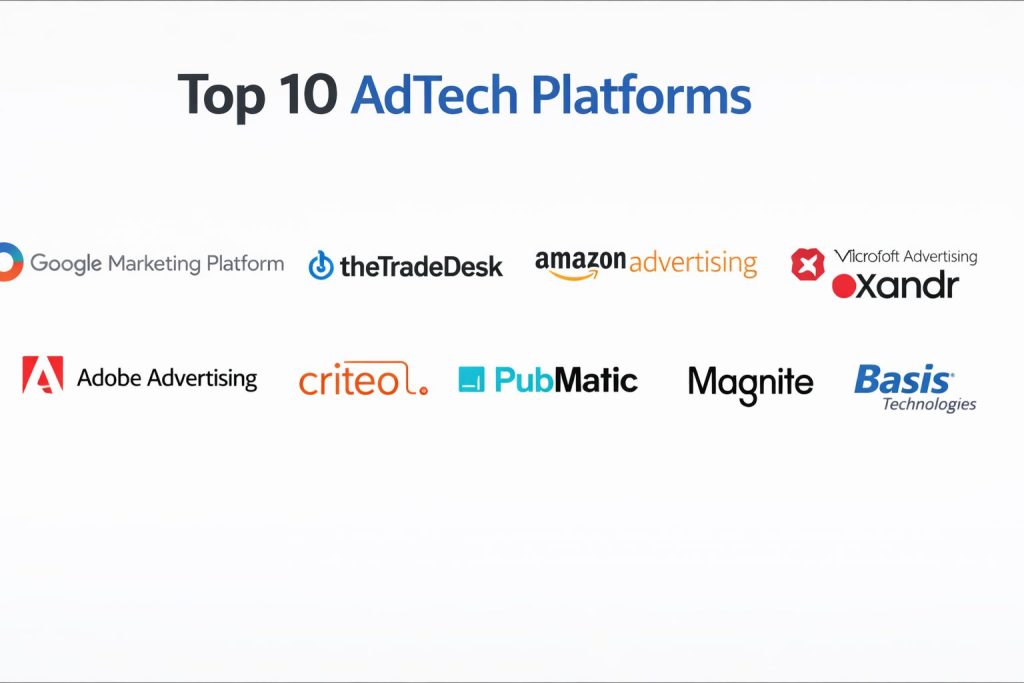
Top 10 AdTech Platforms
#1 — Google Marketing Platform (DV360)
A massive, end-to-end suite that integrates search, display, and video. It is the go-to for agencies that rely heavily on the Google ecosystem.
Key Features
- Integrated Analytics: Seamless connection with Google Analytics 4 for full-funnel tracking.
- Advanced Audience Segments: Access to unique Google signals like search intent and map activity.
- Automated Bidding: Uses Google’s world-class machine learning to hit target CPAs.
- YouTube Integration: Exclusive, high-performance access to YouTube ad formats.
- Privacy Sandbox Ready: Leading the transition to Google’s proprietary cookieless tracking.
Pros
- Most comprehensive data ecosystem in the digital world.
- Familiar interface for anyone who has used Google Ads.
Cons
- Often seen as a “walled garden” with limited external transparency.
- Can be more expensive for small agencies due to platform fees.
Platforms / Deployment
- Web / Cloud-hosted
- Fully Managed / Self-Service
Security & Compliance
- SSO/SAML, MFA via Google Cloud
- ISO 27001, SOC 2, GDPR, CCPA compliant
Integrations & Ecosystem
Deeply embedded in the broader Google Cloud and Workspace environment.
- Google Analytics 4
- BigQuery
- Looker Studio
- Salesforce
Support & Community
Massive documentation through Google Skillshep. Support varies from self-service to premium dedicated account teams for large enterprises.
#2 — The Trade Desk
The leading independent demand-side platform. Known for its transparency and for being a fierce alternative to the “walled gardens.”
Key Features
- Unified ID 2.0: A pioneer in open-source, privacy-compliant identity solutions.
- Koa AI: An industry-leading AI engine that provides transparent bidding recommendations.
- Planner Tool: Data-driven insights to build a media plan before spending a dollar.
- Premium CTV Inventory: Direct access to major streaming networks without middle-man fees.
- Omnichannel Reach: Unified management across audio, mobile, and digital billboards.
Pros
- High level of transparency in pricing and placement.
- Not biased toward its own inventory (unlike Google or Meta).
Cons
- Strictly for high-spend advertisers; often has high monthly minimums.
- Requires significant technical expertise to master.
Platforms / Deployment
- Web / Cloud-hosted
- Self-Service
Security & Compliance
- ISO 27001, SOC 2 Type II
- Unified ID 2.0 (Privacy-first identity)
Integrations & Ecosystem
Works with almost every major data provider and third-party measurement tool.
- Nielsen
- Comscore
- LiveRamp
- Snowflake
Support & Community
Excellent “The Trade Desk Edge” Academy for training. Customer support is highly regarded for its technical depth.
#3 — Amazon Advertising (Amazon DSP)
The heavyweight of retail media. It uses actual purchase history to target shoppers across the web.
Key Features
- First-Party Purchase Data: Targeting based on what users actually buy, not just what they browse.
- Exclusive Inventory: Direct access to Amazon.com, IMDb, and Fire TV.
- Amazon Marketing Cloud (AMC): A clean-room environment for deep behavioral analysis.
- Closed-Loop Measurement: Connects ad clicks directly to Amazon sales figures.
- Twitch Integration: High-impact video placements for reaching gaming audiences.
Pros
- The most valuable “intent” data in the industry.
- Perfect for e-commerce brands looking to scale quickly.
Cons
- Primarily focused on products sold within the Amazon ecosystem.
- Reporting can be complex for those not familiar with retail metrics.
Platforms / Deployment
- Web / Cloud-hosted
- Managed Service / Self-Service
Security & Compliance
- AWS-grade security
- GDPR, CCPA, SOC 2 compliant
Integrations & Ecosystem
Native integration with the entire Amazon/AWS stack.
- Amazon Seller Central
- AWS Clean Rooms
- Shopify (via Bridge)
Support & Community
Extensive training through the Amazon Advertising Learning Console. Support is tiered based on advertiser spend level.
#4 — Meta Ads Manager
The engine behind Facebook, Instagram, and WhatsApp. Essential for social-first and visual storytelling campaigns.
Key Features
- Advantage+ Campaigns: AI that handles audience targeting and creative placement automatically.
- Visual Storytelling: World-class support for Reel and Story vertical video formats.
- Conversational Ads: Direct paths to chat with customers via WhatsApp and Messenger.
- Lookalike Audiences: Still the benchmark for finding new customers similar to your best ones.
- On-Platform Shops: Seamless integration with Facebook and Instagram storefronts.
Pros
- Unbeatable reach for mobile-first, social-driven commerce.
- Very accessible UI compared to complex programmatic platforms.
Cons
- Vulnerable to mobile OS privacy changes (like Apple’s ATT).
- High frequency of algorithm changes can impact campaign stability.
Platforms / Deployment
- Web / iOS / Android
- Self-Service
Security & Compliance
- SSO, MFA
- GDPR, CCPA compliant
Integrations & Ecosystem
- Shopify
- WooCommerce
- Zapier
- AppsFlyer
Support & Community
Meta Blueprint offers widespread certification. Community support is massive, ranging from small business forums to enterprise partners.
#5 — Microsoft Advertising (Xandr)
A unique blend of search intent (Bing) and professional data (LinkedIn), powered by the Xandr programmatic engine.
Key Features
- Professional Targeting: Uses LinkedIn data to target by job title and industry (B2B).
- Microsoft Audience Network: Reaches users across Outlook, MSN, and Microsoft Edge.
- Xandr Invest & Monetize: A full-stack solution for both buying and selling ads.
- Netflix Ad Partnership: Microsoft provides the technology backbone for Netflix’s ad tier.
- Retail Media Network: Growing footprint in grocery and pharmacy retail chains.
Pros
- Best-in-class for B2B targeting and high-intent search data.
- Solid alternative for brands wanting to avoid the Google/Meta duopoly.
Cons
- Overall reach is smaller than Google or Meta.
- Dashboard can feel fragmented as legacy systems are integrated.
Platforms / Deployment
- Web / Cloud
- Self-Service / Managed
Security & Compliance
- ISO 27001, SOC 2, HIPAA
- GDPR, CCPA compliant
Integrations & Ecosystem
- Microsoft Dynamics 365
- Adobe Experience Cloud
Support & Community
Microsoft Advertising Learning Lab provides deep training. Professional support is robust for enterprise accounts.
#6 — Adobe Advertising
Part of the Adobe Experience Cloud, this platform focuses on high-level data integration and journey orchestration.
Key Features
- Adobe Sensei AI: Powers predictive modeling and automated budget switching.
- Cross-Channel Journey: Manage search, display, and TV as a single user experience.
- Deep CDP Integration: Uses first-party data from Adobe Real-Time CDP for targeting.
- Creative Asset Sync: Pulls directly from Adobe Creative Cloud for seamless ad building.
- Enterprise Reporting: High-level dashboards for CMO-level visibility.
Pros
- Perfect for organizations already using the full Adobe stack.
- Strongest focus on the complete customer lifecycle, not just clicks.
Cons
- Extremely high cost; strictly an enterprise-level solution.
- Implementation can take months rather than days.
Platforms / Deployment
- Web / Cloud-hosted
- Enterprise Managed
Security & Compliance
- ISO 27001, SOC 2, HIPAA, FedRAMP
- GDPR, CCPA compliant
Integrations & Ecosystem
- Adobe Analytics
- Adobe Experience Manager
- Salesforce
- Marketo
Support & Community
Adobe Experience League provides a massive knowledge base. Professional services are usually required for setup.
#7 — Criteo
The leader in “Commerce Media.” Criteo specialized in retargeting but has expanded into a full retail data powerhouse.
Key Features
- Commerce Media Platform: Access to a massive network of retailers worldwide.
- Dynamic Product Ads: Automatically shows the exact product a user was looking at.
- Predictive AI: Guesses what a user will buy next based on trillions of data points.
- Privacy-Safe Retargeting: New methods for reaching users without third-party cookies.
- Video for Commerce: Links high-quality video ads directly to product catalogs.
Pros
- Highest ROAS for e-commerce retargeting in the industry.
- Access to retail data that even Google doesn’t see.
Cons
- Can be aggressive; requires careful management to avoid “ad fatigue.”
- Less effective for brand awareness compared to performance marketing.
Platforms / Deployment
- Web / Cloud
- Self-Service / Managed
Security & Compliance
- ISO 27001
- GDPR, CCPA compliant
Integrations & Ecosystem
- Shopify
- Magento
- PrestaShop
- LiveRamp
Support & Community
Robust help center and dedicated account management for mid-to-large advertisers.
#8 — PubMatic
A leading supply-side platform (SSP) that focuses on giving publishers and advertisers a transparent, efficient marketplace.
Key Features
- OpenWrap: An enterprise-grade header bidding solution.
- Media Buyer Console: Tools for advertisers to buy direct from premium publishers.
- Identity Hub: A management tool for multiple cookieless identity solutions.
- CTV & Video Focus: High-quality inventory for premium video content.
- Sustainability Tools: Carbon-efficient auction paths.
Pros
- Very transparent auction mechanics.
- Strong focus on publisher relationships, ensuring high-quality ad environments.
Cons
- More technical; primarily used by sophisticated agencies and publishers.
- Not an all-in-one “buy side” tool like Google or Trade Desk.
Platforms / Deployment
- Web / API-driven
- Cloud-hosted
Security & Compliance
- ISO 27001, SOC 2 Type II
- GDPR, CCPA, TCF 2.2 compliant
Integrations & Ecosystem
- The Trade Desk
- Google DV360
- Amazon DSP
Support & Community
Highly specialized technical support and clear API documentation.
#9 — Magnite
Formed by the merger of Rubicon Project and Telaria, Magnite is the largest independent SSP, especially dominant in CTV.
Key Features
- CTV Specialization: The most advanced tools for managing programmatic TV ads.
- Live Event Tools: Specifically built to handle massive traffic spikes during live sports.
- ClearLine: Direct-to-publisher buying path to reduce “tech tax.”
- Advanced Video Header Bidding: Maximizes revenue for video publishers.
- Global Footprint: Massive scale across the EU, US, and APAC.
Pros
- The undisputed leader for large-scale video and TV publishers.
- Highly efficient infrastructure with minimal latency.
Cons
- Focused primarily on the supply (publisher) side.
- Less relevant for small search or display advertisers.
Platforms / Deployment
- Web / Cloud
- Enterprise Managed
Security & Compliance
- ISO 27001, SOC 2
- GDPR, CCPA compliant
Integrations & Ecosystem
- Disney
- Roku
- Hulu
- Samsung Ads
Support & Community
Premium enterprise support for publishers and major media buyers.
#10 — Basis Technologies
A unique platform that combines programmatic buying with comprehensive media workflow automation.
Key Features
- Basis DSP: A powerful, AI-driven demand-side platform.
- Workflow Automation: Automates the “busy work” of RFPs, IOs, and billing.
- Holistic Reporting: Combines data from search, social, and programmatic in one view.
- Business Intelligence: High-level visualization of agency performance.
- AI Bidding: Real-time optimization across all digital channels.
Pros
- The best tool for agencies looking to increase operational efficiency.
- Eliminates the need for multiple separate reporting and billing tools.
Cons
- Can be complex to set up as it changes how an entire team works.
- Higher entry price for smaller teams.
Platforms / Deployment
- Web / Cloud-hosted
- Self-Service / Managed
Security & Compliance
- SOC 2 Type II
- GDPR, CCPA compliant
Integrations & Ecosystem
- Google Ads
- Meta Ads
- Prisma
Support & Community
Award-winning customer service and “Basis University” for deep team training.
Comparison Table (Top 10)
| Tool Name | Best For | Platform(s) Supported | Deployment | Standout Feature | Public Rating |
| Google DV360 | Google Ecosystem | Web | Cloud | Search Intent Data | 4.6/5 |
| The Trade Desk | Independent Buying | Web | Cloud | Unified ID 2.0 | 4.8/5 |
| Amazon DSP | E-commerce / Retail | Web | Cloud | Purchase-Intent Data | 4.7/5 |
| Meta Ads Manager | Social & Visual | Web, iOS, Android | Cloud | Advantage+ AI | 4.8/5 |
| Microsoft Advertising | B2B / LinkedIn | Web | Cloud | LinkedIn Integration | 4.4/5 |
| Adobe Advertising | Enterprise Journey | Web | Cloud | Adobe Sensei AI | 4.3/5 |
| Criteo | Retargeting | Web | Cloud | Product Recommendation | 4.5/5 |
| PubMatic | Publisher Revenue | Web | Cloud | Header Bidding | N/A |
| Magnite | Connected TV (CTV) | Web | Cloud | Live Event Streaming | N/A |
| Basis Technologies | Agency Automation | Web | Cloud | Workflow Automation | 4.7/5 |
Evaluation & Scoring of AdTech Platforms
The following scoring model compares these tools across key performance and business criteria.
| Tool Name | Core (25%) | Ease (15%) | Integrations (15%) | Security (10%) | Performance (10%) | Support (10%) | Value (15%) | Weighted Total |
| The Trade Desk | 10 | 5 | 10 | 9 | 10 | 9 | 7 | 8.7 |
| Google DV360 | 10 | 7 | 9 | 9 | 9 | 8 | 6 | 8.3 |
| Meta Ads | 9 | 9 | 8 | 7 | 9 | 7 | 8 | 8.2 |
| Amazon DSP | 9 | 6 | 7 | 9 | 9 | 7 | 8 | 7.8 |
| Basis Tech | 8 | 8 | 8 | 8 | 8 | 10 | 7 | 7.8 |
| Criteo | 8 | 7 | 7 | 8 | 9 | 7 | 8 | 7.6 |
| Microsoft Ads | 7 | 8 | 8 | 9 | 7 | 7 | 7 | 7.4 |
| Adobe Adv. | 8 | 4 | 9 | 10 | 8 | 8 | 5 | 7.1 |
| PubMatic | 7 | 5 | 8 | 9 | 8 | 8 | 7 | 6.9 |
| Magnite | 7 | 4 | 8 | 9 | 9 | 7 | 6 | 6.7 |
How to interpret these scores:
- 8.5 – 10.0: Best-in-class; high flexibility and industry-leading technology.
- 7.5 – 8.4: Highly effective; best for specific ecosystems (Social, Google, Amazon).
- Below 7.5: Specialized or Enterprise-only tools that require high budgets or specific use cases.
Which AdTech Platform Is Right for You?
Solo / Freelancer
For an individual marketer, Meta Ads Manager or Google Ads (the simpler version of DV360) are the best places to start. They have no monthly minimums and provide immediate results with an easy-to-use interface.
SMB
Small to medium businesses should look at Basis Technologies or Criteo. Basis can help a small team act like a big agency through automation, while Criteo is the best way for a growing e-commerce shop to recover lost sales through retargeting.
Mid-Market
Growing brands with a dedicated marketing team should graduate to The Trade Desk. It provides the transparency and independent data control needed to scale across multiple channels without being locked into one provider.
Enterprise
Global corporations with massive data needs should choose Adobe Advertising or Google Marketing Platform. These tools offer the highest levels of security, complex user permissions, and the ability to integrate with internal business intelligence systems.
Budget vs Premium
- Budget: Meta, TikTok, and Microsoft (Search) offer low barriers to entry.
- Premium: The Trade Desk and Adobe require significant monthly commitments and technical staffing.
Feature Depth vs Ease of Use
If you want a “set it and forget it” experience, Meta Advantage+ is the winner. If you want to control every single bid and data node, Houdini-style programmatic like The Trade Desk or SideFX integrations are better.
Frequently Asked Questions (FAQs)
1. What is the difference between a DSP and an SSP?
A Demand-Side Platform (DSP) is used by advertisers to buy ad space efficiently. A Supply-Side Platform (SSP) is used by publishers (websites/apps) to sell their ad space to the highest bidder. They are two sides of the same automated transaction.
2. Can I use these platforms without third-party cookies?
Yes. Modern AdTech platforms have moved to “Identity Solutions” like Unified ID 2.0, first-party data matching, and contextual targeting (placing ads based on the content of the page rather than the user’s history).
3. How much budget do I need to start with programmatic advertising?
While social platforms have no minimums, professional DSPs like The Trade Desk often suggest a minimum spend of $10,000 to $20,000 per month to allow their AI enough data to optimize effectively.
4. Are these platforms compliant with GDPR and CCPA?
Most top-tier platforms are fully compliant, but you must still ensure your own data collection methods (like your website’s consent banner) are properly configured to send the correct signals to the platform.
5. What is “Retail Media” and why is it popular?
Retail Media involves advertising on a retailer’s site (like Amazon or Walmart). It is popular because it uses actual purchase data, allowing brands to target people who are currently in “buying mode.”
6. How do I prevent my ads from appearing on “bad” websites?
Top platforms integrate with brand safety tools (like DoubleVerify or Integral Ad Science) that automatically block your ads from appearing next to hate speech, misinformation, or adult content.
7. What is Connected TV (CTV) advertising?
CTV refers to ads shown on televisions connected to the internet (via smart TV apps or devices like Roku). It combines the big-screen impact of traditional TV with the precise targeting of digital ads.
8. Does AdTech use AI?
Extensively. AI is used to determine how much to bid for a specific impression, which creative version to show a specific user, and to predict which users are most likely to buy.
9. How long does it take to set up a campaign?
A basic social media campaign can be live in 30 minutes. A complex programmatic campaign involving multiple data partners and private deals with publishers can take 1 to 2 weeks to set up correctly.
10. Which platform is best for B2B companies?
Microsoft Advertising is generally considered the best for B2B because it allows you to target users based on their professional LinkedIn profiles (Job Title, Seniority, Company Name).
Conclusion
The AdTech landscape is defined by a shift from “tracking users” to “valuing attention.” Whether you are a small brand utilizing Meta’s AI to find your first customers or a global enterprise using The Trade Desk to coordinate a multi-million dollar CTV campaign, the key to success lies in your data strategy.
As third-party cookies vanish, the platforms that win will be those that provide the most transparent and privacy-safe ways to reach audiences. Your next step should be to evaluate your current first-party data (your customer email lists and CRM) and choose a platform that can most effectively activate that data in a cookieless world.