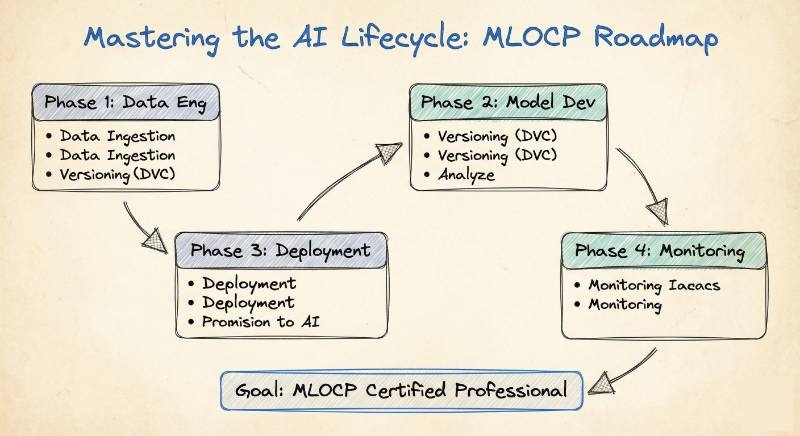
The software engineering world is undergoing a massive shift. For years, we focused on perfecting the delivery of code, but today, the real challenge is the delivery of intelligence. Machine Learning (ML) has moved out of research labs and into the heart of production systems. However, most organizations struggle with a painful reality: building a model is easy, but keeping it running, scaling it, and ensuring it remains accurate is incredibly difficult.
This gap is where MLOps (Machine Learning Operations) lives. As a professional who has navigated the evolution from legacy data centers to automated cloud environments, I’ve seen first-hand that “manual” AI is a recipe for failure. If your ML models are sitting in a notebook and not in a structured, automated pipeline, they aren’t providing real business value. The MLOps Certified Professional (MLOCP) program is designed to solve this exact problem. It provides the framework, tools, and mindset needed to treat Machine Learning as a first-class citizen in the DevOps ecosystem, ensuring that your AI systems are as reliable and secure as your core software.
What is the MLOps Certified Professional (MLOCP) Certification?
The MLOCP is a professional credential provided by DevOpsSchool. It is designed for those who want to move beyond the “notebook” and into the “pipeline.” It validates that you understand how to automate the entire lifecycle of a machine learning model—from the moment data is collected to the moment a model provides a real-time prediction to a user.
Certification Quick Reference
| Track | Level | Who it’s for | Prerequisites | Skills Covered | Recommended Order |
| MLOps | Professional | Engineers & Managers | Basic DevOps & ML | CI/CD/CT, MLflow, K8s, Monitoring | After DevOps Core |
MLOps Certified Professional (MLOCP)
What it is
The MLOCP is a comprehensive program that treats Machine Learning like a first-class citizen in the software world. It isn’t just a test; it’s a framework for building “Continuous Training” (CT) systems. It focuses on the intersection of people, process, and technology to ensure ML models are high-quality, reproducible, and scalable.
Who should take it
- Software Engineers: If you are tired of just building APIs and want to build the infrastructure that powers AI.
- Data Engineers: If you want to ensure the models built on your data pipelines actually survive in the wild.
- DevOps & SRE Professionals: If your company is moving toward AI and you need to know how to support these unique workloads.
- Engineering Managers: If you need to lead teams and make informed decisions about MLOps tooling and budgets.
Skills you’ll gain
- Automated Pipelines (CI/CD/CT): Learning how to not just deploy code, but automatically retrain models when performance drops.
- Model Versioning & Tracking: Mastering tools like MLflow or DVC to keep track of every experiment ever run.
- Container Orchestration: Using Docker and Kubernetes to ensure your ML models can scale to handle millions of requests.
- Monitoring & Observability: Building dashboards that catch “Model Drift” and “Concept Drift” before the business loses money.
- Infrastructure as Code (IaC): Using Terraform to spin up complex GPU-enabled environments in minutes.
Real-world projects you should be able to do
- The Self-Healing Pipeline: Create a system that detects when a model’s accuracy falls below 90% and automatically triggers a new training job.
- Multi-Cloud Deployment: Package a model so it can run identically on AWS, Azure, or an on-premise server.
- A/B Testing Framework: Set up a “Canary” deployment where 10% of users see the new model while 90% see the old one, comparing results in real-time.
Preparation Plan
Your preparation strategy depends largely on your current technical background. As a result, I have broken this down into three distinct timelines.
7–14 Days (The Fast Track)
This path is ideal for those with deep familiarity with Docker and Git. During the first week, you should focus on the MLOCP syllabus, specifically looking at how Jenkins integrates with MLflow. Subsequently, spend the final days taking practice exams to identify any remaining knowledge gaps.
30 Days (The Standard Path)
- Week 1: Master Linux basics and Python for automation.
- Week 2: Learn Docker and Kubernetes for packaging models.
- Week 3: Deep dive into CI/CD for ML (TFX or MLflow).
- Week 4: Build one full project from scratch and review monitoring strategies.
60 Days (The Comprehensive Journey)
For those starting from scratch, the first month should be dedicated to building a strong foundation in DevOps tools like Jenkins and Terraform. Afterward, the second month should focus on advanced MLOps tools like Kubeflow and DVC. Finally, complete three distinct projects to solidify your hands-on experience.
Common Mistakes
- The “One-and-Done” Mentality: Thinking that once a model is deployed, your job is over. In MLOps, deployment is just the beginning of the monitoring phase.
- Manual Steps: If you are manually copying files from a Data Scientist’s laptop to a server, you aren’t doing MLOps. Everything must be scripted.
- Ignoring Data Quality: You can have the best code in the world, but if your data is “trash,” your model will be “trash.” MLOps requires a focus on data lineage.
Best next certification after this
Once you have mastered MLOps, the best next step is AIOps Certified Professional. While MLOps helps you manage models, AIOps helps you use AI to manage your entire IT infrastructure.
Choose Your Path: 6 Learning Journeys
In the modern ecosystem, you don’t have to stay in one lane. Depending on your interests, you can specialize in these 6 key areas:
- DevOps Path: The foundation. Focus on Jenkins, Git, and general automation.
- DevSecOps Path: The “Security First” path. Focus on protecting data and preventing model tampering.
- SRE Path: The “Reliability” path. Focus on uptime, latency, and making sure the AI is always available.
- AIOps/MLOps Path: The “Intelligence” path. Focus on the lifecycle of models and using ML for IT operations.
- DataOps Path: The “Pipeline” path. Focus on the flow of high-quality data from source to model.
- FinOps Path: The “Cost” path. Focus on making sure your cloud bill doesn’t explode due to expensive AI training.
Role → Recommended Certifications
| If your role is… | Take this Primary Certification | Then add this for “Superpowers” |
| DevOps Engineer | DevOps Master | MLOCP |
| SRE | SRE Professional | AIOps Professional |
| Platform Engineer | MLOCP | CKA (Kubernetes) |
| Cloud Engineer | Cloud Professional | FinOps Practitioner |
| Security Engineer | DevSecOps Professional | MLOCP (for AI Security) |
| Data Engineer | DataOps Professional | MLOCP |
| FinOps Practitioner | FinOps Professional | Cloud Economist |
| Engineering Manager | DevOps Leader | MLOCP |
Next Certifications to Take
To stay ahead of the curve, I recommend looking into these three directions:
- Same Track (Advanced): Advanced MLOps Architect—focusing on LLMs (Large Language Models) and generative AI pipelines.
- Cross-Track (Broaden): DevSecOps Certified Professional. As AI becomes more common, hackers are targeting models. You need to know how to defend them.
- Leadership (Growth): SRE Leader or DevOps Leader. If you want to move into Director or VP roles, you need to understand the culture of automation, not just the tools.
Top Institutions for MLOCP Training
Choosing where to learn is as important as what you learn. These institutions provide specialized help for the MLOps Certified Professional (MLOCP):
- DevOpsSchool: The primary provider for MLOCP. They offer instructor-led sessions, real-world labs, and a curriculum that is updated constantly to match industry shifts.
- Cotocus: Excellent for corporate teams. They focus on “learning by doing,” ensuring that engineers can apply MLOps principles to their actual company projects immediately.
- Scmgalaxy: A massive repository of knowledge and community support. They provide extensive resources for those who want to dive deep into configuration management.
- BestDevOps: Known for their career-focused approach, helping engineers transition from traditional IT roles into high-paying MLOps positions.
- DevSecOpsSchool: The best place to learn how to secure your ML pipelines, ensuring that your models are not just smart, but safe from external threats.
- Sreschool: If you want to focus on the “Stability” side of MLOps, this institution provides the deep-dive SRE training you need.
- Aiopsschool: For those who want to take MLOps further and learn how to use AI to predict and prevent system outages.
- Dataopsschool: Focuses on the “Data” half of MLOps, teaching you how to build robust data supply chains that feed your models.
- Finopsschool: Essential for anyone running ML in the cloud. They teach you how to manage the massive costs associated with AI training and inference.
FAQs: MLOps Certified Professional (MLOCP)
1. What exactly does the MLOCP certification cover? The MLOCP focuses on the “Operations” side of Machine Learning. Unlike standard data science courses, this program covers CI/CD for ML, automated model retraining, model versioning with MLflow, containerization using Kubernetes, and real-time monitoring of model performance in production.
2. Is this certification recognized by the industry? Yes, it is a globally recognized benchmark provided by DevOpsSchool. It is specifically designed to meet the hiring requirements of top-tier tech firms and enterprises that are currently scaling their AI and Data Science departments.
3. Do I need to be a mathematician to pass the MLOCP? Not at all. While you should understand the basic concepts of how models work, the MLOCP is an engineering certification. We focus on the infrastructure, automation, and reliability of the models rather than the deep calculus behind the algorithms.
4. Which tools will I master during the MLOCP training? You will get hands-on experience with a professional MLOps stack, including Docker, Kubernetes, Jenkins/GitHub Actions, MLflow, Prometheus, Grafana, and Terraform.
5. How does MLOCP handle the “Data” part of MLOps? The program includes modules on Data Lineage and Data Versioning. You’ll learn how to ensure that the data feeding your models is consistent and how to track changes in data that might cause your model’s accuracy to drop.
6. Is there a practical lab component to the certification? Yes. To earn the MLOCP, you aren’t just tested on theory. You are expected to demonstrate that you can build and manage an end-to-end machine learning pipeline in a real-world environment.
7. How often is the MLOCP curriculum updated? The curriculum is updated at least twice a year. The MLOps field moves fast (especially with the rise of LLMs), and the certification ensures you are learning the latest industry standards and tool versions.
8. Can I take the MLOCP exam online? Yes, the certification process is designed for global accessibility, allowing engineers and managers from India and around the world to take the exam remotely through the official portal.
Career, Difficulty, & Logistics FAQs (The Deep Dive)
1. How difficult is the MLOCP compared to a standard DevOps certification? I’d rate it as a “Level 2” difficulty. It builds upon DevOps foundations but introduces the complexity of “Data Drift” and “Model Decay.” If you already understand CI/CD, you have a head start, but you’ll need to learn how to apply those concepts to non-deterministic ML models.
2. How much time should I realistically set aside for preparation? If you are a working engineer, expect to spend about 4 to 6 weeks. This allows for roughly 1 hour of study on weekdays and a few hours of hands-on lab work over the weekends.
3. What are the absolute prerequisites for this program? You should have a basic comfort level with the Linux command line and a foundational knowledge of Python. Familiarity with basic DevOps tools (like Git) is highly recommended.
4. What is the ideal sequence for my certifications? The best path is: DevOps Certified Professional → MLOps Certified Professional (MLOCP) → AIOps Professional. This sequence ensures you have the “base” automation skills before specializing in the AI niche.
5. What is the real-world value of having MLOCP on my resume? It acts as a “trust signal” for recruiters. MLOps is a high-stakes field; companies don’t want to hire someone to experiment on their production systems. This certification proves you already know the best practices.
6. What kind of salary hike can I expect after getting certified? While it varies by region, MLOps roles in India and globally often command a 20% to 40% premium over standard DevOps roles because the skill set is much rarer.
7. I am an Engineering Manager; will this be too technical for me? No. We have a specific track for managers that focuses on “The MLOps Lifecycle,” “Tooling Selection,” and “Budgeting for AI.” It gives you the vocabulary and technical depth to lead your team effectively.
8. How does this certification help with career outcomes? Beyond the title change, it opens doors to “Platform Engineering” and “AI Infrastructure” teams at major tech companies. It moves you from being a generalist to a specialized high-value asset.
9. Is there a specific “Recommended Order” for learning the tools? Yes. Start with Docker (containers), then move to Jenkins (automation), then MLflow (tracking), and finally Kubernetes (orchestration). This is the order taught in the MLOCP labs.
10. What happens if I fail the exam on my first attempt? Don’t worry—it happens. Most training partners like DevOpsSchool offer a retake policy and additional coaching to help you bridge the gap in your knowledge before your second attempt.
11. How does MLOCP compare to cloud-specific certs (like AWS Machine Learning)? Cloud-specific certs teach you how to use their tools. MLOCP teaches you the engineering principles that work on any cloud, using open-source tools that are standard across the industry.
12. Will this certification help me transition from a Data Analyst to an Engineer? Absolutely. It provides the “engineering rigour” that many Analysts lack, giving you the skills to not just analyze data, but to build the systems that serve it.
Conclusion
We are no longer in an era where “just knowing how to code” is enough. The industry is demanding engineers and managers who can bridge the gap between complex data science and rock-solid production operations. The MLOps Certified Professional (MLOCP) is more than just a certificate; it is a career-defining roadmap. It moves you away from the fragile, manual workflows of the past and into the future of automated, self-healing, and scalable AI infrastructure.
Whether you are an engineer in India looking to lead a global team or a manager tasked with overseeing a digital transformation, mastering MLOps is your most strategic move. By aligning with the standards set by DevOpsSchool, you aren’t just learning a tool—you are mastering a discipline that will remain relevant for the next decade of technology. The “Ops” in AI is where the real work happens, and it’s where the best careers are built.