Introduction
3D modeling tools are essential for creating digital representations of physical objects in three dimensions. These tools allow designers, engineers, and artists to create detailed models that can be used in everything from product design and animation to simulation and printing. At its core, 3D modeling involves building digital structures that can be visualized and tested for real-world applications. The goal is to generate accurate geometry, materials, and details that will ultimately make the model fit for production or presentation.
3D modeling tools matter because they are crucial in industries ranging from engineering and architecture to entertainment and gaming. As demand for high-quality models increases across different sectors, teams need tools that allow for quick iterations, precise control, and a smooth integration into larger workflows. The right tool can help reduce errors, streamline collaboration, and support innovation with powerful design capabilities.
Real-world use cases include:
- Product design and prototyping for manufacturing
- Architecture and interior design visualization
- Character and environment modeling for games and animation
- Simulation models for virtual testing and training
- 3D printing models for rapid prototyping
- Medical and scientific modeling for research and education
What buyers should evaluate:
- Modeling flexibility: polygonal, NURBS, or parametric modeling options
- Interface usability: ease of learning and efficiency for the team
- Rendering capabilities: quality of rendered images and animations
- Performance on large models: speed and reliability with complex scenes
- Tool extensions: availability of plugins and customizability
- Collaboration support: version control, sharing, and team workflows
- Interoperability: compatibility with other CAD, animation, or simulation tools
- File compatibility: support for common 3D file formats and exporting capabilities
- Learning resources: access to tutorials, community support, and documentation
- Security and data handling: controlled access to models and project management
Mandatory paragraph
- Best for: industrial designers, 3D artists, animators, architects, engineers, product designers, and game developers who need robust 3D modeling capabilities.
- Not ideal for: those who require basic 2D sketches, quick renderings, or non-technical modeling tasks, as the software in this category tends to focus on precision and complexity.
Key Trends in 3D Modeling Tools and Beyond
- AI-powered modeling assistance: tools are incorporating AI to speed up tasks like mesh repair, topology optimization, and texture generation.
- Real-time collaboration: more teams are relying on cloud-based modeling tools that allow designers to work simultaneously on the same project.
- Virtual Reality (VR) integration: VR is increasingly being used to create and visualize models in a 3D space, offering designers a more immersive way to view their work.
- Parametric modeling adoption: parametric modeling tools allow for greater flexibility and iteration, especially in engineering and product design.
- Performance optimization: larger and more complex models are becoming more manageable thanks to faster hardware and improved software optimizations.
- Simulation-ready modeling: more tools are enabling testing within the modeling environment, allowing for stress testing, motion simulation, and lighting adjustments in real-time.
- Cross-discipline collaboration: tools that enable collaboration between designers, engineers, and manufacturers are gaining traction to bridge the gap between creative and technical work.
- Cloud rendering and storage: increased reliance on cloud services for rendering, storage, and even real-time feedback loops is growing among remote and distributed teams.
- 3D scanning and modeling integration: advancements in 3D scanning technology are being integrated into modeling software, allowing designers to quickly import and modify real-world objects.
- Customization and automation: custom scripting, plugin ecosystems, and automation for repetitive tasks are increasingly important for optimizing the design process.
How We Selected These Tools (Methodology)
- Based on market adoption and widespread use across various design disciplines including engineering, animation, architecture, and 3D printing.
- Focused on tools that offer flexibility in modeling styles, from polygonal to NURBS to parametric designs.
- Prioritized feature completeness, including modeling, texturing, rendering, and file export capabilities.
- Considered performance and reliability signals: handling large-scale models without significant slowdowns or crashes.
- Examined ecosystem support, including plugins, add-ons, and customization options for extending functionality.
- Factored in collaboration and version control tools for team-based workflows.
- Evaluated learning resources, availability of community support, and training content.
- Security considerations such as data integrity, model storage, and access control were taken into account when applicable.
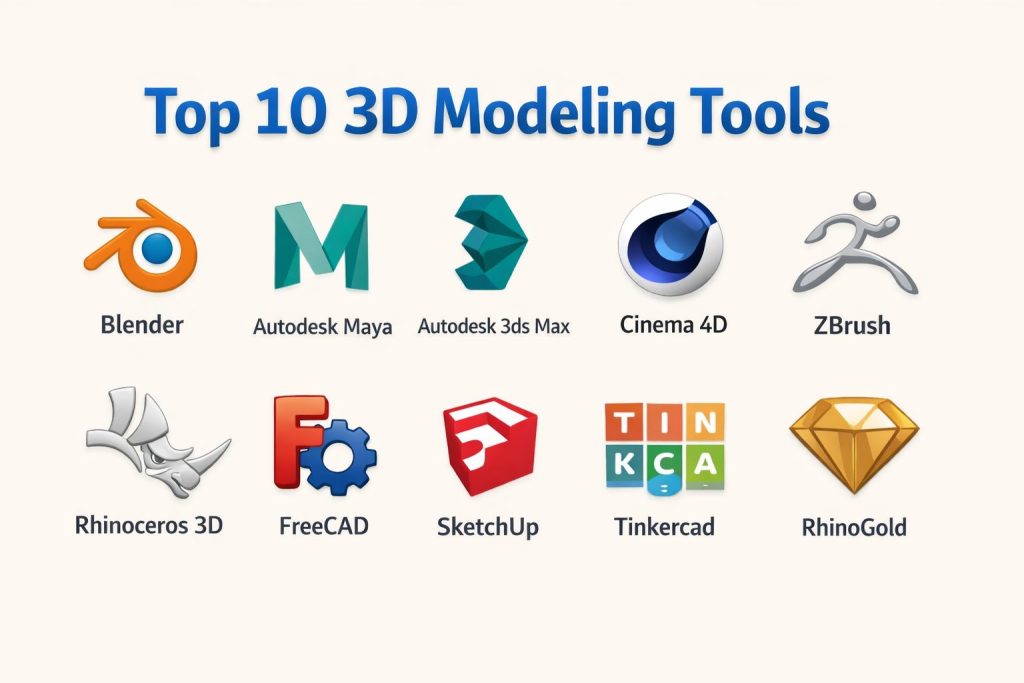
Top 10 3D Modeling Tools
#1 — Blender
Short description: A fully-featured, open-source 3D modeling tool that excels in modeling, sculpting, animation, rendering, and even video editing. Best for those looking for an all-in-one tool with a growing community and feature set.
Key Features
- Powerful polygonal modeling and sculpting tools
- Advanced texturing and shading workflows with procedural and node-based systems
- Animation and rigging tools for character work
- Integrated rendering engines (Cycles and Eevee) for quick previews and high-quality results
- Simulation tools for fluid, cloth, and smoke effects
- Python scripting support for automation and customization
- Strong community-driven plugin ecosystem
Pros
- Completely free and open-source with no hidden costs
- Highly versatile for almost every aspect of 3D creation
- Active community and frequent updates
Cons
- Steep learning curve for beginners
- Large scenes and complex rigs can slow down performance
- Less specialized support compared to paid software
Platforms / Deployment
Windows / macOS / Linux
Self-hosted
Security & Compliance
Not publicly stated.
Integrations & Ecosystem
Blender is integrated into various pipelines through its file import/export capabilities and Python API. It is compatible with many rendering engines and asset managers.
- Plugin ecosystem for additional features and file compatibility
- API for pipeline automation and tool creation
- Works well in small to medium-sized production teams with proper standards
Support & Community
Large and growing community with extensive resources, including tutorials, forums, and third-party plugins.
#2 — Autodesk Maya
Short description: One of the most recognized 3D modeling and animation tools, often used for character animation and high-end VFX work. Best for large-scale professional studios and animation teams.
Key Features
- Advanced polygonal modeling tools and retopology
- Rigging system with advanced skinning and deformation control
- Complex animation tools for keyframing, motion graphics, and character animation
- Integration with VFX tools for particle systems and simulations
- High-end rendering options (Arnold, V-Ray, etc.)
- Custom scripting for automation and production needs
- Seamless integration with other Autodesk products like 3ds Max
Pros
- Extremely robust for character and animation workflows
- Industry standard in film, TV, and game production
- Extensive support for high-end rendering and VFX
Cons
- Expensive licensing, which can be prohibitive for smaller teams
- Steep learning curve for newcomers
- Performance can degrade with large scenes or insufficient hardware
Platforms / Deployment
Windows / macOS / Linux
Self-hosted
Security & Compliance
Not publicly stated.
Integrations & Ecosystem
Maya integrates seamlessly into large production pipelines, particularly in the film and game industries. It supports a range of plugins and industry-standard formats.
- Scripting and plug-ins to extend functionality
- Commonly used in conjunction with other Autodesk products for comprehensive workflows
- Robust pipeline management and integration tools for VFX and animation
Support & Community
Extensive support options with Autodesk’s customer service. Large user community and numerous tutorials and training resources available.
#3 — Autodesk 3ds Max
Short description: A 3D modeling tool widely used for architectural visualization, game design, and product modeling. Known for its intuitive interface and fast scene building capabilities.
Key Features
- Polygonal and spline modeling tools for rapid scene building
- Real-time rendering with support for high-quality output
- Procedural workflow tools for texturing and animation
- Strong support for architectural and product design workflows
- Rich material editor and shader tools
- Extensive library of pre-built assets and textures
- Strong support for rendering engines like V-Ray and Arnold
Pros
- Ideal for architectural visualization and product design
- Faster iteration for scenes with large asset libraries
- Strong support for rendering and post-production
Cons
- Lacks the in-depth animation tools of Maya
- Limited support for high-end character modeling and rigging
- Can become resource-heavy with complex scenes
Platforms / Deployment
Windows
Self-hosted
Security & Compliance
Not publicly stated.
Integrations & Ecosystem
3ds Max works well with architectural, product, and visualization workflows, and is often used in conjunction with rendering engines and visualization tools.
- Commonly integrates with rendering and simulation engines
- Supports plugins for specialized workflows (animation, VFX, rendering)
- Compatible with a wide range of file formats
Support & Community
Strong professional user base, particularly in architectural and game design. Extensive documentation and training content available.
#4 — Cinema 4D
Short description: A versatile 3D tool popular for motion graphics, product animations, and design-focused projects. It’s often used in creative industries for its ease of use and rapid iteration.
Key Features
- Fast, efficient polygonal modeling and sculpting tools
- Powerful motion graphics capabilities with timeline-based animation
- Advanced rendering with both CPU and GPU-based engines
- Strong integration with Adobe After Effects for post-production
- Node-based material and texture creation for procedural workflows
- Extensive library of presets and templates for quick results
Pros
- Fast and efficient for motion graphics and product animations
- User-friendly interface that’s easy to learn
- Great integration with design and post-production software
Cons
- Not as feature-rich for traditional character modeling
- Lacks some of the more advanced rigging tools needed for complex character animation
- Best suited for design and graphics, rather than engineering
Platforms / Deployment
Windows / macOS
Self-hosted
Security & Compliance
Not publicly stated.
Integrations & Ecosystem
Cinema 4D integrates easily with creative toolchains, especially in the motion graphics and post-production spaces.
- Integrates well with Adobe After Effects and other design tools
- Common plugins and add-ons for rendering and animation
- Strong ecosystem of motion graphics templates and assets
Support & Community
Large community with a focus on creative industries. Numerous tutorials, templates, and community resources available.
#5 — ZBrush
Short description: ZBrush is a 3D sculpting software known for its advanced modeling and detailing tools, used primarily for character and creature design in games, movies, and VFX.
Key Features
- Advanced digital sculpting tools for organic shapes
- Powerful brushes and textures for detailed models
- High-resolution mesh support for detailed designs
- Polygroups and subdivision controls for complex modeling
- Integration with other animation and rendering software
- Supports retopology for creating production-ready meshes
- Offers hybrid sculpting and painting workflows
Pros
- Best for detailed, high-resolution sculpting and organic modeling
- Used in top-tier movie studios and game development
- Ideal for character and creature creation
Cons
- Not designed for full CAD or engineering workflows
- Can be complex for beginners to learn
- Limited rigging and animation features
Platforms / Deployment
Windows / macOS
Self-hosted
Security & Compliance
Not publicly stated.
Integrations & Ecosystem
ZBrush works alongside traditional animation and VFX tools, often feeding into other programs for rigging and animation.
- Integrates with Maya, 3ds Max, and other animation tools
- Supports exporting models in common 3D formats
- Commonly used in conjunction with rendering engines like V-Ray
Support & Community
Large user base, with many tutorials and resources from professional artists and hobbyists alike.
#6 — Rhinoceros 3D
Short description: Rhinoceros 3D (Rhino) is known for its versatility in modeling, especially in architecture and industrial design. It excels at creating freeform shapes and complex surfaces.
Key Features
- Precision modeling for both parametric and freeform designs
- Strong fit for creating complex curves and surfaces
- Supports NURBS-based modeling for high detail
- Strong interoperability with other CAD and CAM tools
- Plugin support for additional features and tools
- Rendering support and export to common 3D file formats
- Support for 3D printing and CAM integrations
Pros
- Great for industrial design and architecture
- Excellent for creating freeform, organic shapes and surfaces
- Strong plugin and scriptability support
Cons
- Not as strong for animation-heavy workflows
- Lacks some animation features found in other dedicated tools
- High learning curve for new users
Platforms / Deployment
Windows / macOS
Self-hosted
Security & Compliance
Not publicly stated.
Integrations & Ecosystem
Rhino fits into industrial design and architecture workflows, often working alongside CAM and rendering tools.
- Common integration with CAD, CAM, and rendering platforms
- Support for exporting models to other tools like 3ds Max and V-Ray
- Scripting for task automation and custom workflows
- Supports scripting for complex tasks
Support & Community
Active user community with extensive resources and tutorials. Official support available through licensed versions.
#7 — FreeCAD
FreeCAD is an open-source parametric 3D modeling tool primarily used for engineering and product design, offering customizable workbenches for various applications.
Key Features
- Fully parametric modeling and feature history
- Modular workbench approach for different engineering tasks
- Customizable user interface and scripting options
- Integration with other open-source tools and libraries
- Simulation tools for mechanical design
- Free and open-source, making it accessible for everyone
- Strong file export/import capabilities
Pros
- Completely free and open-source
- Highly customizable and extensible
- Good fit for simple engineering and product design workflows
Cons
- Not as polished or fast as commercial alternatives
- Limited support for high-end visual effects and animation
- Learning curve for beginners, especially with customization
Platforms / Deployment
Windows / macOS / Linux
Self-hosted
Security & Compliance
Not publicly stated.
Integrations & Ecosystem
FreeCAD integrates well with other open-source tools, and has community-developed plugins for additional capabilities.
- Community-driven ecosystem for added functionality
- Integration with simulation and CAM tools
- Strong file exchange and open-source workflow options
- Supports scripting for automation and customization
Support & Community
Strong open-source community, with many tutorials and forums. Formal support is community-driven.
#8 — SketchUp
SketchUp is widely used for architectural and interior design projects, offering easy-to-use tools for quick 3D modeling and visualization.
Key Features
- Fast modeling workflows for architecture and interiors
- Wide range of pre-built models and assets in the 3D Warehouse
- Real-time rendering tools for visualization
- Easy-to-use interface, great for beginners
- Common export formats for collaboration with other tools
- Cloud-based collaboration options with SketchUp for Web
- Support for 3D printing
Pros
- Very beginner-friendly and intuitive
- Fast for creating conceptual models and layouts
- Strong community and asset library
Cons
- Limited advanced features compared to full CAD systems
- Best suited for simpler, conceptual designs
- Not great for mechanical or product design workflows
Platforms / Deployment
Windows / macOS
Cloud / Self-hosted
Security & Compliance
Not publicly stated.
Integrations & Ecosystem
SketchUp works best in architectural workflows and integrates with other tools like AutoCAD and Revit.
- Integration with architectural and visualization workflows
- Strong library of community models and assets
- 3D printing export capabilities
- Cloud-based collaboration with file sharing
Support & Community
Extensive user community with many learning resources. Support options depend on the subscription plan.
#9 — Tinkercad
Tinkercad is a user-friendly, web-based 3D modeling tool designed for beginners, especially useful for creating simple models for 3D printing.
Key Features
- Simple, drag-and-drop 3D design tool
- Fast modeling for basic shapes and objects
- 3D printing integration for quick prototyping
- Free and easy to access via the web
- Direct export to STL and other formats
- Great for educational purposes and beginners
Pros
- Easy to use for new modelers and educators
- Fast to learn and perfect for simple 3D printing models
- Completely free to use
Cons
- Very limited for advanced modeling or complex designs
- Not suitable for high-precision or large-scale projects
- Lacks the depth and customization of professional tools
Platforms / Deployment
Web-based
Cloud
Security & Compliance
Not publicly stated.
Integrations & Ecosystem
Tinkercad is mainly used for simple 3D printing and prototyping.
- Integrates with 3D printing services for direct export
- Basic file export formats for collaborative work
- Limited scripting or plugin support
- Works best in educational or quick prototype environments
Support & Community
Good support for beginners with a vast library of tutorials. Community-driven resources are plentiful.
#10 — RhinoGold
RhinoGold is specialized for jewelry design, providing precise tools for modeling and rendering complex jewelry designs.
Key Features
- Tailored for jewelry design with gemstone and metal modeling tools
- Integration with Rhino for parametric workflows
- Extensive material libraries for rendering realistic models
- Support for CAD jewelry file formats and 3D printing
- Advanced rendering tools for showcasing jewelry designs
- Customizable templates for jewelry designers
- Easy-to-use interface with advanced design capabilities
Pros
- Specifically designed for jewelry design, making it highly accurate
- Great for both beginners and advanced jewelry designers
- Supports 3D printing and prototyping for jewelry
Cons
- Limited appeal outside jewelry design
- Best results come with a good understanding of 3D modeling principles
- More expensive than general-purpose 3D modeling tools
Platforms / Deployment
Windows
Self-hosted
Security & Compliance
Not publicly stated.
Integrations & Ecosystem
RhinoGold integrates directly with Rhino for parametric modeling and is suitable for jewelry design pipelines.
- Works well with Rhino and other jewelry design tools
- File export compatibility for 3D printing
- Rendering tools specifically for high-quality jewelry visualization
- Ideal for jewelers with a focus on product development
Support & Community
Specialized support for jewelry designers and a growing community of users in the jewelry design field.
Comparison Table (Top 10)
| Tool Name | Best For | Platform(s) Supported | Deployment (Cloud/Self-hosted/Hybrid) | Standout Feature | Public Rating |
|---|---|---|---|---|---|
| Blender | All-around 3D modeling | Windows / macOS / Linux | Self-hosted | Free and powerful, flexible toolset | N/A |
| Autodesk Maya | Character animation and rigging | Windows / macOS / Linux | Self-hosted | Advanced rig and motion polish control | N/A |
| Autodesk 3ds Max | Architectural visualization | Windows | Self-hosted | Scene building and visualization for design | N/A |
| Cinema 4D | Motion graphics | Windows / macOS | Self-hosted | Motion graphics and procedural tools | N/A |
| ZBrush | Sculpting and organic design | Windows / macOS | Self-hosted | Unmatched sculpting and detailing for organic models | N/A |
| Rhinoceros 3D | Precision modeling | Windows / macOS | Self-hosted | Ideal for complex curves and surface modeling | N/A |
| FreeCAD | Open-source parametric modeling | Windows / macOS / Linux | Self-hosted | Free and open-source parametric modeling | N/A |
| SketchUp | Architecture and interiors | Windows / macOS | Cloud / Self-hosted | Fast for conceptual modeling and visualization | N/A |
| Tinkercad | Beginner 3D design | Web-based | Cloud | Simple and quick 3D printing for beginners | N/A |
| RhinoGold | Jewelry design | Windows | Self-hosted | Tailored specifically for jewelry design and rendering | N/A |
Evaluation & Scoring of 3D Modeling Software
| Tool Name | Core (25%) | Ease (15%) | Integrations (15%) | Security (10%) | Performance (10%) | Support (10%) | Value (15%) | Weighted Total (0–10) |
|---|---|---|---|---|---|---|---|---|
| Blender | 9.5 | 8.0 | 8.5 | 6.0 | 8.0 | 9.5 | 10.0 | 8.65 |
| Autodesk Maya | 9.8 | 6.5 | 9.5 | 6.5 | 8.5 | 9.0 | 5.5 | 8.10 |
| Autodesk 3ds Max | 8.5 | 7.2 | 8.0 | 6.0 | 7.8 | 7.5 | 6.5 | 7.58 |
| Cinema 4D | 8.0 | 8.5 | 8.0 | 6.0 | 7.5 | 8.0 | 7.5 | 7.85 |
| ZBrush | 9.0 | 6.8 | 8.0 | 6.0 | 8.2 | 8.5 | 6.0 | 7.85 |
| Rhinoceros 3D | 8.5 | 7.5 | 8.5 | 6.0 | 7.8 | 7.2 | 7.5 | 7.75 |
| FreeCAD | 7.5 | 7.8 | 7.0 | 5.5 | 6.5 | 7.0 | 9.0 | 7.45 |
| SketchUp | 7.0 | 9.0 | 7.5 | 5.0 | 7.2 | 8.5 | 7.5 | 7.57 |
| Tinkercad | 6.0 | 9.5 | 6.5 | 5.0 | 6.0 | 7.5 | 9.5 | 7.05 |
| RhinoGold | 8.0 | 7.5 | 8.5 | 6.0 | 7.2 | 7.0 | 7.0 | 7.48 |
Which 3D Modeling Tool Is Right for You?
Solo / Freelancer
You need a fast, versatile tool with a strong community.
- Choose Blender for an all-in-one solution with full capability at no cost.
- Choose Cinema 4D for motion-centric visuals and quick scene assembly.
- Choose ZBrush if your focus is on detailed sculpting, especially characters.
SMB
Small teams need predictable output and collaboration tools.
- Choose Blender for flexibility and community resources.
- Choose Autodesk Maya for character-heavy production.
- Choose Cinema 4D for creative product and motion animation.
Mid-Market
Mid-market teams typically use more specialized software with clear integration across departments.
- Use Autodesk Maya for animation-heavy workflows.
- Add Cinema 4D for fast iteration and product animation.
- Use Blender for flexibility and full control.
Enterprise
Enterprise teams need scalability and strong governance.
- Use Autodesk Maya for complex character workflows and pipeline control.
- Use ZBrush for high-end sculpting needs in large-scale production.
- Add Autodesk 3ds Max if scene assembly and visualization are central.
Budget vs Premium
- If budget is a concern, prioritize Blender for its free and open-source nature.
- If premium investment is possible, focus on tools like Maya for high-end workflows and industry compatibility.
Feature Depth vs Ease of Use
- Autodesk Maya and ZBrush are best for depth and control.
- Cinema 4D is best for ease of use with motion-heavy projects.
Integrations & Scalability
- If assets move across departments, make sure your tool integrates well with the rest of the pipeline.
- For scaling teams, ensure the tool supports automated versioning, consistent file naming, and stable exports.
Security & Compliance Needs
Most 3D tools do not openly provide security certifications, but it’s crucial to manage assets with version control, access restrictions, and secure sharing processes.
Frequently Asked Questions (FAQs)
Which 3D modeling software is best for beginners?
Blender is a great starting point due to its flexibility and abundant learning resources. Cinema 4D is also a good choice for creative-focused teams due to its easy interface.
Do I need a powerful GPU for 3D modeling?
A strong GPU improves performance in rendering and viewport preview. For large-scale models, CPU and RAM are also critical factors.
Can one tool handle both modeling and animation?
Some tools, like Blender and Autodesk Maya, can handle both, but more complex pipelines may require specialized tools for different stages (e.g., ZBrush for sculpting).
How do I improve collaboration in 3D modeling?
Using cloud-based tools or ensuring consistent file export standards and versioning systems helps reduce collaboration issues across teams.
What is the biggest challenge in 3D modeling?
Ensuring that files are easily sharable and that there’s a smooth handoff between design and final output, especially in collaborative settings.
Can I switch between different 3D tools?
Switching tools can be challenging but possible, especially if your workflow supports standard file formats and your team has the skills to adapt to new software.
How do I optimize 3D models for performance?
Focus on low-poly modeling where possible, use instances for repeating objects, and keep your textures optimized. Avoid high-poly meshes unless absolutely necessary.
Are there any free 3D modeling tools?
Blender is a powerful free tool that offers nearly everything you need for 3D modeling, rendering, and animation.
What should I test in
a pilot before committing to a 3D modeling tool?
Test export/import workflows, scene handling for large models, performance under load, and team collaboration processes before fully committing.
How do I reduce rework in 3D modeling?
Establish modeling standards early, use templates, enforce clean topology, and ensure proper naming conventions for efficient asset management.
Conclusion
Choosing the right 3D modeling software depends on your team’s specific needs, budget, and the complexity of your projects. Blender offers broad capability and flexibility for no cost, making it ideal for solo artists or small teams. Autodesk Maya and ZBrush stand out for high-end animation and sculpting, while Cinema 4D excels in creative motion graphics work. By evaluating these tools through the lens of your workflow needs, team size, and future scalability, you can make a more informed decision for your next project.