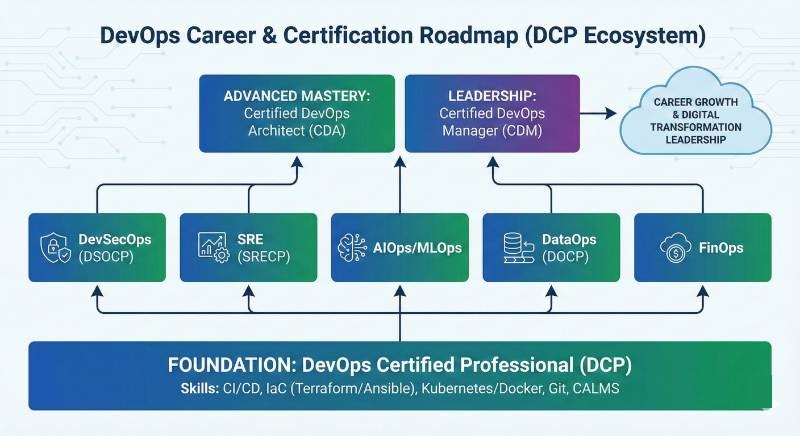
The technology landscape has moved far beyond the era of manual deployments and siloed teams. Today, the demand for high-velocity software delivery has made the DevOps framework the backbone of modern engineering. For software engineers, system administrators, and technical managers, staying relevant means moving beyond basic coding or scripting—it requires a deep understanding of the entire engineering ecosystem.
The DevOps Certified Professional (DCP) program is the industry standard for those looking to master the intersection of development, operations, and security. This guide provides a comprehensive roadmap for anyone looking to transition into or excel within the DevOps, SRE, and DevSecOps domains.
Master Certification Landscape
Navigating the various tracks in the “Ops” world can be overwhelming. The following table provides a clear view of the most impactful certifications currently available under the DevOps Certified Professional ecosystem.
| Track | Level | Who it’s for | Prerequisites | Skills Covered | Recommended Order |
| DevOps | Associate | Software Engineers | Basic Linux | CI/CD, Docker, Git | 1st |
| DevSecOps | Professional | Security Engineers | DevOps Basics | SAST/DAST, Vault | 2nd |
| SRE | Professional | SREs / Ops | DevOps Basics | SLIs/SLOs, Error Budgets | 2nd |
| AIOps/MLOps | Specialist | Data/ML Engineers | Python + DevOps | ML Pipelines, Model Ops | 3rd |
| DataOps | Specialist | Data Engineers | SQL + DevOps | Data Pipelines, ELT/ETL | 3rd |
| FinOps | Management | Managers/FinOps | Cloud Basics | Cloud Billing, Unit Costs | 2nd |
Deep Dive: The DevOps Certified Professional (DCP)
1. DevOps Certified Professional (DCP)
What it is: The DCP is a comprehensive certification focused on the “Golden Path” of automation. It validates a professional’s ability to design, build, and manage end-to-end software delivery pipelines using the latest industry tools.
Who should take it: It is designed for Software Engineers, System Administrators, Cloud Engineers, and Quality Assurance professionals who want to lead the automation efforts within their organizations.
Skills you’ll gain:
- Mastery of the CALMS framework.
- Advanced Infrastructure as Code (IaC) with Terraform and Ansible.
- Containerization and Orchestration with Docker and Kubernetes.
- Design of complex CI/CD pipelines using Jenkins, Git, and GitHub Actions.
Real-world projects you should be able to do:
- Deploy a multi-tier microservices application on a Kubernetes cluster.
- Build a self-healing pipeline that automatically triggers rollbacks on failure.
- Implement full infrastructure provisioning on AWS or Azure using Terraform.
Preparation plan (30 days):
- Days 1–7: Linux Internals, Shell Scripting, and Advanced Git workflows.
- Days 8–14: Docker containerization and Kubernetes cluster management.
- Days 15–21: Mastering Jenkins pipelines and Ansible playbooks.
- Days 22–30: Terraform for Cloud and final Capstone project.
Common mistakes:
- Learning the tools without understanding the underlying DevOps philosophy.
- Neglecting the importance of security within the pipeline.
- Ignoring Linux-level troubleshooting skills.
Best next certification after this: Certified DevOps Architect (CDA).
2. DevSecOps Certified Professional (DSOCP)
What it is: This program focuses on integrating security into every stage of the DevOps lifecycle. It teaches how to “shift-left” security, making it a shared responsibility rather than a final checkpoint.
Who should take it: Security Engineers, DevOps Engineers, and Security Analysts who want to automate compliance and security scanning within modern cloud environments.
Skills you’ll gain:
- Automated Vulnerability Scanning (SAST/DAST).
- Secrets Management using HashiCorp Vault.
- Container Image Scanning and Runtime Security.
- Compliance as Code (CaC).
Real-world projects you should be able to do:
- Integrate automated security gating in a Jenkins pipeline.
- Implement automated credential rotation for cloud services.
- Design a zero-trust network architecture for a Kubernetes environment.
Preparation plan (14 days):
- Days 1–5: Security fundamentals and OWASP Top 10 for DevOps.
- Days 6–10: Hands-on with scanners (Trivy, SonarQube, Snyk).
- Days 11–14: Final project: End-to-end secured CI/CD pipeline.
Common mistakes:
- Viewing security as a “blocker” rather than an “enabler.”
- Failing to include development teams in security discussions.
Best next certification after this: Certified Cloud Security Professional (CCSP).
3. Site Reliability Engineering Certified Professional (SRECP)
What it is: SRE applies software engineering mindsets to IT operations problems. This certification focuses on system stability, reliability, and the operational excellence required for high-availability systems.
Who should take it: Operations Engineers, Backend Developers, and SREs who want to master the Google-pioneered principles of reliability.
Skills you’ll gain:
- Defining and measuring SLIs, SLOs, and SLAs.
- Managing Error Budgets to balance speed and stability.
- Automated Incident Management and Toil reduction.
- Chaos Engineering principles.
Real-world projects you should be able to do:
- Design a monitoring dashboard that tracks real-time error budgets.
- Conduct a chaos experiment to test system resilience during regional cloud failures.
- Automate post-mortem reporting and action item tracking.
Preparation plan (30 days):
- Week 1: Theoretical foundations of SRE and Reliability metrics.
- Week 2: Advanced Observability and Monitoring (Prometheus/Grafana).
- Week 3: Toil reduction and Automation strategies.
- Week 4: Incident Response simulations and mock exams.
Common mistakes:
- Treating SRE as just another name for “Ops” without changing the methodology.
- Focusing solely on uptime while ignoring the developer experience.
Best next certification after this: Master in SRE Engineering.
4. AIOps / MLOps Certified Professional
What it is: This track brings DevOps agility to the world of Machine Learning and Artificial Intelligence. It focuses on the deployment, monitoring, and scaling of ML models in production.
Who should take it: Data Scientists, ML Engineers, and DevOps Engineers moving into the AI/ML space.
Skills you’ll gain:
- Building ML Pipelines (Kubeflow/MLflow).
- Model Versioning and Data Lineage.
- Monitoring model drift and performance in real-time.
Real-world projects you should be able to do:
- Automate the retraining of a model based on performance degradation.
- Deploy a high-scale LLM application using Kubernetes.
Preparation plan (60 days):
- Month 1: Python for Data Science and ML fundamentals.
- Month 2: MLOps toolsets and automated model deployment.
Best next certification after this: AIOps Architect.
5. DataOps Certified Professional (DOCP)
What it is: DataOps aims to improve the quality and reduce the cycle time of data analytics. This certification focuses on the automated management of data pipelines.
Who should take it: Data Engineers, DBAs, and Analytics professionals.
Skills you’ll gain:
- Automated Data Pipeline Orchestration (Airflow).
- Data Quality Testing and Validation as Code.
- Version Control for Data and Schemas.
Real-world projects you should be able to do:
- Build an automated ELT pipeline with built-in data quality checks.
- Implement automated database migrations within a CI/CD flow.
Preparation plan (30 days):
- Focus on Data Orchestration tools and testing frameworks for large datasets.
Best next certification after this: Certified Data Architect.
6. FinOps Certified Professional
What it is: FinOps is the practice of bringing financial accountability to the variable spend model of the cloud. This certification focuses on cloud cost optimization and unit economics.
Who should take it: Managers, Finance professionals, and Cloud Architects.
Skills you’ll gain:
- Cloud Billing and Cost Allocation.
- Rate Optimization and Usage Optimization.
- Implementing FinOps lifecycle (Inform, Optimize, Operate).
Real-world projects you should be able to do:
- Perform a cloud cost audit and identify 20% savings on infrastructure.
- Design a tagging strategy for multi-cloud cost transparency.
Preparation plan (14 days):
- Deep dive into AWS/Azure/GCP billing structures and the FinOps Framework.
Best next certification after this: Certified DevOps Manager.
Choose Your Path: 6 Learning Roadmaps
- The DevOps Path: Start with DCP → Kubernetes Specialist → DevOps Architect. This is the core path for all engineering professionals.
- The DevSecOps Path: Start with DCP → DSOCP → Cloud Security Expert. For those specializing in compliance and cybersecurity.
- The SRE Path: Start with DCP → SRECP → Observability Specialist. The path for those focused on high-availability and system resilience.
- The AIOps/MLOps Path: Start with DCP → MLOps Professional → AI Architect. For engineers bridging the gap between DevOps and AI.
- The DataOps Path: Start with DCP → DOCP → Data Engineer. Best for those managing large-scale data lakes and warehouses.
- The FinOps Path: Start with Cloud Fundamentals → FinOps Professional → IT Director. The ideal path for leadership and financial management.
Role → Recommended Certifications Mapping
| If your role is… | You should take… |
| DevOps Engineer | DCP + CKA (Certified Kubernetes Administrator) |
| SRE | DCP + SRECP + Prometheus Specialist |
| Platform Engineer | DCP + Certified DevOps Architect |
| Cloud Engineer | DCP + AWS/Azure Certified DevOps Engineer |
| Security Engineer | DCP + DSOCP + Certified Security Specialist |
| Data Engineer | DCP + DOCP |
| FinOps Practitioner | FinOps Professional + Cloud Architect |
| Engineering Manager | DCP + Certified DevOps Manager (CDM) |
Next Certifications to Take (Advanced Levels)
Once you have completed the DevOps Certified Professional (DCP), you should look toward one of these three advancement paths to further your career:
- Same Track (Expertise): Certified DevOps Architect (CDA). This is for those who want to design global-scale systems and lead digital transformation projects.
- Cross-Track (Broadening): Certified DevSecOps Professional (DSOCP). Broadening your skills into security ensures you are indispensable in the current “secure-by-default” market.
- Leadership (Management): Certified DevOps Manager (CDM). Focuses on the cultural and people side of DevOps, including budgeting, hiring, and team scaling.
Top Institutions for Training & Certification
- DevOpsSchool: The primary provider for the DCP. They offer an extensive curriculum with over 250 hours of training and specialized internships. Their focus is on high-quality, project-based learning.
- Cotocus: A specialized consulting and training firm focused on enterprise upskilling. They provide high-level mentorship for senior engineers looking to transition into architectural roles.
- Scmgalaxy: A leading community platform that provides technical resources and hands-on training labs. They are particularly known for their deep-dive courses in Git and Configuration Management.
- BestDevOps: Known for their fast-track bootcamps designed for working professionals. They focus on delivering the maximum practical knowledge in the shortest possible timeframe.
- devsecopsschool / sreschool / aiopsschool / dataopsschool / finopsschool: These are niche-focused specialized institutions that offer deep domain expertise in their respective fields, led by industry veterans.
General Career & Certification FAQs
Q1: How difficult is the DCP exam?
The exam is moderately difficult and highly practical. It requires a solid understanding of both theory and hands-on tool usage.
Q2: How much time is needed to prepare?
Most working professionals find that 30 to 45 days of consistent study (2 hours a day) is sufficient.
Q3: Are there any prerequisites?
Basic knowledge of Linux and at least one programming or scripting language (like Python or Bash) is highly recommended.
Q4: In what order should I take these certifications?
Always start with the DCP. It provides the foundation upon which all other tracks (SRE, SecOps, etc.) are built.
Q5: What is the market value of these certifications?
Certified professionals often see a significant increase in salary and are prioritized for senior engineering and leadership roles.
Q6: Can I take the training while working full-time?
Yes, most providers offer weekend batches and self-paced options specifically for working engineers.
Q7: Do these certifications expire?
Most are valid for 2–3 years, after which you may need to take a bridge exam to stay current with new technologies.
Q8: Will I get job placement assistance?
Institutions like DevOpsSchool offer career support and internship opportunities to help you transition into new roles.
Q9: Is there a focus on specific cloud providers like AWS or Azure?
The DCP is cloud-agnostic, focusing on principles that apply to all major providers, though labs usually use AWS or Azure for practice.
Q10: What kind of projects are included?
Projects include building CI/CD pipelines, automating cloud infrastructure, and setting up monitoring stacks.
Q11: How do I handle the high cost of exams?
Many employers offer reimbursement for certifications. Additionally, look for group discounts from the training providers.
Q12: Can I move into management after DCP?
Yes, the DCP is the first step toward the Certified DevOps Manager (CDM) path.
FAQs: DevOps Certified Professional (DCP)
Q1: What is the official certification name?
DevOps Certified Professional (Training & Certification).
Q2: Who provides the official certification?
It is provided by DevOpsSchool .
Q3: Where can I find the official syllabus?
The official link is: DevOps Certified Professional
Q4: Is the DCP exam theoretical or practical?
It is a mix, but heavily emphasizes practical skills through a mandatory Capstone Project.
Q5: Are the trainers experienced?
Yes, courses are led by mentors with over 20 years of global experience in the software industry.
Q6: What is the format of the training?
Training is available via live interactive online sessions, self-paced videos, and corporate classroom settings.
Q7: Does the DCP cover Kubernetes?
Yes, Kubernetes and Docker are core modules within the DCP curriculum.
Q8: Can a Software Engineer benefit from DCP?
Absolutely. It allows developers to understand the production environment, leading to better code and faster releases.
Conclusion
The path to becoming a DevOps Certified Professional is more than just a credential—it is a commitment to a new way of engineering. By mastering the tools of automation, the principles of reliability, and the culture of security, you position yourself at the very top of the technical talent pool.
Whether you are looking to secure your first role as a DevOps engineer or you are a manager looking to modernize your team’s workflow, the DCP program provides the structure and the skills necessary to succeed. The future of engineering is automated, secure, and reliable. With the right training and certification, you can lead that future.