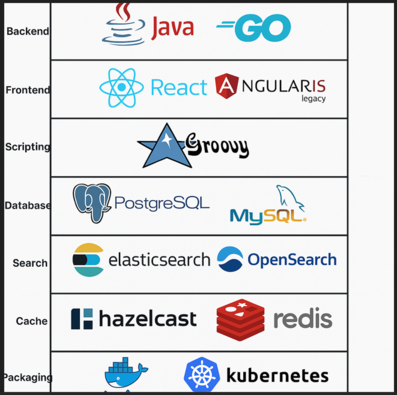
the software development technologies (programming languages, frameworks, databases) used to build the latest JFrog Artifactory product, not the deployment architecture.
✅ Technologies Used to Develop JFrog Artifactory (Latest Versions)
1️⃣ Programming Languages
- Java – Core backend services and API layer are primarily written in Java (Artifactory started as a Java-based platform and still relies on it for core logic).
- Groovy – Used for internal scripting and plugin extensions.
- Go (Golang) – Some newer microservices and performance-critical components are being developed in Go for concurrency and speed.
- JavaScript / TypeScript – Frontend UI is built using modern JS/TS frameworks.
2️⃣ Frameworks & Libraries
- Spring Boot / Spring Framework – For REST APIs, service orchestration, and dependency injection.
- Hibernate / JPA – For ORM and database interaction.
- React / Angular (UI) – Newer UI versions are based on React with TypeScript, while older ones used AngularJS.
3️⃣ Databases & Storage
- PostgreSQL – Default metadata database for both self-hosted and cloud versions.
- MySQL / Oracle / MS SQL – Supported for on-prem enterprise setups.
- Object Storage – AWS S3, Azure Blob, GCP Storage for binaries in cloud versions.
4️⃣ Search & Indexing
- Elasticsearch / OpenSearch – Used for artifact metadata indexing and search capabilities.
5️⃣ Other Technologies
- gRPC + REST APIs – For internal microservices communication.
- Docker & Kubernetes – For packaging and deploying the Artifactory services themselves.
- Hazelcast / Redis – Used for distributed caching and clustering.
- NGINX / HAProxy – For load balancing and routing in HA setups.
✅ Summary
- Backend: Java (Spring Boot), Go (for microservices)
- Frontend: React + TypeScript (UI), AngularJS (legacy)
- Scripting: Groovy
- Database: PostgreSQL (primary), MySQL/Oracle supported
- Search: Elasticsearch/OpenSearch
- Cache: Hazelcast/Redis
- Packaging: Docker + Kubernetes for deployment