MOTOSHARE 🚗🏍️
Turning Idle Vehicles into Shared Rides & Earnings
From Idle to Income. From Parked to Purpose.
Earn by Sharing, Ride by Renting.
Where Owners Earn, Riders Move.
Owners Earn. Riders Move. Motoshare Connects.
With Motoshare, every parked vehicle finds a purpose.
Owners earn. Renters ride.
🚀 Everyone wins.

1. What is Keras?
Keras is an open-source, high-level neural networks API written in Python, designed to enable fast experimentation and prototyping with deep learning models. Created by François Chollet and released in 2015, Keras abstracts the complexities of underlying deep learning frameworks, providing an intuitive, modular, and extensible interface for building neural networks.
Initially supporting multiple backends—TensorFlow, Theano, and Microsoft Cognitive Toolkit—Keras is now primarily integrated into TensorFlow as tf.keras, becoming the official high-level API of TensorFlow from version 2.x onwards.
Keras focuses on enabling easy and fast prototyping, supports both convolutional and recurrent networks, and seamlessly integrates with advanced features like GPU acceleration and distributed training.
2. Major Use Cases of Keras
2.1 Rapid Prototyping and Research
Keras allows developers and researchers to build complex neural network architectures with just a few lines of code. This flexibility accelerates experimentation and iteration, making it ideal for academic research and fast proof-of-concept developments.
2.2 Computer Vision
With strong support for convolutional layers, Keras is widely used in image classification, object detection, semantic segmentation, and image generation tasks. Popular architectures like VGG, ResNet, and Inception are available in tf.keras.applications for transfer learning.
2.3 Natural Language Processing (NLP)
Keras’s recurrent and transformer layers support text processing tasks such as sentiment analysis, machine translation, text generation, and question answering.
2.4 Time Series Forecasting and Signal Processing
Using recurrent layers like LSTM and GRU, Keras models can analyze sequential data for forecasting stock prices, weather, or sensor readings.
2.5 Generative Models
Keras is used to build GANs (Generative Adversarial Networks), VAEs (Variational Autoencoders), and other generative architectures for applications including image synthesis, style transfer, and anomaly detection.
2.6 Reinforcement Learning
Keras serves as a backbone for reinforcement learning agents, integrating with libraries such as Stable Baselines and OpenAI Gym.
2.7 Education and Industry Adoption
Keras’s simplicity has made it a popular teaching tool for deep learning and is widely adopted in industry for production AI solutions.
3. How Keras Works Along with Architecture
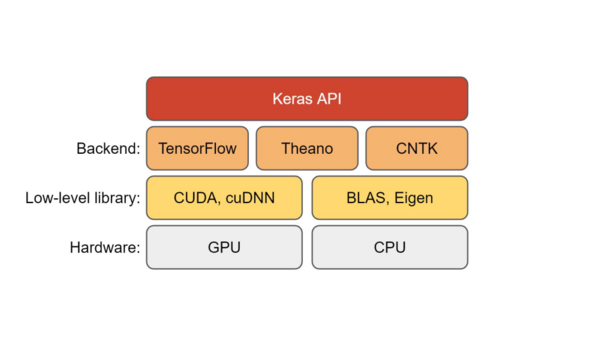
Keras is structured around a few core components that simplify building deep learning models:
3.1 Layers
The primary building blocks are layers, which are modules that process inputs into outputs. Layers can be:
- Core Layers: Dense (fully connected), Activation, Dropout.
- Convolutional Layers: Conv1D, Conv2D, Conv3D for spatial data.
- Recurrent Layers: LSTM, GRU, SimpleRNN for sequential data.
- Normalization Layers: BatchNormalization, LayerNormalization.
- Advanced Layers: Attention, Embedding, Lambda.
3.2 Models
Two principal APIs to build models:
- Sequential API: Stack layers linearly; simple and straightforward.
- Functional API: Supports complex graphs, branching, multiple inputs/outputs.
Example:
from tensorflow.keras.models import Sequential
from tensorflow.keras.layers import Dense

model = Sequential([
    Dense(64, activation='relu', input_shape=(100,)),
    Dense(10, activation='softmax')
])
Code language: JavaScript (javascript)
3.3 Backend Engine
Keras relies on TensorFlow (primarily tf.keras) to perform low-level tensor computations and automatic differentiation, enabling efficient execution on CPU, GPU, or TPU.
3.4 Optimizers
Keras provides a variety of optimizers to update model weights during training, including:
- SGD (Stochastic Gradient Descent)
- Adam
- RMSprop
- Adagrad
3.5 Loss Functions
Loss functions quantify the difference between predicted and true values. Commonly used ones are:
- Mean Squared Error (MSE) for regression
- Categorical Crossentropy for multi-class classification
- Binary Crossentropy for binary classification
3.6 Callbacks
Callbacks allow controlling training behavior. Examples:
EarlyStoppinghalts training when performance stagnates.ModelCheckpointsaves the best model during training.TensorBoardintegrates with TensorFlow’s visualization tool.
4. Basic Workflow of Keras
Step 1: Data Preparation
Prepare input data, including normalization, reshaping, and one-hot encoding as necessary.
Step 2: Model Definition
Use the Sequential or Functional API to define the neural network architecture.
Step 3: Compilation
Compile the model specifying optimizer, loss function, and metrics.
model.compile(optimizer='adam',
              loss='categorical_crossentropy',
              metrics=['accuracy'])
Code language: JavaScript (javascript)
Step 4: Training
Train the model with .fit(), supplying data, batch size, and epochs.
model.fit(x_train, y_train, epochs=10, batch_size=32, validation_split=0.2)
Step 5: Evaluation
Assess model performance on unseen test data.
model.evaluate(x_test, y_test)
Code language: CSS (css)
Step 6: Prediction
Use the trained model to predict labels on new data.
predictions = model.predict(new_data)
Step 7: Save and Load Models
Persist models for later use or deployment.
model.save('my_model.h5')
loaded_model = tf.keras.models.load_model('my_model.h5')
Code language: JavaScript (javascript)
5. Step-by-Step Getting Started Guide for Keras
Prerequisites
Install TensorFlow (which includes Keras):
pip install tensorflow
Example: Classifying Handwritten Digits with MNIST Dataset
import tensorflow as tf
from tensorflow.keras.models import Sequential
from tensorflow.keras.layers import Flatten, Dense

# Load dataset
(x_train, y_train), (x_test, y_test) = tf.keras.datasets.mnist.load_data()

# Normalize data
x_train, x_test = x_train / 255.0, x_test / 255.0

# Build model
model = Sequential([
    Flatten(input_shape=(28, 28)),
    Dense(128, activation='relu'),
    Dense(10, activation='softmax')
])

# Compile model
model.compile(optimizer='adam',
              loss='sparse_categorical_crossentropy',
              metrics=['accuracy'])

# Train model
model.fit(x_train, y_train, epochs=5)

# Evaluate model
test_loss, test_acc = model.evaluate(x_test, y_test)
print(f'Test accuracy: {test_acc}')
Code language: PHP (php)
Tips for Effective Use
- Use
validation_splitor validation datasets to monitor overfitting. - Experiment with dropout and batch normalization layers for regularization.
- Leverage pre-trained models for transfer learning on small datasets.
- Utilize TensorBoard callback for interactive training visualization.
6. Advanced Keras Features and Ecosystem
- Custom Layers and Models: Build complex architectures by subclassing.
- Distributed Training: Multi-GPU and TPU support with minimal changes.
- Mixed Precision Training: Speed up training on modern GPUs.
- Integration with TensorFlow Hub: Use pre-trained modules.
- Keras Tuner: Hyperparameter tuning made easy.
- TF Data: Efficient input pipelines via the
tf.dataAPI.
7. Summary
Keras democratizes deep learning by providing a simple yet powerful API to design and train neural networks. Its modular design, seamless integration with TensorFlow, and extensive ecosystem make it suitable for both beginners and experts. Whether for image classification, NLP, or custom architectures, Keras enables rapid development, experimentation, and deployment of deep learning solutions.