Source: VentureBeat (originally published June 26, 2019)
Booster Closes $56 Million Series C to Expand Mobile Fuel Delivery
Booster, a San Mateo, California-based startup that delivers gasoline directly to parked vehicles, announced a $56 million Series C funding round led by Invus, with participation from returning investors Conversion Capital, Madrona Venture Group, Maveron, Perot Jain LP, and Vulcan Capital, plus new strategic investor Enterprise Holdings. The raise follows a $20 million Series B and brings Booster’s total funding to $88.5 million. CEO Frank Mycroft stated the capital will be used primarily to accelerate geographic expansion.
“We are really proud to have the support and confidence from these top investors as we work to change the way consumers get their fuel.”
— Frank Mycroft, CEO and Founder, Booster
Mycroft, a former Boeing engineer, founded Booster in 2014 with the premise that refueling a car should be as frictionless as any other on-demand service. The company’s Series C investors include Enterprise Holdings as a strategic partner, signaling interest from established players in fleet and vehicle services.
How the Booster Service Works
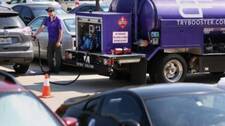
Booster operates a fleet of purple mini fuel tankers that drive directly to customers’ vehicles — whether in a corporate parking lot or a residential area — and fill the tank while the car is parked. As of the funding announcement, the company had:
- Delivered more than 20 million gallons of fuel
- Completed over two million individual deliveries
- Served customers across more than 20 U.S. cities, including the San Francisco Bay Area, Los Angeles, Orange County, and Dallas-Fort Worth
Each truck is inspected and permitted by the U.S. Department of Transportation and local fire departments in compliance with applicable regulations, according to the company.
Requesting a Delivery: The Customer Workflow
- Open the Booster mobile app.
- Pin your vehicle’s location on the map.
- Ensure the gas cap is accessible (unlocked).
- A Booster truck arrives and refuels the car — no driver presence required.
Booster’s proprietary routing and dispatch platform, called FuelOS, optimizes delivery routes to reduce congestion and idle time. The company claims its model prevents approximately 2.32 million pounds of carbon emissions (roughly 1.4 pounds per delivery avoided) by eliminating individual trips to gas stations.
Pricing Model: No Membership Fees
Booster charges a per-delivery fee but does not require a subscription or membership. Customers pay the cost of fuel plus the delivery charge. The company says it procures fuel directly from major providers, which it claims enables higher margins than a typical retail gas station operation — an important differentiator in a market known for thin pump margins (historically around 7%).
This model has attracted a roster of large corporate clients who offer Booster as an employee benefit, including Toyota, Yahoo, Cisco, eBay, IBM, Oracle, PayPal, Pepsi, and Mercedes.
Traction and Revenue at the Time of Funding
Mycroft cited strong unit economics ahead of the Series C. As of November 2018 (approximately seven months before the announcement), Booster was reportedly generating $180,000 in daily revenue. While the company had not publicly disclosed profitability, the revenue figure and the participation of strategic investors like Enterprise Holdings suggested meaningful commercial traction.
A Crowded but Nascent Market
Booster is not alone in targeting the U.S. retail gasoline market, estimated at approximately $300 billion annually. Several other startups have pursued similar models:
- Filld (San Francisco) — raised close to $30 million for residential and commercial mobile refueling.
- Yoshi — received a $13.7 million investment led by GM and ExxonMobil for on-demand car care and fuel delivery.
- WeFuel, Purple, and InstaFuel — additional players operating in overlapping segments.
Despite the competition, Mycroft expressed confidence in Booster’s lead position, pointing to delivery volume and enterprise client relationships as key differentiators.
“Our relationship with Enterprise started as a fleet customer, and now we’re very happy to welcome them, and Total, as investors. Their confidence in our business, and our ability to learn from their deep industry knowledge positions us to continue our leadership in the mobile fueling category.”
— Frank Mycroft, CEO, Booster
Why This Matters for Fleet and Enterprise Operations
For DevOps and technology teams evaluating operational tooling and employee benefit programs, Booster’s model illustrates a broader trend: applying routing optimization software, mobile-first UX, and logistics automation to reduce friction in traditionally manual workflows. FuelOS — Booster’s backend — is an example of proprietary operations software built to solve a physical-world logistics problem at scale, a pattern increasingly common across industries from last-mile delivery to field services.
The company’s enterprise integrations (offering refueling as an employee perk) also reflect a growing category of B2B2C workplace services that reduce employee time loss on non-work tasks — a model familiar to any organization managing distributed teams or large campuses.