Amazon Web Services (AWS), launched by Amazon in 2006, has grown into the world’s leading public cloud platform. It offers a broad catalog of services — from core compute and storage to machine learning, databases, analytics, and developer tooling — used by organizations ranging from early-stage startups to global enterprises such as Netflix, Expedia, Dow Jones, and Comcast.
For IT professionals evaluating their next career move, the question is straightforward: does specializing in AWS translate into stable, well-compensated work? The evidence suggests yes — but the details matter. This article walks through the state of the AWS job market, the official certification paths, what it costs to get certified, and realistic salary benchmarks.
Why the AWS Job Market Remains Strong
AWS consistently holds the largest share of the public cloud infrastructure market. Analysts have long placed AWS ahead of Microsoft Azure and Google Cloud Platform in IaaS (Infrastructure as a Service) revenue, and the gap narrows only gradually as all three vendors grow. This entrenched market position means that enterprises already running workloads on AWS need skilled people to build, operate, and optimize those environments — and hiring demand has historically outpaced the supply of qualified candidates.
A significant proportion of public cloud job postings are AWS-specific, reflecting the platform’s market share. As organizations push deeper into cloud-native architectures, machine learning pipelines, and data analytics — all areas where AWS has mature service offerings — the breadth of skills required only increases, creating opportunities across architect, developer, operations, and security roles.
AWS Certification Tracks
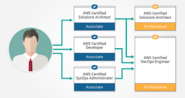
AWS introduced its certification program in 2013. Certifications are organized across four tiers and two dimensions — role-based and specialty — giving candidates a structured progression regardless of their starting point.
Foundational Level (1 Certification)
- AWS Certified Cloud Practitioner — An entry-level credential covering core cloud concepts, basic AWS services, pricing models, and security fundamentals. Suitable for non-technical stakeholders, sales roles, or engineers who are completely new to AWS.
Associate Level (3 Certifications)
- AWS Certified Solutions Architect – Associate — Designing resilient, cost-optimized architectures on AWS.
- AWS Certified SysOps Administrator – Associate — Deploying, managing, and operating systems on AWS.
- AWS Certified Developer – Associate — Developing and maintaining AWS-based applications.
Professional Level (2 Certifications)
- AWS Certified Solutions Architect – Professional — Advanced architectural design for complex, large-scale AWS environments.
- AWS Certified DevOps Engineer – Professional — Provisioning, operating, and managing distributed application systems on AWS with a focus on CI/CD and automation.
Specialty Certifications
Specialty certifications validate deep expertise in focused domains. At the time of the original article, three were available:
- Advanced Networking – Specialty
- Big Data – Specialty
- Security – Specialty
Note: AWS periodically updates its certification catalog. Check the official AWS Certification page for the current list, as additional specialties (e.g., Machine Learning, Database, Data Analytics) have been added since this article was originally written.
Exam Format and Costs
All AWS certification exams use multiple-choice and multiple-response questions. The following fee and duration information was accurate at the time of original publication — verify current pricing on the AWS website before registering, as fees are subject to change.
| Level | Exam Fee | Practice Exam Fee | Duration |
|---|---|---|---|
| Foundational | $100 | — | 90 minutes |
| Associate | $150 | $20 | 130 minutes |
| Professional & Specialty | $300 | $40 | 170 minutes |
Certifications are valid for three years (note: the original article stated two years — AWS changed its recertification cycle; confirm the current policy before planning your renewal). Recertification requires passing a current version of the exam or a higher-level exam in the same path.
How to Prepare for AWS Certifications
Preparation resources fall into several categories:
- AWS’s own training: AWS offers free digital training through AWS Skill Builder, along with paid classroom and virtual instructor-led courses.
- Third-party platforms: Providers such as A Cloud Guru, Linux Foundation, and Pluralsight offer structured video courses with hands-on labs.
- Practice exams: AWS sells official practice exams. Third-party providers also offer question banks that mirror the exam format.
- Hands-on experience: Working directly in the AWS console and CLI is arguably the most important preparation. AWS offers a free tier that lets you spin up real services at no cost within defined limits.
- Community resources: AWS re:Post (formerly AWS Forums), Reddit communities such as r/aws, and study groups can help clarify difficult concepts.
Self-study is viable for disciplined learners, but a structured course from a recognized training provider gives you a defined syllabus, a realistic timeline, and — in instructor-led formats — the ability to ask questions specific to your environment.
Salary Expectations
AWS-certified professionals command above-average salaries in the IT industry. The original article cited figures from ZipRecruiter ($127,000/year average for AWS Developers) and a Global Knowledge salary survey ($113,932 average for AWS-certified candidates). These figures are from approximately 2019–2020 and should be treated as directional rather than current benchmarks — compensation data shifts with market conditions, location, and role specialization.
What the data consistently shows is that holding an AWS certification correlates with higher compensation compared to non-certified peers in similar roles. Professionals who combine certification with practical experience — particularly at the Professional or Specialty level — tend to see the strongest salary premiums.
Is an AWS Career Right for You?
AWS is a strong career bet for engineers who:
- Enjoy infrastructure, distributed systems, or cloud-native application development.
- Want to work across diverse industries — AWS is used in finance, healthcare, media, retail, government, and more.
- Are comfortable with continuous learning, since AWS releases new services and features at a high cadence.
- Are looking for global job portability — AWS skills are in demand across most major tech markets worldwide.
Starting with the Cloud Practitioner or Solutions Architect – Associate certification gives you a structured entry point. From there, gaining real-world project experience alongside your certifications is what separates candidates who can talk about AWS from those who can actually build and operate systems on it.
Further Learning
The following video playlist provides additional context on getting started with AWS certifications: