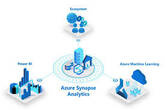
Announced at Microsoft Ignite 2019, Azure Synapse Analytics represents what Microsoft describes as the next evolution of Azure SQL Data Warehouse. The platform is designed to close a long-standing gap between data warehouses and data lakes — two critical infrastructure components that historically could not work in concert with each other, forcing teams to operate them in isolation and manually move data between them.
What Is Azure Synapse Analytics?
Azure Synapse Analytics is a unified analytics service that brings together enterprise data warehousing and big data analytics under a single, integrated experience. The core motivation behind it, as articulated by Raghu Ramakrishnan, Microsoft’s CTO for Data, was to stop bolting features onto individual services and instead pull their core capabilities together:
“Instead of trying to add more features to each of our services, we decided to take a step back and figure out how to bring their core capabilities together to make it easy for customers to collect and analyze all of their increasingly diverse data, to break down data silos and work together more collaboratively.”
Raghu Ramakrishnan, Microsoft CTO for Data
Before Synapse, many cloud analytics vendors sold collection, retrieval, and analysis tools as separate products. These tools could not natively connect with one another and required users to learn and operate each one independently. Synapse aims to eliminate that fragmentation by allowing analysts, data engineers, and data scientists to manage and query both relational and unstructured data from within a single service — using standard SQL as a common interface.
According to Rohan Kumar, Corporate Vice President for Azure Data, the platform was built in direct response to customer feedback: mass cloud migration had delivered flexibility, elastic compute, and large-scale storage, but translating those advantages into tangible, data-driven business outcomes remained difficult because the tooling was too fragmented.
Key Features
Azure Synapse Analytics ships with a set of integrated capabilities spanning the full analytics lifecycle:
- Azure Synapse Studio: A unified web-based workspace for data prep, data management, data warehousing, big data analytics, and AI tasks — all in one place, without switching between tools.
- Power BI integration: Native connectivity to Power BI for building and publishing reports directly from the analytics workspace, reducing the steps required to share insights with business stakeholders.
- Azure Machine Learning integration: Built-in support for training and applying ML models against the data stored in Synapse, enabling intelligent applications without exporting data to a separate ML platform.
- Code-free data pipeline management: Visual tools for orchestrating data pipelines, making the platform accessible to users without deep coding expertise.
- Standard SQL support: The ability to query both relational data in the warehouse and unstructured data in data lakes using familiar SQL syntax, lowering the learning curve for existing SQL practitioners.
- Rewritten SQL query engine: Microsoft substantially rearchitected the SQL processing engine to be optimized for cloud-native workloads, handling large bursts of concurrent queries and diverse, petabyte-scale datasets.
- DevOps compatibility: The platform is designed to support DevOps workflows, including source control integration and CI/CD pipelines for data engineering assets.
What Developers and Data Engineers Gain
One of the most significant practical benefits for engineering teams is the elimination of large-scale data copying. Historically, deriving insights from both data warehouses and data lakes required copying terabytes of data between systems — a slow, expensive, and error-prone process. Azure Synapse Analytics is designed to query data in place across those sources, removing that bottleneck.
Microsoft also emphasized flexibility in the analytics engine layer, stating that enterprises will be able to choose their preferred analytics engine rather than being locked into a single provider’s approach.
The rewritten SQL engine is notable from an engineering standpoint. Microsoft described the effort as substantial — effectively rewriting core query processing logic to make it cloud-native, capable of scaling elastically to handle sudden large workloads and heterogeneous datasets simultaneously.
For data scientists, the unified workspace means an end-to-end data pipeline — from raw ingestion through transformation, modeling, and visualization — can be built and managed in a single environment, reducing context switching and pipeline complexity.
Accessibility for Non-Technical Users
Microsoft positioned Azure Synapse Analytics not only as a tool for data engineers and scientists but also as a platform accessible to business analysts with limited technical depth. The code-free pipeline tools and the Power BI integration mean that business professionals can locate, collect, and visualize data from multiple sources without requiring deep engineering knowledge. The goal, according to Microsoft, is to compress the time to deliver actionable business insights from weeks or months to a matter of days.
How Azure Synapse Compares to Alternatives
At the time of its announcement, Microsoft made performance claims comparing Azure Synapse Analytics to competing services. The company stated that Synapse could run equivalent queries over petabyte-scale datasets in significantly less time than Google BigQuery, and that the platform is built to support thousands of concurrent users — a scale that some competitors struggle with.
Azure Synapse does not operate in a vacuum. Competing and complementary solutions in the query-over-large-datasets space include:
- Google BigQuery: A fully managed, serverless data warehouse with strong SQL support and deep Google Cloud integration.
- AWS Athena: A serverless, interactive query service built on Presto that queries data directly in Amazon S3.
- Presto / Trino: Open-source distributed SQL query engines widely used for federated queries across heterogeneous data sources.
- Snowflake: A cloud-native data platform offering separation of storage and compute with strong multi-cloud support.
Each of these platforms has distinct architectural trade-offs. The key differentiator Microsoft is betting on with Synapse is tight integration across its existing Azure ecosystem — particularly Power BI and Azure Machine Learning — reducing the integration overhead that teams typically face when assembling multi-vendor analytics stacks.
Strategic Context for the Microsoft Azure Ecosystem
Azure Synapse Analytics reflects a broader trend among hyperscale cloud providers to consolidate their growing portfolios of analytics, big data, and AI services into unified platforms rather than continuing to expand a catalog of loosely related point solutions. By weaving Synapse into existing Azure products, Microsoft moves toward offering enterprise customers a more complete and coherent cloud data platform — one where the cost and complexity of integrating separate analytics, ML, and BI tools is substantially reduced.
At launch, the service was available in preview and not yet generally available. Teams evaluating it at that stage should verify current GA status, regional availability, and pricing tiers against the official Azure documentation, as these details will have evolved since the initial announcement.