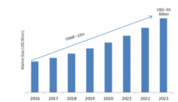
This article summarizes market research data originally published by Reports and Data, as cited by themarketstrategies.com (2019). All figures are sourced from that report and reflect 2018 baseline data with projections to 2026.
Market Overview
The global continuous delivery (CD) market was forecast to reach USD 6.48 billion by 2026, according to a 2019 report by Reports and Data. The primary growth catalysts identified were the accelerating shift toward digitalization and widespread enterprise adoption of DevOps practices. The increasing use of automation in application deployment was also cited as a significant positive force on market expansion.
Why Continuous Delivery Is Gaining Traction
Continuous delivery addresses several longstanding pain points in software development and release management:
- Faster feedback loops: CD pipelines surface integration and regression issues quickly, allowing teams to resolve problems before they compound.
- Full change traceability: Tooling tracks every change through the pipeline, making it straightforward to identify when and where a defect was introduced.
- Automated environment provisioning: Infrastructure-as-code and environment automation reduce the manual effort involved in standing up consistent test and staging environments.
- Built-in compliance and security: Security and compliance checks are integrated from the beginning of the development lifecycle rather than bolted on at the end.
- End-to-end visibility: Teams gain clearer visibility into build state, test results, and deployment health across every stage of the pipeline.
How a CD Pipeline Works
A typical CD pipeline is event-driven. A commit or merge to a source code repository triggers a notification to the CD tool, which then executes the configured pipeline stages in sequence. If the build stage fails — for example, due to a compilation error or misconfigured dependency — the pipeline halts and alerts the team. This fail-fast behavior is a core design principle: catching fundamental configuration or code problems as early as possible minimizes the cost of fixing them.
Key Market Findings (2018 Baseline)
The Reports and Data research highlighted the following market characteristics as of 2018:
Organization Size
Large enterprises held approximately 64% of market share in 2018. Their greater resources and more complex software delivery challenges made them early and heavy adopters of CD tooling and DevOps investment.
Deployment Type
On-premises deployments accounted for roughly 59% of market share in 2018. Enterprises — particularly those in regulated industries — preferred on-premises deployments to maintain control over sensitive data, meet compliance requirements, and ensure reliable internal accessibility.
Component Split
The solutions segment (software and hardware) held approximately 55% of market share, with demand driven by organizations seeking low-risk, on-demand deployment capabilities. Services — including professional and managed services — made up the remainder.
Industry Vertical
The IT and telecommunications sector led all verticals with approximately 21% of market share. This was attributed to the sector’s early investment in AI, IoT, and machine learning, as well as its drive to digitize end-to-end operations to meet rapidly shifting customer expectations.
Regional Breakdown
North America held the largest regional share at approximately 30% in 2018. The concentration of major CD vendors in the region, combined with mature big data, AI, and machine learning ecosystems, created strong demand for reliable, high-frequency application delivery pipelines.
Market Segmentation Framework
The report segmented the global continuous delivery market across the following dimensions:
Pipeline Stages
- Source stage
- Build stage
- Test stage
- Deploy stage
Organization Size
- Small and Medium-Sized Enterprises (SMEs)
- Large Enterprises
Deployment Type
- Cloud
- On-premises
Component
- Solution
- Software
- Hardware
- Services
- Professional Services
- Managed Services
Industry Vertical
- Banking, Financial Services, and Insurance (BFSI)
- Retail and Consumer Goods
- Healthcare
- Manufacturing
- Telecom and IT
- Education
- Media and Entertainment
- Others
Region
- North America (U.S.)
- Europe (UK, France)
- Asia Pacific (China, India, Japan)
- Middle East and Africa (MEA)
- Latin America (Brazil)
Key Vendors and Competitive Landscape
The report identified a broad set of vendors competing in the continuous delivery market. Key participants included:
IBM, Atlassian, CA Technologies, XebiaLabs, Puppet Enterprise, Electric Cloud, CloudBees, Chef Software, Flexagon, Microsoft, Clarive, Micro Focus, Wipro, Accenture, Applariat, VMware, Shippable, Red Hat, Spirent, CircleCI, JetBrains, Heroku, AppVeyor, Bitrise, Kainos, and Infostretch.
Vendors were noted to be pursuing growth through mergers, acquisitions, and technology partnerships — strategies typical of a consolidating market where platform breadth and integration depth increasingly determine competitive position.
Takeaways for DevOps Teams
The market data from this period reflects trends that have continued to play out: CD tooling has become standard practice rather than a differentiator, cloud-native delivery platforms have grown their share against on-premises alternatives, and the vendor landscape has consolidated significantly through acquisitions. For engineering teams evaluating CD investment, the segmentation framework above remains a useful lens for scoping requirements — particularly around deployment model, pipeline stage coverage, and whether managed services are preferable to self-hosted tooling.