This article is based on reporting originally published at searchaws.techtarget.com (October 2019), authored by Chris Kanaracus.
What Is RDS on VMware?
In October 2019, AWS made its Relational Database Service (RDS) available for on-premises VMware deployments, extending a managed database experience beyond the public cloud for the first time. The launch gave VMware customers a way to manage SQL-based relational databases running inside their own data centers using the same tooling, operational model, and automation they rely on in the AWS cloud.
RDS on VMware handles common database operations including automated backup, patch management, replication, and disaster recovery — capabilities that DBAs already depended on in the public cloud version of RDS — but applied to workloads that must remain on premises for regulatory, latency, or architectural reasons.
Supported Databases at Launch
At general availability, RDS on VMware supported three database engines:
- Microsoft SQL Server
- PostgreSQL
- MySQL
Oracle Database was notably absent. According to contemporary reporting, one likely contributing factor was Oracle’s complex and often contentious licensing policy around VMware deployments — a source of compliance risk and cost that has spawned entire consulting practices. Additionally, AWS and Oracle had a very public rivalry at the time: Amazon had just announced it had completed a multi-year migration of its own consumer business off Oracle databases onto AWS-native services. AWS indicated it anticipated adding Oracle support in the future, based on customer demand.
Infrastructure Requirements
RDS on VMware was not described as a simple drop-in deployment. AWS evangelist Jeff Barr noted at launch that “the process is more involved than usual” and directed users to detailed documentation. The baseline infrastructure requirements for running the on-premises management plane were significant:
- vSphere version: 6.5 or higher
- Minimum cluster resources for management tooling: 24 vCPUs, 24 GiB of RAM, and 180 GB of storage
- Connectivity: Outbound internet access from the vSphere cluster and secure HTTPS connections to AWS public endpoints
- Additional resources are required on top of these minimums for each database instance customers deploy
The connectivity requirement — that on-premises clusters must maintain outbound connections to AWS — underlines the hybrid nature of the service. Management and automation live in AWS; compute and storage remain on premises.
Strategic Significance
AWS first announced RDS on VMware in August 2018, making the October 2019 general availability the culmination of a lengthy engineering effort. The launch was initially limited to AWS’s U.S. East region, scaled back from the original plan to simultaneously launch in U.S. West, Tokyo, and Frankfurt — suggesting AWS may have wanted to validate the offering at limited scale before broader rollout.
Keith Townsend, co-founder of consulting firm The CTO Advisor and a former VMware solutions architect, described it as a meaningful but complex undertaking:
“It’s a significant engineering effort, with a ton of questions around ensuring performance and support. I’m not clear on demand, but it’s a great opportunity to compete against Oracle, seeing Amazon is very public about their migration off Oracle to RDS.”
Keith Townsend, Co-founder, The CTO Advisor
Where RDS on VMware Fits in the Hybrid Cloud Landscape
The launch arrived at a moment when the hybrid cloud market was rapidly becoming more crowded and complex. Three contemporaneous developments provide useful context:
VMware Cloud on AWS
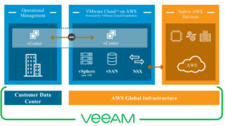
Generally available since 2017, VMware Cloud on AWS moves VMware’s Cloud Foundation stack onto AWS bare-metal infrastructure. It is sold and managed by VMware and had gained commercial traction by the time RDS on VMware launched. RDS on VMware complements this offering by moving AWS-managed services in the opposite direction — into customer-owned VMware environments.
AWS Outposts
Announced in November 2018, AWS Outposts was expected to reach general availability around AWS re:Invent 2019. Outposts deploys AWS-designed and AWS-managed hardware appliances on premises, replicating a broader slice of the AWS platform locally. RDS on VMware and Outposts address overlapping but distinct use cases: RDS on VMware integrates with existing VMware infrastructure, while Outposts introduces AWS-native hardware.
VMware and Oracle Partnership
Shortly before the RDS on VMware launch, VMware and Oracle announced a partnership through which Oracle would sell bundled SKUs of VMware software alongside Oracle Cloud Infrastructure. Unlike VMware Cloud on AWS — which is a managed service — the VMware-Oracle arrangement placed emphasis on customer self-management, representing a different philosophy toward hybrid cloud operations.
VMware’s Container Ambitions
At VMworld in August 2019, VMware announced Project Pacific — an effort to embed Kubernetes directly into vSphere. This signaled VMware’s intent to remain relevant not just for virtual machine workloads but for container-based architectures, broadening its appeal as enterprises modernized their application platforms.
Key Takeaways for DevOps and Infrastructure Teams
- Familiar RDS tooling on premises: Teams already using RDS in AWS can apply similar automation and operational patterns to on-premises VMware clusters without managing the database engine directly.
- Not a lightweight deployment: The management plane has substantial resource requirements separate from database instances — plan infrastructure accordingly.
- Connectivity is mandatory: The service requires persistent outbound connectivity to AWS endpoints. Air-gapped or network-restricted environments are not supported without additional architecture work.
- Oracle licensing complexity remains: Until Oracle support is added and licensing questions are resolved, shops running Oracle on VMware will not benefit from this offering.
- Part of a broader hybrid strategy: RDS on VMware sits alongside VMware Cloud on AWS and the anticipated AWS Outposts in a growing portfolio of options for organizations that cannot or will not move all workloads to the public cloud.
Original reporting by Chris Kanaracus for TechTarget’s SearchAWS, October 2019.