Source: ENR.com. Original reporting by ENR; this article summarizes and expands on their coverage.
A People-First Philosophy Drives Award-Winning Firm
On Kenner Kingston’s desk at Salt Lake City-based Architectural Nexus sit schematic sketches that tell the story of the firm’s evolving mission. They are not renderings for a hospital wing or a research laboratory—two market segments where Architectural Nexus has built considerable expertise—but rather plans for a rainwater collection and reuse system for an off-the-grid home in Moab, Utah. The firm is collaborating with a community nonprofit that helps low-income residents construct their own sustainable straw-bale homes in the desert region.
That project encapsulates what Kingston, president of Architectural Nexus, describes as a fundamental shift in the firm’s thinking over the past five years.
“In the past five or so years, we’ve had a real shift in our thinking. It is not about the project or the building, it is about the people. We are people driven in the pursuit of meaningful experiences.”
— Kenner Kingston, President, Architectural Nexus
That philosophy earned Architectural Nexus recognition as ENR’s 2019 Intermountain Design Firm of the Year. The firm was founded through the 2003 merger of Jensen Haslem Architects and Thomas Petersen Hammond Architects, and has since grown to nearly 120 employees with offices in Salt Lake City and Sacramento, California. The firm reported revenue of $19.9 million in 2017 and $22 million in 2018, regularly ranking among the top ten design firms in the Intermountain region.
A Diverse and Multidisciplinary Design Studio
Robb Harrop, director of design at Architectural Nexus, articulates the firm’s client-centered approach succinctly: “We like projects that have a purpose and a vision. Something deeper than just keeping the rain off your head. We want to help clients find what is meaningful to them.”
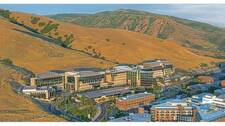
That approach has produced strong results across multiple sectors. In healthcare, the firm has designed all four completed phases of the Huntsman Cancer Institute (HCI) at the University of Utah in Salt Lake City. The most recent phase—a 230,000-square-foot, $100-million research and office facility—exemplifies the firm’s patient-centered design thinking. Ben Tanner, executive director of the HCI, credits Architectural Nexus with understanding the unique needs of oncology patients.
“Their thoughtful work shows up in our patient satisfaction surveys. Patients always have great things to say about the look and feel of our buildings, and it’s a wonderful place for our clinical and research staff as well.”
— Ben Tanner, Executive Director, Huntsman Cancer Institute
A fifth phase of the HCI project was underway at the time of the award. The firm also completed a $114-million hospital in Nampa, Idaho, for the St. Luke’s Health System, which opened in fall 2017. Sandee Gehrke, vice president of operations at St. Luke’s, praised Architectural Nexus for investing time to understand the organization’s culture and brand identity before putting pen to paper.
Beyond healthcare, the firm’s Salt Lake City portfolio includes the $160-million, 400,000-square-foot Hardware Village apartment and condominium complex and a $7-million, 48,000-square-foot mixed-use residential and retail building in the city’s 9th and 9th district. In higher education, the firm completed the College Activities Center at Gillette College in Gillette, Wyoming, which features a 2,100-seat basketball arena, athlete support facilities, and flexible multi-use space.
Multiple LEED-certified designers work alongside specialists in landscape design, energy analysis, interior design, animation and visualization, and graphic design. Kingston notes that housing all these disciplines under one roof enables the firm to pursue both large, complex commissions and smaller experimental projects that push the boundaries of new technology and construction techniques.
Employee Ownership as a Cultural Cornerstone
Architectural Nexus was in the process of completing an Employee Stock Ownership Plan (ESOP) in 2019. For Kingston, what began as a leadership-transition and financial planning tool evolved into a genuine expression of the firm’s values.
“In 2014 we really had a change in mindset, and the ESOP went from being a financial tool to a culture tool, a way to align with the values of the firm… One of our partners said at one point, ‘What is more Nexus than an ESOP?’ and it just hit me that he was right.”
— Kenner Kingston, President, Architectural Nexus
Julie Berreth, vice president of operations, describes the firm’s internal culture as deliberately flat—characterized by a compressed compensation structure, a commitment to paying employees a living wage, and an extensive mentoring program designed to develop the next generation of architects and designers. The firm also joined the International Living Future Institute’s (ILFI) JUST program, which provides guidelines and external auditing on social justice and diversity performance.
To translate these values into direct community impact, Architectural Nexus launched the Nexus Builds program approximately two years prior to receiving the award. The initiative has partnered with the Seattle-based Block program to design and build tiny off-the-grid homes for people experiencing homelessness on donated urban lots. At the time of the award, employees were constructing a tiny home in a corner of the firm’s Salt Lake City headquarters parking lot, scheduled for delivery to Seattle. Director of communications Brian Cassil described the project as meaningful beyond simple volunteerism: “This is very purpose driven, but at its core it is also about mastery and how to get better at what we do.”
Beyond Conservation: Embracing Regenerative Design
Architectural Nexus has been an early advocate of sustainable design in the Intermountain region. In 2010, its Salt Lake City office became one of the first LEED Platinum certified buildings in the area. But the firm’s ambitions have since moved well beyond conventional green building metrics.
The clearest expression of this trajectory is the firm’s Sacramento office, a renovated office and warehouse building that opened in 2016 in the city’s historic district. The project was designed in accordance with the International Living Future Institute’s Living Building Challenge (LBC)—one of the most rigorous sustainability frameworks in the built environment industry. The completed building features a composting system, onsite agriculture, onsite water filtration and treatment, highly efficient electrical systems, and a solar photovoltaic array. It achieved LEED Platinum certification (level four) and was recognized in 2018 as the first Living Building in California and the 19th in the world certified by ILFI.
Berreth frames the firm’s design philosophy as anticipatory rather than reactive: “We don’t want to look at a building stuck on a site, but how it enhances the wider community and the people around it. Even if we are not putting something like PV panels on a project today, we want to anticipate they might be added one day and design space for them.”
Kingston sees regenerative design—which seeks to restore the built environment to a more natural state, treating buildings as habitats rather than machines—as the logical next phase for the industry and the firm’s greatest strategic opportunity.
“For a long time, most firms in our industry have been climbing this mountain called sustainability. Some of us who were lucky got to the top and looked across to see what was next, and we saw regenerative design, things like the Living Building Challenge… I’m excited for the next five years because I think we are perfectly positioned for oncoming growth in regenerative design.”
— Kenner Kingston, President, Architectural Nexus
From rainwater systems for low-income desert housing to one of California’s most advanced Living Buildings, Architectural Nexus continues to demonstrate that people-centered architecture and environmental responsibility are not competing priorities—they are the same goal expressed at different scales.